1942–1943: The counter-offensive at Stalingrad
Third Battle of Kharkov
- Dates:
- 19 February – 15 March 1943
- Front:
- Eastern Front
- Location:
- The area between the Donets and the Dnieper: the Donbas, the surroundings of Pavlohrad, Krasnohrad (today Berestyn), Kharkiv and Belgorod (USSR)On the battle map →
- Sides:
- Nazi GermanyErich von Manstein, Hermann Hoth, Paul HausserSoviet UnionNikolai Vatutin, Filipp Golikov, Markian Popov
- Result:
- German victory. Army Group South destroyed Popov's mobile group and the right wing of the South-Western Front, then the left wing of the Voronezh Front, retook Kharkiv on 14–15 March and Belgorod on 18 March. The front came to a halt on the Donets; north of Belgorod the Kursk salient was formed.
- Author:
- Łukasz
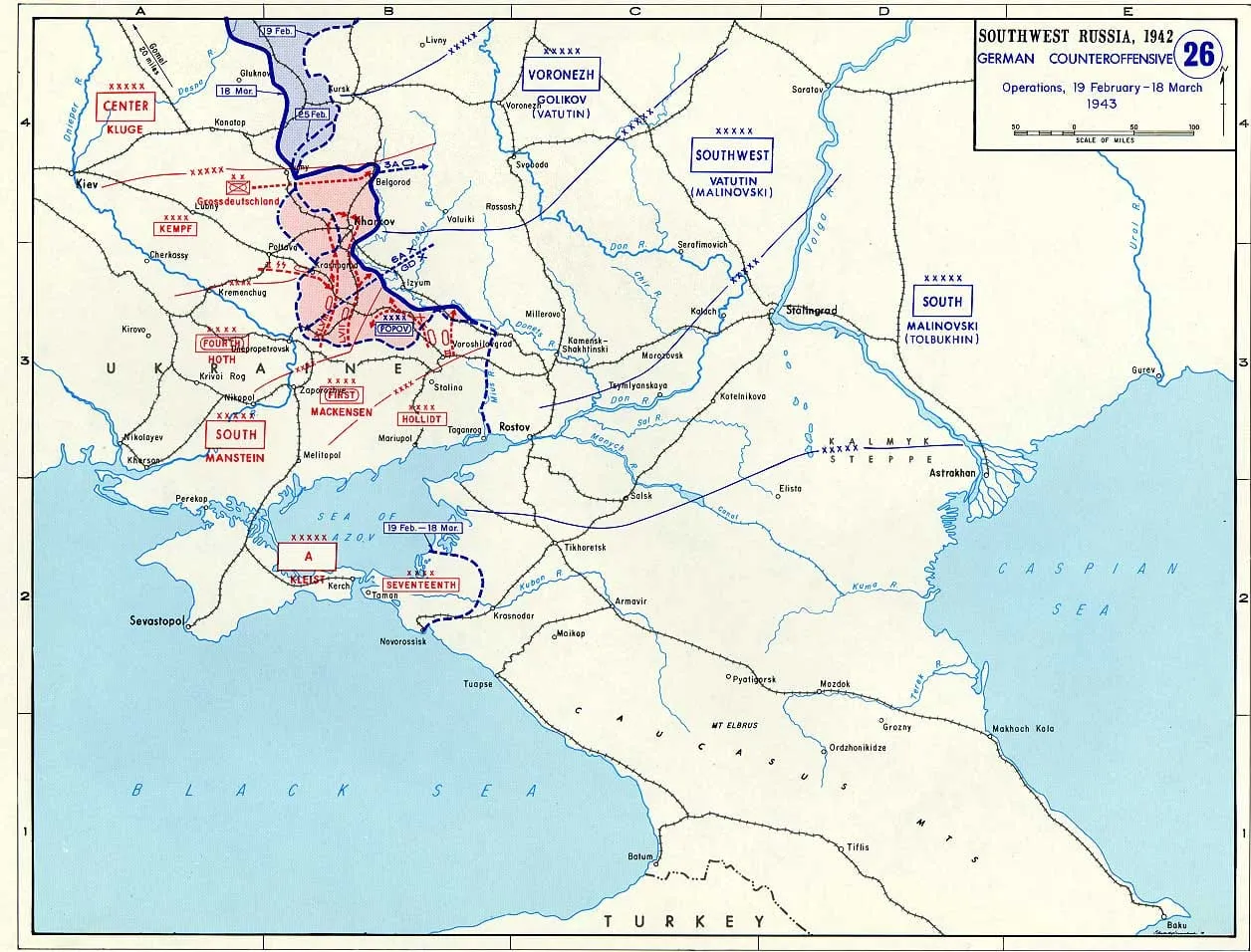
The Third Battle of Kharkov is the name given in Western historiography to the German counter-offensive on the southern wing of the Eastern Front between 19 February and 15 March 1943. Field Marshal Erich von Manstein, commander of Army Group South, allowed the exhausted Soviet armies, strung out over hundreds of kilometres, to advance almost to the Dnieper and then struck at their flanks. Within two weeks he had destroyed the mobile group of General Markian Popov and the right wing of General Nikolai Vatutin’s South-Western Front, and then turned north against General Filipp Golikov’s Voronezh Front. Colonel General Hermann Hoth’s 4th Panzer Army, with General Paul Hausser’s SS Panzer Corps as its main battering ram, retook Kharkiv barely a month after it had given the city up to the Red Army, and on 18 March captured Belgorod.
The battle brought to a close the winter campaign of 1942–1943, which had begun with the encirclement of the Sixth Army at Stalingrad. After that disaster the Germans showed once more that on the open steppe, with superiority in tanks and aircraft at the point of attack, they could defeat a more numerous enemy. It was the last great German operational victory in the East. It did not, however, reverse the course of the war: it restored the front roughly to the line of summer 1942, and the spring thaw halted both sides on the line on which the Battle of Kursk was to be fought in July.
Name and dates
The name “Third Battle of Kharkov” counts the battles for the city from the autumn of 1941: the first was the defence of Kharkiv in October 1941, when the Germans took the city, and the second the failed Soviet offensive of May 1942. The Germans spoke of these operations as the Donets campaign (Donezfeldzug) or as Manstein’s “counter-stroke”. Soviet and Russian historiography divides them into several operations: the defensive fighting of the South-Western Front in the Donbas in the second half of February, and the Kharkov defensive operation of the Voronezh Front, dated 4–25 March 1943. Some accounts describe the whole under the name “Battle of Kharkov (1943)”.
The start of the battle may be dated to 19 February 1943. On that day, as Hitler was concluding his conference at Manstein’s headquarters in Zaporizhzhia, the SS Panzer Corps received orders to strike south, and the 1st Panzer Army began to tighten the ring around Popov’s group. Some authors date the battle from 20 or 21 February, when the 4th Panzer Army went over to the attack. Its end may be placed on 15 March: on 14 March the German command announced the capture of the city, but fighting in the tractor factory on its south-eastern edge went on for another day or two. The capture of Belgorod on 18 March and the fruitless German attacks that continued until about 25 March were the final chord of the counter-offensive, after the main battle was over.
Background
At the turn of January and February 1943 the southern wing of the German Eastern Front was going through its deepest crisis since the start of the war with the Soviet Union. On 2 February the last units of the Sixth Army surrendered at Stalingrad. Before that, the Voronezh Front had routed the Hungarian Second Army and the Italian Alpine Corps on the Don, and on 25 January it retook Voronezh. Army Group A was withdrawing from the Caucasus, and Manstein’s Army Group Don, which in December had tried in vain to break through to Stalingrad, was falling back towards the lower Don.
The Stavka concluded that the moment had come to destroy the entire southern wing of the Wehrmacht. On 29 January Vatutin’s South-Western Front launched Operation Gallop (Russian Skachok): General Fyodor Kharitonov’s 6th Army and General Vasily Kuznetsov’s 1st Guards Army forced the Donets and retook Izium and Lozova, while Popov’s mobile group – four worn-down tank corps with fewer than 140 tanks between them – pushed south towards the Sea of Azov. On 11 February its 4th Guards Tank Corps entered Krasnoarmeysk (today Pokrovsk), cutting the railway that supplied the German forces in the Donbas. On 2 February the Voronezh Front had begun Operation Star (Zvezda): Kursk, taken by the Germans in November 1941, fell on 8 February, Belgorod on 9 February and Kharkiv on 16 February, abandoned by the SS Panzer Corps against Hitler’s orders.
The Stavka and the front commanders read the German movements as a flight behind the Dnieper. On 6 February Manstein had wrung from Hitler permission to give up the eastern part of the Donbas and to withdraw to the Mius; on 14 February the Red Army entered Rostov. By shortening the front, however, Manstein freed panzer divisions, which he shifted from his eastern to his western wing. Vatutin, convinced that the enemy was retreating, demanded a further advance towards the Dnieper crossings at Dnipropetrovsk (today Dnipro) and Zaporizhzhia instead of digging in. On 13 February (12 or 14 February according to some sources) Army Group Don was renamed Army Group South and also took over the sector of the disbanded Army Group B, including Kharkiv.
By then the Soviet divisions were utterly exhausted. After two to three months of continuous offensives, the rifle divisions of the Voronezh Front numbered 3,500–4,000 men each, and some divisions of the 69th Army only 1,000–1,500. Tanks stood idle without fuel, and the nearest working railway stations lay 200–300 kilometres behind the front line. Even so, the Stavka kept setting new objectives: the Voronezh Front was to advance on Poltava and on towards Kiev, and the South-Western Front was to reach the Dnieper before the ice broke up. Liberated Kharkiv was to become the temporary capital of the Ukrainian SSR.
Hitler in Zaporizhzhia and Manstein’s plan
The loss of Kharkiv enraged Hitler. On 17 February he flew to the headquarters of Army Group South in Zaporizhzhia intending – so Manstein believed – to relieve him of command and order the immediate recapture of the city. Manstein convinced him that a frontal attack on Kharkiv stood no chance as long as Soviet tank corps were roaming the army group’s rear. He proposed first to destroy Vatutin’s forward groupings between the Donets and the Dnieper, then to strike at the Voronezh Front and retake Kharkiv, and in a third phase, together with Army Group Centre, to eliminate the Soviet salient around Kursk. When Hitler flew out on 19 February, Soviet tanks were, according to German accounts, some 30 kilometres from the airfield.
For the counter-offensive Manstein had Hoth’s 4th Panzer Army with XLVIII Panzer Corps and the SS Panzer Corps (known from the spring as II SS Panzer Corps), the 1st Panzer Army of General Eberhard von Mackensen with XL and LVII Panzer Corps, the group of General Karl-Adolf Hollidt on the Mius, and the group (Armeeabteilung) of General Werner Kempf near Kharkiv. Hausser’s corps consisted of the Leibstandarte SS Adolf Hitler, Das Reich and the newly arrived Totenkopf divisions – some 20,000 front-line soldiers in February, with several companies of Tiger heavy tanks. Field Marshal Wolfram von Richthofen’s Luftflotte 4 raised the number of its sorties in February from about 350 to about 1,000 a day.
According to German estimates, Manstein committed some 160,000 men to the attack against some 210,000 Soviet troops. On the axes of attack, however, the Germans had a superiority in tanks, and a manifold one: several hundred serviceable vehicles against a few dozen that had survived the winter advance.
Course of the battle
19–28 February: the destruction of Popov’s group and the 6th Army
The first blows fell on Popov’s group. The divisions of XL Panzer Corps of the 1st Panzer Army surrounded its spearheads near Krasnoarmeysk; on 21 February Vatutin, still convinced of a German retreat, refused permission to withdraw the group, which had about 25 serviceable tanks left. On 24 February its remnants were encircled; some of the men broke out to the north, abandoning their equipment.
At the same time the SS Panzer Corps struck south from Krasnohrad (Berestyn), and XLVIII Panzer Corps attacked Pavlohrad from the south. Between 20 and 23 February the Leibstandarte and Das Reich cut across the rear of the 6th Army (PL), whose leading corps already stood on the approaches to the Dnieper; the 25th Tank Corps, some 100 kilometres ahead of the rest of the army, was cut off without fuel and destroyed. Soviet aircraft had spotted the German regrouping as early as 19 and 20 February, but the front command took it for a screen covering a retreat. The Stavka agreed to let the 6th Army and the 1st Guards Army go over to the defensive only on 25 February. The withdrawal to the Donets lasted until early March, under constant fighting and with heavy losses.
To rescue its neighbour, on 22 February the Stavka ordered the Voronezh Front to send General Pavel Rybalko’s 3rd Tank Army (PL) and the 69th Army south towards Krasnohrad. Their attacks on 24–27 February broke against the German defences on the western edge of the breach. On 25 February, in the north, the newly formed Central Front of General Konstantin Rokossovsky, made up partly of armies released from Stalingrad, opened its offensive. It was meant to encircle the German forces in the Oryol salient and reach the Desna; after initial successes, especially by the 2nd Tank Army, it stalled and was broken off in March.
By the last days of February the balance of the first phase amounted to a defeat for the Red Army. According to German reports quoted by Manstein in his memoirs, his troops had destroyed or captured 615 tanks and several hundred guns between the Donets and the Dnieper, and the enemy had lost some 23,000 killed and 9,000 prisoners. These figures come from the victorious side and are probably inflated, but Russian historians do not dispute the scale of the defeat either. A gap several dozen kilometres wide had opened between the Soviet fronts.
1–10 March: the advance on Kharkiv
On 28 February the command of Army Group South ordered the turn north against the Voronezh Front. On 3 March the 3rd Tank Army, which had barely managed to obtain fuel and ammunition, launched an attack of its own on the SS Panzer Corps; its 15th Tank Corps was surrounded by Totenkopf, and its 12th Tank Corps was threatened with being cut off by the Leibstandarte and Das Reich. By 5 March Rybalko’s army had been shattered, and its remnants were fleeing north, harried by Ju 87 dive-bombers. Between 1 and 5 March the 4th Panzer Army advanced some 80 kilometres and stopped a dozen or so kilometres south of Kharkiv; on 6 March the Leibstandarte seized a bridgehead on the Mzha river.
On 7 March Manstein, despite the approaching thaw, decided to press on, but not frontally: the SS Panzer Corps was to bypass Kharkiv from the west and close it off from the north. The Großdeutschland Division returned to the front and split the junction of the 69th and 40th Armies. On 8 March, at the village of Sokolovo south-west of Kharkiv, the soldiers of Lieutenant Colonel Ludvík Svoboda’s 1st Czechoslovak Independent Field Battalion (PL) went into action; the fight at Sokolovo was the baptism of fire of the Czechoslovak unit in the USSR. On 9 March the gap between the 69th Army and the remnants of the 3rd Tank Army was 45 kilometres wide, and a day later about 60. Counter-attacks by tank corps and rifle divisions thrown in from the reserve did not change the situation. On the evening of 10 March the Germans reached the outskirts of Kharkiv.
11–15 March: fighting in the city
The 4th Panzer Army’s order of 10 March instructed the SS Panzer Corps to take Kharkiv “as quickly as possible”, but Hoth and Manstein preferred to encircle the city rather than draw panzer divisions into street fighting. Hausser decided otherwise. On the morning of 11 March the Leibstandarte broke into Kharkiv from the north, along the road and the railway from Belgorod, while Das Reich attacked from the west. The former gained a foothold in the northern districts after heavy fighting; the latter was held up at a deep anti-tank ditch and broke through towards the main railway station only during the night. Hoth three times ordered Das Reich to be pulled out of the city and sent east to cut the defenders’ lines of retreat. Hausser refused twice, arguing that disengaging from the enemy was too risky; only on 12 March did he carry out the third order.
On 12 March the Leibstandarte, fighting house by house, reached Dzerzhinsky Square (today Freedom Square), which the Germans renamed “Leibstandarte Square”. During the night Joachim Peiper’s battalion crossed the Kharkiv River and formed a bridgehead in the southern part of the city. On 13 March the division cleared further blocks, and on 14 March the German command announced that Kharkiv was in its hands. Resistance continued at the tractor works on the south-eastern edge of the city. The defenders there included soldiers of the 17th NKVD Brigade, the 19th Rifle Division and the 25th Guards Rifle Division, who on 14 and 15 March were given permission to withdraw towards the Donets. By 17 March some units of the 3rd Tank Army had escaped from the encirclement to the left bank of the river.
The fighting in Kharkiv cost the SS Panzer Corps more than any other part of the counter-offensive. By 17 March it is estimated to have lost some 44 per cent of its combat strength, including about 160 officers and 4,300 NCOs and men. Hausser’s critics argued that the assault could have been replaced by an encirclement; his defenders, that the rapid capture of the city hastened the collapse of the Soviet defence on the Donets.
Belgorod and the end of the counter-offensive
After the fall of Kharkiv the Soviet defence on the Donets fell apart. Units of the SS Panzer Corps and the Großdeutschland Division pushed north and on 18 March took Belgorod, which the Germans had lost on 9 February. Graivoron fell on 12 March and Borisovka on 14 March. The Stavka threw the 21st Army, the 64th Army and the 1st Tank Army into the threatened sector, together with the 3rd Guards Tank Corps, which stopped Großdeutschland at Borisovka. German attacks continued until roughly 25 March, but with the rasputitsa – the season of mud – arriving earlier than usual, the divisions bogged down, and Army Group Centre refused to take part in a thrust on Kursk. The front froze along the Donets south of Belgorod, while north of Belgorod the Soviet line bulged far to the west, enclosing Kursk.
Kharkiv under renewed occupation
For the inhabitants of Kharkiv the return of the Germans meant further months of occupation after barely four weeks of Soviet rule. According to the findings of the Soviet Extraordinary State Commission, later presented at the Kharkov trial in December 1943, in the days when the city was being taken SS soldiers murdered wounded prisoners of war in the military hospital on Trinkler Street: some were shot, others burned to death in the building, which had been set on fire. Soviet sources speak of several hundred victims (the figures most often given range from about 400 to about 800); the exact number can no longer be established. Reprisals also fell on the civilian population, including people who had cooperated with the restored Soviet authorities in February. Kharkiv remained in German hands until 23 August 1943.
Losses
According to Grigori Krivosheev’s tabulation, in the Kharkov defensive operation (4–25 March) the Voronezh Front and the units of the South-Western Front fighting alongside it lost 45,219 killed, missing and captured, and 41,250 wounded and sick – some 86,500 men in all. This figure does not include the losses of the South-Western Front and Popov’s group in the second half of February, for which estimates vary; according to German reports, the enemy lost some 23,000 killed and 9,000 prisoners in the first phase of the counter-offensive alone. The 6th Army, the 3rd Tank Army and Popov’s group were shattered in the battle, and the armour of both Soviet fronts in this sector practically ceased to exist. In March the Voronezh Front lost more than 600 guns and about 1,350 mortars.
German losses are harder to establish. Polish and Western literature usually gives some 10,000–12,000 killed, wounded and missing for the whole counter-offensive; the SS Panzer Corps alone lost about 4,500 men, most of them in the fighting for Kharkiv.
Significance
The Third Battle of Kharkov is regarded as the Wehrmacht’s last great victory on the Eastern Front and as a model example of “mobile defence”: Manstein gave up ground to gain reserves, let the enemy advance beyond the limits of its supply lines and struck at its flanks. After the defeat at Stalingrad and the loss of the Sixth Army, he managed to close a breach in the front several hundred kilometres wide and to stabilise the southern wing – something almost nobody in the German command had thought possible as late as February. Some historians, however, Robert Citino among them, stress that this was an operational rather than a strategic success: the Germans regained Kharkiv and Belgorod but did not reverse the balance of a winter in which they had lost the whole Sixth Army and huge allied forces.
For the Red Army the defeat was a lesson. The Stavka had overestimated its own strength and underestimated the Wehrmacht’s capacity to counter-attack, just as it had at Kharkiv a year earlier. In the following months the Soviet command rebuilt its armies in this sector and, instead of launching another premature offensive, prepared for defence. At the end of March Vatutin took over command of the Voronezh Front from Golikov.
The most important consequence of the battle was the shape of the front. Between Oryol and Belgorod there remained a deep Soviet salient around Kursk. Faced with a choice between waiting for the next Soviet offensive and repeating Manstein’s manoeuvre, or attacking himself, Hitler chose to attack: the elimination of the Kursk salient became the aim of Operation Citadel. In July 1943 the same SS divisions set out from near Belgorod into the Battle of Kursk, which ended in a German defeat and finally handed the initiative on the Eastern Front to the Red Army. In August 1943 Kharkiv was liberated for the second time, this time for good.