Germany
Hermann Hoth
Commander of XV Motorised Corps (1938–1940), Panzer Group 3 (1940–1941), the 17th Army (1941–1942) and the 4th Panzer Army (1942–1943), Colonel General (from 1940)
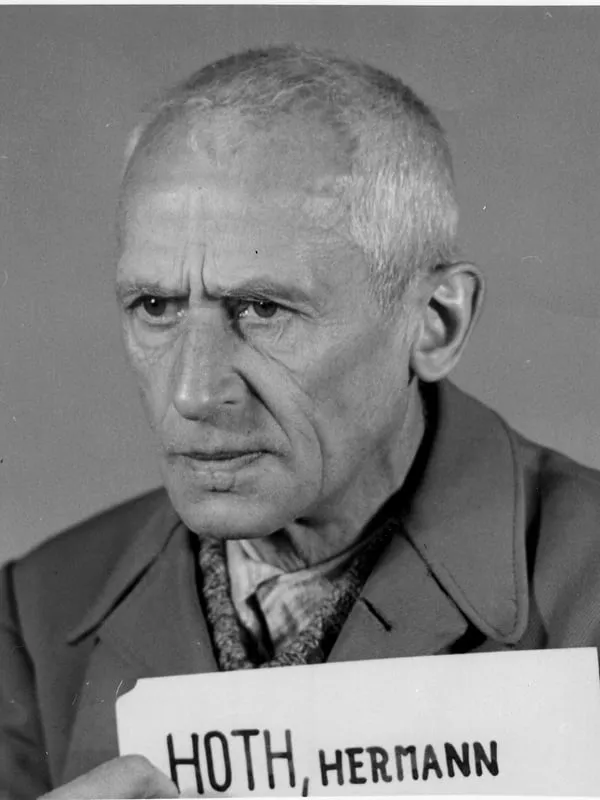
- Born:
- 12 April 1885, Neuruppin (Brandenburg, German Empire)
- Died:
- 25 January 1971, Goslar (Lower Saxony)
- Author:
- Natalia
- Photo:
- Office of Military Government for Germany, United States, domena publiczna, Wikimedia Commons

Hermann Hoth was a German general who between 1939 and 1943 commanded large armoured formations of the Wehrmacht in all of its major land campaigns. His corps drove through Poland in 1939 and crossed the Meuse at Dinant in 1940; in 1941 his Panzer Group 3 closed the Minsk pocket from the north and took Vitebsk; and in 1942 his 4th Panzer Army advanced on Stalingrad and then tried to break through to the 6th Army encircled there. Contemporaries and historians alike count him among the ablest armoured commanders of the Second World War. He was also one of the generals who most openly embraced the Nazi vision of the war in the east: as an army commander he called on his soldiers to “exterminate” the Jews without mercy, and an American tribunal at Nuremberg convicted him of war crimes and crimes against humanity.
A Prussian staff officer
He was born on 12 April 1885 in Neuruppin in Brandenburg, the son of an army doctor, and spent his childhood in Demmin in Western Pomerania. In 1896 he entered the cadet corps in Potsdam, and in 1904 he began his service as an officer cadet in the 72nd Infantry Regiment at Torgau. A year later he was commissioned as a lieutenant. From 1910 to 1913 he studied at the War Academy in Berlin, where he learned Russian, and in April 1914 he was posted to the Great General Staff.
He spent almost the whole of the First World War on staffs. In August 1914, thanks to his Russian, he was assigned to the staff of the 8th Army in East Prussia, where he witnessed the Russian invasion and Paul von Hindenburg’s victory at Tannenberg. He came away with a deep aversion to the Russians, whose way of waging war he regarded as “bestial”, and an admiration for Hindenburg. Later he served, among other posts, on the staff of the commander of the air service (the Luftstreitkräfte), and he ended the war as first staff officer of the 30th Infantry Division.
In the Reichswehr
After the revolution of 1918 and the Armistice of Compiègne, Hoth, more loyal to Hindenburg than to the new republic, served in General Georg Maercker’s Freikorps (PL) and took part in suppressing left-wing uprisings, among them in Halle. Accepted into the 100,000-strong Reichswehr, he worked mainly on staffs, including in the Truppenamt, the disguised General Staff. According to some of his biographers, in 1927 he travelled to the Soviet Union as part of the secret military cooperation between the two states. From 1929 he commanded a battalion in Stargard, and in 1932 he took over the 17th Infantry Regiment in Brunswick.
In the 1920s he kept his distance from the Nazis, but after the Reichstag election of 1930, when the NSDAP became the second-largest party in the country, he began to look on Hitler with sympathy. After the Nazis came to power in 1933, however, he fell foul of local party officials by criticising the killings of communists and social democrats in Brunswick, and was transferred to Lübeck. According to the historian Johannes Hürter, Hoth, unlike most senior officers, made a thorough study of National Socialist ideology and broadly approved of it; although he expressed some unease at the persecution of German Jews, he judged their fate less important than the struggle against communism and the restoration of Germany’s power.
Under Hitler: from division to corps
On 1 October 1934, promoted to Generalmajor, he took command in Liegnitz (Legnica) of the infantry command from which the 18th Infantry Division was formed. In 1936 he became a Generalleutnant. In the autumn of 1938, as his division was marching into the Sudetenland after the Munich Agreement, he was given the task of forming XV Motorised Corps in Jena, to which the light divisions – mixed formations of tanks, motorised infantry and artillery – were subordinated. In November 1938 he was promoted to General of Infantry.
Poland and France
In September 1939 XV Corps, with the 2nd and 3rd Light Divisions, formed part of General Walter von Reichenau’s 10th Army, which in the invasion of Poland delivered the main thrust from Upper Silesia towards Warsaw. Hoth’s corps fought the Kraków Cavalry Brigade, then units of the Prusy Army on the approaches to Kielce, and on 8–9 September, together with other corps, it closed the ring around Polish divisions in the Battle of Iłża. On 27 October 1939 Hoth received the Knight’s Cross of the Iron Cross. Before the campaign in the west the light divisions were converted into panzer divisions.
In May 1940 Hoth’s corps, with the 5th and 7th Panzer Divisions – the latter commanded by General Erwin Rommel – advanced through the Ardennes on the right wing of the offensive, north of Ewald von Kleist’s panzer group. On 12–13 May his divisions seized bridgeheads over the Meuse at Dinant, at the same time as the breakthrough at Sedan; they then shattered the left wing of the French 9th Army, beat off the British counter-attack at Arras and tightened the ring around the Allied forces at Lille and Dunkirk. In the second phase of the campaign, on 6–7 June, the corps broke through the front on the Somme at Airaines and split the French 10th Army. After the fighting at Airaines soldiers from his units murdered captured French colonial troops, mostly black Senegalese; one of the victims was Captain Charles N’Tchoréré. On 12 June his divisions accepted the surrender of the British 51st Division at Saint-Valery. After the victory over France, on 19 July 1940, Hitler promoted him to Colonel General.
Panzer Group 3 in Russia
On 16 November 1940 the headquarters of XV Corps was redesignated Panzer Group 3, which under the Barbarossa plan was to form the northern pincer of Field Marshal Fedor von Bock’s Army Group Centre. On 30 March 1941 Hoth heard the speech at the Reich Chancellery in which Adolf Hitler announced to his commanders a war of annihilation against “Jewish Bolshevism”; Hoth’s notes are one of the most important sources for that address. He had no doubts about the rightness of the war; in his notes Bolshevik Russia figured as an Asiatic, despotic threat to Europe.
On 22 June 1941, the day of the German attack on the USSR, Hoth’s tanks captured the bridges over the Niemen at Olita (Alytus) intact; on 24 June they took Wilno, and on 28 June his 20th Panzer Division forced its way into Minsk, closing the pocket from the north in the Battle of Białystok–Minsk. At the beginning of July his corps crossed the Dvina, and on 9 July they captured Vitebsk, opening the road to Smolensk. On 15 July the 7th Panzer Division cut the Smolensk–Moscow highway at Yartsevo, and in the Battle of Smolensk the groups of Hoth and Heinz Guderian encircled three more Soviet armies. On 17 July Hoth was awarded the Oak Leaves to the Knight’s Cross. Later, together with Guderian and Bock, he opposed dispersing the armoured forces to the flanks and argued for a march straight on Moscow. In October his group closed the pocket at Vyazma from the north, in the first phase of the Battle of Moscow.
Like all the German armies in the east, Hoth’s panzer group carried out the Commissar Order, which required captured Red Army political commissars to be shot; the reports of its subordinate units show that this was done as a matter of course. Hoth also ordered that Soviet soldiers caught in civilian clothes be shot as partisans. After the war, as historians note, he was the only German general to admit that he had considered the order justified.
The 17th Army and the war of annihilation
In October 1941 Hoth took command of the 17th Army in Ukraine. In its rear the operational groups of the SS and police were at work, and Hoth’s staff cooperated with them more closely than under his predecessor. After Field Marshal Reichenau issued his order on “severe treatment” of the “Jewish subhumans”, Hoth issued an order of the day of his own on 17 November 1941. In it he called on his soldiers to stamp out immediately and without mercy every sign of active or passive resistance and every machination of the “Jewish-Bolshevik agitators”, since their extermination was “a dictate of our own survival”. He also ordered civilians encountered in the forests to be shot as suspected partisans and supported requisitions of food that condemned the cities to starvation. In December 1941 in Artemivsk (Bakhmut), within his army’s area, an SD detachment shot more than 1,200 Jews; Hoth knew of the execution. At the same time he softened some of the orders from above, instructing that Ukraine was not to be treated as a colony and that its inhabitants were to be shown a measure of respect.
In the winter of 1941–1942 the 17th Army held off the Soviet offensive at Izium only with difficulty, and in May 1942 it fought in the Second Battle of Kharkov.
Stalingrad, Kharkov, Kursk
On 1 June 1942 Hoth took over the 4th Panzer Army. In the German summer offensive, Case Blue (Fall Blau), his army broke through the Soviet front on 28 June and at the beginning of July reached the Don at Voronezh. At the end of July Hitler took most of its forces away and gave them to General Friedrich Paulus’s 6th Army. The weakened 4th Panzer Army attacked Stalingrad from the south and in September was fighting in the city’s outskirts. Hoth was one of the few German commanders to warn that the 6th Army’s overstretched and weakly held southern flank was in danger.
On 19 November 1942 the Red Army launched Operation Uranus. The blow south of Stalingrad shattered part of Hoth’s forces, and half of his army was trapped in the encirclement together with the 6th Army. The remnants of his troops, reinforced as part of Field Marshal Erich von Manstein’s Army Group Don, were to break through to the encircled forces. Operation Wintergewitter (Winter Storm) began on 12 December from Kotelnikovo. Hoth’s tanks reached the Myshkova river, a few dozen kilometres from the ring, but there they were stopped by the Soviet 2nd Guards Army, while Operation Little Saturn threatened the rear of the whole of Army Group Don. The attack collapsed, Paulus was refused Hitler’s permission to break out towards it, and the relief of Stalingrad failed.
In February and March 1943 the rebuilt 4th Panzer Army was the main instrument of Manstein’s counter-offensive, in which the Germans retook Kharkov (the Third Battle of Kharkov). In July 1943 Hoth led the southern pincer of Operation Citadel in the Battle of Kursk. His divisions broke through several belts of Soviet defences but became bogged down around Prokhorovka; some historians detect signs of exhaustion in him at that time. On 15 September 1943 he received the Swords to the Knight’s Cross for the retreat and the defence on the Dnieper. In November the Red Army broke through his front and on 6 November recaptured Kiev. Hitler blamed him, calling him a “prophet of doom” and a defeatist; Hoth was sent on leave, and on 10 December 1943 he was relieved and transferred to the reserve.
The end of the war and the trial
He returned to service only in April 1945, when he was entrusted with the defence of the Saale area around Halle and Leipzig, and then with a command in the Ore Mountains. After brief resistance to the advancing Americans he surrendered to them at the beginning of May 1945.
In the High Command Trial, the twelfth of the trials held at Nuremberg before American military tribunals, Hoth stood in the dock with thirteen other senior Wehrmacht commanders. He claimed that he had known nothing of the murder of the Jews and had passed on the Commissar Order under duress; the tribunal found these explanations unconvincing. On 27 October 1948 he was acquitted of crimes against peace and conspiracy but convicted of war crimes and crimes against humanity – for implementing the Commissar Order, mistreating prisoners of war and murdering civilians – and sentenced to 15 years’ imprisonment. He served his sentence in the war crimes prison at Landsberg. In April 1954 he was released on parole, and in 1957 his sentence was deemed served.
Last years
He settled in Goslar at the foot of the Harz mountains. In 1956 he published Panzer-Operationen, a book on the operations of Panzer Group 3 in the summer of 1941, and he also wrote on armoured forces for the new Bundeswehr, with whose commanders he kept in touch. He helped the former Nazi propagandist Paul Carell write Unternehmen Barbarossa (1963), one of the pillars of the myth of the “clean Wehrmacht”. He died in Goslar on 25 January 1971.
Assessment
Military historians from David Glantz to Earl Ziemke see Hoth as one of the most experienced German armoured commanders and a master of mobile defence. In 1941 he was, alongside Guderian, the architect of the great encirclements at Minsk and Smolensk, and his wartime notes, long overlooked, complement Halder’s diary as a source for the history of the campaign. Yet Hoth was also one of those generals who did not merely carry out criminal orders but supplied their ideological justification themselves. His order of November 1941, calling for the “extermination” of the Jews as a condition of Germany’s survival, shows how deeply the Wehrmacht’s commanders were committed to the war of annihilation in the east – and how little truth there was in the legend of apolitical professionals that Hoth helped to create after the war.
Sources
Commanded in battles
(08)- 22 June – 9 July 1941Battle of Białystok–MinskEastern Front
- 10 July – 10 September 1941Battle of Smolensk (1941)Eastern Front
- 28 June – 18 November 1942Case BlueEastern Front
- 23 August 1942 – 2 February 1943Battle of StalingradEastern Front
- 19–23 November 1942Operation UranusEastern Front
- 12–23 December 1942Operation Winter StormEastern Front
- 19 February – 15 March 1943Third Battle of KharkovEastern Front
- 5 July – 23 August 1943Battle of KurskEastern Front
Mentioned in battles
(05)Often appears with
People who appear in the same events.