- Category:
- Military operations
- Front:
- Eastern Front
- Date:
- 2 February 1943
- Author:
- Natalia
- Battle:
- Battle of Stalingrad
- Tags:
- Wehrmacht, Red Army, Friedrich Paulus, Joseph Goebbels
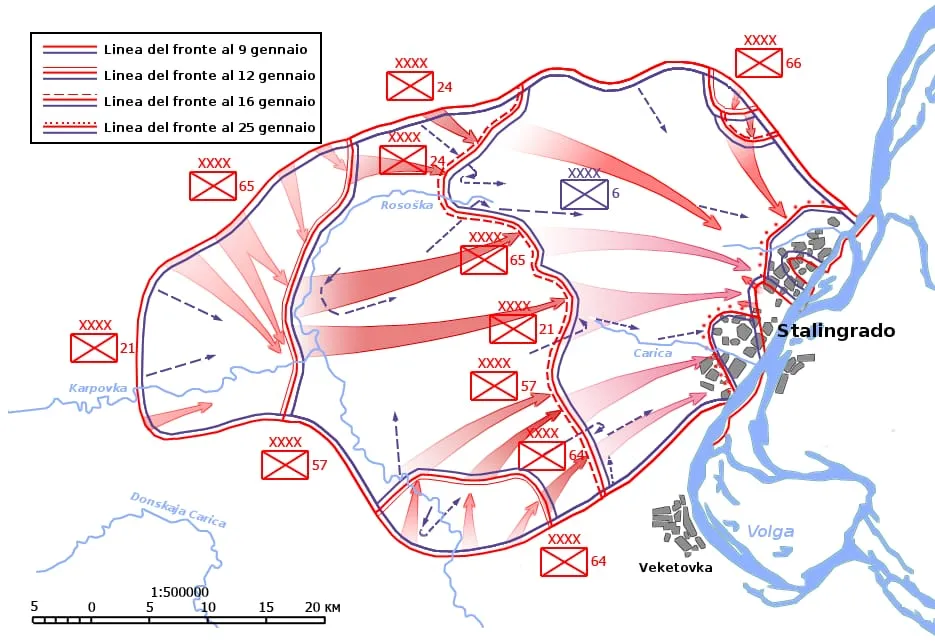
On the morning of 2 February 1943, in the shattered factory district of northern Stalingrad, the last units of the German Sixth Army laid down their arms. Their commander, General Karl Strecker of the XI Army Corps, surrendered two days after Field Marshal Friedrich Paulus had been taken prisoner in the basement of a department store in the city centre. After more than five months of fighting in the city and more than two months of encirclement, the Battle of Stalingrad was over. That day the Soviet command recorded the completion of Operation Ring (Koltso) and the destruction of the entire encircled force.
The Germans were officially told of the defeat a day later. On 3 February the Wehrmacht High Command announced in a special radio bulletin that “the battle for Stalingrad has ended”, and three days of mourning were decreed in the Reich. War chronologies stress that this was the first time the Nazi authorities publicly admitted a defeat. More precisely, it was the first defeat whose scale could not be hidden: an entire field army had been killed or captured.
The last pocket
After Soviet troops split the pocket in two on 26 January, Paulus remained in the southern part, while Strecker directed the defence of the northern one. When the Sixth Army headquarters surrendered on 31 January, Paulus, now a prisoner, refused to order the whole army to capitulate, explaining that he did not command troops who were not with him. The northern pocket, which took in the industrial area – the Tractor Factory, the Barrikady works and the surrounding workers’ settlements – therefore fought on. It held the remnants of more than a dozen German divisions and what was left of two Romanian divisions, most of them decimated and without ammunition, food or fuel.
Against this force the commander of the Don Front, General Konstantin Rokossovsky, sent several armies backed by a massive concentration of artillery. On 1 February the Soviets opened a hurricane bombardment of the positions in the ruined factories and then went over to the attack. In the last days of January Adolf Hitler had still been sending messages into the pocket calling for a fight “to the last round”, and Strecker had replied that his soldiers would do their duty.
Early on 2 February Strecker learned that one of his officers had, on his own initiative, opened talks with the Soviets about laying down arms. He concluded that further resistance was pointless. Together with his chief of staff, Colonel Helmuth Groscurth – an officer who had belonged to military opposition circles against Hitler as early as 1939 – he drafted the last report sent from Stalingrad. It stated that XI Corps had done its duty and ended with the cry “Long live Germany!”, omitting the customary salute to the Führer. The corps then laid down its arms. Groscurth died of typhus in captivity in April 1943; Strecker survived and returned to Germany in 1955.
As late as 1 February the Wehrmacht communiqué (the Wehrmachtbericht) reported that “the northern group under General of Infantry Strecker is still holding out”. A day later organised resistance ceased. Scattered groups of soldiers who refused to surrender were still hiding in the ruins. According to Soviet reports they numbered several thousand, perhaps even more than ten thousand in all; the NKVD went on hunting them down for several weeks, and the last skirmishes were recorded at the beginning of March.
The balance of Operation Ring
On the evening of 2 February Rokossovsky and the representative of Headquarters (the Stavka), the newly appointed Marshal of Artillery Nikolai Voronov, reported to Joseph Stalin that, in fulfilment of his order, the troops of the Don Front had completed the rout and destruction of the enemy force encircled at Stalingrad and that fighting in the city had ceased. Operation Ring, begun on 10 January, had lasted more than three weeks – far longer than the Soviet command had expected, for it had counted on dealing with the pocket in about a week.
According to the Don Front’s tallies, some 91,000 German and allied soldiers were taken prisoner between 10 January and 2 February (the precise Soviet figure is 91,545, including prisoners rounded up in the following weeks), among them around 2,500 officers and 24 generals, Paulus included. Some studies give the figure of 22 generals. The prisoners included Romanians, Croats from a regiment attached to the Sixth Army, and thousands of former Soviet citizens who had served the Germans as auxiliaries. The Soviets captured several thousand guns, hundreds of aircraft – most of them damaged or grounded on the pocket’s airfields – and tens of thousands of vehicles.
In November the Soviets had encircled, by various estimates, some 250,000 to 300,000 men; more recent German research gives lower figures, around 195,000–220,000 German soldiers alone. Tens of thousands of them died in the pocket – in combat, and from hunger, frost and disease – while several tens of thousands of wounded and specialists were flown out by the airlift before the last airfields were lost in January.
The fate of the prisoners
The Stalingrad prisoners emerged from the ruins utterly exhausted, many suffering from frostbite, wounds and disease, and often infected with typhus. They were marched on foot through the frost to makeshift camps around the city, which lacked food, medicine, fuel and shelter. Mortality in the first months was enormous. German historians, among them Rolf-Dieter Müller, attribute it both to the condition in which the soldiers left the pocket and to incompetence and supply shortages on the Soviet side. According to the most frequently cited estimates, roughly half of the prisoners had died by the spring of 1943, and some calculations put the figure higher.
The generals and some staff officers were taken to camps near Moscow, where conditions were incomparably better. Of the rank and file and junior officers, sent to labour camps deep inside the USSR, only a small fraction ever returned home: by various counts some 5,000 to 6,000 men, most of them only in 1955, after Chancellor Konrad Adenauer’s visit to Moscow.
The bulletin of 3 February
For a long time the German public did not know how grave the Sixth Army’s position was. Propaganda said nothing about the encirclement, and the bulletins of December and early January spoke vaguely of “heavy defensive fighting”. Only in mid-January did they begin to use phrases that an attentive listener could read as a harbinger of disaster. On 30 January, the tenth anniversary of the seizure of power, Hermann Göring gave a speech in which he compared the defenders of Stalingrad to the Spartans at Thermopylae – the soldiers in the pocket listened on the radio as they were bidden farewell as if already dead.
The announcement of the defeat itself was prepared by the Propaganda Minister, Joseph Goebbels, who noted in his diary that work on the staging of the bulletin had gone on late into the night. During the day on 3 February the Reich’s radio stations interrupted their programmes to broadcast a special bulletin from the Wehrmacht High Command. It began: “The battle for Stalingrad has ended. True to its oath to the last breath, the Sixth Army under the exemplary command of Field Marshal Paulus has succumbed to the superiority of the enemy and to unfavourable circumstances.” The bulletin portrayed the army as a “bulwark” fighting on behalf of all Europe against Bolshevism and closed with the statement that its soldiers had “died so that Germany might live”. The announcement was accompanied by solemn funeral music; accounts differ on the details.
The authorities decreed three days of national mourning. Theatres, cinemas and places of entertainment were closed, and the radio played only serious music. Mourning flags and black-bordered obituaries, however, were forbidden: the mourning was meant to be heroic, not dispiriting.
The heart of this narrative was the myth of an army that had died to the last man. The bulletin made no mention of prisoners and implicitly counted all the soldiers of the Sixth Army among the fallen. Meanwhile Moscow radio, followed by the BBC, reported that more than 90,000 men had been captured, among them a field marshal and over twenty generals. As more and more Germans secretly listened to foreign stations despite severe penalties, the truth spread quickly. Thousands of families lived for years not knowing whether their loved ones had been killed or were in captivity; for a long time Moscow did not hand over lists of prisoners.
“The first admitted defeat”
The popular claim that this was the first time the Nazi government admitted a setback needs qualifying. The Reich had suffered serious defeats before – from the lost Battle of Britain, through the defeat before Moscow in the winter of 1941, to the retreat from El Alamein in the autumn of 1942 – but propaganda had either passed over them in silence or presented them as planned manoeuvres, “shortening the front” or temporary difficulties. Stalingrad was the first defeat whose scale could not be concealed and which the regime officially announced as such, at the same time raising it to the status of a national tragedy.
Goebbels decided that if the defeat could not be hidden, it had to be exploited. The sacrifice of the Sixth Army was to become a call to mobilise all the nation’s strength. Already in January the Reich had introduced compulsory labour service for men and women, and in the following weeks propaganda began to prepare the ground for the slogan of “total war”, which the minister proclaimed in mid-February at the Berlin Sportpalast.
The reports of the SS Security Service (SD), which monitored public opinion, recorded a profound shock after 3 February. People asked why no attempt had been made to break out of the encirclement; they criticised the military leadership and, for the first time, the Führer himself; there were even graffiti recalling the defeat of 1918. Trust in official bulletins declined, although the regime did not lose control of society. For some officers Stalingrad became the impulse to join the military opposition, and in mid-February the students of Munich’s White Rose distributed a leaflet stating that the “brilliant strategy of the World War corporal” had senselessly and irresponsibly driven 330,000 German men to their deaths.
Losses
Counted from the Germans’ entry into the great bend of the Don in July 1942, the Battle of Stalingrad was one of the bloodiest battles in history. According to Soviet archival data published in the tables compiled by General Grigori Krivosheev’s team, the Red Army lost a total of about 1.13 million men in the defensive operation (17 July – 18 November 1942) and the offensive operation (19 November 1942 – 2 February 1943), of whom nearly 479,000 were killed, died or went missing. Some historians consider these figures too low; more recent Russian estimates speak of over 1.3 million.
Axis losses are harder to count, since they depend on whether one includes only the Sixth Army and the Fourth Panzer Army or also the allied armies shattered on the Don during Operation Uranus and the subsequent Soviet blows. Soviet and Russian historiography speaks of some 800,000 killed, wounded and captured in the period of the Soviet counter-offensive alone and about 1.5 million in the battle as a whole; Western historians usually give lower figures, but even by their reckoning the Romanian, Italian and Hungarian armies together lost several hundred thousand men on the Don, and the German Army Groups B and Don hundreds of thousands more.
Civilian losses were enormous. Before the battle Stalingrad had several hundred thousand inhabitants, refugees included; after the liberation, by various accounts, between 1,500 and several thousand were counted in the ruins. The number of civilians killed – in bombing raids, in the fighting, from hunger and during deportations for forced labour – is estimated in the tens of thousands, and in some Russian calculations at far more. The city was almost completely destroyed.
Reactions in the USSR and the world
In the Soviet Union the victory was celebrated as the turning point of the Great Patriotic War. On 4 February a rally of the city’s defenders and inhabitants was held in ruined Stalingrad. The Soviet press published photographs of columns of prisoners and captured generals, and the commanders of the battle received promotions and decorations. In March Stalin himself took the title of Marshal of the Soviet Union.
In the West Stalingrad was greeted with enthusiasm and relief. The British press, the conservative papers included, wrote of a victory that had saved European civilisation; King George VI ordered a sword of honour to be made for the “steel-hearted citizens of Stalingrad”, which Winston Churchill presented to Stalin at the end of 1943. On 23 February, the anniversary of the founding of the Red Army, celebrations were held in its honour in Britain. From then on Washington and London treated the USSR as a future victorious power, and Soviet demands for the opening of a second front carried more weight.
The defeat shook the Reich’s allies. In Finland, after a conference at headquarters on 3 February, the country’s leadership concluded that Germany might lose the war and began to look for a way to a separate peace. In Romania and Hungary, which had lost most of their field armies on the Don, reluctance to keep sending troops east grew, and cautious soundings of the Western Allies began. Even before the battle ended, Benito Mussolini had been urging Hitler to come to terms with Stalin so as to concentrate his forces against the British and Americans. Turkey, with whose leaders Churchill had held talks at Adana at the end of January, became even more wary of Berlin.
Place in the war
The battle, which had begun in the summer of 1942 as one of the objectives of the German offensive in the south of the USSR, ended with the destruction of the Wehrmacht’s strongest field army. From the encirclement of the Sixth Army in November Hitler had forbidden it to break out of the pocket, and later to surrender, relying on the airlift and a relief force. According to the memoirs of Field Marshal Erich von Manstein, when the two met at headquarters on 6 February Hitler declared that he alone bore responsibility for Stalingrad. In conversations with his entourage, however, he also blamed the allied armies on the Don, the Luftwaffe and Paulus himself, who had not taken his own life.
For the Red Army it was the first great strategic success in which it had encircled and destroyed an entire German army. The blows on the Don, begun while the fighting for the city was still going on, grew into a general offensive: Soviet troops pushed towards Rostov, Kharkiv and the Donbas, and the German First Panzer Army had to withdraw hastily from the Caucasus. Once the pocket had surrendered, the forces freed at Stalingrad could be moved to other sectors of the front.
Historians agree that Stalingrad was the psychological turning point of the war, but differ in their assessment of its military weight. Some stress that Germany had already lost its chance of victory in the winter of 1941, and that the initiative in the east had not yet passed permanently to the Soviets: in the second half of February and in March Manstein launched a successful counter-attack, retook Kharkiv and stabilised the front. The final decision on the Eastern Front came only in the summer of 1943, with the Battle of Kursk. Others, such as the British historian Geoffrey Roberts, argue that it was precisely at Stalingrad that the question was settled of whether Germany would be able to exploit the resources of the USSR in a long war against the whole world.
Its political significance, however, is beyond doubt. For the first time an entire German army had ceased to exist and its commander had been taken prisoner. For occupied Europe, the Poles included, the news from Stalingrad was the first clear sign that the Reich could lose the war. In Germany the belief in the Wehrmacht’s invincibility was coming to an end, and the regime responded to the defeat not by looking for a way out of the war but by radicalising it further.
Sources
Meanwhile
(04)Elsewhere, within a week.
- 29 January 1943 · PacificThe Battle of Rennell IslandOn 29–30 January 1943 Japanese torpedo bombers sank the cruiser Chicago off Rennell Island while covering the evacuation of Guadalcanal.
- 28 January 1943 · SocietyCompulsory labour in the ReichSauckel's decree of 27 January 1943 required German men aged 16–65 and women aged 17–45 to register for work in the defence of the Reich.
- 7 February 1943 · EconomyShoe rationing in the United StatesOn 7 February 1943 the US announced that from 9 February leather shoes would be rationed – three pairs per person a year. The army needed the leather.
- 27 January 1943 · Western FrontThe first American raid on GermanyOn 27 January 1943 American bombers attacked Germany for the first time. Of 91 B-17s and B-24s dispatched, 53 bombed Wilhelmshaven and three were lost.
Related events
(04)The same battle, people or subject.
- 10 January 1943 · Eastern FrontOperation RingOn 10 January 1943, after its ultimatum was rejected, the Don Front attacked the Stalingrad pocket. Pitomnik fell on 16 January and Gumrak on 22 January.
- 19 November 1942 · Eastern FrontOperation Uranus beginsOn 19 November 1942 the Red Army hit the Romanians on the 6th Army's flanks. In three days the front broke and the pincers were closing west of Stalingrad.
- 12 December 1942 · Eastern FrontOperation Winter Storm beginsOn 12 December 1942 a German relief force for the Sixth Army set out from Kotelnikovo. Hoth's tanks reached the Myshkova but never got through to the pocket.
- 22 November 1942 · Eastern FrontThe encirclement of the Sixth Army at StalingradOn 22–23 November 1942 the Soviet pincers closed at Kalach. Hitler forbade Paulus's Sixth Army to break out – it was to hold “Fortress Stalingrad”.