Soviet Union
Konstantin Rokossovsky
Commander of the 16th Army (1941–1942), the Don Front (1942–1943), the Central Front (1943) and the 1st and 2nd Belorussian Fronts (1943–1945), Marshal of the Soviet Union (from 1944), Marshal of Poland and Polish Minister of National Defence (1949–1956)
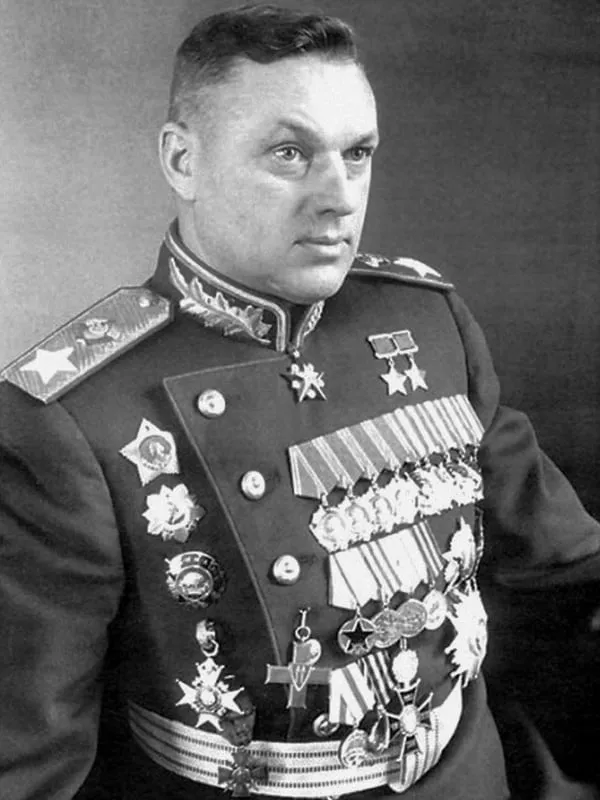
- Born:
- 21 December 1896, Warsaw (Russian Empire)
- Died:
- 3 August 1968, Moscow (Soviet Union)
- Author:
- Łukasz
- Photo:
- autor nieznany, CC BY 4.0, Wikimedia Commons

Konstantin Rokossovsky (in Polish, Konstanty Rokossowski) was one of the most gifted commanders of the Red Army in the Second World War and one of the most ambiguous figures in twentieth-century Polish history. The son of a Polish railwayman from Warsaw, a tsarist dragoon in the First World War and a Red cavalryman in the Civil War, he fell victim to the Great Purge in 1937 and spent almost three years in prison, where he was tortured. Released in 1940, over the next five years he held commands at Moscow, Stalingrad and Kursk, in Operation Bagration and in the last battles in Pomerania and Mecklenburg. After the war Stalin sent him to Poland as Minister of National Defence and Marshal of Poland. To some he was an outstanding soldier who always gave his nationality as Polish; to others he was a symbol of Soviet control over Poland and the commander of the army that stood in Praga, on the far bank of the Vistula, while Warsaw fought.
A Warsaw childhood
He was born in Warsaw on 21 December 1896 (9 December by the Julian calendar). For years Soviet biographies gave his birthplace as Velikiye Luki in Russia, which suited the career of a Soviet marshal better; research by Polish and Russian historians and family documents point to Warsaw. His father, Ksawery Rokossowski, came from impoverished Greater Poland gentry and worked on the railways; his mother, Antonina née Ovsyannikova, was a Russian of the Orthodox faith. Both parents died while Konstanty was still a child – his father in 1902 – and the boy had to earn his own living early: he worked in a confectioner’s, in a stocking factory and then as an apprentice to a stonemason. For taking part in a May Day march in 1912 he spent several weeks in Pawiak prison.
Dragoon and Red cavalryman
In August 1914 he joined the Russian army, in the 5th Kargopol Dragoon Regiment. In the very first weeks of the war, on a reconnaissance near the village of Klwów, he earned the Cross of St George. He fought in the Kingdom of Poland, on the Bzura, and then in Lithuania and Latvia; he was wounded twice and rose to the rank of non-commissioned officer.
After the revolution he went over to the Red Guard with a group of soldiers from his regiment, and then to the Red Army; in 1919 he joined the Bolshevik party. During the Civil War he fought in the Urals and in Siberia against the forces of Admiral Alexander Kolchak, and in 1921 in Transbaikalia against the troops of Baron Roman von Ungern-Sternberg. He was badly wounded several times and received two Orders of the Red Banner. It was then, too, that he changed his patronymic from Ksaveryevich to Konstantinovich.
In the 1920s he was a cavalry instructor in Mongolia, where he met his future wife, Yulia Barmina; their daughter Ariadna was born in 1925. In 1924–1925 he completed the advanced course for cavalry commanders in Leningrad together with Georgy Zhukov, who a few years later served under him in the 7th Samara Cavalry Division. In 1929 he commanded a cavalry brigade in the conflict with China over the Chinese Eastern Railway. By the mid-1930s he was a cavalry corps commander with the rank of Komdiv.
In an NKVD prison
In August 1937, at the height of the purges in the army, he was arrested on charges of spying for Poland and Japan. His Polish origins and his links with former superiors who had already been killed made him an easy target. According to the accounts of fellow prisoners and of his family, he was beaten, his teeth were knocked out, his ribs were broken, and at least twice he was led out to a mock execution. He nevertheless refused to sign any statement incriminating himself or others. His wife and daughter were exiled to the provinces.
In March 1940, after the humiliating experience of the Winter War, some of the imprisoned officers were released to fill the gaps in the command cadre. Rokossovsky was freed, his rank was restored, and in June 1940 he was made a major general. He is said to have carried a pistol for the rest of his life so as not to be taken alive if he were ever arrested again.
From Dubno to Moscow
When Germany attacked the Soviet Union on 22 June 1941, Rokossovsky was commanding the 9th Mechanised Corps in Ukraine. His corps, under strength and equipped with obsolete tanks, took part in the tank battle around Dubno, Lutsk and Brody; it is judged to have been the most sensibly handled of the South-Western Front’s mechanised corps. In July he was moved to the Smolensk area, where from broken units and reserves he formed an operational group defending the Yartsevo sector, and in August he took command of the 16th Army, which in the Battle of Smolensk and the September counter-attacks helped to pin down German forces on the Moscow axis.
In the autumn, during Operation Typhoon, he escaped encirclement at Vyazma and gathered new divisions around the 16th Army’s headquarters to defend the Volokolamsk axis. In the Battle of Moscow his army took the brunt of the November attack by German panzer divisions towards Klin and Solnechnogorsk, falling back step by step to Kryukovo, a few dozen kilometres from the Kremlin. In December it took part in the counter-offensive and recaptured Istra and Volokolamsk. In March 1942 Rokossovsky was badly wounded by a shell splinter and spent several months in hospital. In July he took command of the Bryansk Front.
Stalingrad and Kursk
In September 1942 Stalin gave him command of the newly created Don Front north of Stalingrad. In Operation Uranus his troops struck the German forces in the small bend of the Don and helped to close the ring around the Sixth Army. When attempts to destroy the pocket at a stroke failed, the Stavka entrusted the elimination of the encircled forces entirely to him. On 8 January 1943, together with the Stavka representative, General Nikolai Voronov, he sent Friedrich Paulus an offer of surrender, and when it was rejected he conducted Operation Ring, which ended with Paulus’s surrender and, on 2 February, that of the last units in the northern part of the city. The captured field marshal was interrogated at his headquarters. Rokossovsky was promoted to colonel general, and in April 1943 to general of the army.
In February 1943 he took over the Central Front, which after an unsuccessful winter offensive towards Oryol was holding the northern face of the Kursk salient. It was his front that was to receive the blow of Model’s Ninth Army. He built a defence in depth, concentrating his artillery and anti-tank guns on the axis that – as he rightly foresaw – the Germans would choose: along the Oryol–Kursk railway. On the night before 5 July, acting on the testimony of a captured German, he ordered an artillery counter-preparation against the enemy’s assembly areas. When Operation Citadel began, Model managed within a week to drive only a dozen or so kilometres into the Central Front’s defences. After Hitler called off the offensive, the Central Front from 15 July took part in the counter-offensive against the Oryol salient and then advanced towards the Desna and the Dnieper. The Battle of Kursk as a whole earned him a reputation as a master of defence. In October 1943 his front was renamed the Belorussian Front, and in February 1944 the 1st Belorussian Front.
Bagration and Warsaw
In the summer of 1944 Rokossovsky was one of the architects of Operation Bagration, which smashed the German Army Group Centre. According to his memoirs he pushed through, against Stalin’s wishes, a plan for two equal thrusts through the marshes of Polesie, one of which led to the encirclement of the Germans at Bobruisk; some historians regard this story as embellished. On 29 June 1944 he was made Marshal of the Soviet Union, and in July his troops entered Polish territory, took Lublin and Brest and reached the Vistula.
On 1 August 1944 the Warsaw Uprising broke out. Rokossovsky’s leading units, approaching Praga, the district of Warsaw on the right bank of the Vistula, were counter-attacked by German panzer divisions near Radzymin and Wołomin and halted. Praga was not taken until September; a crossing to the left bank of the Vistula by units of General Zygmunt Berling’s 1st Polish Army received no support and ended in disaster, and on 2 October the uprising capitulated. Rokossovsky maintained to the end that his exhausted troops had been in no condition to come to Warsaw’s aid. Most historians believe that the fate of the uprising was sealed by the political decision of Stalin, who had no intention of helping the Home Army, which answered to the government in London; how much the front commander himself could have done in the circumstances remains a matter of dispute.
East Prussia, Pomerania, Mecklenburg
In November 1944 Stalin gave the 1st Belorussian Front, which was to strike at Berlin, to Zhukov, and moved Rokossovsky to the head of the 2nd Belorussian Front. Rokossovsky took this as a demotion; the decision is often explained by Stalin’s unwillingness to let a marshal of Polish origin take Berlin. In January 1945 his troops entered East Prussia and cut it off from the Reich, reaching the Vistula Lagoon near Elbląg (Elbing). In February and March they conquered Gdańsk Pomerania and Western Pomerania, together with Gdańsk (Danzig) and Gdynia. The Red Army’s entry into East Prussia and Pomerania was accompanied by mass rape, looting and murder of civilians; in January Rokossovsky issued an order condemning these crimes, but he was unable to stop them. At the beginning of May his troops met Field Marshal Bernard Montgomery’s British army near Wismar in Mecklenburg. On 24 June 1945 he commanded the Victory Parade in Red Square, which was taken by Zhukov. He was twice made a Hero of the Soviet Union and held the Order of Victory.
Marshal of Poland
After the war he commanded the Soviet Army’s Northern Group of Forces, stationed in Poland with its headquarters in Legnica. In November 1949, at Stalin’s wish, Bolesław Bierut appointed him Minister of National Defence and Marshal of Poland. From 1950 he was a member of the Politburo of the Polish United Workers’ Party (PZPR), and from 1952 a deputy prime minister.
During his tenure the Polish Army was rebuilt on the Soviet model, and key posts were taken by Soviet officers. Thousands of pre-war officers and of soldiers returning from the West were removed from the army. Military Information, the counter-intelligence service subordinate to the defence minister and run by Soviet officers, fabricated cases of an alleged conspiracy in the army: in the Trial of the Generals in 1951 long prison sentences, including life imprisonment, were handed down, and in later trials death sentences, carried out among others on Commander Zbigniew Przybyszewski, who in September 1939 had commanded the headland battery in the defence of Hel. The extent of Rokossovsky’s personal responsibility for these crimes is disputed, but as minister he bore political responsibility for them. In June 1956 the army he headed was used to crush the workers’ protest in Poznań; historians assess his role in that decision in different ways.
In the wave of change in 1956 Rokossovsky became a symbol of Soviet tutelage over Poland. Rallies demanded that he leave. In October, when Władysław Gomułka became First Secretary and an alarmed Nikita Khrushchev flew to Warsaw, Rokossovsky was left out of the new Politburo. In November he was dismissed as minister and deputy prime minister; he left for the Soviet Union together with most of the Soviet officers serving in the Polish Army.
Last years
In the Soviet Union he was a deputy minister of defence, in 1957–1958 commander of the Transcaucasian Military District, and from 1962 one of the inspectors general of the Ministry of Defence. He devoted his last years to his memoirs, A Soldier’s Duty, which appeared in 1968, shortly after his death. He died of cancer in Moscow on 3 August 1968. His ashes were placed in the Kremlin Wall.
Significance
Rokossovsky belonged to the group of commanders – with Zhukov, Aleksandr Vasilevsky and Ivan Konev – who between 1942 and 1945 turned the tide of the war in the east. He had a reputation for sparing his soldiers more than many of his colleagues, and his defence at Kursk became a model for Soviet military art. Many Russians remember him as one of the finest marshals of the war.
In Poland his memory is deeply divided. He was a Pole by birth, spoke Polish and gave his nationality as Polish in every document – and yet, as a front commander in 1944 and as defence minister in the Stalinist years, he embodied Poland’s subordination to the Soviet Union. His life – that of a Warsaw railwayman’s son who survived NKVD torture to become a marshal of two countries – shows how, in eastern Europe, the Second World War and its aftermath were bound up with the fates of individual people.
Sources
Commanded in battles
(08)- 23 August 1942 – 2 February 1943Battle of StalingradEastern Front
- 19–23 November 1942Operation UranusEastern Front
- 5 July – 23 August 1943Battle of KurskEastern Front
- 26 August – 23 December 1943Battle of the DnieperEastern Front
- 22 June – 29 August 1944Operation BagrationEastern Front
- 13 January – 25 April 1945East Prussian offensiveEastern Front
- 10 February – 4 April 1945East Pomeranian offensiveEastern Front
- 16 April – 2 May 1945The Battle of BerlinEastern Front
Mentioned in battles
(08)Often appears with
People who appear in the same events.
On the timeline
(39)1941
1942
1943
1944
1945
January
February
March
April
May
- 09
- Victory Day in the USSRA decree of 8 May 1945 made 9 May Victory Day in the USSR. That evening Stalin announced the end of the war with Germany, and Moscow fired a 30-salvo salute.
- The surrender on BornholmOn 9 May 1945 a Soviet landing party accepted the surrender of the German garrison of the Danish island of Bornholm, a day after air raids on Rønne and Nexø.