Germany
Joachim Peiper
Adjutant to Heinrich Himmler (1938–1941), commander of the 1st SS Panzer Regiment “Leibstandarte” (1943–1945), SS-Standartenführer (1945)
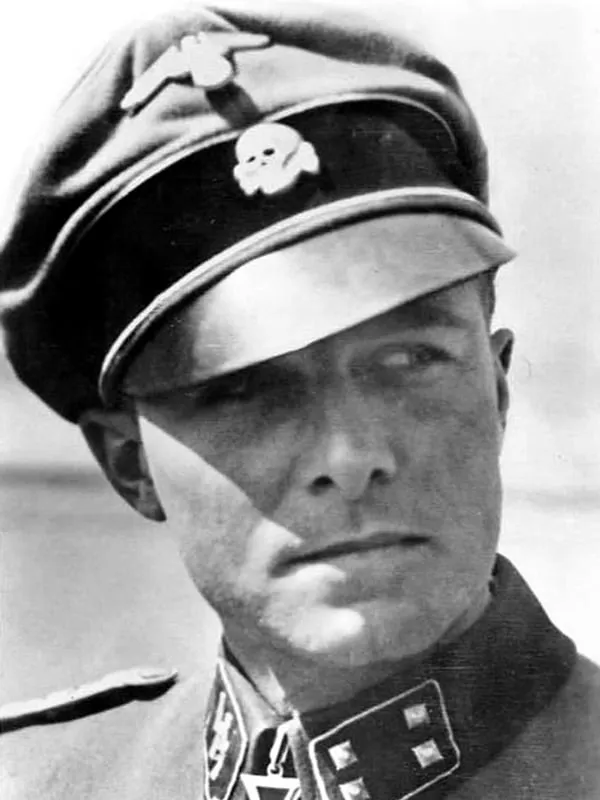
- Born:
- 30 January 1915, Berlin (German Empire)
- Died:
- 14 July 1976, Traves (France)
- Author:
- Łukasz
- Photo:
- Ruffneck'88, CC BY-SA 4.0, Wikimedia Commons

Joachim Peiper, known to his comrades as Jochen, was an SS officer who rose from Heinrich Himmler’s staff to command the leading armoured battlegroup of the Ardennes offensive. Young, educated and fluent in English, he was regarded in the Waffen-SS as a model front-line officer and received some of Germany’s highest decorations. At the same time, the units he commanded left behind them burnt villages in Ukraine, murdered civilians at Boves in Italy and executed American prisoners at Malmedy. Sentenced to death in 1946, he was released from prison ten years later. He died in 1976 in France, in a house set on fire by attackers who were never identified.
Youth and Himmler’s staff
He was born on 30 January 1915 in Berlin, the youngest of the three sons of Woldemar Peiper, a professional officer who had served in German East Africa during the First World War. In 1933, while still a schoolboy, he joined a mounted unit of the SS, and after his school-leaving examinations he chose a career in that organisation. He graduated from the SS officer cadet school (Junkerschule) at Braunschweig and in 1936, as an SS-Untersturmführer, was posted to the Leibstandarte SS Adolf Hitler, the bodyguard of Adolf Hitler.
In 1938 he was assigned to the Personal Staff of the Reichsführer-SS and soon became one of his adjutants. Himmler thought exceptionally highly of him; in 1939 Peiper married Sigurd Hinrichsen, a secretary from Himmler’s entourage. As adjutant he accompanied the SS chief on his travels through occupied Poland and on visits to concentration camps and ghettos. According to his own later accounts, cited by his biographer Jens Westemeier, he witnessed early experiments in killing people with gas. After the war Peiper consistently passed over these years at the heart of the SS apparatus, presenting himself purely as a soldier.
He went through the French campaign of 1940 as a platoon and company commander in the Leibstandarte, winning both classes of the Iron Cross, and then returned to Himmler. In 1941 he left the staff and rejoined the Leibstandarte, by then fighting on the Eastern Front.
The Eastern Front and the “Blowtorch Battalion”
From 1942 Peiper commanded the III Battalion of the Leibstandarte’s 2nd Panzergrenadier Regiment – a unit equipped with armoured half-tracks, which allowed him to make fast, deep raids. In February 1943, during the fighting for Kharkiv, he broke through the Soviet lines to the encircled 320th Infantry Division and brought it out together with hundreds of wounded; for this action he received the Knight’s Cross on 9 March 1943. A few days later his battalion was among the first to force its way into the city when the Germans retook Kharkiv, and in July it fought at Prokhorovka.
This same efficiency had a dark side. In soldiers’ accounts and in the findings of historians – Westemeier among them – Peiper’s unit appears under the nickname “Lötlampen-Abteilung”, the “Blowtorch Battalion”, from the burning of Ukrainian villages during the fighting in the winter of 1943. It is linked to the killing of the inhabitants of Yefremivka and Semenivka near Kharkiv in February 1943; historians differ on how far the battalion itself and how far other sub-units of the division were involved. What is certain is that the Leibstandarte waged a war in the east in which the killing of prisoners and civilians was no exception, and that Peiper was one of its most highly regarded commanders.
Boves
In the summer of 1943 the division was transferred to northern Italy. After the announcement of the Italian surrender Peiper’s battalion disarmed the Italian army in Piedmont. On 19 September 1943 Italian soldiers and partisans in the mountains above Boves near Cuneo captured two SS men; in response Peiper’s unit shelled the little town and set it on fire – several hundred houses burned down and at least 23 civilians were killed, among them the local parish priest, who had earlier been used as a go-between in negotiations for the release of the prisoners (figures according to Italian findings). It was one of the first mass German reprisals against the population of Italy. An investigation conducted in the 1960s by the West German public prosecutor’s office in Stuttgart was dropped in 1968 for lack of evidence of Peiper’s personal guilt.
In the autumn of 1943 he returned to Ukraine. After the death of its previous commander he took over the Leibstandarte’s 1st SS Panzer Regiment and fought near Zhytomyr; in January 1944 he received the Oak Leaves to the Knight’s Cross. In the summer of 1944 the regiment was bled white in Normandy, and Peiper himself, ill and exhausted, spent several weeks on sick leave.
Kampfgruppe Peiper in the Ardennes
In December 1944 the 29-year-old SS-Obersturmbannführer was given a task on which the fate of the whole offensive on the northern wing was to depend: at the head of a battlegroup of some 4,800 men, with Panther and Panzer IV tanks and heavy Tiger IIs, he was to break through the American lines and seize the bridges over the Meuse as quickly as possible. The battlegroup was the spearhead of the 1st SS Panzer Division in Sepp Dietrich’s 6th SS Panzer Army.
The first day, 16 December, brought delays – traffic jams and a destroyed bridge meant that Peiper did not really get moving until the night. On 17 December his troops took Honsfeld and Büllingen, where prisoners were killed, and at noon the spearhead passed the Baugnez crossroads. There soldiers from the sub-units following behind it shot prisoners from the American 285th Field Artillery Observation Battalion – this was the Malmedy massacre, in which 84 Americans were killed. Peiper himself had already driven on, but killings of prisoners and civilians marked the whole route of his battlegroup, from Honsfeld to Stavelot and La Gleize.
On 18 December Peiper forced his way into Stavelot, but American engineers blew the bridges at Trois-Ponts and Habiémont just ahead of his tanks. Blocked in the Amblève valley, out of fuel and cut off from the rest of the division, he was stuck around Stoumont and La Gleize, where from 23 December, when the skies over the Ardennes cleared, Allied bombs also rained down on him. On the night of 23/24 December, with his superiors’ consent, he abandoned his tanks and vehicles and with about 800 men made his way on foot back to the German lines. Roughly one-sixth of the whole battlegroup thus returned. This marked the end of the 6th SS Panzer Army’s deepest thrust, as the American counter-offensive in the Ardennes gathered pace.
Despite this failure, on 11 January 1945 Peiper received the Swords to the Knight’s Cross, and later promotion to SS-Standartenführer. In the spring of 1945 he fought in Hungary, in the last German offensive at Lake Balaton, and in May he gave himself up to the Americans in Austria.
The Dachau trial and the sentence
The Americans quickly established who had commanded the battlegroup at Malmedy. From 16 May to 16 July 1946 Peiper, together with 72 other defendants – Dietrich among them – stood trial before an American military tribunal on the site of the former Dachau camp. The indictment covered the killing of prisoners and civilians in a dozen or more places along the battlegroup’s route. Peiper accepted a commander’s responsibility for his men but denied having ordered the killing of prisoners. The court sentenced him and 42 other defendants to death by hanging.
The sentence was never carried out. The defence counsel, Colonel Willis Everett, accused the investigators of extorting confessions; the case was taken up by military review boards and, in 1949, by a US Senate subcommittee, in whose proceedings Senator Joseph McCarthy played an active part. None of these bodies confirmed the allegations of systematic torture, but irregularities in the investigation and the changing political climate – the Cold War and the building of the Bundeswehr – favoured the reduction of sentences. In 1951 Peiper’s sentence was commuted to life imprisonment and later shortened, and on 22 December 1956, as one of the last of those convicted in the case, he was released on parole from Landsberg prison.
After the war and death at Traves
With the backing of HIAG, the Waffen-SS veterans’ organisation, Peiper found work at Porsche and then at Volkswagen. He left Porsche after protests by Italian trade unionists who remembered Boves. In the 1960s prosecutors took up his case again – this time over the Italian affair – but the proceedings were dropped. In 1972 he settled in France, in the village of Traves in the Haute-Saône department, where he worked translating military books.
In 1974 he was recognised, and in June 1976 communists put up leaflets about his past in the area; the story was also reported by L’Humanité. Peiper received threats; he sent his family back to Germany but stayed on himself. On the night of 13/14 July 1976, on the eve of the French national holiday, his house was fired on and set alight. A charred body, identified as Peiper’s, was found in the ruins. The perpetrators were never found; a group calling itself “the Avengers” claimed responsibility, and rumours grew up around his death that he had survived – without any evidence.
Place in the history of the war
Peiper is the figure who shows most clearly the two faces of the Waffen-SS. After the war veterans’ circles and some popular literature turned him into a hero, a model of the brave armoured commander wronged by “victors’ justice”. Historians, above all Jens Westemeier, have shown him as a man deeply committed to Nazism, a close associate of Himmler and a commander whose units murdered prisoners and civilians on every front. The raid of Kampfgruppe Peiper was itself a military failure: the battlegroup never reached the Meuse and lost almost all its equipment, while the crime at Malmedy stiffened the American soldiers’ will to fight. His case also became a symbol of how quickly after the war Cold War politics softened the sentences for war crimes.
Sources
Mentioned in battles
(03)Often appears with
People who appear in the same events.