1942: The German summer offensive
Second Battle of Kharkov
- Dates:
- 12–28 May 1942
- Front:
- Eastern Front
- Location:
- Kharkiv Oblast (Ukraine): from Vovchansk and Staryi Saltiv north-east of Kharkiv to the Barvenkovo (Izium) salient beyond the Donets, between Balakliia, Lozova, Barvenkovo and SlovianskOn the battle map →
- Sides:
- Soviet UnionSemyon Timoshenko, Nikita Khrushchev, Ivan Bagramyan, Fyodor KostenkoNazi GermanyFedor von Bock, Ewald von Kleist, Friedrich Paulus
- Result:
- German victory. The Soviet two-pronged attack on Kharkiv stalled after a few days, and the counter-strokes of Kleist from the south and Paulus from the north cut off the Barvenkovo salient. The main forces of the 6th and 57th Armies and of the Bobkin group were killed or captured in the pocket, and the Red Army lost the reserves it needed to defend the south against Operation Blue.
- Author:
- Natalia
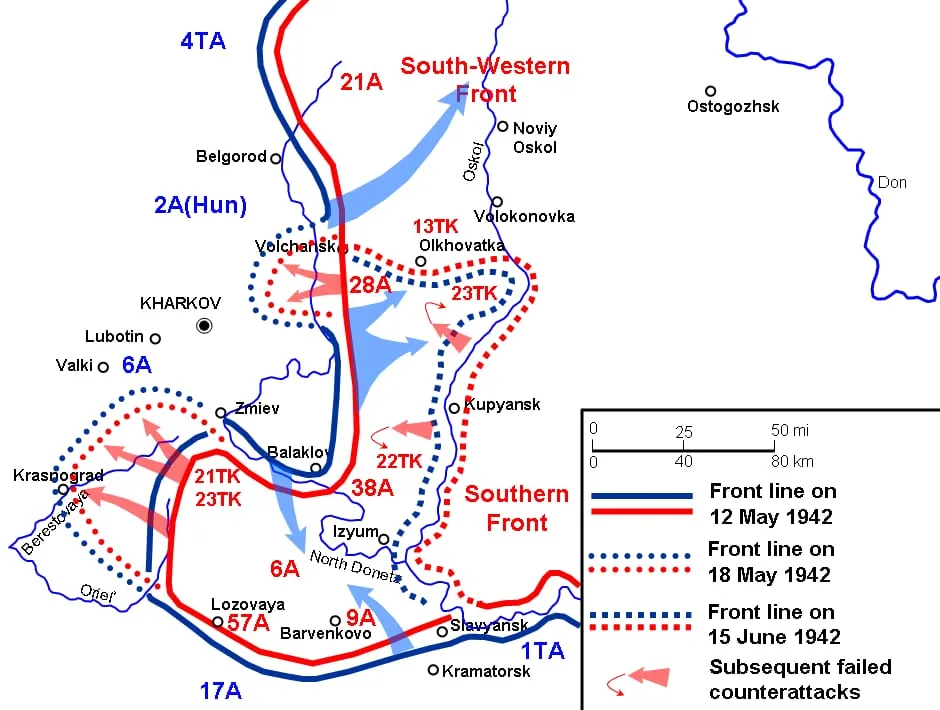
The Second Battle of Kharkov was one of the last great German encirclement victories on the Eastern Front and one of the Red Army’s most painful defeats of 1942. It began on 12 May as a Soviet offensive: the troops of Marshal Semyon Timoshenko struck from two directions at Kharkiv in order to encircle the German Sixth Army defending it and recover the second-largest city of Soviet Ukraine. After three days of promising progress the attack slowed, and on 17 May it was hit from the south by the First Panzer Army of Colonel General Ewald von Kleist. For weeks the Germans had been preparing an operation of their own in precisely that sector, intended to cut off the salient from which the Soviet attack had been launched. In less than a week the pincers of Kleist and Friedrich Paulus closed on the Donets, trapping more than a quarter of a million Soviet soldiers in the pocket at Barvenkovo. At most one in ten of them escaped.
Name and dates
In Polish and Western historiography the engagement is known as the Second Battle of Kharkov (the first being the fighting in which the Germans took the city in October 1941, the third that of February and March 1943). Soviet and Russian historians speak of the Kharkov operation, and of its final phase as the “Barvenkovo trap”. The Germans called their counter-stroke Operation Fridericus, and German writing has adopted the name the spring battle of Kharkov (Frühjahrsschlacht bei Charkow).
The dates 12–28 May are framed by the start of the Soviet attack and by Timoshenko’s order of 28 May, which formally ended the operation. Grigoriy Krivosheev, in his tabulation of Soviet losses, gives 12–29 May, and isolated groups of encircled men were still fighting their way east as late as 30–31 May. Some chronologies give other dates for individual stages. According to German and Soviet documents Kleist’s attack began on the morning of 17 May, not on 18 May as some tabulations have it; 18 May was the original date for Operation Fridericus, set in the directive of 30 April. The German pincers met on the Donets on 22 May (some sources say 23 May), depending on whether one counts the first contact between the spearheads or the sealing of the ring. Nor did the Soviet 9th Army attack and capture Krasnohrad: the attack in that direction was made by the operational group of General Leonid Bobkin, which reached the town but did not take it, while the 9th Army, together with the 57th, defended the southern flank of the salient.
Background
In the autumn of 1941 Army Group South took Kharkiv and reached the Donets, and at the end of November it was thrown back from Rostov. After the victory at Moscow Joseph Stalin concluded that the Wehrmacht was close to collapse, and on 5 January 1942 he ordered a general offensive along the whole front. In the south one part of it was the Barvenkovo–Lozovaya offensive (18–31 January). Troops of the South-Western and Southern Fronts broke through the line between Balakliia and Sloviansk, took Barvenkovo and Lozova, the main supply base of the German Seventeenth Army, and cut the railway supplying the First Panzer Army. They did not achieve their aim – cutting off the Germans on the Sea of Azov – but they left a deep salient on the western bank of the Donets, named the Izium salient after the town at its base and the Barvenkovo salient after the town at its centre. The railway junction at Lozova lay inside it, and from its western edge it was not far to Pavlohrad and Dnipropetrovsk.
For both sides the salient was at once an opportunity and a threat. The Soviets saw it as a springboard for an attack on Kharkiv from the south and on the Dnieper crossings; the Germans saw it as an awkward wedge in their front which had to be removed before the summer offensive. Since January Army Group South had been commanded by Field Marshal Fedor von Bock, who had replaced Walter von Reichenau after the latter’s sudden death, while command of the Sixth Army at Kharkiv had passed to General der Panzertruppe Friedrich Paulus, until then Deputy Chief of the Army General Staff, who had no experience of commanding a large formation in the field.
In March 1942 the Military Council of the South-Western Direction – Marshal Timoshenko, commander-in-chief of the Direction and at the same time commander of the South-Western Front; Nikita Khrushchev, member of the council; and the chief of staff, Lieutenant General Ivan Bagramyan – proposed to Stalin a great offensive by three fronts, the Bryansk, South-Western and Southern, which was to reach the line Gomel–Kiev–Cherkasy–Mykolaiv. The General Staff rejected the plan as unrealistic given the lack of reserves. The Chief of the General Staff, Marshal Boris Shaposhnikov, supported by General Aleksandr Vasilevsky and General of the Army Georgy Zhukov, advised a temporary strategic defensive for the spring. Stalin, convinced that the Germans would strike at Moscow again, accepted this only halfway: he kept the reserves in the centre but allowed a series of offensives with limited objectives from Leningrad to the Crimea. The most important of them was the limited operation Timoshenko proposed in April: to destroy the German grouping at Kharkiv and liberate the city with the forces of the Direction alone. Vasilevsky and Shaposhnikov warned that an attack out of a narrow salient would be risky, but Timoshenko and Khrushchev vouched for its success. Stalin approved the plan, and one of the last Stavka directives on the matter is dated 17 April.
The Germans were preparing to strike at the same place from the opposite side. Directive No. 41 of 5 April provided that, before the main summer offensive, the Crimea would be “cleared” and the Izium salient cut off. The orders for Operation Fridericus were issued on 30 April: the Sixth Army was to attack from the north, from near Balakliia, and Kleist’s group – the First Panzer Army with part of the Seventeenth Army – from the south, from near Sloviansk and Kramatorsk, both towards Izium. The date was set for 18 May. At the same time Erich von Manstein’s Eleventh Army was to smash the Crimean Front on the Kerch Peninsula; Operation Trappenjagd opened on 8 May and tied down most of the VIII Air Corps of General Wolfram von Richthofen. At the end of April and the beginning of May the divisions of Army Group South were brought up to full strength, and further formations were moved to Kharkiv and Sloviansk. Soviet reconnaissance failed to notice this: Timoshenko expected to face a weakened Sixth Army on the defensive, not an enemy preparing an attack of its own.
Soviet forces and plan
Timoshenko planned a double envelopment of Kharkiv. The main blow was to come from the northern part of the Barvenkovo salient. The 6th Army (PL) of Lieutenant General Avksentiy Gorodnyansky (PL) was to advance north-west, straight on Kharkiv, while on its left flank the operational group of Major General Leonid Bobkin, with the 6th Cavalry Corps, was to make for Krasnohrad to cover the attack from the west. Two fresh tank corps, the 21st and 23rd, were earmarked to exploit the breach. The secondary attack, out of a small bridgehead at Staryi Saltiv and from the area of Vovchansk north-east of the city, was entrusted to the 28th Army of Lieutenant General Dmitry Ryabyshev and the flanks of the 21st Army of Major General Vasily Gordov and the 38th Army of Major General Kirill Moskalenko. The two arms were to meet west of Kharkiv and close the ring around the German Sixth Army. If this succeeded, Timoshenko wanted to push on to Dnipropetrovsk and cut the supply lines of the whole of Army Group South; the Stavka did not approve this part of the plan.
The southern flank of the salient, a long and weakly fortified sector running from near Lozova to Sloviansk, belonged to the Southern Front of Lieutenant General Rodion Malinovsky. It was held by the 57th Army of Lieutenant General Kuzma Podlas and the 9th Army of Major General Fyodor Kharitonov – in all a mere eleven rifle divisions and one brigade on a front more than 170 km long. The commander of the 9th Army asked for the time and means to build a strong anti-tank defence, but according to Soviet accounts Malinovsky and Timoshenko refused. It was precisely on this sector that the Germans were concentrating Kleist’s forces.
Soviet figures speak of about 640,000 men and 1,200 tanks in the forces assigned to the operation in the Kharkiv direction; Krivosheev gives 765,300 men for the two fronts. On the German side Paulus had four army corps in the Kharkiv area (XXIX, XVII, LI and VIII), supported by Hungarian troops, while in the south Kleist had the III Motorised Corps of General Eberhard von Mackensen, the XI, XXXXIV and LII Army Corps and the Romanian VI Corps. The Soviet preparations ran late: the regrouping coincided with the rasputitsa, the season of mud, the roads turned into quagmires, and the concentration was so chaotic that, as Moskalenko later admitted, the Germans had no difficulty in “divining our intentions”.
Timoshenko’s offensive (12–16 May)
At 6.30 a.m. on 12 May the Soviet artillery opened an hour-long preparatory bombardment and aircraft attacked the German positions. At 7.30 a.m. the infantry and tanks moved off, simultaneously on both sides of Kharkiv. In the north the 28th and 38th Armies drove into the positions of the XVII Corps of General Karl-Adolf Hollidt. The heaviest fighting was for the village of Nepokrytaya, which Major General Aleksandr Gorbatov’s 226th Rifle Division took in the afternoon, and for Ternovaya, where an encircled German garrison, supplied from the air, held out for many days until it was relieved. On the first day the attack in the north advanced up to 10 km. Moskalenko noticed, however, that instead of the one division he had expected he faced two, and near Staryi Saltiv the German 3rd Panzer Division was already counter-attacking.
In the south the success was greater. The 6th Army and the Bobkin group broke the front of the VIII Corps of General Walter Heitz between Balakliia and Lozova, and the 62nd Infantry Division was shattered. By 14 May the breaches on both sides were each about 50 km wide, the spearheads of the 6th Army were 20–25 km from Kharkiv, and Bobkin’s cavalry was bypassing Krasnohrad and threatening the road to Poltava, where Bock had his headquarters. Bock judged the situation dangerous but forbade Paulus to make any larger counter-attacks without air support.
Timoshenko, however, failed to exploit the moment. He held back the two tank corps that were to enter the breach in the south until 17 May, and for the following days the attack was carried mainly by tired infantry. In the north, on 15 and 16 May, the attacks of the 28th Army stalled in front of the German second line, and German tanks recovered some of the lost ground. By the evening of 16 May the rifle units of both groupings had advanced 20–35 km, but the mobile formations that were to close the encirclement were still standing at the bases of the breaches.
Air power and Hitler’s decision
The outcome of the battle was decided largely in the air. The core of the German close-support aviation in the south, Richthofen’s VIII Air Corps, was fighting in the Crimea. Adolf Hitler first ordered it to be transferred to Kharkiv, then changed his mind and left Richthofen at Kerch and Sevastopol, but took some units from him; by 15 May he had reinforced the IV Air Corps of General Kurt Pflugbeil, part of Colonel General Alexander Löhr’s Luftflotte 4, with several wings of Ju 88 and He 111 bombers and Ju 87 dive-bombers. Richthofen complained that the army treated the air force as its maidservant. From 14–15 May the Luftwaffe dominated the battlefield: it destroyed Soviet supply columns and tanks, dropped supplies to encircled garrisons, and its reconnaissance directed the fire of the artillery. According to German records, the IV Air Corps flew more than 15,600 sorties in the sixteen days of the battle and dropped about 7,700 tonnes of bombs. Colonel General Franz Halder later held that it was above all the air force that broke the Soviet offensive.
On 14 May, when the Sixth Army’s position was at its most difficult, Bock considered using part of Kleist’s forces to reinforce Paulus directly. Hitler and Halder argued for a bolder solution: Kleist was to strike as soon as possible from the south at the base of the salient, as the Fridericus plan envisaged, even if the northern arm, tied down in the defence of Kharkiv, could not yet move. That same day Hitler ordered Kleist to prepare the attack. An operation originally conceived as a double pincer thus began as a single-armed blow.
Kleist’s attack (17–19 May)
Before dawn on 17 May, after a short artillery preparation, Kleist’s group struck north from the area of Sloviansk and Kramatorsk into the 9th Army. The spearhead was Mackensen’s III Corps with the 14th and 16th Panzer Divisions and the 60th Motorised Division, with the XXXXIV and LII Army Corps attacking alongside; further west the XI Corps pushed back the 57th Army from near Lozova. The 9th Army’s defence, overstretched and without reserves, collapsed within a few hours. On the first day the Germans advanced about 10 km, and their aircraft broke up the retreating columns and the crossings. The 9th Army’s headquarters was losing contact with its divisions, and the army itself began to disintegrate.
Timoshenko reported the German attack to Moscow and asked for reinforcements, but he still regarded it as a local counter-attack. On the evening of 17 May General Vasilevsky, who was standing in for the sick Shaposhnikov at the General Staff, proposed to Stalin that the attack on Kharkiv be halted and the 6th Army and the Bobkin group be turned against Kleist. Stalin refused, citing the reports of the Military Council of the Direction that the situation was under control. According to Bagramyan’s memoirs, on the morning of 18 May Timoshenko himself assured Stalin by telephone that there was no need to pull the main forces out of the attack. On 18 May Vasilevsky renewed his proposal, again to no effect. That evening, according to Vasilevsky’s memoirs, Khrushchev telephoned him: he said that Stalin had rejected the council’s proposal to break off the attack immediately, and asked the Chief of Staff to put it forward once more. Vasilevsky replied that he had already tried several times and advised Khrushchev to approach Stalin directly; Stalin, speaking through Georgy Malenkov, confirmed the order to continue the offensive. The participants’ accounts contradict each other here: Bagramyan blames above all Timoshenko, Vasilevsky and Zhukov blame Stalin and the command of the Direction, while Khrushchev later presented himself as the man who had warned in vain.
On 18 May Kleist’s tanks reached the Donets near Izium, not far from the mouth of the Oskil, and the next day they crossed the Bereka river near Petrovskoye. The base of the salient was narrowing rapidly, and the 57th Army and the remnants of the 9th were pushed west and north, deeper into the salient. On 19 May units of the Sixth Army moved south from the north, from the area of Merefa and from the German bridgehead on the Donets near Andreyevka: parts of the 3rd and 23rd Panzer Divisions and the 44th Infantry Division, under the joint command of General Hermann Breith. Only that afternoon did Timoshenko order a switch to the defensive along the whole front, and the Stavka agree to halt the 6th Army’s attack and turn it against the Germans. By then it was too late.
The encirclement (20–23 May)
On 19–20 May Timoshenko formed the troops in the salient – the 6th and 57th Armies and the Bobkin group – into a grouping under his deputy, Lieutenant General Fyodor Kostenko. It was to turn back from the attack on Kharkiv, strike south-east and open the way across the Donets. Turning several corps and dozens of divisions around in one or two nights, on sodden roads and under constant air attack, proved almost impossible. On 20 May the Soviet 2nd Cavalry Corps counter-attacked the western flank of Kleist’s wedge near Gavrilovka, but German infantry, among them the 1st Mountain Division, took over the screening of the flank. The Luftwaffe destroyed or damaged most of the bridges over the Donets, cutting the lines of retreat.
On 22 May the 14th Panzer Division took Gusarovka and reached the Donets, while Breith’s units approached from the north. That day – or, according to some sources, on 23 May – the pincers closed south-east of Balakliia. In the north, near Vovchansk, the 28th Army went over to the defensive, and the XVII Corps recovered its lost positions and relieved the garrison of Ternovaya. Trapped in the triangle between Merefa, Lozova and Balakliia were the main forces of the 6th and 57th Armies, the Bobkin group, part of the 9th Army and the two tank corps – according to various estimates between 200,000 and more than 250,000 men.
The Barvenkovo pocket (24–28 May)
The ring tightened steadily. On 25 May the encircled troops made their first great attempt to break out to the east. The commander of the German 1st Mountain Division, General Hubert Lanz, described in a report how for two nights tens of thousands of Soviet soldiers with tanks and guns came in waves against his division’s positions, which held the front only with the utmost difficulty. That day the commander of the 57th Army, General Podlas, was seriously wounded and died soon afterwards; according to some accounts he took his own life to avoid capture. By day the encircled men were defenceless against air attack. Ju 87s, Ju 88s and He 111s bombed incessantly, using among other things fragmentation cluster bombs, while German observers on the hills directed the fire of the guns.
On 26 May the remnants of the encircled forces were pressed into an area of a dozen or so square kilometres around the village of Lozovenka, west of Izium. The roads and ravines between Krutoyarka and Fyodorovka were choked with abandoned vehicles, horses and thousands of dead and wounded. That day General Bobkin was killed and General Kostenko went missing; he was last seen on 26 May, and that day has been accepted as the date of his death. On 27 May the commander of the 6th Army, General Gorodnyansky, was killed while trying to break out. Among those taken prisoner was the commander of the 6th Cavalry Corps, Major General Aleksandr Noskov. Bock personally viewed the battlefield from a hill near Lozovenka.
Parts of the 6th and 57th Armies, supported by a composite tank group under General Grigory Kuzmin made up of the remnants of several brigades and of both tank corps, managed, at enormous cost, to break through near the village of Chepel on the Donets; the 38th Army helped them from outside. According to Soviet figures about 22,000 men escaped from the pocket. On 28 May Timoshenko issued the order formally ending the operation, but isolated groups were still breaking out until 30–31 May.
Losses
Figures for the losses vary considerably. According to Krivosheev’s tabulation the Kharkov operation cost the Red Army 277,190 men, including 170,958 killed, missing and captured and 106,232 wounded and sick; another Soviet report, cited in Polish and Russian literature, speaks of 266,971 men, including 207,047 captured or missing. The Germans claimed about 240,000 prisoners and more than 1,200 tanks destroyed or captured; one German document even gives a figure of more than 350,000 prisoners, which Russian researchers regard as greatly inflated. According to incomplete Soviet data, 652 tanks, 1,646 guns and 3,278 mortars were lost. The commanders of the 6th and 57th Armies, the deputy front commander Kostenko and the group commander Bobkin were killed, as were many divisional commanders. German and allied losses are usually estimated at about 20,000 killed, wounded and missing.
Significance
The Second Battle of Kharkov destroyed the reserves the Red Army had built up in the south over the winter and spring, and opened the way for the German summer offensive. In June Army Group South carried out further preliminary operations: Wilhelm, near Vovchansk in mid-June, which encircled part of the 28th Army, and Fridericus II near Kupiansk at the end of June. On 28 June Operation Blue began. The weakened South-Western and Southern Fronts could not stop it; in July the Germans reached the Don, and in the autumn Stalingrad and the Caucasus. For Paulus the victory at Kharkiv was the greatest success of his career – he received the Knight’s Cross for it – and his Sixth Army became the spearhead of the advance that ended for it at Stalingrad.
The defeat did not bring a purge of the Red Army on the scale of 1941. In a letter to the Military Council of the front at the end of June Stalin compared it to the defeat of the armies of Samsonov and Rennenkampf in East Prussia in 1914, and wrote that if he were to tell the country the whole truth about the loss of 18–20 divisions, the members of the council would be “dealt with very severely”. Bagramyan was removed from his post and appointed chief of staff of the 28th Army. Timoshenko remained in command, though his standing was never again what it had been. Kharkiv and the Crimea also weighed on diplomacy: on 25 May Stalin instructed Vyacheslav Molotov, who was negotiating in London, to drop the demand for recognition of the Soviet Union’s frontiers of June 1941.
The responsibility for the defeat was disputed for years. In their memoirs Zhukov and Vasilevsky blamed Stalin, who had ignored the warnings and failed to concentrate reserves in the south-west, but also the command of the Direction, which had persuaded him of success and failed to secure the flank of the salient. In his speech “On the Cult of Personality and Its Consequences” at the 20th Congress of the Communist Party of the Soviet Union in February 1956, Khrushchev presented Kharkiv as an example of Stalin’s “military genius”: he claimed that the Military Council had proposed breaking off the attack and that Stalin, “contrary to common sense”, had ordered it to continue, at the cost of hundreds of thousands of soldiers. The memoirs of Bagramyan and Vasilevsky and the documents from the archives show a more complex picture: until 18 May it was Timoshenko and Khrushchev who assured Moscow that the threat from Kleist was exaggerated. Above all, the battle showed that in 1942 the Red Army did not yet know how to conduct deep offensive operations against a Wehrmacht which, despite its winter defeat, had retained its capacity for rapid manoeuvre and its crushing superiority in the air.