- Category:
- Crimes and repression
- Front:
- Poland
- Date:
- 16 May 1943
- Author:
- Łukasz
- Tags:
- Holocaust, resistance, Poland, Jürgen Stroop
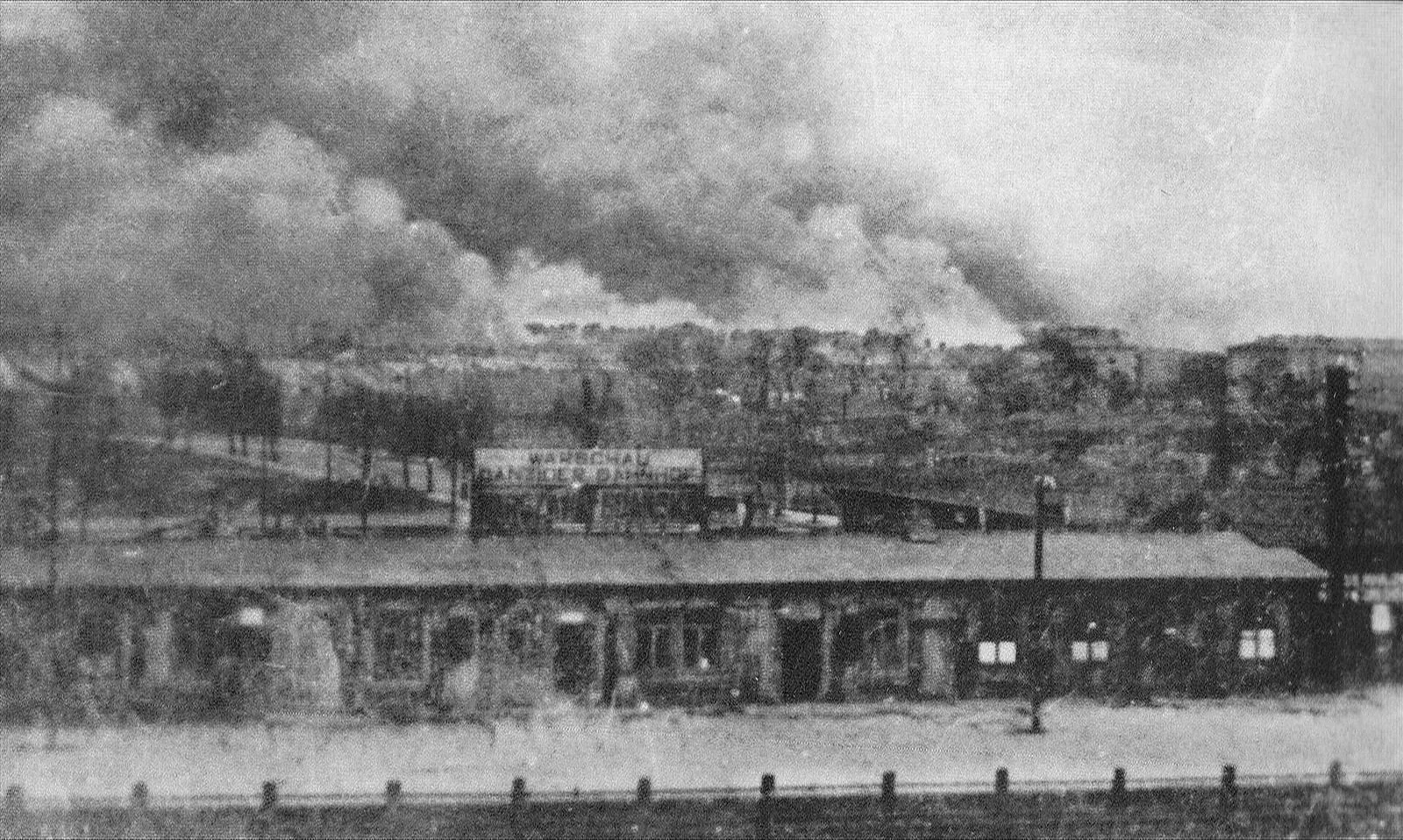
At 8.15 p.m. on Sunday 16 May 1943 an explosion destroyed the Great Synagogue on Tłomackie Street, the largest Jewish house of worship in Warsaw and one of the city’s landmarks. The detonator was pressed by SS-Brigadeführer Jürgen Stroop himself, commander of the forces that since 19 April had been liquidating the Warsaw Ghetto. With this gesture he brought to a close what his reports called the “grand operation”, and he reported to his superiors: “Es gibt keinen jüdischen Wohnbezirk in Warschau mehr!” – “The Jewish residential district in Warsaw no longer exists!” This sentence became the title of his final report to Heinrich Himmler.
The Germans regarded this day as the end of the uprising that had broken out on the eve of Passover. In reality the fighting did not suddenly stop on 16 May, and the ghetto itself had ceased to exist earlier: from 22 April it had been burned down building by building and turned into a desert of rubble in which the last fighters and thousands of civilians hid in cellars and bunkers. The date of 16 May marks above all the moment when Stroop considered his task accomplished and blew up a symbol which, as it happens, had stood outside the ghetto boundaries since 1941.
Fighting in the ruins
At the end of April the uprising changed its character. After the Jewish Military Union (ŻZW) withdrew from Muranowski Square and further blocks were burned down, there was no longer any front or any fixed points of resistance. Groups from the Jewish Combat Organisation (ŻOB) emerged from the bunkers at night, attacked German patrols and sought contact with other survivors. On 1 and 2 May heavy fighting took place in Franciszkańska Street, where fighters who had earlier withdrawn from the brushmakers’ workshops were holding out. By day the Germans combed the ruins with dogs, listened for sounds beneath the rubble, blew up the entrances to shelters and pumped smoke or gas into them. Every day Stroop reported several hundred or several thousand Jews “caught” and dozens of bunkers discovered.
On 5 May the Prime Minister and Commander-in-Chief, General Władysław Sikorski, called on his compatriots at home over BBC radio to help and shelter people fleeing the ghetto. The Polish underground on the “Aryan” side had carried out several actions by the walls in April, but it had neither the strength nor the weapons to change the course of events. For the fighters in the ghetto, what mattered most now was a way out: contact with Yitzhak Zuckerman, the ŻOB’s representative on the other side of the wall, and the sewers beneath the city.
Miła 18
In May the ŻOB’s most important refuge was the bunker beneath the building at 18 Miła Street. It had been built before the uprising by smugglers, who placed it at the fighters’ disposal. It had several entrances, water, electricity and a kitchen, and at its peak about 300 people were sheltering there, including the organisation’s command with Mordechai Anielewicz. On 8 May the Germans, most probably acting on testimony extracted from captured Jews, surrounded the bunker at Miła 18 and called on those hiding inside to come out. The civilians came out; the fighters stayed. When gas was pumped inside, some of them died fighting and most took their own lives so as not to fall into German hands. About a hundred fighters died there – sources give figures from 80 to 120 – among them Anielewicz and his companion Mira Fuchrer. A few people, among them Tosia Altman, managed to escape through the last undiscovered exit.
The death of the commander and most of the staff meant the end of the ŻOB’s organised fighting. The ruins of Miła 18 were never excavated; after the war a mound with a memorial stone was raised on the site, and the bunker became the collective grave of its defenders.
Through the sewers to Prosta Street
Even before 8 May the ŻOB had sent Simcha Rotem, known as “Kazik”, to the “Aryan” side to prepare the evacuation of the survivors. He was helped by a soldier of the People’s Guard (Gwardia Ludowa), Władysław Gaik (PL), known as “Krzaczek”, and by two Polish sewer workers, Wacław Śledziewski and Czesław Wojciechowski. On the night of 8–9 May Rotem made his way through the sewers into the ghetto and at 22 Franciszkańska Street found survivors, among them Marek Edelman and Zivia Lubetkin, as well as several fighters who had escaped from Miła 18. About fifty people went down into the sewers and, wading through the sewage, reached a point beneath Prosta Street, where they waited almost two days for transport.
At about 10 a.m. on 10 May a lorry pulled up by the manhole. Some forty people were pulled out of the sewer and, in broad daylight, before the eyes of passers-by, driven to the forest near Łomianki. Part of the group, which had moved into a side channel, could not be collected in time; these people later came up to the surface, were handed over to the Germans and were killed. The survivors formed an Anielewicz partisan unit of the People’s Guard in the forests near Wyszków, which was destroyed later in 1943; others, such as Edelman, Lubetkin and Zuckerman, went into hiding in Warsaw and in August 1944 fought in the Warsaw Uprising.
Zygielbojm’s protest
News of the fighting and of the destruction of the ghetto reached London through couriers and the radio stations of the Polish Underground State. On 11 May Szmul Zygielbojm, the Bund’s representative on the National Council of the Republic of Poland (the government-in-exile’s advisory parliament), took a fatal overdose of sleeping pills in his London flat. He died the following day, 12 May. In a letter to President Władysław Raczkiewicz and Prime Minister Sikorski he wrote that responsibility for the murder of the Jews of Poland lay above all with the perpetrators, but indirectly also with the whole of humanity, with the Allied nations and governments, which had taken no real steps to stop this crime. He called his death a protest against the passivity of the world. His wife and son had perished in the Warsaw Ghetto.
Zygielbojm’s act was also a response to the Bermuda Conference, which in April, in the very days when the ghetto was burning, had ended without any decisions that might save the Jews of occupied Europe. A year earlier it had been Zygielbojm who publicised the Bund Report on the mass murder of Jews in Poland in the West. His letter was published in the British press, but Allied policy did not change: the aim remained military victory, which was supposed to bring salvation, although for most Polish Jews it was to come too late.
The blowing up of the synagogue
When in mid-May the Germans concluded that only scattered hiding places remained in the ruins, Stroop decided to end the operation with a spectacular act. He chose the Great Synagogue on Tłomackie Street, built in 1876–1878 to a design by Leandro Marconi, a symbol of the assimilated, progressive part of Warsaw’s Jewish community. Sappers prepared the building for demolition, and on the evening of 16 May Stroop, surrounded by officers and with an eye to photographs, set off the charge. Years later, in a cell in Mokotów prison, he told Kazimierz Moczarski that it had been a magnificent sight and a symbol of triumph over Jewry; Moczarski recorded this conversation in his book Conversations with an Executioner.
That same evening Stroop reported to the Higher SS and Police Leader in the General Government, Friedrich Wilhelm Krüger, that the “grand operation” had been completed at 8.15 p.m. with the blowing up of the synagogue. On the site of the synagogue, in post-war Warsaw, an office block went up – known to Varsovians as the Blue Skyscraper – built in fits and starts over several decades, around which an urban legend grew up about a curse hanging over the place.
Stroop’s figures
The often-repeated statement that some 14,000 Jews died in the ghetto and some 40,000 were deported to the extermination camps at Majdanek and Treblinka rests entirely on Stroop’s own figures, and simplifies them. In his final report he stated that a total of 56,065 Jews had been “caught”, of whom about 7,000 had been killed on the spot and 6,929 deported to Treblinka, where they were murdered. The sum of these two figures gives the 14,000. The remaining 40,000-odd people were for the most part sent not to Treblinka but to the camp at Majdanek and to the labour camps at Trawniki, Poniatowa and Budzyń. Separately, Stroop estimated that a further 5,000–6,000 people had died in buildings that were blown up or burned.
Historians treat these figures with caution. The report was meant to demonstrate the effectiveness of the operation, and the numbers of those “caught” probably included people counted twice. On the other hand, there were more people in the ghetto than German records showed, because in addition to the registered inhabitants there were “wild” residents in hiding who appeared in no census. Estimates of the number of people in the ghetto in April 1943 range from about 40,000 (according to Israel Gutman, a participant in the uprising) to 50,000–60,000. According to frequently cited estimates, at least 13,000 Jews died on the spot during the uprising and the liquidation of the ghetto, including some 6,000 burned alive or suffocated by smoke. Stroop put his own losses at 16 killed and about 90 wounded; Marek Edelman and other survivors considered these figures to be greatly understated.
Most of those deported survived Warsaw by only a few months. At Majdanek some were murdered immediately on arrival, and on 3 and 4 November 1943, in Operation Harvest Festival (Aktion Erntefest), the Germans shot some 42,000 Jews at Majdanek, Trawniki and Poniatowa – to a large extent the same people who had been dragged out of the Warsaw bunkers in April and May.
The report for Himmler
Stroop’s report was prepared in three copies: for Himmler, for Krüger and for the author himself. The leather-bound volume contained a description of the units employed, the daily teleprinter reports on the progress of the operation and several dozen photographs with handwritten captions such as “Pulled from the bunkers by force”. Stroop wrote in a language in which the defenders of the ghetto and the civilians in hiding were “bandits” and their murder an “operation”. What was meant to be a monument to his success became one of the most important pieces of evidence of the crime. In 1945 the report was submitted to the tribunal at Nuremberg as document 1061-PS, and one of its photographs – a boy with his hands raised in front of levelled rifles – is among the best-known images of the Holocaust.
Himmler was pleased with the operation. On 18 June 1943 Stroop received the Iron Cross First Class, and in September he was sent to Greece as Higher SS and Police Leader. A few weeks later he was transferred to Wiesbaden, where he commanded the SS and police in the Rhein-Westmark region until the end of the war.
After 16 May
The announcement that the operation was over did not mean that there were no more people in the ruins. Individual groups of fighters and civilians hid in bunkers for weeks; it is estimated that after the official end of the operation the Germans caught or killed another 2,000–3,000 people. Shots could be heard in the ruins until June, and some of those in hiding, later known as the Robinson Crusoes of Warsaw, survived in the rubble until as late as 1944. A group of ŻZW fighters under Paweł Frenkel, which had crossed to the “Aryan” side back in April, hid in a tenement in Grzybowska Street; according to accounts cited in the literature, it was betrayed to the Germans in June and died fighting.
The Germans systematically blew up and demolished the area of the former ghetto, salvaging bricks and scrap metal. In the summer of 1943, on its edge in Gęsia Street, they established the KL Warschau concentration camp, known as Gęsiówka, to which Jewish prisoners from other countries were brought to carry out the demolition work. When the Warsaw Uprising broke out in August 1944, this part of the city was a sea of rubble stretching over several dozen hectares; on 5 August the Zośka Battalion captured Gęsiówka and freed the prisoners held there.
After the war Stroop stood trial twice. An American tribunal at Dachau sentenced him to death in 1947 for crimes against downed Allied airmen, after which he was extradited to Poland. In 1951 the Warsaw Voivodeship Court sentenced him to death for crimes committed in Warsaw, including the destruction of the ghetto, and on 6 March 1952 the sentence was carried out in Mokotów prison.
Place in the war
The Warsaw Ghetto Uprising was the largest armed revolt by Jews during the Holocaust and the first urban uprising in occupied Europe. A few hundred poorly armed fighters of the ŻOB and ŻZW, together with thousands of civilians in hiding, resisted the forces of the SS, the police and the Wehrmacht for almost four weeks – longer than some states had held out against the Wehrmacht in 1940. It had no chance of victory, and its participants knew it; they fought to choose the manner of their own deaths, and so that the world would learn what was happening.
The destruction of the Warsaw Ghetto sealed the fate of the largest Jewish community in occupied Europe: of the roughly 450,000 people whom the Germans had crammed into it in 1940–1942, only a few per cent survived the war. In the following months of 1943 the Germans liquidated the remaining ghettos in the General Government and the annexed territories, and the example of Warsaw gave others courage: in August an uprising broke out in the Białystok Ghetto, and in August and October the prisoners of the extermination camps at Treblinka and Sobibór rose in revolt. Operation Harvest Festival in November 1943 meant the end of most of the labour camps to which the survivors of the Warsaw bunkers had been sent.
Thanks to the testimony of survivors, the archive of Emanuel Ringelblum and, paradoxically, Stroop’s own report, the uprising has become one of the best-documented episodes of the Holocaust. The anniversary of its outbreak, 19 April, is commemorated every year in Warsaw, and the Monument to the Ghetto Heroes, unveiled in 1948 on the rubble of Muranów, has become one of the most important sites of remembrance of the war in Europe.
Places·Warsaw
Sources
Meanwhile
(04)Elsewhere, within a week.
- 15 May 1943 · PoliticsThe founding of the National Council of the ResistanceOn 15 May 1943 London announced the National Council of the Resistance, in which Jean Moulin united underground movements, unions and parties under de Gaulle.
- 13 May 1943 · MediterraneanThe Axis surrender in AfricaOn 13 May 1943 Messe's Italian First Army, the last Axis force in Tunisia, surrendered. Some quarter of a million men were captured; the war in Africa was over.
- 12 May 1943 · DiplomacyThe Trident ConferenceOn 12 May 1943 Churchill and Roosevelt opened the Trident Conference in Washington. It set 1 May 1944 as the date for the cross-Channel invasion.
- 11 May 1943 · PacificThe landing on AttuOn 11 May 1943 the US 7th Infantry Division landed on Japanese-occupied Attu. Fog, freezing cold and defences in the hills slowed the advance.
Related events
(04)The same battle, people or subject.
- 22 April 1943 · PolandThe burning of the Warsaw GhettoFrom 22 April 1943 Stroop burned the Warsaw Ghetto building by building. The ŻZW left Muranowski Square, but the ŻOB and those in bunkers fought on for weeks.
- 19 April 1943 · PolandThe Warsaw Ghetto Uprising beginsOn 19 April 1943, the eve of Passover, ŻOB and ŻZW fighters drove back the Germans entering the Warsaw Ghetto. They soon returned under Jürgen Stroop.
- 18 January 1943 · PolandThe first armed resistance in the Warsaw GhettoOn 18 January 1943 the Germans resumed deportations from the Warsaw Ghetto. ŻOB fighters first resisted with arms; after four days the action was halted.
- 16 August 1943 · PolandThe Białystok Ghetto UprisingOn 16 August 1943 the Germans began liquidating the Białystok ghetto. Several hundred poorly armed fighters resisted; their leaders died in the ghetto.