Poland
Władysław Sikorski
Commander of the Fifth Army (1920), Prime Minister (1922–1923), Minister of Military Affairs (1924–1925), Prime Minister of the Polish government-in-exile and Commander-in-Chief (1939–1943)
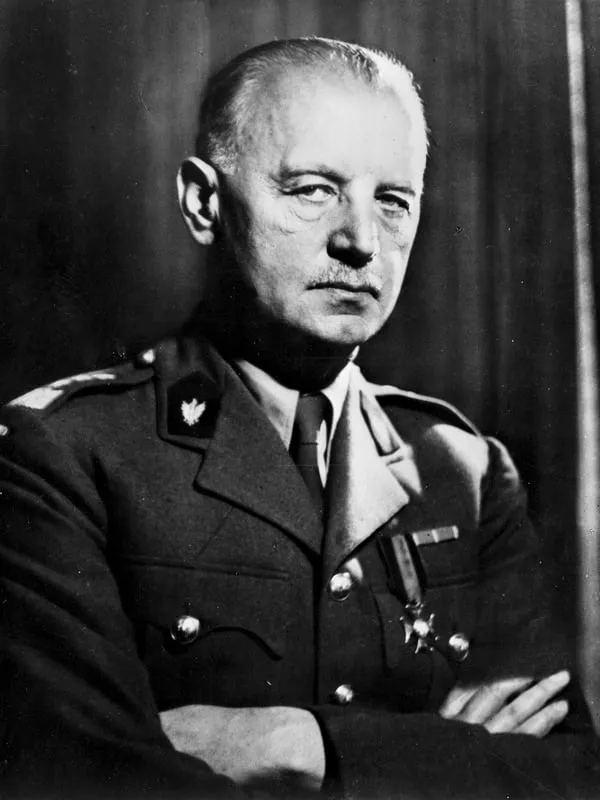
- Born:
- 20 May 1881, Tuszów Narodowy (Austria-Hungary)
- Died:
- 4 July 1943, Gibraltar
- Author:
- Łukasz
- Photo:
- Office of War Information, domena publiczna, Wikimedia Commons

Władysław Sikorski was the most important Polish leader of the first years of the Second World War. He began as a co-founder of the riflemen’s underground in Galicia and an organiser of the Legions; in 1920 he commanded an army in the Battle of Warsaw, and in 1922–1923 he was prime minister. After the May Coup he was pushed to the sidelines by Józef Piłsudski and his camp, and for a decade he warned against the resurgent power of Germany. After the defeat of September 1939 he took the helm of the government-in-exile and rebuilt the Polish Army, first in France and then in Britain. Thanks to him Poland remained in the war as an ally and not merely as an occupied country. He tried to settle relations with the Soviet Union, which in 1939 had invaded Poland together with Germany, and concluded an agreement with it that brought tens of thousands of Poles out of the Soviet labour camps. He was killed in an air crash at Gibraltar in July 1943, a few months after the Katyn massacre came to light and Moscow broke off relations.
Engineer and rifleman
He was born on 20 May 1881 in Tuszów Narodowy near Mielec, in Galicia, the son of a village schoolteacher and organist who died when Władysław was four. He attended the teachers’ seminary in Rzeszów and a grammar school in Lwów (Lviv), and then studied road and bridge engineering at the Lwów Polytechnic. As an engineer he worked on the regulation of the San river. In 1904–1905 he did one-year volunteer service in the Austrian army and became a reserve officer.
Around 1907 he drew close to the pro-independence wing of the socialist movement and met Piłsudski. In 1908 in Lwów he was one of the co-founders of the secret Union of Active Struggle, and in 1910 of the legal Riflemen’s Association. In the Provisional Commission of Confederated Independence Parties he was responsible for military affairs. The riflemen were to form the cadre of a future Polish army in a war between the partitioning powers.
The Legions and the break with Piłsudski
After the outbreak of war in 1914 Sikorski became head of the Military Department of the Supreme National Committee in Kraków, which organised the Polish Legions within the Austro-Hungarian army. He was in charge of recruitment, supply and training. In 1916 he parted ways with Piłsudski. The Commandant had concluded that without political concessions from the Central Powers no more Poles should be enlisted. Sikorski wanted to continue cooperating with Austria and to go on recruiting. After the oath crisis of 1917, when Piłsudski ended up in a German prison, Sikorski served in the Polish Auxiliary Corps. After the Treaty of Brest-Litovsk of February 1918, which handed the Chełm region to Ukraine, he protested and was interned by the Austrians. The conflict of 1916 weighed on relations between the two men for the rest of their lives.
The wars for the borders
In the autumn of 1918, as Austria-Hungary was falling apart, Sikorski built up Polish forces in Galicia on the orders of General Tadeusz Rozwadowski. In the Polish–Ukrainian War he commanded operational groups around Lwów. In the war against the Bolsheviks he commanded the 9th Infantry Division and the Polesie Group, in which one of the regimental commanders was Władysław Anders. On 6 August 1920, at the most critical moment of the war, he took command of the new Fifth Army, which was to defend the approaches to Warsaw north of Modlin, between the Narew and the Wkra. In the Battle of Warsaw his army held off the Soviet assault on the capital from the north and went over to the counter-attack on the Wkra before Piłsudski’s main blow from the Wieprz got under way. In those days he worked with the Allied mission that had arrived in Poland, which included General Maxime Weygand. He later described the battle in his book Nad Wisłą i Wkrą (“On the Vistula and the Wkra”). In 1921 he became Chief of the General Staff.
Prime minister and minister
On 16 December 1922, the day President Gabriel Narutowicz was assassinated, the Marshal (Speaker) of the Sejm, Maciej Rataj, entrusted him with the offices of prime minister and minister of the interior. Sikorski declared a state of emergency and brought the tension after the assassination under control. On 15 March 1923 his government secured recognition of Poland’s eastern borders by the Conference of Ambassadors, which closed the period of wars over the frontiers. He had no stable majority in the Sejm, however, and after the right and the peasant party concluded the Lanckorona Pact he stepped down at the end of May 1923. From February 1924 to November 1925 he was minister of military affairs in the government of Władysław Grabski and prepared laws on the organisation of the armed forces that limited the powers of the inspector general, which alienated Piłsudski still further. He then commanded the Corps District in Lwów.
On the sidelines
During the May Coup of 1926 Sikorski formally took neither side, although according to his associates he helped the government troops. The victors did not trust him. In 1928 he was relieved of command of the district, and until 1939 he remained a general “at the disposal” of the minister, without a posting. He spent much of his time in France, to which he was bound by friendships with French soldiers and politicians, and he wrote. In his 1934 book Przyszła wojna (“The Future War”) he predicted that the next war would be a war of manoeuvre, decided by armour and aircraft rather than by lines of trenches. In articles in the Kurier Warszawski he warned against the remilitarisation of Hitler’s Germany and the consequences of concessions by the Western powers. He advocated a close alliance with France.
In February 1936, together with Ignacy Jan Paderewski, General Józef Haller and Wojciech Korfanty, he formed at Paderewski’s Swiss villa the Front Morges, an alliance of the centre-right opposition against the Sanacja regime that called for democratisation and closer cooperation with France. Out of it grew, in 1937, the Labour Party. When in August 1939 war became inevitable, Sikorski asked Marshal Edward Rydz-Śmigły for a command at the front. He did not receive one.
Prime minister of the government-in-exile
After the German invasion of 1 September and the Soviet invasion of 17 September 1939, the Polish authorities crossed the Romanian border and were interned. Sikorski made his way through Romania to Paris. On 30 September 1939 the new president, Władysław Raczkiewicz, appointed him prime minister, and on 7 November he also became Commander-in-Chief. The government, based first in Paris and then in Angers, was recognised by France, Britain and the United States. It included men of the Front Morges, socialists, members of the peasant party and National Democrats from the camp of Roman Dmowski, as well as representatives of the Sanacja. In December 1939 the National Council, a substitute parliament, was set up with Paderewski as its chairman. The government regarded Germany as the main enemy, but also pledged to recover the lands seized by the USSR.
Sikorski rebuilt the army. By the spring of 1940 there were more than 80,000 Polish soldiers in France – volunteers from the émigré community and men who had escaped from Poland through Romania and Hungary. The Independent Podhale Rifles Brigade fought at Narvik, and two divisions in the defence of France. The fall of France in June 1940 was an immense shock to Sikorski, who had believed in its power all his life. On 19 June he met Prime Minister Winston Churchill in London and assured him that the Poles would fight at Britain’s side to the end. Part of the army was evacuated to Britain. Polish airmen took part in the Battle of Britain, in which No. 303 Squadron won fame, and the Polish navy fought in the Atlantic. In the Middle East the Independent Carpathian Rifles Brigade was formed, and in 1941 it helped defend Tobruk. In occupied Poland Sikorski was immensely popular, and people would say: “When the sun climbs higher, Sikorski draws nigher.”
The agreement with Moscow
As early as the summer of 1940 Sikorski believed that an understanding had to be sought with the Soviet Union, which sooner or later would clash with Germany. This view almost cost him his post: in July 1940 President Raczkiewicz tried to dismiss him and backed down only under pressure from the army and the National Council. After the German attack on the USSR on 22 June 1941 Sikorski decided that the time had come. Under pressure from the British, who were eager for a new ally, he negotiated with the Soviet ambassador in London, Ivan Maisky. On 30 July 1941 he signed the Sikorski–Maisky Agreement. The Soviet Union recognised that its treaties with Germany of 1939, including the Molotov–Ribbentrop Pact concluded by Vyacheslav Molotov, had lost their validity as regards territorial changes in Poland. It agreed to an “amnesty” for Polish citizens in prisons and labour camps and to the formation of a Polish army in the USSR.
The agreement did not, however, settle the eastern border, and the word “amnesty” implied that the Poles had committed some crime. In protest the foreign minister, August Zaleski, General Kazimierz Sosnkowski and Marian Seyda left the government. Sikorski, however, believed that every day of delay meant more victims among the hundreds of thousands of deportees. General Anders, released from the Lubyanka prison, became commander of the army in the USSR. At the beginning of December 1941 Sikorski flew to the USSR and held talks in the Kremlin with Joseph Stalin. Asked about the thousands of missing Polish officers, Stalin replied that they had probably fled to Manchuria. The meeting ended with a joint declaration of friendship and cooperation. In 1942, after disputes over supplies and the size of the army, Anders’s army was evacuated to Iran together with thousands of civilians. Sikorski regarded this as a necessary evil.
From the beginning of 1942 it was becoming clear that Stalin wanted to keep the lands seized in 1939 and shift Poland’s border westwards, to the so-called Curzon Line. Sikorski firmly refused any changes to frontiers during the war, invoking the Atlantic Charter and the Treaty of Riga. He travelled to Washington several times, where he held talks with President Franklin Delano Roosevelt. He also pressed for a post-war confederation with Czechoslovakia as a bulwark against Germany.
Katyn and Gibraltar
On 13 April 1943 the Germans announced that they had discovered mass graves of Polish officers in the Katyn forest near Smolensk. They were part of the Katyn massacre, in which the NKVD had murdered some 22,000 Polish prisoners of war and prisoners in the spring of 1940. Moscow blamed the Germans for the crime. Sikorski’s government asked the International Red Cross to investigate, and the USSR, accusing the Poles of collaborating with Hitler, broke off diplomatic relations with it on the night of 25–26 April 1943. Stalin began to create Polish bodies dependent on himself – the Union of Polish Patriots and the division of Zygmunt Berling. At the same time Sikorski’s dispute with Anders was growing; Anders regarded the policy towards Moscow as an illusion and in a letter to President Raczkiewicz argued for a change of government.
In the spring of 1943 Sikorski flew to the Middle East to inspect the army and calm the mood. On the way back, on 4 July 1943 at around 11 p.m., his Liberator aircraft plunged into the sea a dozen or so seconds after taking off from the airfield at Gibraltar. Sixteen people were killed, among them the general’s daughter Zofia and the Chief of Staff to the Commander-in-Chief, General Tadeusz Klimecki. Only the Czech pilot, Eduard Prchal, survived. A British court of inquiry established that the cause was a jammed elevator control, but did not explain how this had come about. The circumstances of his death quickly gave rise to speculation about an assassination – Soviet, British or Polish – for which no evidence has been found to this day. The investigation by the Institute of National Remembrance and the examination of his remains after their exhumation in 2008 ruled out the possibility that the general had been shot or strangled before the crash.
Sikorski was buried in the Polish airmen’s cemetery at Newark in England. In 1993 his remains were moved to the crypt of Wawel Cathedral.
Significance
Sikorski’s death was a blow to the Polish cause that no one was able to make good. His successors, Prime Minister Stanisław Mikołajczyk and Commander-in-Chief Sosnkowski, had neither his standing with the Allies nor his popularity at home. Four months later, at the Tehran Conference, Churchill and Roosevelt agreed with Stalin that Poland’s eastern border would run approximately along the Curzon Line. Historians argue over whether Sikorski, had he lived, could have changed this. Some believe that his policy towards Moscow was the only realistic attempt to save Polish independence; others that it was an illusion from the start.
Whatever the verdict in these disputes, it was Sikorski who ensured that after September 1939 Poland did not vanish from the theatre of war. It had a government recognised by the Allies, and an army, air force and navy that fought on until 1945. His life spans a whole era: from the riflemen’s conspiracy against Russia, through the war against the Bolsheviks and government in the reborn state, to the war that destroyed that state.
Sources
Commanded in battles
(02)Mentioned in battles
(07)Often appears with
People who appear in the same events.
On the timeline
(58)The 40 most important of 58 events. All tagged “Władysław Sikorski” (10) →
1920
1924
1939
September
October
- 06
- The surrender at KockOn 6 October 1939 General Kleeberg’s Polesie group laid down its arms near Kock – the last regular Polish Army formation still fighting in the 1939 campaign.
- Hitler offers peaceOn 6 October 1939 Hitler proposed a peace conference in the Reichstag if the West accepted the conquest of Poland, whose fate was for Germany and the USSR.