- Category:
- Military operations
- Front:
- Poland
- Date:
- 19 April 1943
- Author:
- Natalia
- Tags:
- Holocaust, resistance, Poland, Mordechai Anielewicz
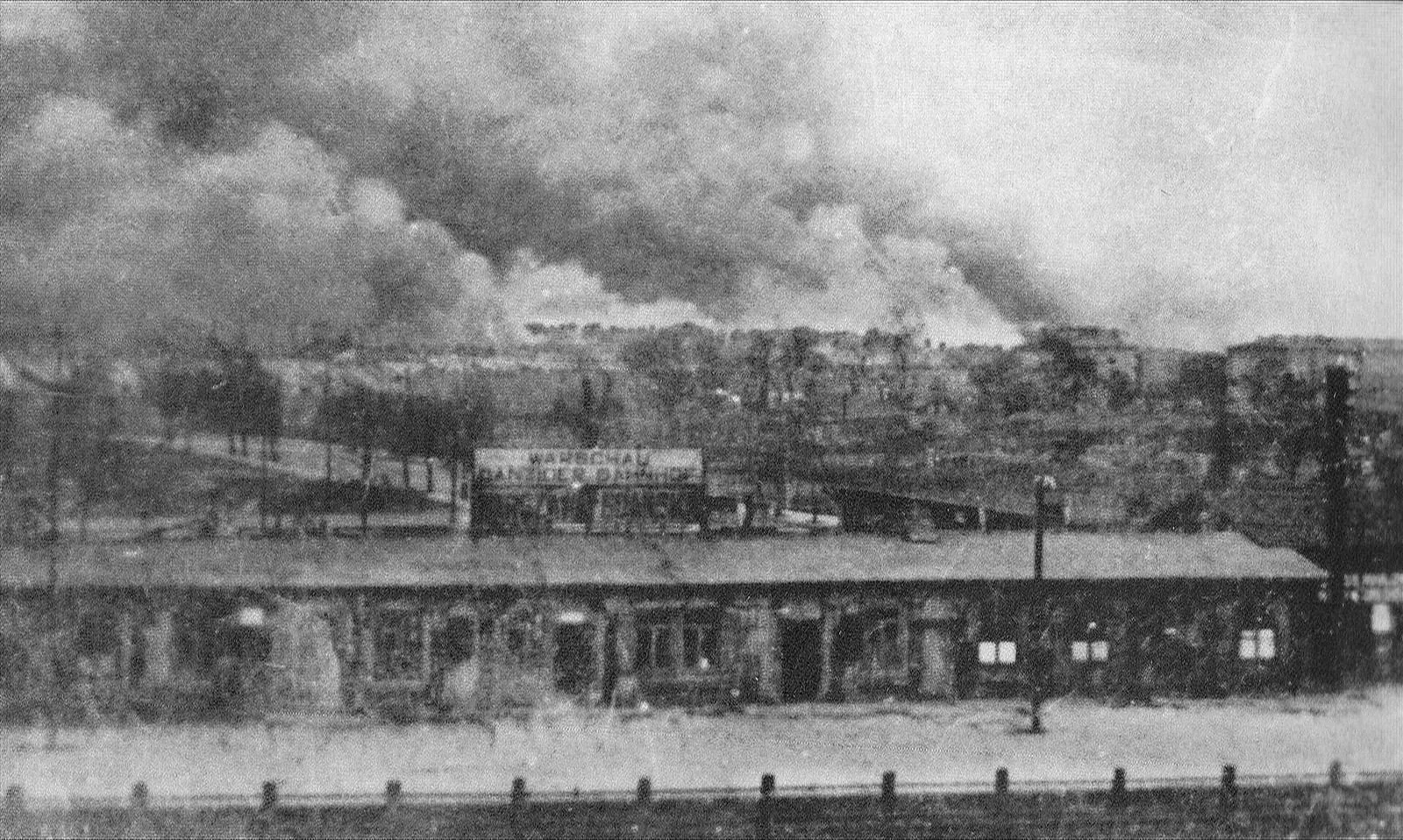
Before dawn on Monday 19 April 1943, German SS and police units entered the Warsaw Ghetto to deport its last inhabitants within three days. It was the day before Passover – that evening Jews were to sit down to the first Seder meal, commemorating the exodus from bondage in Egypt. Instead of obedient columns at the Umschlagplatz, the Germans found empty streets and fire from the windows. Fighters of the Jewish Combat Organisation (ŻOB), commanded by Mordechai Anielewicz, and of the Jewish Military Union (ŻZW) showered the advancing columns with grenades and petrol bombs and within a few hours forced them to withdraw. That morning Reichsführer-SS Heinrich Himmler removed the SS and Police Leader in Warsaw from command and entrusted it to Jürgen Stroop. Later the same day the Germans returned to the ghetto, better organised and with guns and armoured vehicles. So began the Warsaw Ghetto Uprising – the first urban uprising in German-occupied Europe.
The remnant ghetto
Of the almost half a million people the Germans had crammed behind the walls of the Warsaw Ghetto in 1940–1941, only a small proportion remained in the spring of 1943. About 100,000 had died of hunger and disease, and between 22 July and 21 September 1942, during the Great Deportation, some 265,000–300,000 had been sent to the gas chambers of Treblinka. According to various estimates, 50,000–70,000 people were left in the so-called remnant ghetto. Officially, about 35,000–40,000 lived there as workers in German workshops (the “shops”) and their families; the rest were hiding “wild”, without the right to be there.
After the Great Deportation the survivors had no more illusions about the meaning of the word “resettlement”. People who in the summer of 1942 had still believed they were being sent east to work were now building hiding places. Hundreds of shelters – known in the ghetto as bunkers – were built in cellars, under floors and behind false walls, often with ventilation and stores of food and water, sometimes connected to the sewers or the electricity supply. The best equipped were in Miła, Nowolipie, Leszno, Świętojerska and Franciszkańska Streets. The inhabitants’ plan for survival and the fighters’ plan for battle complemented each other: the fighters were to inflict losses on the Germans and delay the deportations, while the population was to vanish underground.
The first trial of strength came on 18–22 January 1943. When the Germans resumed deportations, the ŻOB opened fire for the first time and the inhabitants hid en masse in the shelters. The Germans deported about 5,000–6,000 people but broke off the operation after four days. The January self-defence changed the mood in the ghetto and the attitude of the Polish underground towards the Jewish fighters. From then on hardly anyone reported for deportation voluntarily.
Two organisations
The Jewish Combat Organisation was formed in July 1942, in the first days of the Great Deportation, on the initiative of left-wing Zionist youth movements (Hashomer Hatzair, Dror, Akiba), which in the autumn were joined by Bundists and communists from the Polish Workers’ Party. Its commander was the 23-year-old Mordechai Anielewicz; his deputy was Yitzhak Zuckerman, who in April was on the “Aryan” side as the organisation’s representative, and its staff included Marek Edelman of the Bund and Hersz Berliński of Poale Zion-Left. In the spring of 1943 the ŻOB had 22 fighting groups, with, according to various estimates, from about 220 to 500–600 fighters in all, many of them women. The groups were deployed in three areas: the central ghetto, the Többens and Schultz workshops on Leszno and Nowolipie Streets, and the brushmakers’ workshop on Świętojerska Street.
The Jewish Military Union grew out of the Revisionist Zionist movement and its youth wing, Betar. Its military commander was Paweł Frenkel, and its leadership included Leon Rodal and the physician Dawid Wdowiński. The Union numbered, according to estimates, from 150 to 250–400 people, but it was better armed, because it had money to buy weapons and its own contacts on the Polish side. Its main position was in the tenement houses on Muranowski Square (PL). The two organisations did not manage to merge – they were divided by politics and a dispute over who should be subordinate to whom – but they agreed on a division of the areas to be defended.
Their weapons were meagre. Each fighter usually had a pistol with a dozen or so rounds, a few grenades, many of them home-made, and petrol bombs. Rifles were rare, machine guns isolated. Some of the weapons came from the Home Army: its commander, Brigadier General Stefan Rowecki (“Grot”), recognised the ŻOB in November 1942, and after the January fighting the Home Army gave the organisation several dozen pistols, grenades and explosives, together with instructions for making incendiary bottles. The rest was bought on the black market, often at extortionate prices, with money levied from the ghetto’s wealthier inhabitants. The fighters knew they could not win. What mattered to them was that Jews should not go to their deaths without a fight, and “the choice of how to die”, as survivors later wrote.
Himmler’s order
The Germans had not given up their plan to liquidate the ghetto. On 16 February 1943 Himmler ordered the workshops and their workers to be moved to labour camps in the Lublin region and the district to be razed to the ground. The transfer to Trawniki and Poniatowa went badly, however: the ŻOB put up posters calling on people to refuse to leave, set fire to warehouses whose contents were to be shipped out, and carried out death sentences on Jewish Gestapo informers. In March and early April the ghetto already knew that the final operation was a matter of days.
The operation was prepared by the SS and Police Leader in the Warsaw District, SS-Oberführer Ferdinand von Sammern-Frankenegg. The Higher SS and Police Leader in the General Government, Friedrich Wilhelm Krüger, and Himmler, however, had no confidence in his abilities. On 17 April SS-Brigadeführer Jürgen Stroop arrived in Warsaw; until then an SS and police officer in the District of Galicia, he had earlier hunted partisans in occupied Ukraine. Formally he came as an observer, in practice as a ready replacement. According to an often repeated version not confirmed by documents, Himmler wanted the liquidation of the ghetto to be a “present” for Adolf Hitler’s 54th birthday on 20 April. Sammern assumed that three days would be enough.
The night before Passover
On the evening of 18 April, according to survivors’ accounts, a warning came from the Polish side that the operation would begin the next day. At about 2 a.m. the ghetto was surrounded by a tight cordon of German gendarmerie and police, supported by the Polish “Blue” Police. Anielewicz put the organisation on alert: the fighters took up their assigned positions at windows and in attics, while couriers went from house to house calling on the population to go down into the shelters. Slogans such as “To arms! Women and children to the shelters!” appeared on the walls. The ghetto, where preparations for the festival were to have begun, was suddenly deserted.
At about 6 a.m. (some sources give an earlier hour) two columns entered the ghetto: several hundred SS men from Waffen-SS reserve and training battalions, policemen and soldiers of auxiliary formations trained at the Trawniki camp, made up mainly of Ukrainians, as well as Latvian and Lithuanian policemen. They came in from Nalewki Street and through the gate at the corner of Zamenhofa and Gęsia Streets, bringing with them a captured French tracked vehicle and armoured cars. A vehicle with a loudspeaker called on the Jews to report for “resettlement”.
The first clashes
The column on Nalewki at the corner of Gęsia was met by fire from ŻOB groups in the windows of the tenements, by grenades and by petrol bombs. According to accounts, the fighting there lasted about two hours; the Germans, caught in a narrow street, suffered losses and withdrew beyond the gate. The second column was attacked at the junction of Zamenhofa (PL) and Miła (PL) Streets, where the groups fighting alongside Anielewicz himself were posted. The fighters set an armoured vehicle on fire and forced the attackers to flee. “The Germans ran away from the ghetto twice,” Anielewicz wrote a few days later in a letter to Zuckerman, smuggled out to the “Aryan” side. For people who for three and a half years had seen the Germans only as masters of life and death, it was a shock.
Sammern-Frankenegg reported the failure to Krüger in Kraków and, according to Stroop’s account, proposed calling in bombers. At about 8 a.m. Stroop, with the consent of Krüger and Himmler, took over command. Sammern was sidelined and later transferred to Croatia, where he was killed fighting Yugoslav partisans in September 1944. Stroop rejected the idea of bombing and reorganised his forces. Instead of round-ups in the streets, he decided to strike at the main centres of resistance, push the fighters into an ever smaller area and destroy their strongholds one by one.
Stroop returns to the ghetto
Before noon the Germans re-entered the ghetto, this time in smaller assault detachments covered by armoured vehicles and by the fire of guns positioned on Krasiński Square. They first attacked along Zamenhofa Street, where the fighters, after an exchange of fire, withdrew deeper into the blocks. Then they advanced on Nalewki; the ŻOB groups there held out, according to accounts, for about six hours before moving through attics and cellars to neighbouring buildings. SS men also burst into the hospital on Gęsia Street and, according to witnesses, murdered some of the patients who could not be hidden.
The heaviest fighting took place on Muranowski Square, where the ŻZW had a machine gun and well-prepared positions. The Germans failed to take it that day. In the first days of the uprising a blue-and-white flag and a white-and-red flag were hoisted over a tenement on the square, visible from the Polish side of the wall; tearing them down became a matter of prestige for Stroop, as he recounted in prison after the war. The details of the ŻZW’s fighting are far less well documented than those of the ŻOB – its commanders were killed, and many post-war accounts of the Union’s cooperation with Polish organisations turned out to be unreliable or invented – so historians present them with great caution.
At about 8 p.m. Stroop broke off the attack and withdrew his units behind the walls, strengthening the cordon. For the Germans the first day ended without a decision. Stroop reported a dozen or so killed and wounded on his side; Jewish sources and the Polish underground press spoke of several dozen killed. The reliability of these figures is limited on both sides, but it is known that Stroop’s reports understated his own losses. According to accounts, the ŻOB lost one fighter that day. In the undefended parts of the ghetto the Germans caught 580 people, who were earmarked for deportation.
Help from beyond the walls
On the evening of 19 April a unit of the Home Army’s Directorate of Diversion (Kedyw) under Captain Józef Pszenny (“Chwacki”) attempted to blow a hole in the ghetto wall on Bonifraterska Street to open an escape route for the fighters. The attempt failed: the sappers were spotted before they could breach the wall, and in the firefight with the Germans two Home Army soldiers were killed and several wounded. In the following days units of the Home Army and the communist People’s Guard attacked German posts and gun crews by the walls – on 20 April a People’s Guard group fired on an artillery position on Nowiniarska Street – while smaller socialist and democratic organisations tried to smuggle weapons into the ghetto. These actions were few and small in relation to the need; their scale and significance are disputed in the historiography, as is the question of whether the Polish underground could have done more. For the fighters, however, what mattered was that someone on the other side of the wall was fighting alongside them.
The following days
On 20 April the Germans returned to the ghetto at dawn. Their main target was the brushmakers’ workshop in the block bounded by Świętojerska, Wałowa, Franciszkańska and Bonifraterska Streets, defended by ŻOB groups under Marek Edelman. The fighters detonated a mine under a detachment entering through the workshop gate and rejected a German offer of a ceasefire to allow the inhabitants to be led out. Among those killed was Michał Klepfisz, who, according to Edelman, covered his comrades’ retreat by throwing himself at a German machine gun. On Muranowski Square the ŻZW held out, according to most accounts, until 21–22 April. Stroop soon realised that the fighters were avoiding open battle and that tens of thousands of people were sitting in shelters his men could not find. He therefore began cutting off water, electricity and gas, blowing up cellars and setting fire to buildings where he suspected bunkers.
On 23 April Anielewicz wrote Zuckerman a letter that became one of the most famous documents of the uprising: “Something has happened beyond our boldest dreams […]. The dream of my life has come true. Jewish self-defence in the ghetto has become a fact.” He also wrote that the fighters did not know how long they would hold out and that many of them would die.
Its place in the war
19 April 1943 was not yet the day of decision, but it was a turning point. A few hundred poorly armed civilians – most of them in their twenties – took up open battle with the SS in a great city and held up the German operation for a whole day. The uprising had no military objective and no chance of victory; it was a response to genocide and a choice to fight rather than wait passively for death. It broke out four months after the joint Allied declaration of 17 December 1942, in which the Allied governments condemned the extermination of the Jews, and on the same day that an Anglo-American conference on refugees opened in Bermuda – one that ended without any real help for those being murdered. That same evening in Belgium three young men stopped a transport carrying Jews to Auschwitz.
Stroop needed almost four weeks to crush the resistance. He systematically burned the ghetto building by building and drove people out of the shelters with smoke, tear gas and explosives. On 8 May the Germans surrounded the bunker at Miła 18, where Anielewicz and most of the ŻOB staff died; some of the surviving fighters, among them Edelman, who had survived in the bunker at Franciszkańska 22, escaped through the sewers to the Polish side on 10 May. On 16 May Stroop blew up the Great Synagogue on Tłomackie Street and reported: “Es gibt keinen jüdischen Wohnbezirk in Warschau mehr!” (“The Jewish residential district in Warsaw no longer exists!”). According to his report, more than 56,000 people were captured or killed; thousands died in the fighting and the fires, and most of the rest were deported to Treblinka and to camps in the Lublin region, where they were murdered in November 1943 in Operation Harvest Festival (Aktion Erntefest). The Warsaw Ghetto Uprising became the symbol of Jewish resistance during the Holocaust. In Poland its anniversary is marked every year on 19 April at the Monument to the Ghetto Heroes, and the date of Israel’s Holocaust Remembrance Day, Yom HaShoah, was chosen in the Hebrew calendar with reference to the uprising.
Places·Warsaw
Sources
Meanwhile
(04)Elsewhere, within a week.
- 18 April 1943 · PacificThe death of Admiral YamamotoOn 18 April 1943 American P-38 fighters shot down Admiral Yamamoto’s aircraft over Bougainville. The ambush was made possible by breaking a Japanese code.
- 18 April 1943 · MediterraneanThe Palm Sunday massacreOn 18 April 1943 US P-40s and British Spitfires shattered a Ju 52 formation off Cape Bon. The Axis air bridge to Tunisia began to collapse.
- 15 April 1943 · Western FrontThe raids on Stuttgart and PilsenOn the night of 14–15 April 1943 the RAF bombed Stuttgart. Two nights later a raid on the Škoda works at Pilsen missed its target, and 36 bombers were lost.
- 15 April 1943 · ScandinaviaFinland and peace with the USSRIn April 1943 Finland turned down an American offer to mediate peace talks with the USSR and announced it would continue its “defensive war”.
Related events
(04)The same battle, people or subject.
- 22 April 1943 · PolandThe burning of the Warsaw GhettoFrom 22 April 1943 Stroop burned the Warsaw Ghetto building by building. The ŻZW left Muranowski Square, but the ŻOB and those in bunkers fought on for weeks.
- 18 January 1943 · PolandThe first armed resistance in the Warsaw GhettoOn 18 January 1943 the Germans resumed deportations from the Warsaw Ghetto. ŻOB fighters first resisted with arms; after four days the action was halted.
- 16 May 1943 · PolandThe end of the Warsaw Ghetto UprisingOn 16 May 1943 Stroop blew up the Great Synagogue on Tłomackie and declared the Warsaw Ghetto at an end. His report listed 56,065 Jews “caught”.
- 16 August 1943 · PolandThe Białystok Ghetto UprisingOn 16 August 1943 the Germans began liquidating the Białystok ghetto. Several hundred poorly armed fighters resisted; their leaders died in the ghetto.