Germany
Jürgen Stroop
SS and Police Leader of the Warsaw District (1943), Higher SS and Police Leader in Greece (1943) and in Rhine-Westmark (1943–1945), SS-Gruppenführer
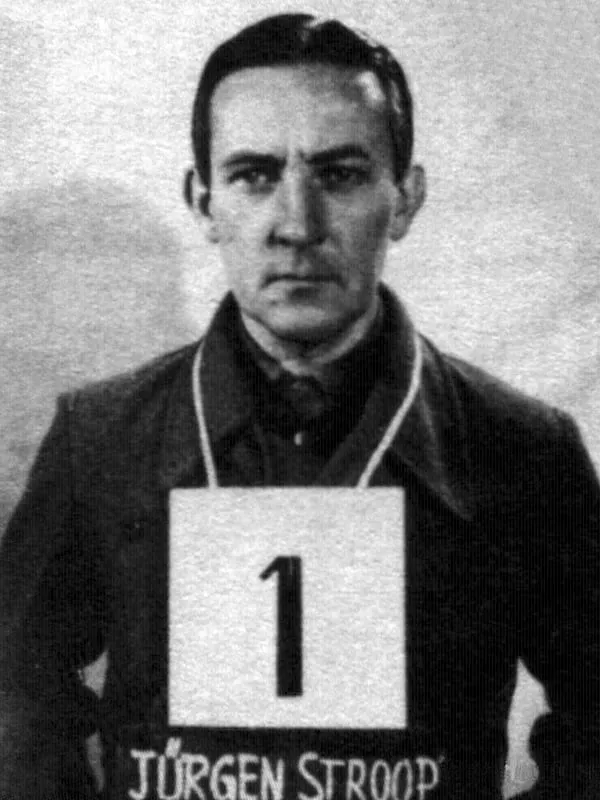
- Born:
- 26 September 1895, Detmold (Principality of Lippe, German Empire)
- Died:
- 6 March 1952, Warsaw
- Author:
- Łukasz
- Photo:
- autor nieznany, domena publiczna, Wikimedia Commons

Jürgen Stroop, until 1941 Josef Stroop, was a German SS and police general who went down in history as the butcher of the Warsaw Ghetto. In the spring of 1943, on the orders of Heinrich Himmler, he crushed the Ghetto Uprising in less than four weeks, burned the district down house by house and deported or murdered its last inhabitants. He described his work in an album for Himmler known as the Stroop Report – one of the most important documents of the Holocaust. He was neither an ideologue nor an outstanding commander but a zealous executor of orders, to whom National Socialism had given social advancement and power. After the war he was sentenced to death by both an American and a Polish court; before his execution he spent several months in the same cell as the Home Army soldier Kazimierz Moczarski, who recorded their conversations in one of the most important Polish books about Nazism.
A clerk from Detmold
He was born on 26 September 1895 in Detmold, capital of the small principality of Lippe, the son of a sergeant in the local police. The family was Catholic, and his mother very devout. He finished elementary school and trained at the local land registry office, where he worked as an assistant. He never acquired any higher education, a gap he later tried to make up for in his SS career with courses and ostentatious zeal.
During the First World War he volunteered for the army and fought on the Western Front, where he was wounded and in 1915 received the Iron Cross 2nd Class. He ended the war as a Vizefeldwebel (a senior sergeant). Back in Detmold he returned to the land registry office, was active in veterans’ organisations and married in 1923. As he recounted years later, under the influence of the writings of Mathilde Ludendorff, wife of General Erich Ludendorff, he abandoned Catholicism for a pseudo-Germanic religiosity; in SS documents he described himself as “gottgläubig” (“believing in God” outside the Churches).
SS career
He joined the SS on 1 July 1932 and the NSDAP on 1 September. During the campaign for the Lippe Landtag elections in January 1933, which the Nazis staged as a show of strength just before Hitler came to power, he caught the attention of party leaders, including Himmler, to whom he thereafter owed almost all his promotions and to whom he was blindly devoted. In March 1933 he became commander of the auxiliary police in Lippe, and later he worked on SS staffs in Münster and Hamburg. In 1938, by then an SS-Standartenführer, he entered the Sudetenland with SS units and served there in the Liberec (Reichenberg) area.
After the German invasion of Poland in September 1939 he became commander of the SS sector in Gniezno and then headed the Selbstschutz in Poznań – a formation of local ethnic Germans which in the autumn of 1939 took part in mass executions of the Polish intelligentsia and of Jews in the Warthegau. His part in these crimes was later one of the charges at his trial in Warsaw. In the summer of 1941 he fought on the Eastern Front with the SS Totenkopf Division. In May of that year he changed his first name from Josef to Jürgen – “for ideological reasons” and in memory of a son who had died in infancy.
In September 1942, promoted to SS-Brigadeführer, he was sent to occupied Ukraine, where as an inspector attached to the Higher SS and Police Leader “Russia South” and garrison commander in Kherson he fought partisans and oversaw security for the construction of the through road from Lwów to Donetsk (Durchgangsstraße IV), on which thousands of Jewish forced labourers died. In February 1943 he was transferred to Lwów (Lviv), where according to some sources he was acting SS and Police Leader of the District of Galicia. The liquidation of the ghettos was under way there at the time.
The Warsaw Ghetto
On 17 April 1943 Stroop arrived in Warsaw on the orders of Himmler and of the Higher SS and Police Leader in the General Government, Friedrich Wilhelm Krüger. Officially he was to assist the SS and Police Leader of the Warsaw District, Ferdinand von Sammern-Frankenegg, who was preparing the final liquidation of the ghetto. When on the morning of 19 April Sammern’s units entered the ghetto and were driven back by fighters of the Jewish Combat Organisation and the Jewish Military Union, Stroop took command. He had on average just over 2,000 men a day at his disposal: two Waffen-SS reserve battalions, the Order Police, Wehrmacht sappers and artillerymen, auxiliary formations trained at Trawniki, and officers of the Polish “Blue Police”, who manned the walls. Against them stood a few hundred poorly armed fighters and tens of thousands of civilians hiding in shelters.
After the first days, in which the fighters, avoiding open combat, kept inflicting losses on his units, Stroop changed his method. He ordered the water, gas and electricity to be cut off, and then had the ghetto set on fire block by block and the cellars in which people were hiding blown up. Shelters were located with dogs, listening devices and informers, and their occupants were smoked out with smoke, tear gas and explosive charges. Thousands of people died in the flames; many jumped from burning buildings. Those caught were shot on the spot or driven to the Umschlagplatz, from where they were deported to Treblinka and to the camps at Majdanek, Trawniki and Poniatowa. On 8 May his men surrounded the bunker at 18 Miła Street, in which the ŻOB commander Mordechai Anielewicz and most of his staff died.
On 16 May 1943 Stroop personally pressed the detonator button that blew up the Great Synagogue on Tłomackie Street, which stood outside the ghetto boundary. In his prison conversations he recalled the moment as a “wonderful sight” and a “fantastic spectacle”. That same day he reported to Krüger: “The Jewish residential district in Warsaw no longer exists!” By his count 56,065 Jews were captured or killed, of whom about 7,000 were killed in the course of the operation, and by his estimate a further 5,000–6,000 died in blown-up shelters and fires. He put his own losses at 16 killed and about 90 wounded – figures that historians and the accounts of his subordinates regard as understated.
The report, titled with the words of his final dispatch – “Es gibt keinen jüdischen Wohnbezirk in Warschau mehr!” – was bound on Stroop’s orders in black leather in three copies: for Himmler, for Krüger and for himself. It comprised 75 typewritten pages: a list of the forces employed, the daily dispatches and more than 50 photographs with handwritten captions. Among them is the picture of a boy with his hands raised, being led out of a hiding place with others at gunpoint – one of the best-known photographs of the 20th century. After the war the report served as evidence at the Nuremberg trial, and in 2017 it was inscribed on UNESCO’s Memory of the World Register. For the liquidation of the ghetto Stroop received the Iron Cross 1st Class on 18 June 1943, presented by Krüger at a ceremony in the Łazienki Park. As SS and Police Leader in Warsaw he was also responsible for executions of Poles, including the shooting of a hundred prisoners on 16 July 1943.
Greece and the Rhineland
In September 1943, after Italy’s capitulation, Himmler sent Stroop to Athens as Higher SS and Police Leader in Greece. Stroop brought the Greek police and the collaborationist Security Battalions under his control, and on 7 October 1943 he ordered all Jews in the territory under his authority to register – a step that preceded their later deportation to Auschwitz. His brutality and arrogance, however, set him at odds with the German civil and military authorities in Greece, who refused to cooperate with him. He was recalled as early as November and replaced by Walter Schimana. On 9 November 1943 Stroop was promoted to SS-Gruppenführer and Generalleutnant of Police.
From November 1943 until the end of the war he was Higher SS and Police Leader for the Rhine-Westmark region, based in Wiesbaden. After the failed attempt on Hitler’s life on 20 July 1944 he took part in the repression of the conspirators and those around them; in his conversations with Moczarski he also boasted of a role in the case of Field Marshal Günther von Kluge, though no other source confirms this. In the autumn of 1944 and the winter of 1945 nine downed and captured American airmen were murdered in his region – according to the prosecution, on the basis of his instruction that they were not to be treated as prisoners of war. According to some sources, in the last months of the war he was preparing the structures of the Werwolf sabotage movement in his region. On 8 May 1945 he was detained by the Americans in Bavaria; according to most accounts he was hiding under an assumed name as a Wehrmacht reserve officer.
Two trials
In 1947 an American military tribunal at Dachau tried Stroop and 21 of his subordinates for the killing of the airmen. Stroop denied giving any such orders and blamed his subordinates. On 21 March 1947 he was sentenced to death by hanging. The sentence was not carried out because, in line with earlier Polish requests, the Americans handed him over to Poland: at the end of May 1947 he was flown to Tempelhof airfield in Berlin and handed over to Polish officers.
He waited more than four years for his trial in Poland, for much of that time in the prison on Rakowiecka Street in Warsaw (today the Warsaw-Mokotów Remand Centre). The trial before the Warsaw Regional Court began on 18 July 1951 and lasted three days. Tried alongside him was Franz Konrad, an SS man responsible for the plundering of property from the ghetto. Stroop was charged with membership of the SS as a criminal organisation, the liquidation of the Warsaw Ghetto and the murder of tens of thousands of people, the shooting of a hundred Poles in July 1943 and participation in crimes against the civilian population in the Warthegau. On 23 July 1951 the court sentenced both defendants to death, stating that it had found no mitigating circumstances whatsoever in Stroop’s conduct. Stroop was hanged in Mokotów prison on 6 March 1952 at 7 p.m. According to prison accounts, he showed no remorse to the end.
Conversations with an executioner
Before the trial the communist authorities placed Stroop in the same cell as Kazimierz Moczarski, an officer of the Home Army’s Bureau of Information and Propaganda and of its Directorate of Underground Struggle, who had been imprisoned by the communist security service and tortured during interrogation, and with the Gestapo officer Gustav Schielke. According to Moczarski’s account in his book, they spent 255 days together, from 2 March to 11 November 1949; more recent research points rather to 1950. Why a hero of the underground was locked up with a German war criminal – whether to humiliate and break him, or by chance – is not known.
Stroop told his cellmates his whole life story: his childhood in Lippe, his cult of Himmler, the “beauty” of the SS and how he had burned the ghetto. Moczarski, a lawyer and journalist by training, memorised these conversations and, after his release in 1956 and his rehabilitation, checked them against documents and witnesses. He published extracts in 1967 in the weekly Polityka; the complete text, censored, was serialised in the monthly Odra in 1972–1974, and in 1977, after the author’s death, the book Conversations with an Executioner appeared. The full, uncensored edition was not published until 1992. The book is a penetrating portrait of an ordinary man whom the system turned into a mass murderer: Stroop emerges from it as a vain careerist, in love with uniforms and decorations, devoid of moral imagination and convinced to the end that his deeds had been right. In 1977 Andrzej Wajda staged an adaptation at the Teatr Powszechny in Warsaw, and in 2006 a television film version directed by Maciej Englert was made.
Significance
Stroop was one of many senior SS and police officers who carried out the policy of extermination in occupied Europe, but his name has become permanently linked with the best-known act of Jewish resistance during the war. It is ironic that his vainglorious album, prepared as proof of his own efficiency, became the principal German source for the history of the uprising and irrefutable evidence of the crime – at Nuremberg, in Warsaw and in the memory of the world. His daily dispatches, although they understated his own losses and portrayed the fighters as “bandits”, make it possible to reconstruct the course of the fighting day by day. Moczarski’s Conversations with an Executioner, for its part, made him, alongside Rudolf Höss, one of the best-documented cases of how an ordinary provincial clerk became an agent of genocide.
Sources
Often appears with
People who appear in the same events.