- Category:
- Crimes and repression
- Front:
- Poland
- Date:
- 16 August 1943
- Author:
- Natalia
- Tags:
- Holocaust, resistance, Poland, Odilo Globočnik
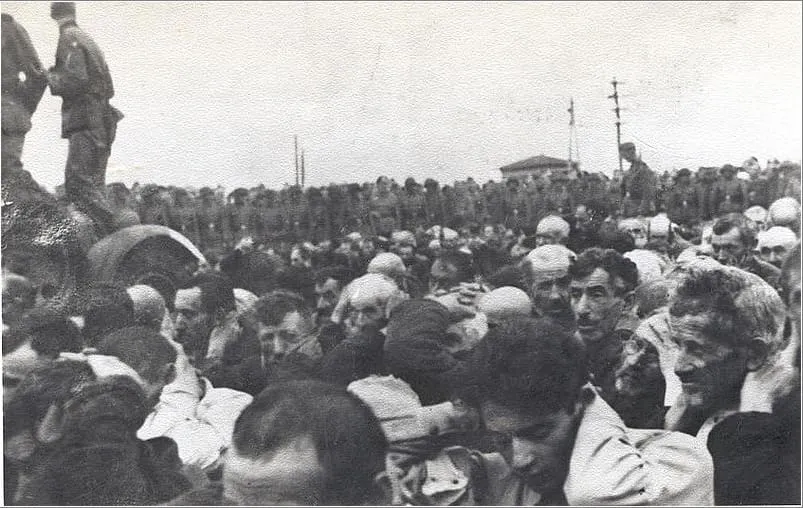
During the night of 15–16 August 1943 German police and SS units threw a cordon around the ghetto in Białystok. In the morning it was announced that all its inhabitants – some 30,000 people – were to report with their luggage to an assembly square, from where they would be “resettled”. For the Jewish underground this was the signal it had been awaiting for months. Several hundred young people, armed with about twenty-five rifles, about a hundred pistols and bottles of petrol and acid, attacked the Germans at the ghetto fence on Smolna Street. They wanted to breach it and lead as many people as possible out to the nearby Knyszyn Forest.
The plan failed. German superiority was overwhelming, and the weapons and ammunition were enough for a few hours’ fighting at most. Resistance at isolated points nevertheless continued for several more days. The leaders of the uprising, Mordechai Tenenbaum and Daniel Moszkowicz, died in the ghetto – according to the findings of post-war historians they took their own lives when their ammunition ran out. The ghetto ceased to exist, and its inhabitants were deported to camps where most of them perished. After the Warsaw Ghetto Uprising, the Białystok Ghetto Uprising was the largest armed Jewish revolt in occupied Poland.
Białystok before the war and under two occupations
In the interwar period Białystok was one of the largest centres of Jewish life in Poland. According to the 1931 census, Jews made up about 43 per cent of the city’s more than 91,000 inhabitants. Jewish entrepreneurs and workers built the textile industry that earned the city the nickname of “the Polish Manchester”, and the city had Jewish newspapers, schools, libraries, sports clubs and every party – from the Zionists to the Bund and the communists.
In September 1939 the city was briefly occupied by the Wehrmacht, which then handed it over to the Red Army under the German–Soviet agreements. Under Soviet rule Jewish businesses and organisations were closed down, and some of the inhabitants – Jews and Poles – were deported into the interior of the USSR. At the same time thousands of Jewish refugees poured into the city from the German occupation zone. Among them was a Warsaw communist, Daniel Moszkowicz, who was later to share command of the uprising.
German troops entered Białystok on 27 June 1941, in the first days of the Battle of Białystok–Minsk. That same day men of Order Police Battalion 309 began a massacre in the Jewish quarter. They herded men – by various estimates from 700 to more than a thousand – into the Great Synagogue and set it on fire with them inside. On that day, later called “Red Friday”, up to 2,000 Jews were killed in all. In July German police battalions shot thousands more men outside the city. According to approximate figures, more than 5,000 Jews were murdered in Białystok in the first weeks of the German occupation.
The ghetto, 1941–1943
At the end of July 1941 the Germans set aside a closed district for the Jews on both sides of the Biała river, and on 1 August they sealed it. More than 40,000 people found themselves inside, and soon, after transfers from the surrounding small towns, about 50,000. Białystok became the capital of Bezirk Bialystok, a district subordinated to the Oberpräsident of East Prussia, Erich Koch, rather than to the authorities of the General Government or the Reich Commissariat in the east. The ghetto was surrounded by a wooden fence topped with barbed wire, and the exits were guarded by Jewish police under German supervision.
The Judenrat was formally headed by Rabbi Gedalia Rosenman, but real power lay with the engineer Efraim Barasz (PL), a businessman and Zionist activist from Wołkowysk. Barasz staked everything on a strategy of “rescue through work”: dozens of workshops and factories – above all textile and shoemaking – were set up in the ghetto, working for the Wehrmacht. He reckoned that the Germans would not destroy a ghetto that was economically useful to them. For a time the calculation seemed sound: the Białystok ghetto survived longer than most ghettos in Poland, although in the autumn of 1941 the Germans expelled some 4,500 of the poorest inhabitants to Prużany, and food rations fell to 300 grams of bread a day.
These hopes proved illusory. On 5–12 February 1943 the Germans carried out the first great deportation action. About 10,000 people were sent to the Treblinka extermination camp, and between several hundred and 2,000 people – depending on the source – were killed on the spot, mostly the sick and the weak. Barasz, who supplied the lists of deportees, believed that by giving up some people he would save the rest. After the February action some 30,000 Jews remained in the ghetto, most of them employed in workshops working for the army.
The underground in the ghetto
The underground in the Białystok ghetto grew out of two milieux. The first was the communists and their sympathisers, grouped in the Anti-Fascist Organisation, in which Moszkowicz was active. The second was the youth of the Zionist organisations: the left-wing Hashomer Hatzair, Dror (PL) and Hechalutz, as well as the right-wing Betar. The two groups differed not only in ideology but also in their aims. The communists wanted above all to lead people out to the forest and fight as partisans alongside Soviet units; the Zionists inclined towards fighting in the ghetto itself, in defence of dignity, even without any chance of survival.
The key figure became Mordechai Tenenbaum, an activist of Frayhayt and Hechalutz born in Warsaw in 1916. After the outbreak of war he made his way to Wilno (Vilnius), where he organised aid for Jews, and he travelled around the occupied country on the false papers of a Tatar, Yusuf Tamaroff. In 1942 he returned to Warsaw with news of mass murders in the east. After the Great Deportation the Jewish Combat Organisation (ŻOB) decided to prepare resistance in other ghettos too, and in the autumn of 1942 it sent him to Białystok. His models were both the Warsaw ŻOB and the Wilno FPO.
Tenenbaum established cautious cooperation with Barasz, who kept him informed of German intentions but tried to the end to save the ghetto through concessions and did not want to allow any action that would give a pretext for its destruction. On Tenenbaum’s initiative an underground ghetto archive was set up, modelled on Emanuel Ringelblum’s Warsaw archive: it collected documents of the Judenrat and the German authorities, testimonies and diaries. The Underground Archive of the Białystok Ghetto (PL) was hidden before the liquidation and found after the war; today it is one of the most important sources for the history of the ghetto.
The underground collected weapons with great difficulty. They were bought from peasants and smugglers, stolen from German depots where Jews worked, and some were made in the ghetto. Contact with the outside world was maintained by young women of “Aryan” appearance living outside the ghetto on false papers – among them Chaika Grossman, who survived the war and later became a member of the Israeli Knesset. These couriers carried weapons, money and messages, and after the uprising they helped survivors to hide and made contact with the partisans.
During the February 1943 action the underground was unable to mount organised resistance. There were only isolated acts of defiance. The best known was that of Yitzhak Malmed, who threw acid over a German soldier; in reprisal the Germans shot dozens of people and hanged Malmed himself, who had given himself up. February made the underground realise that, divided into rival groups, it risked being unable to oppose the next action at all. Under the impact of news of the fighting in the Warsaw ghetto, the two groups joined forces under a common command in the summer of 1943; Polish historiography calls this organisation the Anti-Fascist Fighting Organisation. Tenenbaum became its commander, Moszkowicz his deputy. A group of fighters had already left for the forest and formed a Jewish partisan unit, Forois (Yiddish for “Forward”).
The decision to liquidate
In the summer of 1943 Heinrich Himmler was pressing for the liquidation of the last large ghettos in the occupied east, including those in which Jews worked for the military. After the experience of Warsaw, where resistance had lasted almost a month, the SS had no intention of giving the fighters time to prepare a defence. The liquidation of the Białystok ghetto was entrusted to Odilo Globocnik, SS and Police Leader in the Lublin district, who directed Operation Reinhard – the extermination of the Jews of the General Government. Globocnik brought men from his Lublin staff to Białystok. The forces assembled for the action consisted of units of the German Order Police and Security Police and of auxiliary formations made up of Ukrainians, Latvians and other foreigners, including men trained at the SS camp at Trawniki (PL). The Germans had artillery and at least one tank or armoured vehicle.
This time the Germans made sure of surprise. They occupied the workshops in the ghetto so that they would not become strongpoints as in Warsaw, and ordered the inhabitants to gather at an assembly square on the other side of the Biała river, where the houses were mostly wooden.
The fighting of 16–20 August
The plan of the uprising was drawn up by Moszkowicz. Combat groups were to strike simultaneously at several points – on Fabryczna, Nowogródzka, Chmielna and Ciepła Streets – to draw off German forces, while the main blow on Smolna Street was to break through the fence at the point closest to the forest. Not only the fighters but also the crowd gathered on the square were to escape through the breach. The organisers hoped that the ghetto’s inhabitants, knowing where the transports led, would join the rising.
On the morning of 16 August, as people were walking with their bundles to the assembly point, the fighters opened fire. They set buildings alight to screen themselves with smoke and threw petrol bombs and grenades. On Smolna Street they managed to break through the fence for a short time, but the breach came under heavy machine-gun fire. According to Polish sources the fighters had in all about 25 rifles, about a hundred pistols, one or two machine guns and home-made grenades. The number of combatants is estimated at 300–500. Most of the crowd did not follow them – people were exhausted and terrified, and many still believed they were going to labour camps. Some Jews themselves put out the fires.
By evening the main resistance had been broken. The Germans drove the ghetto’s inhabitants to the Białostoczek district, where trains were waiting. Groups of fighters, however, went on defending themselves in houses and bunkers around Smolna, Chmielna and Ciepła Streets. The Germans burned down one block after another and blew up hiding places. According to the United States Holocaust Memorial Museum in Washington, 71 fighters found in one of the bunkers were captured and shot. Organised resistance died out on 20 August; on that day the Germans declared the action over, although they went on hunting down individual people in hiding for weeks afterwards.
The circumstances of the deaths of Tenenbaum and Moszkowicz long remained unknown, because no one from the commanders’ immediate circle survived. The historian Szymon Datner, himself an escapee from the Białystok ghetto and a partisan, established on the basis of witness accounts that both men took their own lives when their ammunition was exhausted and further defence had become impossible. This version became accepted in the literature, although to this day it rests on indirect accounts.
Several dozen fighters – according to some sources about 150 – managed to get out of the ghetto and reach the Knyszyn Forest. There they joined the Forois group and formed the Jewish partisan unit Kadima, which at the end of 1943 became part of a Soviet partisan brigade.
The deportations
The uprising did not halt the deportations. Transports left Białystok from 17 August. According to Polish studies, at least 30,000 people were deported in all; other estimates are lower, because some of the inhabitants died in the ghetto or were deported later. The trains were sent to Treblinka, where the new arrivals were murdered in the gas chambers immediately, to the Majdanek concentration camp (KL Lublin), where selections were carried out, and to Auschwitz-Birkenau. Those fit for work were moved from Majdanek to camps at Poniatowa, Bliżyn and Auschwitz. The transports from Białystok were among the last to reach Treblinka – only two weeks earlier, on 2 August, the camp’s prisoners had staged a revolt there, and the Germans were already preparing to dismantle it.
The children met a separate fate. About 1,200 children from the ghetto, accompanied by several dozen adults, were sent to the Theresienstadt ghetto in the Protectorate of Bohemia and Moravia, where they were held in isolation from the other prisoners. According to researchers at Terezín, there was a plan to exchange them for Germans interned by the Allies or to let them leave for Palestine. On 5 October 1943, however, the children and their carers were sent to Auschwitz, where all of them were murdered.
Efraim Barasz and the members of the Judenrat were deported together with the other inhabitants; the circumstances of Barasz’s death are not known precisely, and he probably died in the autumn of 1943. The Germans kept several thousand people for a few more weeks in the so-called small ghetto and then sent them to Majdanek. Most of the Białystok Jews who ended up in labour camps in the Lublin region were killed on 3–4 November 1943 in the mass executions the Germans called “Erntefest” (“Harvest Festival”). The Germans allocated the empty flats of the former ghetto to Polish families expelled from Białowieża and the surrounding area.
Significance
The Białystok Ghetto Uprising had no chance of success, and its participants knew it. For Tenenbaum, as earlier for Mordechai Anielewicz in Warsaw, the fight was above all a choice of how to die and a testimony that the Jews had not gone to their extermination without resistance. Barasz’s conduct and his strategy of “rescue through work” are still debated – some see in it a tragic attempt to save at least some of the people, others a submissiveness that made the Germans’ task easier. Scholars comparing the ghettos in Minsk, Kraków and Białystok point out that uprisings broke out where the Zionist underground was strong and managed to carry the communists with it.
For the Germans, the liquidation of the Białystok ghetto was part of the final stage of the extermination of the Jews in Poland. After Warsaw and Białystok came the turn of the Wilno ghetto, liquidated in September 1943. In the autumn, after the revolt of the Sobibór prisoners in October, the Germans closed the Operation Reinhard camps and erased their traces, and the November “Erntefest” ended the existence of the large labour camps for Jews in the Lublin region.
Of the roughly 50,000–60,000 Jews who had lived in and around Białystok before the war, only a few hundred – according to various estimates – survived: about 200 survivors of the camps, a few dozen who had hidden on the “Aryan” side, some of them with the help of Polish families later honoured as Righteous Among the Nations, and about 60 partisans. The Red Army entered Białystok on 27 July 1944. Tenenbaum’s archive, dug up after the war, and the accounts of the couriers and partisans made it possible to reconstruct the history of the ghetto and the uprising. Tenenbaum and Moszkowicz were posthumously awarded the Cross of Grunwald, and a square in Białystok on the site of the former ghetto now bears Tenenbaum’s name.
Places·Białystok
Sources
Meanwhile
(04)Elsewhere, within a week.
- 17 August 1943 · Western FrontOperation HydraOn the night of 17–18 August 1943 nearly 600 RAF bombers attacked the rocket centre at Peenemünde. About 700 people died, most of them forced labourers.
- 15 August 1943 · PacificThe landing on Vella LavellaOn 15 August 1943 the Americans bypassed strongly held Kolombangara and landed on weakly held Vella Lavella – the first deliberate “leapfrog” in the Solomons.
- 17 August 1943 · Western FrontThe Schweinfurt–Regensburg raidOn 17 August 1943 376 US B-17s attacked the Schweinfurt ball-bearing plants and the Messerschmitt works at Regensburg by day. Sixty bombers did not return.
- 17 August 1943 · DiplomacyThe Azores AgreementOn 17 August 1943 Salazar, invoking the alliance of 1373, gave Britain the use of ports and airfields in the Azores. Neutral Portugal leaned towards the Allies.
Related events
(04)The same battle, people or subject.
- 16 May 1943 · PolandThe end of the Warsaw Ghetto UprisingOn 16 May 1943 Stroop blew up the Great Synagogue on Tłomackie and declared the Warsaw Ghetto at an end. His report listed 56,065 Jews “caught”.
- 14 October 1943 · PolandThe Sobibór uprisingOn 14 October 1943 prisoners of the Sobibór death camp killed a dozen or so SS men and guards. About 300 escaped to the forest; a few dozen survived the war.
- 3 November 1943 · PolandOperation Harvest FestivalOn 3–4 November 1943 the SS and police shot about 42,000 Jews at Majdanek, Trawniki and Poniatowa – the last forced labourers of the Lublin region.
- 19 November 1943 · PolandThe Janowska camp uprisingOn 19 November 1943 the Germans murdered the Jewish prisoners of the Janowska camp in Lwów. That evening the “Death Brigade” of Sonderkommando 1005 revolted.