Equipment
The Junkers Ju 52 "Tante Ju"
A three-engined airliner that became the Luftwaffe's workhorse: it carried Franco's troops, paratroopers to Crete and supplies to Stalingrad.
- Role:
- transport aircraft
- State:
- Germany
- Maker:
- Junkers
- First flight:
- 13 October 1930
- Built:
- about 4,800
- Author:
- Łukasz
- Updated:
- 1 November 2026
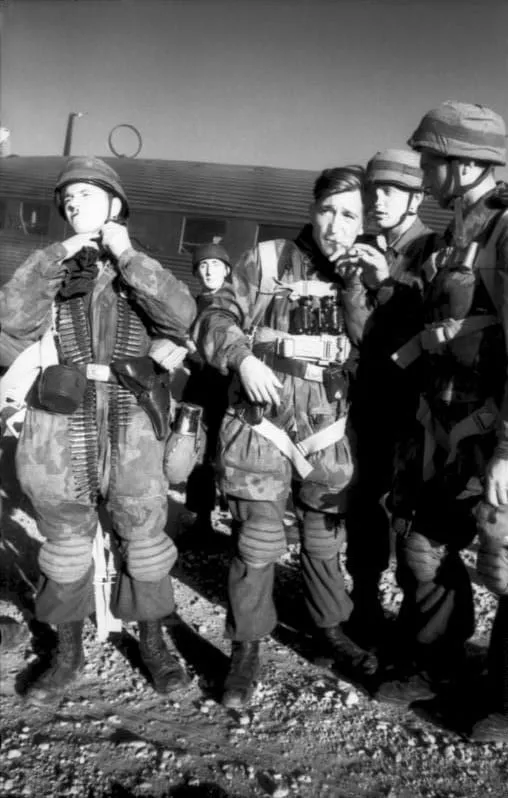
The Junkers Ju 52 was neither fast nor modern: three radial engines, a fixed undercarriage and a corrugated-metal fuselage like the Junkers aircraft of the First World War. But it was reliable, easy to maintain and able to land on almost any meadow, so it became the Luftwaffe’s standard transport. Without it there would have been no airlift to save Franco’s coup, and no airborne landings in Norway, the Netherlands and Crete. And when Hitler ordered encircled armies to be supplied from the air, the Ju 52 was given tasks beyond its powers, and its losses at Stalingrad and over Tunisia were the losses of the entire German air transport force.
From the airlines to the Luftwaffe
The aircraft was designed by Ernst Zindel’s (PL) team at Hugo Junkers’ works in Dessau (PL). The first example, with one engine, flew on 13 October 1930, but it proved underpowered, and after a few examples the company switched to three engines. The Ju 52/3m first flew on 7 March 1932 and soon became one of Europe’s most popular airliners: it took seventeen passengers and flew in the colours of Germany’s Luft Hansa and nearly thirty airlines in all, from Switzerland to China and South America. Hitler used one in the 1932 election campaign, and as chancellor he was given his own Junkers, flown by his personal pilot Hans Baur. The Germans called the aircraft “Auntie Ju” (Tante Ju).
In 1934 the still-secret Luftwaffe ordered a bomber version. It was meant to serve only until proper bombers were ready, but for several years it was the backbone of the German bomber force, and according to some counts several hundred were delivered by 1935. The bomber was easily converted into a transport, and it was this ability that decided its fate.
Spain and the first airlift
In July 1936 the rebel troops of General Francisco Franco were stuck in Morocco, because the Republican fleet was blockading the Strait of Gibraltar. By the end of the month the first Ju 52s, with Lufthansa and Luftwaffe crews, had arrived at Tetuán, and in August there were about twenty. According to German figures, by October they had carried well over ten thousand soldiers with their weapons to Seville and Jerez. It was the first airlift on such a scale, and without it, in the view of historians of the civil war, the coup might have ended in defeat. Afterwards Ju 52s flew as bombers with the Condor Legion; three squadrons of them carried out the heaviest part of the raid on Guernica. By the end of 1937 they were considered obsolete as bombers and were replaced by newer types.
Airborne landings 1939–1941
In September 1939 Ju 52s carried supplies behind the advancing divisions, and during the raids on besieged Warsaw they were also used to drop incendiary bombs. The real test, however, came in the spring of 1940. On 9 April paratroopers from Ju 52s seized the airfield at Aalborg, and the same day dozens of transports flew troops and fuel through occupied Denmark to Norway, where they landed at the airfields of Oslo and Stavanger. The Norwegian campaign cost them about 150 aircraft. On 10 May more than forty Ju 52s towed the gliders carrying the sappers who took Fort Eben-Emael, and hundreds more dropped Kurt Student’s paratroopers and landed infantry around The Hague. Dutch anti-aircraft fire and the fighting on the airfields destroyed or badly damaged, by most counts, about half of the 430 transports used in the Dutch campaign.
In the winter of 1940–41 the Germans lent the Italians several dozen Ju 52s, which flew reinforcements from Apulia to Albania. The peak, and at the same time the end, of the great airborne landings came in May 1941 on Crete. More than 500 Junkers carried paratroopers, gliders and a mountain division to the island, landing under fire at Maleme airfield. The Germans took Crete, but between about 170 and more than 270 Ju 52s were destroyed or badly damaged, depending on the count, and the paratroopers’ losses convinced Hitler that such an operation could not be repeated. The plan for a landing on Malta, for which some 500 Ju 52s were to be used, was shelved for good in 1942.
Airlifts and their cost
On the Eastern Front the Ju 52 became the aircraft of the encircled. In the winter of 1942 transports supplied the troops trapped at Demyansk for several months, and the success of that operation emboldened Göring and Hitler to make promises that could not be kept. At Stalingrad the airlift was supposed to deliver at least 300 tonnes a day; a Junkers carried about two tonnes, and the average came to about a hundred tonnes. According to the most often cited figures, 266 Ju 52s were lost there between 24 November 1942 and the end of January 1943, many of them with instructors taken from the flying schools.
A few months later a similar disaster struck them over the Mediterranean. From November 1942 Ju 52s flew from Sicily to Tunisia dozens of times a day, and at the beginning of April 1943 as many as a hundred and fifty, low over the water and in large formations. From 5 April Allied fighters hunted them for two weeks, and on 18 April, Palm Sunday, they broke up a formation of about 65 Junkers: according to Luftwaffe records 24 were shot down and 35 damaged aircraft crash-landed in Sicily. After that spring the German air transport force never regained its former strength.
Yet the Ju 52s flew to the end. In November 1943 they dropped paratroopers in the battle of Leros, and in February 1944 they flew the wounded out of the Korsun pocket until the field airstrip had to be abandoned. In June 1944 General Eduard Dietl was killed in the crash of a Ju 52 in Styria. Production in Germany ended in 1944. Sources give a total of between 4,835 and 4,845 aircraft, and it is not always clear whether they include machines built outside Germany. After the war Ju 52s were still built in France and Spain, and the Swiss Air Force flew them until 1982.
Sources
Battles
(04)- 17 July 1936 – 1 April 1939The Spanish Civil WarFrom July 1936 to April 1939 Franco's Nationalists, backed by Germany and Italy, fought the Soviet-supported Republic. Hundreds of thousands died.
- 10–17 May 1940Dutch CampaignFrom 10 to 17 May 1940 Germany conquered the Netherlands. The airborne assault on The Hague failed, but after Rotterdam was bombed the Dutch army surrendered.
- 20 May – 1 June 1941Battle of CreteFrom 20 May 1941 German paratroopers and mountain troops took Crete in twelve days. Maleme won them the battle, but their losses put Hitler off airborne drops.
- 17 November 1942 – 13 May 1943Tunisian campaignNovember 1942 – May 1943. After a winter stalemate, Kasserine and Mareth, the Allies took Tunis and Bizerte, and the Axis lost its last army in Africa.
In the chronicle
(21)1940
- 9 April 1940Germany invades Norway
- 9 April 1940Germany occupies Denmark
- 16 April 1940The fighting for Trondheim
- 10 May 1940Germany attacks in the West
- 10 May 1940The capture of Fort Eben-Emael
- 10 May 1940The Battle for The Hague
- 14 June 1940The shooting down of the Kaleva
- 30 June 1940The Germans occupy the Channel Islands
- 22 November 1940The Greeks take Korçë
- 8 December 1940The Greeks take Gjirokastër
- 28 December 1940Italy asks Germany for help