Germany
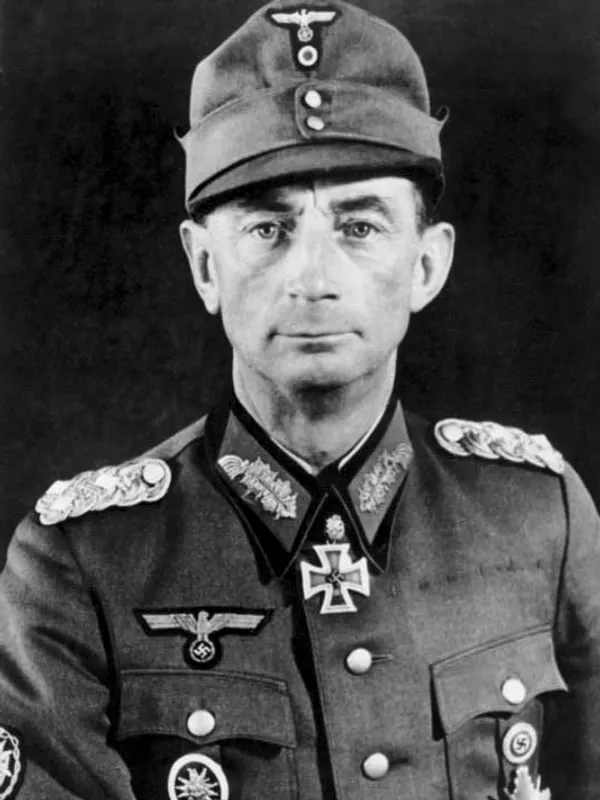
Eduard Dietl
Commander of the 3rd Mountain Division (1938–1940), commander of Mountain Corps Norway (1940–1942), commander of the 20th Mountain Army (1942–1944), Colonel General (1942)
- Born:
- 21 July 1890, Bad Aibling (Bavaria, German Empire)
- Died:
- 23 June 1944, Hochwechsel near Waldbach (Styria, Third Reich)
- Author:
- Natalia
- Photo:
- Bauriedl, CC BY-SA 3.0 DE, Wikimedia Commons

Eduard Dietl was one of the few Wehrmacht generals who had known Adolf Hitler since the first months of his political career in Munich, and one of the most popular commanders of the Third Reich. In the spring of 1940 his mountain troops seized the Norwegian port of Narvik, the outlet for Swedish iron ore, and then for two months, cut off from supplies, held out in the mountains against Norwegian, British, French and Polish forces several times their number. Propaganda made him “the hero of Narvik”, and Hitler made him the first soldier of the Wehrmacht to receive the Oak Leaves to the Knight’s Cross. For the next four years Dietl commanded German forces in the far north, where he failed to take Murmansk. He was killed in an air crash in June 1944. He was a convinced National Socialist, and historians point to his responsibility for crimes committed by troops under his command.
A Bavarian officer
He was born on 21 July 1890 in Bad Aibling in Upper Bavaria, the son of a tax official. He passed his Abitur in 1909 at the grammar school in Rosenheim. On 1 October 1909 he joined the 5th Infantry Regiment of the Bavarian army in Bamberg as an officer cadet, and after the war school in Munich he was commissioned as a second lieutenant in October 1911.
In the First World War he fought on the Western Front as commander of a machine-gun platoon, battalion adjutant and later regimental and brigade adjutant. He was wounded several times, first in October 1914 and last in October 1918. He received both classes of the Iron Cross. He ended the war as a lieutenant.
With Epp and Hitler
In the spring of 1919 Dietl joined Colonel Franz von Epp’s Freikorps as a company commander and in May took part in the bloody crushing of the Bavarian Soviet Republic in Munich. He passed with his unit into the provisional Reichswehr, in which he became a captain in August 1919.
In this milieu he met Hitler, then an informant and propagandist for the Reichswehr run by Captain Karl Mayr. Through Ernst Röhm Dietl joined the German Workers’ Party, the forerunner of the NSDAP, and was one of its first members, with membership card number 524. He soon left it, because serving officers were not allowed to belong to a party, but he remained attached to the movement and to Hitler. German stories that it was Dietl who recommended Hitler as a speaker to the troops are not borne out by the documents. All that is certain is that in his funeral oration in 1944 Hitler recalled that Dietl had allowed him to address his company.
As a company commander in the 19th Infantry Regiment, Dietl took part in the Bavarian right’s conspiracies against the Republic. From the spring of 1923 he gave military training to the party’s Munich storm troops, the SA. He was not let in on the preparations for the Munich Putsch, but on 8 and 9 November 1923 he refused to use his company against the putschists. A regimental board found no insubordination, since he had received no explicit order, but he was transferred to the Ohrdruf training ground in Thuringia.
Creator of the mountain troops
In the mid-1920s Dietl taught tactics at the infantry school in Munich and then returned to the 19th Regiment, whose III Battalion was a mountain unit. In 1926 he married Gerda-Luise Haenicke, a general’s daughter, with whom he had four children. He was a keen skier and mountaineer who competed in races, and in 1931 he became one of the first Reichswehr officers to qualify as an army mountain guide. In February 1930 he was promoted to major, and in 1931 he took over the regiment’s mountain battalion in Kempten.
Hitler’s rise to power accelerated his career. In 1933 he was a lieutenant colonel, and on 1 January 1935 a colonel. He helped organise the Winter Olympics at Garmisch-Partenkirchen in 1936. In October 1935 he took command of the 99th Mountain Infantry Regiment in Füssen. After the Anschluss of Austria, on 1 April 1938 he was promoted to Generalmajor and given command of the 3rd Mountain Division, then being formed in Graz, made up mainly of former Austrian army soldiers from Styria and Carinthia. His chief of staff was the Austrian Julius Ringel. In October 1938 the division occupied part of the Sudetenland around Znojmo without a fight.
In September 1939 the 3rd Mountain Division took part in the invasion of Poland as part of the 14th Army. On 1 September it advanced from Slovakia across the Tatra borderland, and its 139th Regiment supported the 4th Light Division’s march on Kraków for several days. After only two weeks the division was withdrawn and moved west to the French border.
Narvik
At the beginning of 1940 Hitler personally decided that Dietl would lead the landing at Narvik, the most distant objective of Operation Weserübung. On 1 April he promoted him to Generalleutnant. About 2,000 men of the 139th Mountain Infantry Regiment and the divisional staff sailed in ten destroyers under Commodore Friedrich Bonte, with Dietl aboard the flagship. On the morning of 9 April, as the Wehrmacht invaded Norway, the destroyers sank two Norwegian coastal defence ships in the fjord, and the commander of the Narvik garrison, a sympathiser of Vidkun Quisling’s party, surrendered the town without a fight after talking with Dietl. That same day the mountain troops seized the Norwegian arms depots at Elvegårdsmoen.
The success was short-lived. The destroyers, which had not had time to refuel, were struck by two British attacks: on 10 April Captain Warburton-Lee’s flotilla sank two of them, along with a ship carrying ammunition and heavy equipment for Dietl, and on 13 April a force including the battleship Warspite destroyed the remaining eight. Dietl was cut off from the sea in northern Norway, but he gained some 2,600 shipwrecked sailors, whom he armed with captured Norwegian weapons and incorporated into the defence. Over the following weeks he received only small reinforcements flown in by air, including paratroopers. When, after the second battle, Hitler in a fit of nerves wanted to order him to cross into Sweden and accept internment, OKW staff officers held the order back.
Facing Dietl were General Carl Gustav Fleischer’s Norwegian 6th Division, the British, who had been landing at Harstad since mid-April, and later French Chasseurs Alpins and legionnaires and the Polish Independent Podhale Rifle Brigade – together several times as many soldiers as he had himself. On 9 May Dietl received the Knight’s Cross. At the end of May, pushed back along the ore railway towards the Swedish border near Bjørnfjell, he was close to defeat, and on 28 May the Allies retook Narvik. He was saved by events in France: the Allies evacuated their forces by 8 June, Dietl’s troops returned to the ruined town, and on 10 June at Bjørnfjell Dietl accepted the surrender of the Norwegian forces on that front, bringing the Battle of Narvik to an end.
German propaganda turned the defence of Narvik into proof of the German soldier’s indomitability. On 19 July 1940 Hitler promoted Dietl to General der Infanterie (the rank was later renamed General der Gebirgstruppe) and made him the first soldier of the Wehrmacht to be awarded the Oak Leaves to the Knight’s Cross. A special decoration, the Narvik Shield, was instituted for those who had taken part in the fighting. Dietl became an almost legendary figure in Germany, and his relaxed, “man of the people” manner and concern for his men, played up by propaganda, added to his popularity.
In the far north
In June 1940 Dietl took command of Mountain Corps Norway, with the 2nd and 3rd Mountain Divisions, stationed in the northernmost part of the country. As the invasion of the USSR was being prepared, he was given the task of striking from Finnish Lapland at Murmansk, the only ice-free Soviet port in the north. In June 1941 the corps occupied the Finnish region of Petsamo (Pechenga), with its nickel mines, and on 29 June it advanced eastwards in Operation Silver Fox (Silberfuchs). In the trackless tundra, without roads or supplies, the offensive stalled on the Zapadnaya Litsa river, a few dozen kilometres from the border. Further attempts in September also failed, and the 3rd Mountain Division suffered such heavy losses that it had to be withdrawn from the front. The historian Winfried Heinemann credits Dietl with a talent for leading men directly but rates his operational abilities as limited.
In January 1942 Dietl took command of the newly formed Army of Lapland, renamed the 20th Mountain Army in June 1942, which held the front from the Barents Sea to central Finland and numbered up to 220,000 men. On 4 June 1942, during a visit to Finland for the 75th birthday of Marshal Carl Gustaf Mannerheim, Hitler announced Dietl’s promotion to Colonel General. Dietl was on good terms with the Finns, who showered him with decorations, and he was the most important link between Hitler and his Finnish ally.
Ideology and crimes
Dietl was not a party member, since soldiers were forbidden to join, but he was an ardent supporter. On 30 January 1943 Hitler awarded him the NSDAP’s Golden Party Badge. After the defeat at Stalingrad Dietl assured Joseph Goebbels that the front fully supported his call for “total war”, and on 9 November 1943, the twentieth anniversary of the putsch, he gave a fiery speech in front of the Feldherrnhalle in Munich calling for perseverance. At the end of 1942 he issued an order against marriages between German soldiers and Norwegian women, in which he described Norwegian women as “racial driftwood” (rassisches Treibholz) and “inferior representatives of neighbouring peoples”. Some historians regard this order as extreme even by the standards of the Third Reich.
The German historian Jakob Knab and other researchers point to Dietl’s involvement in war crimes. In 1941 the Commissar Order was passed down in the forces under his command, and Soviet prisoners of war were handed over to the SD security service to be shot. West German prosecutors investigated these killings in 1968–1978 but were unable to attribute them to specific perpetrators. Dietl was also responsible for the Wehrmacht’s field punishment camps in Finland and northern Norway, in which soldiers sentenced by courts martial were worked to death as slave labour on road building, and those who weakened were shot on the march. In a speech of 16 June 1942 he himself threatened that prisoners who could not keep up would be killed.
Death
In the summer of 1944 Finland, under attack by the Red Army on the Karelian Isthmus, was looking for a way out of the war. Dietl was summoned to Hitler at the Berghof. According to accounts, he proposed using some of the forces in the north on the Eastern Front, which angered Hitler. On 23 June 1944, on the return flight, the Junkers Ju 52 in which he was travelling crashed on the slope of the Hochwechsel mountain in Styria. Everyone on board was killed, including three other generals. Rumours of sabotage ordered by Hitler proved unfounded.
News of Dietl’s death was held back for a week so as not to harm the talks with Finland. On 1 July 1944 Hitler delivered an oration at his state funeral, calling him a “dear and loyal friend” and a model National Socialist officer, and posthumously awarded him the Swords to the Knight’s Cross. Dietl was buried in Munich’s Northern Cemetery. Command of the 20th Mountain Army passed to General Lothar Rendulic, who a few months later, after Finland left the war, led the retreat through Lapland and northern Norway.
Memory
In the Federal Republic of Germany Dietl long remained an honoured namesake: in 1964 a Bundeswehr barracks in Füssen was named after him, and streets in several Bavarian towns bore his name. From the 1980s, as his views and his role in the punishment camps came to light, he became a subject of controversy. In 1990 Graz revoked his honorary citizenship, and in 1995 Defence Minister Volker Rühe had the barracks renamed. Streets named after him were also renamed in the 1990s.
In the history of the war Dietl remains above all the face of Narvik, the only front of the Norwegian campaign on which the Germans stood for several weeks on the brink of defeat. His life also links the earliest years of Hitler’s movement with the last year of the war: from the Freikorps and the Munich SA, through the campaigns of 1939 and 1940, to the failed drive on Murmansk and the front in Lapland, from which German troops withdrew only in the autumn of 1944.
Sources
Commanded in battles
(02)Mentioned in battles
(01)Often appears with
People who appear in the same events.