1940–1941: The war in the Balkans
Battle of Crete
- Dates:
- 20 May – 1 June 1941
- Front:
- Balkans
- Location:
- Crete and the surrounding sea: Maleme airfield and the valley of the Tavronitis stream, Chania, Suda Bay and the hills around Galatas, the airstrip and town of Retimo (Rethymno), Heraklion, the road across the White Mountains to Chora Sfakion on the south coast; the Kythira and Kasos straits and the waters north of the islandOn the battle map →
- Sides:
- Nazi Germany and ItalyKurt Student, Alexander LöhrUnited Kingdom, New Zealand, Australia and GreeceBernard Freyberg, Andrew Cunningham
- Result:
- German victory. German airborne troops, supported by the 5th Mountain Division and an air force that dominated the skies, took Maleme airfield on 21 May and overran the whole island within twelve days. The Royal Navy stopped the seaborne landing but lost three cruisers and six destroyers to air attack. Some 16,000–18,000 soldiers were evacuated from Crete, while about 12,000 Commonwealth troops and more than 5,000 Greeks were taken prisoner. The Germans lost about 4,000 killed and missing, and Hitler concluded that the age of large parachute operations was over.
- Author:
- Natalia
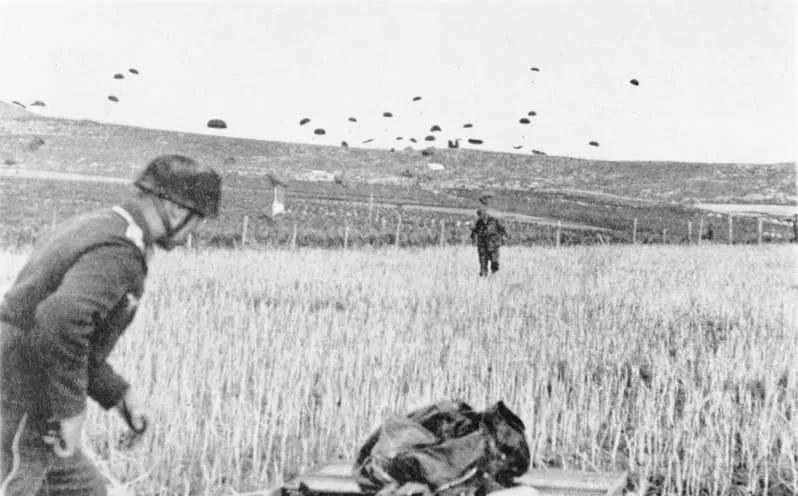
The Battle of Crete was the first campaign in history in which an island was captured chiefly from the air. On 20 May 1941, three weeks after the fall of Athens, the German XI Air Corps under General der Flieger Kurt Student dropped paratroopers and landed gliders near the airfields and towns of the north coast of Crete. The island was held by a British, New Zealand, Australian and Greek garrison, much of it made up of soldiers evacuated from the mainland without their heavy weapons, under the New Zealander Major General Bernard Freyberg. Thanks to decrypted German signals, the defenders knew where and when the attack would come, and on the first day they inflicted enormous losses on the paratroopers.
The battle was decided in a single night. During the night of 20–21 May a New Zealand battalion, convinced that its companies had been overrun, withdrew from Hill 107, which dominated the airfield at Maleme. In the morning the Germans occupied the abandoned positions, and transport aircraft carrying mountain troops began landing on the runway. A belated counter-attack failed to retake the airfield. Admiral Andrew Cunningham’s fleet scattered the convoys bringing reinforcements, but suffered its heaviest losses of the war to air attack. The defenders fell back across the mountains to the south coast, from where warships carried them off to Egypt by night, and on 1 June the last few thousand men laid down their arms. The Germans won, but at so high a price that Adolf Hitler abandoned any further large parachute operations.
Name and dates
The Germans called the operation “Unternehmen Merkur” (Operation Mercury), after the Roman messenger of the gods. German historiography speaks of the airborne battle for Crete (Luftlandeschlacht um Kreta), while the British preparations for the island’s defence bore the codename “Scorcher”. The landing was an operation separate from Marita, the German invasion of Greece, and the Luftwaffe planned it only in the second half of April.
The battle began on 20 May 1941, when the first bombs fell and the first gliders landed in the morning. It is taken to have ended on 1 June, when the last evacuation ships sailed at dawn and the troops left behind at Chora Sfakion surrendered. It is often said that the battle lasted seven days; in fact the fighting went on for twelve, although its outcome was settled in the first three. Some studies end it on 31 May, when the main evacuation was completed.
Background
The British arrived on Crete at the request of the Greek government after the Italian attack on Greece of 28 October 1940. The first troops from Alexandria landed there as early as 1 November, and an advanced fleet base was set up in Suda Bay. This allowed the Greeks to send the Cretan 5th Division to the Albanian front. The island closed the Aegean Sea from the south, and from its airfields British bombers could have reached the Romanian oilfields around Ploiești. Even so, little was done there for half a year: the garrison went through seven commanders, and by April 1941 only the airfields at Maleme and Heraklion and an airstrip near Retimo (Rethymno) had been prepared. In March, in Suda Bay, Italian explosive motor boats disabled the cruiser HMS York.
When the Germans crushed Greece in April, Crete suddenly became a front line. Winston Churchill decided to defend it, and some of the troops evacuated from the mainland were sent there. On 23 April King George II moved to the island with the government of Emmanouil Tsouderos. On 30 April the Commander-in-Chief Middle East, General Archibald Wavell, entrusted the defence of the island to Freyberg, who reported the very next day that his forces were wholly inadequate. Wavell, however, had nothing to send him: in Libya Erwin Rommel stood before Tobruk and on the Egyptian frontier, and from 2 May there was also the war with Iraq.
On the German side the idea came from the Luftwaffe. The commander of Luftflotte 4, General Alexander Löhr, put forward a plan to take the island from the air on 15 April, and Student, who since January had commanded XI Air Corps, which grouped all the parachute troops, won Hermann Göring over to it. On 21 April Student, accompanied by the Luftwaffe chief of staff, General Hans Jeschonnek, presented the plan to Hitler. Hitler, worried about Romanian oil, signed Directive No. 28 on 25 April, ordering the capture of Crete as a base for the air war against Britain in the eastern Mediterranean. At the same time he stipulated that the operation must take place in May and must not delay Operation Barbarossa. The date was set for 16 May, but delays in delivering aviation fuel to the airfields in Greece pushed it back to 20 May.
Opposing forces
Göring entrusted the operation to Löhr’s Luftflotte 4; Löhr was promoted to Colonel General on 3 May. The assault force was Student’s XI Air Corps: the 7th Air Division under General Wilhelm Süssmann, Germany’s only parachute division, and the Air Landing Assault Regiment of Generalmajor Eugen Meindl, with its glider units. The 5th Mountain Division of General Julius Ringel, which had received no training for airborne operations whatever, was to land on the captured airfields. In all, some 22,000 men were assigned to the attack, of whom about 7,000 were to come by sea in Greek fishing boats (caiques) escorted by Italian torpedo boats. More than 500 Junkers Ju 52 transport aircraft and several dozen gliders were assembled. Cover was provided by VIII Air Corps under General Wolfram von Richthofen, with several hundred bombers, dive-bombers and fighters.
The plan was a compromise between Löhr, who wanted to concentrate his forces around Maleme and Chania, and Student, who preferred to strike at many points at once. In the morning Meindl’s Group “Komet” was to take Maleme airfield, and Süssmann’s Group “Mars” was to take Chania, then the island’s capital, and Suda Bay. In the afternoon the same aircraft were to drop Colonel Alfred Sturm’s 2nd Parachute Regiment at Retimo and Colonel Bruno Bräuer’s 1st Parachute Regiment at Heraklion. German intelligence badly underestimated the enemy: it reckoned on a few thousand British troops and hardly any Greeks, and expected the inhabitants, mostly republicans, to welcome the Germans.
In reality there were about 42,000 defenders. Some 32,000 were Commonwealth troops: the island’s original garrison, including the British 14th Infantry Brigade, and about 18,000 men from Greece, above all the New Zealand 2nd Division less one brigade, the Australian 19th Brigade and a medley of soldiers from shattered units. There were about 10,000 Greeks: recruits, cadets, the remnants of divisions from the mainland and the Cretan gendarmerie, armed with old rifles and often with no more than a dozen or so rounds per man. Artillery, anti-aircraft guns, communications and transport were all lacking, and the dozen or so tanks were worn out. The last fighters, whittled away in air raids since mid-May, were sent back to Egypt on 19 May.
Freyberg divided the island into four independent sectors. Maleme and the area around Galatas were defended by Brigadier Edward Puttick’s New Zealanders; Chania and Suda Bay by Major General Edward Weston’s force; Retimo by Lieutenant Colonel Ian Campbell’s Australians together with two Greek regiments; and Heraklion by Brigadier Brian Chappel’s 14th Brigade. Freyberg proposed destroying the airfields, but Cairo refused, hoping that the RAF would need them again.
The defenders also knew a great deal. Codebreakers at Bletchley Park were reading Luftwaffe signals enciphered on Enigma, and in May they passed to Cairo and to Freyberg almost the entire operational order: the objectives of the landing, the forces involved and finally the date of the attack. To protect the source, Freyberg received this material in the guise of reports from an agent in Athens and could not regroup his troops in a way that might give it away. The signals, however, also spoke of a seaborne landing, whose strength the British overestimated, and Freyberg left considerable forces on the coast, far from the airfields. Historians still debate whether he misread the intelligence or was sensibly guarding against a threat he could not rule out.
The course of the battle: 20 May, four landings
On the morning of 20 May, after a heavy bombardment, gliders and transport aircraft appeared over Maleme at about 8 a.m. Gliders of Meindl’s regiment came down in the dry bed of the Tavronitis stream west of the airfield and on the slopes of Hill 107; their crews seized the bridge and some of the anti-aircraft positions, but many men were killed on landing. The paratroopers jumped from a low altitude carrying only pistols and grenades, while the rest of their weapons were dropped separately in containers. Until they reached them they were almost defenceless. The III Battalion of the assault regiment came down directly on New Zealand positions east of the airfield and, according to German returns, lost about 400 of its 600 men, including its commander, Major Otto Scherber. Meindl himself was badly wounded in the chest. By evening the Germans held only a scrap of ground west of the Tavronitis.
Group “Mars” lost its commander from the outset: General Süssmann’s glider broke away from its towing aircraft and crashed on the island of Aegina, killing him. His 3rd Parachute Regiment under Colonel Richard Heidrich landed in a valley south-west of Chania, which the defenders named Prison Valley after a building that stood there, and around the village of Galatas. Many aircraft dropped their men far from the target or among the positions of the New Zealand 4th and 10th Brigades. The paratroopers neither took the hills above Galatas nor got anywhere near Chania. At Alikianos German engineers were halted by the Greek 8th Regiment together with local volunteers, and at Kastelli, at the western tip of the island, the Greek 1st Regiment and armed civilians wiped out a detachment of paratroopers.
The second wave took off late, because the aircraft had to be refuelled by hand from drums and clouds of dust on the improvised airfields in Greece prevented large formations from taking off together. At Retimo the 2nd Parachute Regiment landed at about 4.15 p.m. The battalion dropped near the airstrip took one of the hills but lost some 400 killed and wounded; the second was driven back from the town by Greek gendarmes and armed inhabitants; and the regimental headquarters came down in the middle of the Australian positions, and Colonel Sturm was taken prisoner the next day. At Heraklion Bräuer’s regiment began landing at about 5.30 p.m. The defenders, who had held their fire during the preceding air raid, shot down many aircraft and destroyed the battalions dropped close to the airfield. The Germans broke into the western part of the town and the harbour, but the Greeks drove them out with a counter-attack.
By evening not one of the German objectives had been taken. According to German literature, of the roughly 10,000 men dropped that day about 6,000 were still fit to fight, although only seven of the 493 transport aircraft had been shot down. Because so many radio sets had been destroyed, Student in Athens long had no idea what was happening on the island.
On Crete the Germans met mass resistance from the civilian population, which their experience on mainland Greece had not led them to expect. Cretans, including women, old men and priests, seized hunting guns, old rifles, axes and knives and attacked paratroopers who had landed in olive groves far from their units. The German command regarded them as illegal francs-tireurs, and rumours of the mutilation of German soldiers’ bodies – partly exaggerated, partly the result of corpses decomposing in the heat – later served to justify reprisals.
The course of the battle: Hill 107 and the loss of Maleme (20–22 May)
Hill 107 and the airfield were held by the New Zealand 22nd Battalion under Lieutenant Colonel Leslie Andrew. During the day the Germans cut his communications with two companies on the western side of the airfield. Andrew concluded that they had been overrun and asked the commander of the 5th Brigade, Brigadier James Hargest, for support from the neighbouring 23rd Battalion. Hargest refused, wrongly believing that this battalion was busy fighting off paratroopers, and sent only two companies, which arrived late. An evening counter-attack with two tanks collapsed when both vehicles broke down. After dark Andrew, with Hargest’s consent, withdrew the battalion from the hill. The companies on the western side, which had not been overrun at all, learned of this towards dawn and also pulled out.
On the German side the evening looked just as bleak: the paratroopers at Maleme expected to be driven into the sea in the morning. Student, however, decided to stake everything on Maleme, where the most progress had been made. On the morning of 21 May the pilot of a Ju 52 who landed on the edge of the airfield as a test confirmed that landings there were possible. The Germans occupied the abandoned hill, and in the afternoon, under fire from New Zealand artillery, Ju 52s carrying battalions of the 100th Mountain Regiment began to land. Many aircraft crashed on the runway, on the beach and in the fields, but the men climbed out and went into action. The last parachute reserves were also dropped, under Colonel Hermann-Bernhard Ramcke, who replaced Meindl. By evening Maleme was in German hands.
Freyberg ordered a counter-attack for the night of 21–22 May by the New Zealand 20th Battalion and the Māori Battalion, but the 20th Battalion could move only after being relieved by the Australian 2/7th Battalion, which, for lack of transport, arrived many hours late. The attack began at about 3.30 a.m. The New Zealanders reached the edge of the airfield, but at dawn dive-bombers appeared and the entrenched paratroopers and mountain troops beat off the assault. Freyberg kept some units back on the coast for fear of a seaborne landing. From then on the Germans had a permanent air bridge: according to German literature, an average of about 20 aircraft an hour landed at Maleme, taking off the wounded on the return flight. On 22 May Ringel took command in the west of the island, and the mountain troops set off eastwards towards Chania, outflanking the defenders through the hills to the south.
New Zealand and British historians regard the night-time abandonment of Hill 107, the failure to counter-attack at once and the retention of reserves on the coast as the mistakes that handed victory to the Germans, although they disagree over how much of the blame lies with Andrew, Hargest, Puttick and Freyberg himself.
The course of the battle: the fight at sea (21–23 May)
Cunningham’s cruisers and destroyers kept south of Crete by day and at night entered the Aegean through the Kythira and Kasos straits to intercept convoys. Battleships covered them from the west, but after its defeat at Cape Matapan the Italian fleet did not leave harbour. The real enemy was the air force. As early as 21 May Italian bombers sank the destroyer HMS Juno.
During the night of 21–22 May Rear Admiral Irvine Glennie’s force intercepted, north of Chania, a flotilla of about twenty caiques carrying a battalion of mountain troops under the escort of the Italian torpedo boat Lupo. Her commander, Francesco Mimbelli, attacked the cruisers and laid a smokescreen, while the British spent several hours hunting down and shooting up the boats. About 300 German soldiers were killed, far fewer than was believed in London at the time. On the morning of 22 May Rear Admiral Edward King’s force came upon a second convoy south of Milos, escorted by the torpedo boat Sagittario. Under constant air attack and running short of anti-aircraft ammunition, King broke off the pursuit, but the convoy turned back. Until the fleet withdrew, the Germans made no further attempt to bring troops by sea.
The Royal Navy paid for this on 22 and 23 May. Bombers attacked the ships in the Kythira Strait all day, damaging the battleships Warspite and Valiant. The destroyer Greyhound was sunk, and the cruisers Gloucester and Fiji, sent to her aid with their anti-aircraft ammunition almost exhausted, went down in the afternoon and evening; more than 700 men died in Gloucester alone. On the morning of 23 May dive-bombers sank the destroyers Kashmir and Kelly, the latter commanded by Captain Lord Louis Mountbatten. Cunningham reported to London that the fleet could not operate north of Crete by day without fighter cover. German air superiority had proved stronger than British command of the sea.
During the night of 22–23 May the destroyer Decoy took off King George II and Prime Minister Tsouderos from Agia Roumeli on the south coast; after the landing near Chania they had crossed the mountains on foot. The remaining ministers left during the night of 24–25 May aboard the minelayer Abdiel. The Greek government moved to Egypt and then to London.
The course of the battle: Galatas and the fall of Chania (23–27 May)
After the loss of Maleme the New Zealanders fell back to a line at Galatas, a few kilometres west of Chania. Ringel’s mountain troops, supported by aircraft now operating from the airfield on the island, joined up with Heidrich’s paratroopers. On the afternoon of 25 May, after a heavy bombardment, the Germans launched an assault and broke into the village, and the depleted battalions began to give way. That evening the commander of the 10th Brigade, Colonel Howard Kippenberger, led a counter-attack by two companies of the 23rd Battalion with two light tanks. In bayonet fighting in the narrow streets the New Zealanders retook Galatas, but they lacked the strength to hold it and withdrew eastwards during the night. In western Crete the mountain troops advancing on the port of Paleochora were held up on 24 and 25 May near the village of Kandanos by local people and a handful of gendarmes.
On 26 May Freyberg reported to Wavell that his men had reached the limit of their endurance and that the position was hopeless. During the night of 26–27 May some 800 commandos of Colonel Robert Laycock’s Layforce still arrived in Suda Bay, but all they could do now was cover the retreat. On the morning of 27 May Wavell informed Churchill that the battle was lost and, with London’s approval, ordered an evacuation. That day Australians and New Zealanders, among them the Māori Battalion, threw back an attack by mountain troops with a bayonet charge on a road the soldiers called 42nd Street, buying the retreating units several hours. The Germans entered the ruins of Chania, and on 28 May they took the harbour in Suda Bay.
In the east of the island the defenders were still holding their positions. At Retimo Campbell’s Australians and the Greeks captured several hundred paratroopers and surrounded the rest in an olive-oil factory and in the village of Perivolia, while at Heraklion the 14th Brigade held the airfield and the town. They could not, however, change the course of a battle that had already been decided at Maleme. On 28 May about 3,000 soldiers of the Italian Regina Division from Rhodes landed near Sitia at the eastern tip of the island.
The course of the battle: retreat across the mountains and evacuation (27 May – 1 June)
The troops in the western part of the island could be taken off only from the small harbour of Chora Sfakion (Sfakia) on the south coast. A single road led there across the White Mountains, and it petered out a few kilometres short of the sea. From the night of 27–28 May columns of soldiers mixed with unarmed stragglers trudged along it, hungry and thirsty, hiding from aircraft by day. The retreat was covered by Layforce, the New Zealand 5th Brigade, the Māori Battalion and the Australians, who in a series of skirmishes held off mountain troops trying to outflank the columns through the mountains. The commandos paid the highest price: of some 800, fewer than 200 came back.
During the night of 28–29 May Rear Admiral Bernard Rawlings’s force took off the entire Heraklion garrison, more than 4,000 men. On the return voyage the damaged destroyer Imperial had to be scuttled, and Hereward was sunk by bombs. For many hours dive-bombers attacked the overloaded cruisers: in Orion, according to various counts, from about 260 to more than 350 men were killed, including over a hundred evacuated soldiers and the ship’s captain, and Dido was also badly damaged. When fears arose in Cairo that the fleet would lose too many ships, Cunningham is said to have replied: “It takes the Navy three years to build a ship; it takes three hundred years to build a tradition” – and the evacuation would go on. Ships took soldiers off from Chora Sfakion over four nights, the largest number, about 6,000, during the night of 29–30 May. During the night of 30–31 May Freyberg, on Wavell’s orders, flew out to Egypt in a flying boat. The last ships sailed at dawn on 1 June, and that same day the anti-aircraft cruiser Calcutta, which was steaming out to meet them, was sunk by bombers north-west of Alexandria.
Left behind on the shore at Chora Sfakion were, according to various calculations, between 5,000 and 6,500 soldiers, who surrendered on 1 June. At Retimo Campbell, whom the evacuation order never reached, was surrounded by tanks and artillery and surrendered on 30 May. Several hundred soldiers then went into hiding on the island with the help of the inhabitants, and many of them were smuggled to Egypt in the following months. According to the New Zealand official history, about 17,000 soldiers were evacuated (other calculations give 16,500 to 18,600), a little over half the Commonwealth garrison.
Losses
Churchill claimed that the Germans had lost more than 15,000 men, but German documents give far fewer. According to the report of Luftflotte 4, 3,986 men were killed and missing, while the British official history, drawing on the same sources, gives 1,990 killed, 1,995 missing and 2,131 wounded. The New Zealand official historian Daniel Davin estimated total losses at about 6,700 men. The 7th Air Division and the assault regiment suffered most. According to the official history, the Luftwaffe lost 147 aircraft destroyed in combat and 73 in accidents, and various calculations put the number of Ju 52s destroyed or badly damaged at between about 170 and more than 270.
According to the official history, the losses of British and Dominion land forces amounted to 1,742 killed, 1,737 wounded and 11,835 prisoners. The Royal Navy lost 1,828 dead, three cruisers (Gloucester, Fiji and Calcutta) and six destroyers (Juno, Greyhound, Kelly, Kashmir, Imperial and Hereward). The battleships Warspite and Valiant were damaged, as were the aircraft carrier Formidable, hit on 26 May during a raid on the airfields on Karpathos, and several cruisers. On 1 June the Mediterranean Fleet had only two serviceable battleships and three cruisers in the eastern part of the sea; for the Royal Navy this was the costliest operation of the war. More than 5,000 Greeks were also taken prisoner. The number of civilians killed has never been established; they died in bombing raids, in the fighting and in summary executions, such as the shooting of several dozen men in the village of Misiria near Retimo on 23–24 May.
Significance
Crete was Britain’s last great defeat in Europe before Germany attacked the Soviet Union. After Norway, Dunkirk and Greece, it was the fourth time since the spring of 1940 that the British had evacuated a beaten army under falling bombs. They feared that the island would serve the Germans as a springboard for an attack on Cyprus, Syria, Iraq or Egypt, but 22 June showed that Hitler had merely been securing his southern flank before the war in the east; VIII Air Corps had left for that front even before the battle ended. Crete remained under occupation until May 1945.
The victory changed German thinking about airborne landings. In July 1941 Hitler is said to have told Student that the day of the paratroopers was over, because their weapon, surprise, had been lost. From then on the paratroopers fought mainly as elite infantry, and the airborne landing on Malta planned for 1942 was called off. The Allies drew the opposite conclusion and accelerated the build-up of their own airborne forces, which in 1943–1944 landed in Sicily, in Normandy and at Arnhem; in February 1942 the British also formed the RAF Regiment to defend airfields. The battle also showed the limits of intelligence: Ultra gave Freyberg knowledge of the enemy’s plan, but it could not take the place of aircraft, tanks and communications, nor guard against errors of command.
The final act was terror. On 31 May Student, as the first German commandant of the island, ordered “punitive expeditions” in reprisal for the inhabitants’ part in the fighting: levies, shootings and the burning of villages, to be carried out swiftly and without formalities. On 2 June paratroopers shot the men of Kondomari near Maleme – 23 according to German documents, about 60 according to other sources – and on 3 June they razed Kandanos to the ground, killing some 180 inhabitants (the massacres of Kandanos and Kondomari). These were the first of the reprisals that by 1945 had cost the lives of several thousand Cretans. The resistance of May 1941 became the seed of the Cretan resistance movement, which worked with the British throughout the occupation. In 1946 Student stood trial before a British military court for crimes against prisoners of war on Crete, but he was never held to account for the crimes against civilians.