- Category:
- Military operations
- Front:
- Balkans
- Date:
- 20 May 1941
- Author:
- Natalia
- Battle:
- Battle of Crete
- Tags:
- Greece, Luftwaffe, Kurt Student, Bernard Freyberg
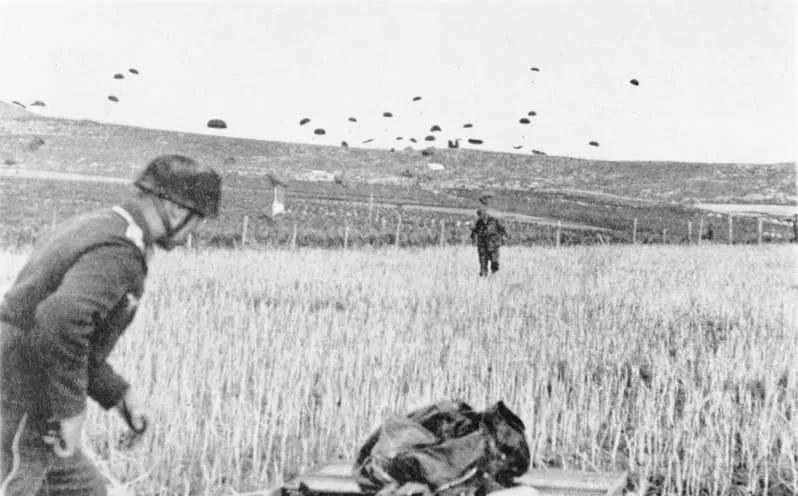
On the morning of 20 May 1941, after an hour of heavy bombing, hundreds of three-engined Junkers Ju 52 transport aircraft appeared over the northern coast of Crete. First gliders began landing in a dry riverbed west of Maleme airfield; then the sky above the olive groves filled with parachutes. So began Operation Mercury (Unternehmen Merkur), the first attempt in history to capture a large island chiefly from the air. On the first day the German paratroopers took none of their objectives and suffered losses such as their arm had never known. During the night, however, the commander of the New Zealand battalion defending the hill that dominated Maleme airfield, convinced that his companies had been destroyed, withdrew from it. That decision, taken in the dark and without a clear picture of the situation, decided the battle.
War chronologies record under this day that German paratroopers landed on Crete and that the battle for the island “will last seven days”. In fact the fighting lasted nearly two weeks. The British command judged the situation hopeless on 26–27 May, but the evacuation through the ports of the south coast went on until the night of 31 May–1 June, and the last units on the beaches at Chora Sfakion surrendered on 1 June.
An island on the road to Egypt
The British had been on Crete since November 1940. A few days after Italy attacked Greece, with Athens’ consent, they landed the first battalion on the island and turned Suda Bay into an advanced base for the Mediterranean Fleet. This allowed the Greeks to send their own 5th Cretan Division to the Albanian front; it went on fighting on the mainland and never returned to the island as a unit. In seven months the garrison had seven commanders, and the defences were scarcely developed, even though as early as March Italian explosive motor boats had attacked ships in Suda Bay.
Everything changed in April. After three weeks of the German invasion of Greece, the Royal Navy evacuated from the mainland some 50,000 British, Australian and New Zealand soldiers, landing many of them at Suda Bay. On 23 April King George II and the government of Emmanouil Tsouderos moved to Crete, and four days later the Germans entered Athens. Winston Churchill decided that the island must be defended. From Crete British bombers could reach the Romanian oilfields, while in German hands the same island would bring the Luftwaffe closer to Alexandria and the Suez Canal.
On the German side the plan to take Crete was the work of the airmen. General Kurt Student, commander of XI Air Corps, in which all the parachute and glider troops had been combined in January 1941, was looking for a great task for them, and for a success for the Luftwaffe after the Battle of Britain. Together with the commander of Luftflotte 4, General Alexander Löhr, he won over Hermann Göring, and on 21 April he presented the plan to Adolf Hitler. Some staff officers of the High Command of the Wehrmacht preferred to strike at Malta, and the army command was wholly absorbed in preparations for the war against the Soviet Union laid down in Directive No. 21. Hitler nevertheless chose Crete, because he feared British air raids on the Romanian oil that would be indispensable in the coming campaign. On 25 April he signed Directive No. 28 on Operation Mercury. In it he set one hard condition: the capture of the island must not delay the attack in the east, and the units earmarked for that campaign must be released by the end of May.
Mercury against Creforce
For the attack the Germans assembled XI Air Corps in Greece: the 7th Air Division (PL) of General Wilhelm Süssmann, comprising three Fallschirmjäger (PL) parachute regiments, and the Air Landing Assault Regiment of Generalmajor Eugen Meindl, trained to land by parachute and by glider. They were to be reinforced by the 5th Mountain Division of General Julius Ringel, which was to be flown in to captured airfields and partly carried by sea in flotillas of Greek caiques under the escort of Italian torpedo boats. In all, some 22,000 soldiers were to take part in the operation. More than 500 Ju 52s and several dozen DFS 230 gliders took off from dusty airfields in Attica and the Peloponnese, with support provided by VIII Air Corps under General Wolfram von Richthofen, which according to various tallies had between 430 and 570 bombers, Ju 87 dive-bombers and fighters. Löhr was in overall command, and Student commanded the airborne operation, directing it from his headquarters in Athens. The date was put back from 16 to 20 May because the fuel had not arrived in time.
The plan was a compromise between Löhr, who wanted to concentrate on the west of the island, and Student, who preferred to strike at many points simultaneously. Two waves were planned. In the morning Meindl’s Group Komet was to take Maleme airfield, and Süssmann’s Group Mars to seize Chania, the island’s capital, and Suda Bay. In the afternoon the same aircraft were to drop most of Colonel Alfred Sturm’s 2nd Parachute Regiment over the airfield at Retimo (Rethymno), and Group Orion – Colonel Bruno Bräuer’s 1st Parachute Regiment with one battalion of the 2nd – over Heraklion. Admiral Wilhelm Canaris’s intelligence service gave assurances that there were at most a few thousand British on the island and that the Cretans, mostly supporters of the late Eleftherios Venizelos, would not fight for the king.
In reality there were some 42,000 soldiers on Crete. About 32,000 belonged to the forces of the British Commonwealth: the original garrison and the New Zealanders, Australians and British evacuated from Greece, often without heavy weapons, transport or even their own officers. About 10,000 were Greeks: recruits from training centres, cadets of the gendarmerie school, Cretan gendarmes and the remnants of units that had made their way over from the mainland. The Greeks had obsolete rifles and often fewer than thirty rounds per man. The Allied forces, named Creforce, had been commanded since 30 April by Major General Bernard Freyberg, chosen personally by Churchill. The defence had 85 guns, many of them captured Italian pieces, and twenty-odd worn-out tanks. The last RAF fighters flew off to Egypt on 19 May, and of the 27,000 tons of supplies sent to the island in May the Luftwaffe allowed only a small fraction to get through.
Freyberg, however, knew what was coming. The British were reading Luftwaffe signals enciphered on the Enigma machine and from the end of April passed from Bletchley Park to Cairo and Crete news of XI Air Corps’ preparations, and at the beginning of May of its objectives: Maleme, Chania, Retimo and Heraklion. To protect the source, this information reached Freyberg in the guise of reports from a supposed agent in Athens. On 5 May the general signalled that he could not understand the nervousness and was not in the least worried about an airborne attack; he was more concerned about a combination of airborne and seaborne landings. For that reason part of his force remained on the coast, awaiting a landing from the sea. Historians argue over whether he misread the signals or could not move his troops without revealing to the Germans that their ciphers were being broken. Cairo turned down his request for the airfields to be destroyed. He therefore deployed his troops around the four objectives known from the signals, with the 2nd New Zealand Division in the Maleme and Galatas area.
Morning at Maleme
Early on the morning of 20 May the first wave took off from the airfields in Greece. At the very outset Group Mars lost its commander: the glider carrying General Süssmann’s staff broke away from its tow soon after take-off and crashed on the island of Aegina. The general was killed, and his men landed on Crete without knowing it. At about seven o’clock the Luftwaffe began bombing and strafing the positions around Maleme and Chania. The commander of the New Zealand 22nd Battalion defending the airfield, Lieutenant Colonel Leslie Andrew, a holder of the Victoria Cross from the First World War, later recorded that the bombing was worse than the shelling on the Somme and at Passchendaele.
At about eight, while the raid was still in progress, the gliders of the I Battalion of the Assault Regiment began landing in the wide, dry bed of the Tavronitis river west of the airfield and on its banks. Their crews were to silence the anti-aircraft guns and capture the bridge over the river and Hill 107, which dominated the runway. Behind the gliders came Ju 52s carrying paratroopers. German parachute troops at that time jumped from low altitude carrying only pistols, grenades and knives, because rifles, machine guns and ammunition were dropped in separate containers. The New Zealanders of the 21st, 22nd and 23rd Battalions shot at the men as they floated down and at those running for the containers. The regiment’s III Battalion, dropped east of the airfield straight onto the positions of the 23rd Battalion, was all but wiped out: one of its companies lost 112 of its 126 men, and the battalion as a whole, according to figures cited by historians, about 400 of 600. Its commander, Major Otto Scherber, was killed. The commander of the I Battalion, Major Walter Koch, who a year earlier had led the assault on Eben-Emael, was severely wounded. That same day a bullet in the chest put General Meindl himself out of the fight.
Even so, the Germans managed to seize the bridge over the Tavronitis and the ground west of the airfield. The II and IV Battalions, dropped further from the New Zealand positions, rallied and began attacking Hill 107 from the west and south. Dive-bombers attacked the New Zealand trenches, marked out by the Germans with signal panels, all day long. Andrew’s battalion was spread over a wide area and quickly lost contact with its companies on the western edge of the airfield. In the afternoon Andrew asked the commander of the 5th Brigade, Brigadier James Hargest, for the help of the 23rd Battalion, which stood close by. Hargest refused, in the mistaken belief that this battalion was itself fighting off paratroopers. In reality the 23rd Battalion had already dealt with the Germans in its own sector and was waiting for orders.
At the western end of the island, near Kisamos, then called Kastelli, some 70 paratroopers were attacked by the Greek 1st Regiment, made up mostly of recruits, and by armed inhabitants of the surrounding villages. The detachment ceased to exist: most of its men were killed and the rest taken prisoner.
Prison Valley and Galatas
At the same time Group Mars was landing east of Maleme. Its core was the 3rd Parachute Regiment of Colonel Richard Heidrich, which was to land in a broad valley south-west of Chania that the defenders called Prison Valley after the prison building at Agia that stood in it. The battalion dropped closest to the village of Galatas came down right on the New Zealand positions and was destroyed before its men could assemble. The two other battalions and an engineer battalion, however, rallied in the valley, took the prison and pushed the poorly armed Greek 6th Regiment off a nearby hill. To the south-west the Greek 8th Regiment, supported by the inhabitants of the surrounding villages, fought the engineers all day near Alikianos. The commander of the New Zealand 10th Brigade, Colonel Howard Kippenberger, who was defending Galatas with a scratch force of drivers, gunners without guns and soldiers from units broken up in Greece, pressed for a swift counter-attack on the prison, but an evening attack by small forces failed to drive the paratroopers out of the valley.
Of the two glider companies sent against Chania, one captured an anti-aircraft battery south of the town, while the other, which landed on the Akrotiri peninsula near Freyberg’s headquarters, was destroyed. King George II was living in a house near Chania, which the Germans approached to within a few hundred metres. That same day his British and New Zealand guard led him into the mountains, from where, after several days’ march, he reached the south coast and sailed for Egypt.
Afternoon over Retimo and Heraklion
The second wave was several hours late. The aircraft had to be refuelled by hand from drums, and clouds of dust on the airfields forced them to take off in small groups. The supporting air units were not told of the delay and bombed Retimo and Heraklion as planned, so that when the transports arrived there were no longer any German bombers or fighters over the objectives.
At Retimo the first Ju 52s appeared at a quarter past four. The airfield was defended by two Australian battalions under Lieutenant Colonel Ian Campbell, dug in on the ridges above the coast, and two Greek regiments. The aircraft flew low along the shore, many paratroopers were killed in the air, and the regimental staff landed in the middle of the Australian positions. Colonel Sturm was taken prisoner the next day. One battalion managed to take a hill at the eastern edge of the airfield, while the other, dropped further west, advanced on the town. At about six in the evening it was driven back by the Retimo gendarmes together with armed townspeople, among them clergymen.
At Heraklion the Germans began jumping at about half past five, over the most strongly defended place on the island. Bräuer expected a few hundred defenders; he faced more than 7,000, including some 2,700 Greeks. Brigadier Brian Chappel’s British 14th Brigade and the Australian 2/4th Battalion sat out the raid under cover without giving away their positions. The battalion dropped between the airfield and the sea, straight onto the positions of the Scottish Black Watch, lost some 400 killed and wounded within half an hour. Another battalion broke through the gates of the Venetian walls into the town and fought Greek soldiers and townspeople in the streets until late at night, when it withdrew outside the walls. Some fifteen transport aircraft were shot down there. Bräuer, who had landed with the reserve east of the town, realised only after midnight that his attack had collapsed.
All over the island that day Cretans fought – with hunting guns, old rifles from the days of the struggle against the Turks, weapons taken from dead paratroopers, and even axes and farm tools. They killed Germans who had lost their way, showed soldiers where they were hiding and carried off the containers that had been dropped. For the first time in this war the Germans encountered mass resistance by civilians. Many paratroopers regarded it as a crime against the laws of war, and while the battle was still going on the German command began to speak of atrocities against the wounded. Most of these accusations were not confirmed even by an inquiry conducted by the Germans themselves, but they served as justification for reprisals against the population.
Night on Hill 107
By the evening of 20 May not one German objective had been taken. The airfields at Maleme, Retimo and Heraklion remained in the defenders’ hands, as did Chania and Suda Bay. According to figures cited by historians, of the nearly 10,000 soldiers dropped on Crete that day perhaps 6,000 were fit to fight by the evening. The paratroopers at Maleme expected to be driven into the sea in the morning. Student in Athens had no news from the island for a long time, because the radio sets had been smashed on landing, and the first reports spoke of the failure of all four attacks. In London Churchill, informing the House of Commons of the Italian surrender at Amba Alagi and of the fighting at Sollum, added that in the morning an “airborne attack in great strength” had begun on Crete and that a “serious battle” was developing.
At Maleme, before dark, Lieutenant Colonel Andrew committed his last reserve, an infantry platoon with two Matilda tanks, to a counter-attack on the western edge of the airfield. Both tanks broke down, and the infantry was driven back. Andrew had no news from his western companies and concluded that they had been overrun. He reported to Hargest that he might be forced to withdraw. “If you must, you must,” the brigadier replied. The small reinforcements promised for the night did not change the position. At around midnight Andrew withdrew the remnants of the battalion from Hill 107 to the positions of the 21st and 23rd Battalions. His western companies, which had in fact held their positions, learned before dawn that they had been left alone and withdrew as well. Neither the divisional commander, General Edward Puttick, nor Freyberg knew what had happened, and no night counter-attack was organised.
On the morning of 21 May the Germans walked onto the abandoned hill almost without a fight. During the night Student had decided to stake everything on Maleme, where his men were closest to their objective, and to throw in all his reserves there. At dawn a single Ju 52 landed experimentally at the edge of the airfield and managed to take off again. In the afternoon, under artillery fire, more and more aircraft carrying soldiers of the 5th Mountain Division began landing on the runway and the beach. From that moment the Germans had an air bridge to Crete, and the defence, though more numerous, could no longer cut it.
Place in the war
The battle that began on 20 May lasted another eleven days. The counter-attack on Maleme on the night of 21–22 May came too late, and the Royal Navy, which broke up one of the German convoys of caiques bound for the island, paid for its command of the sea with heavy losses to Luftwaffe bombs. At Galatas the New Zealanders fought further bitter actions, but from 26 May Creforce was falling back across the White Mountains to the south coast, from which the fleet evacuated part of the garrison. The island fell on 1 June. By their own reckoning the Germans lost nearly 4,000 killed and missing and several hundred transport aircraft. Allied losses on land and at sea amounted, by various calculations, to about 4,000 killed, and well over ten thousand British, Dominion and Greek soldiers were taken prisoner. The Mediterranean Fleet lost three cruisers and six destroyers. Even before the fighting ended, Student issued orders for reprisals against the population, which in the first days of June brought the shootings at Kondomari and the destruction of Kandanos – the beginning of a long series of occupation crimes on Crete.
For the German parachute troops Crete was a Pyrrhic victory. According to Student’s account, Hitler told him in July that the day of the paratrooper was over, because the trump card of surprise had been lost. For the rest of the war the Germans never again mounted an airborne landing on this scale, and Student’s men fought mainly as elite infantry. The Allies drew the opposite conclusion from the battle and accelerated the build-up of their own airborne divisions, which three years later landed in Normandy and at Arnhem. On the first day all four landings had in practice been repulsed, and the battle was decided by communications that failed on a single hill. As a result Britain lost its last foothold in Greece, and the Luftwaffe gained a base at the eastern end of the Mediterranean just as Hitler was turning his main forces east.
Sources
Meanwhile
(04)Elsewhere, within a week.
- 18 May 1941 · AfricaThe surrender at Amba AlagiIn May 1941 British, Indian and South African troops and Ethiopian patriots surrounded Amba Alagi. The Viceroy, the Duke of Aosta, surrendered with honours.
- 22 May 1941 · PolandFourth deportation from the eastern landsOn 21 May 1941 the NKVD began the last deportation from the Kresy. It came in waves until the German attack on the USSR and took tens of thousands of people.
- 17 May 1941 · Middle EastThe Battle of FallujahOn 19 May 1941 British troops from Habbaniya took the Euphrates bridge at Fallujah, opening the road to Baghdad, and on 22 May repulsed an Iraqi counter-attack.
- 23 May 1941 · Middle EastDirective No. 30On 23 May 1941 Hitler’s Directive No. 30 named the Arab freedom movement a natural ally against England and granted Iraq modest aid. It came too late.
Related events
(04)The same battle, people or subject.
- 28 May 1941 · BalkansThe evacuation from CreteOn 28 May 1941 the Royal Navy began taking the defeated garrison off Crete. By 1 June it had lifted some 17,000 men, losing ships and almost 2,000 sailors.
- 2 June 1941 · Crimes and repressionThe massacres at Kondomari and KandanosA day after Crete fell, the Germans turned on its people. On 2 June 1941 they shot the men of Kondomari; on 3 June they razed Kandanos to the ground.
- 24 April 1941 · BalkansThe evacuation from GreeceOn the night of 24–25 April 1941 the Royal Navy began lifting the British corps off Greek beaches. By 1 May some 50,000 men had left, without heavy equipment.
- 13 May 1941 · Middle EastFliegerführer Irak at MosulOn 13 May 1941 the core of Fliegerführer Irak, a German air group sent via Vichy Syria to aid Rashid Ali’s government, reached Mosul.