Equipment
Messerschmitt Bf 110
Göring's twin-engined 'destroyer': it failed as an escort fighter in the Battle of Britain, then became the backbone of the German night-fighter force.
- Role:
- heavy fighter, night fighter
- State:
- Germany
- Maker:
- Bayerische Flugzeugwerke (Messerschmitt AG)
- First flight:
- 12 May 1936
- Built:
- about 6,000 (between about 5,800 and 6,170, depending on the count)
- Author:
- Łukasz
- Updated:
- 1 November 2026
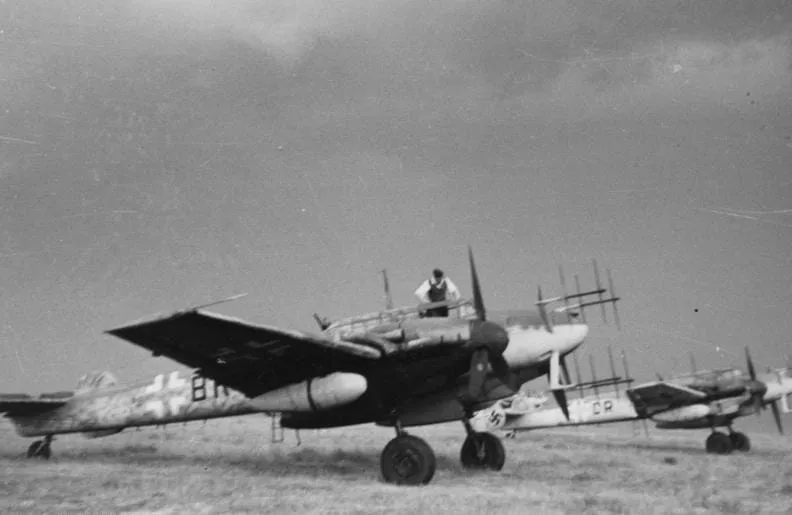
The Messerschmitt Bf 110 was the Luftwaffe’s answer to a question every air force was asking in the 1930s: how to give bombers fighter cover all the way to a distant target. Two engines gave it range, and the cannon in its nose gave it firepower no single-engined fighter had. In the first campaigns of the war the aircraft seemed to live up to these hopes, but in the summer of 1940 over England it turned out that in combat with modern fighters it needed protection itself. Instead of disappearing, it found a new role: as a radar-equipped night fighter it shot down hundreds of British bombers.
Göring’s “destroyer”
The idea of the heavy fighter, called Zerstörer, “destroyer”, in Germany, was warmly backed by Hermann Göring. In 1934 the Reich Air Ministry called for designs for a twin-engined, long-range combat aircraft, and the competition was won by the Augsburg firm where Willy Messerschmitt worked. Rudolf Opitz flew the prototype on 12 May 1936. It proved faster than the ministry had asked for, faster even than the contemporary versions of the single-engined Bf 109, though less manoeuvrable. The crew was a pilot and a gunner, who defended the aircraft from the rear cockpit with a single machine gun, while in front it had two 20 mm cannon and four machine guns. It only gained real fighting value with Daimler-Benz engines, in the C version, which reached the units in 1939.
First victories
Over Poland in September 1939 the Luftwaffe used about a hundred Bf 110s and, according to German tallies, lost about ten. In the September campaign these aircraft escorted bombers and strafed airfields, and their crews claimed dozens of victories over Polish fighters. On 18 December 1939 Bf 110s, together with Bf 109s, inflicted heavy losses on Wellingtons in the Battle of the Heligoland Bight, which led the British to give up daylight raids on Germany.
On 9 April 1940 Bf 110s destroyed the Danish air force on the ground, and in Norway they helped to take Fornebu airfield near Oslo, landing there before the infantry arrived. In the campaign in the west, in May and June 1940, losses mounted: according to Luftwaffe tallies, about 60 aircraft were lost, roughly a third of the strength with which the Zerstörergeschwader had started.
Defeat over England
In the Battle of Britain the Bf 110 was supposed to do what it had been built for: escort bombers far from their bases. Spitfires and Hurricanes, however, exploited its weakness: heavy and unwieldy, it could not turn with them, and could not always run away from them either. Bf 110 units defended themselves by circling in a closed ring in which each aircraft covered the tail of the one in front. The most painful day came on 15 August, when Bf 110s of ZG 76, which had flown from Norway to northern England with extra fuel tanks and without their gunners so that they could get home at all, lost many aircraft without protecting the bombers. Three days later, on the hardest day of the battle, Göring ordered the single-engined Bf 109s to escort the twin-engined Messerschmitts as well. According to figures from German documents, the Luftwaffe began the battle with 237 serviceable Bf 110s and lost 223 of them in it.
Something else did work, though. The experimental group Erprobungsgruppe 210 used the Bf 110 as a fast fighter-bomber, and on the eve of Eagle Day attacked British radar stations on the coast. From that experience grew the later use of the Bf 110 as a ground-attack aircraft in the Balkans, in Africa and on the Eastern Front, where in June 1941 it supported the ground troops in the first days of Operation Barbarossa.
From Malta to Mosul
In January 1941 Bf 110s from Sicily escorted the dive bombers that attacked the carrier Illustrious. In May a small group of them flew to Iraq to support Rashid Ali’s coup, but in the Anglo-Iraqi War the Germans lost all the Bf 110s they had sent and in the end evacuated their personnel. On 10 May 1941 Hitler’s deputy Rudolf Hess took off from Augsburg in a specially prepared Bf 110 and flew alone to Scotland, where he baled out.
Night fighter
The Bf 110 made its real career after dark. In the summer of 1940 the first night-fighter wing was formed, commanded by Wolfgang Falck, who had previously flown the Bf 110. A large aircraft with good range and heavy armament was well suited to hunting British bombers, and there was room for an extra crew member to work the radar. At first it was guided by ground stations; from 1942 the aircraft received the Lichtenstein airborne radar, whose aerials on the nose cost them dozens of kilometres an hour in speed. When in July 1943 the RAF began dropping strips of foil that jammed the radars, the Germans introduced a new radar and the tactic of free hunting within the bomber stream, and the aircraft were fitted with Schräge Musik, cannon firing obliquely upwards. On the night of 30–31 March 1944, during the Nuremberg raid, night fighters, many of them Bf 110s, shot down most of the 95 bombers lost that night, the most Bomber Command lost on a single raid. The most successful night fighter pilot of the war, Heinz-Wolfgang Schnaufer (PL), flew only the Bf 110 and was credited with 121 victories.
The last years
By day, Bf 110s returned to the fight in 1943, defending the Reich against American bombers. With rockets under their wings they broke up B-17 formations, as on “Black Thursday”, 14 October 1943, but once the bombers were accompanied by American long-range fighters, the heavy Messerschmitts became easy prey for them. During Big Week in February 1944 the Bf 110 units suffered painful losses, and by the spring they had all but vanished from the daytime skies over Germany.
Its successor was to be the Messerschmitt Me 210, but that aircraft’s design faults meant the Bf 110 was built until early 1945, mainly at the works in Gotha. The number built varies with the source, from about 5,800 to more than 6,100. No Bf 110 flies today, and one of the surviving night fighters, surrendered in Denmark in May 1945, is on display at the RAF Museum in London.
Sources
Battles
(02)- 10 July – 31 October 1940Battle of BritainFrom 10 July to 31 October 1940 the Luftwaffe tried to destroy the RAF ahead of an invasion of Britain. It failed, and Hitler postponed the landing.
- 2–31 May 1941Anglo-Iraqi WarFrom 2 to 31 May 1941 the British defeated Rashid Ali's army: they held RAF Habbaniya, took Fallujah and reached the outskirts of Baghdad.