Germany
Rudolf Hess
Hitler's secretary (1925–1932), Deputy Führer of the NSDAP and Reich Minister without Portfolio (1933–1941)
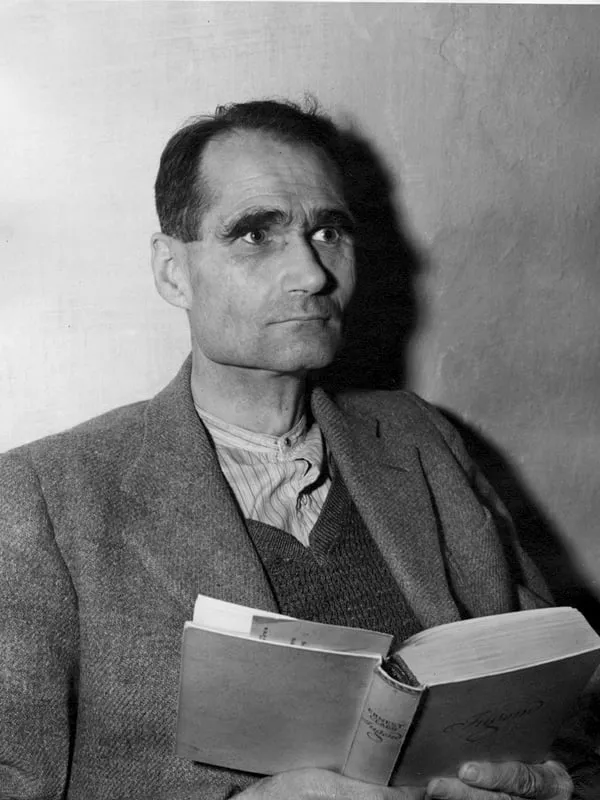
- Born:
- 26 April 1894, Alexandria (Egypt)
- Died:
- 17 August 1987, West Berlin, Spandau Prison
- Author:
- Natalia
- Photo:
- United States Army Signal Corps, photographer, domena publiczna, Wikimedia Commons

Rudolf Hess was the most devoted companion of Adolf Hitler from the earliest years of the Nazi movement. From 1920 he listened to him with boundless admiration; in Landsberg prison he typed up the manuscript of “Mein Kampf”, then for years served as his secretary, and in 1933 he formally became Deputy Führer of the NSDAP and a Reich minister. As one of the high priests of the leader cult he proclaimed that Hitler “is Germany”, and he signed laws that stripped Jews of their rights. On 10 May 1941, a few weeks before Germany’s invasion of the Soviet Union, he flew alone to Scotland to make peace with Britain on his own initiative. He spent the rest of his life, forty-six years, in captivity and in prison. Sentenced at Nuremberg to life imprisonment for his part in preparing a war of aggression, from 1966 he was the sole inmate of Berlin’s Spandau Prison, where he took his own life in 1987. To neo-Nazis he became a martyr.
Childhood in Egypt and the Great War
He was born on 26 April 1894 in Alexandria, Egypt, the eldest son of Fritz Hess, a prosperous merchant who owned an import firm whose roots lay in Wunsiedel in Upper Franconia. He spent his childhood in Alexandria’s German community, kept apart from the Egyptians and from the British, who then ruled the country. In 1908 he was sent to a Protestant boarding school in Bad Godesberg near Bonn. He then studied at a commercial school in Neuchâtel in Switzerland and began a commercial apprenticeship in Hamburg, preparing to take over the family business.
In August 1914 he volunteered for the Bavarian Army. He fought in the infantry on the Western Front, among other places at Verdun, and then in Romania, where in August 1917 he was seriously wounded – for the third time in the war. In the autumn of 1917 he was promoted to lieutenant of the reserve. In 1918 he trained as a fighter pilot but did not see combat before the war ended. He greeted the defeat with disbelief. He blamed the left, and he regarded the Treaty of Versailles as a fraud perpetrated by President Wilson. In 1919 he wrote to his parents that the only thing keeping him alive was “the hope of the day of revenge”.
At Hitler’s side
After the war the family lost its fortune when the British confiscated its business in Egypt. Hess settled in Munich and began to study economics and history. He was profoundly influenced by the geography professor Karl Haushofer, the founder of German geopolitics, who became his friend. He belonged to the nationalist Thule Society, and in the spring of 1919 he fought against the Bavarian Soviet Republic in the Freikorps of Franz von Epp. There he met, among others, Ernst Röhm.
On 19 May 1920 he heard Hitler speak for the first time at a meeting of the NSDAP and fell under his spell at once. On 1 July 1920 he joined the party. From then on his life revolved around Hitler. Hess, educated and worldly, introduced him to Munich’s middle classes and to General Erich Ludendorff. In 1921 he won an essay competition on what the man who would lead Germany out of its decline should be like: he described a dictator who would deal ruthlessly with Marxism, parliamentarism and the Jews. Crude antisemitism appeared in his letters of those years, and he greeted the murder of the Jewish Foreign Minister Walther Rathenau in 1922 with mockery.
During the Beer Hall Putsch on 8 November 1923 Hess arrested members of the Bavarian government in the Bürgerbräukeller and drove some of them out of the city as hostages. After the putsch failed he went into hiding, briefly in Austria and then with friends in Bavaria. In the spring of 1924 he gave himself up voluntarily, was sentenced to eighteen months’ fortress confinement and served his sentence in Landsberg together with Hitler. There he took down and typed the texts that Hitler dictated and read to him, which became the first volume of “Mein Kampf”. Historians do not regard him as a co-author, although it was through him that Haushofer’s idea of “living space” found its way into the book.
Secretary and Deputy Führer
From April 1925 Hess was Hitler’s private secretary. He kept his diary, handled his correspondence, saw to his finances and controlled access to him. He helped to create the leader cult within the party, popularising the “Heil Hitler” greeting and the form of address “my Führer”. On 20 December 1927 he married Ilse Pröhl; their only son, Wolf Rüdiger, was born in 1937. Hess was a keen aviator and in 1934 won an air race around the Zugspitze. In December 1932, after Gregor Strasser’s departure, he took charge of the NSDAP’s Central Political Commission.
On 21 April 1933 Hitler appointed him his deputy in the party leadership, and in December 1933 Reich Minister without Portfolio. Hess had the right to give his opinion on draft laws and on the appointment of senior officials, and his office supervised the party and its foreign organisations. Historians differ in their assessment of his real power. Most consider him a weak politician who confined himself to representation and left the day-to-day work to his ambitious chief of staff, Martin Bormann. Some, such as Rainer F. Schmidt, credit him with considerable influence in the early years of the regime. In public he was one of the chief preachers of the Hitler cult. At the Nuremberg party rally of 1934 he cried: “The Party is Hitler. Hitler is Germany, just as Germany is Hitler.”
In 1934 he took Hitler’s side in the conflict with the SA. In a radio speech on 25 June he warned those who were thinking of a “second revolution”, and during the Night of the Long Knives he went through the lists of those marked for death with Hitler. Hess also took part in preparing the Nuremberg Laws of 1935, and together with other ministers he signed the decrees that step by step deprived Jews of their rights and property. He spoke of “Jewish Bolshevism” as Germany’s enemy. On the other hand, he used his influence to protect from persecution the family of Haushofer, whose wife was of Jewish descent. In 1940 he demanded a separate, draconian criminal law for Poles in occupied Poland, including flogging.
On 1 September 1939, the day of the attack on Poland, Hitler announced in the Reichstag that if anything happened to him his successor would be Hermann Göring, and after Göring, Hess. This was the high point of his career and at the same time the beginning of its end: in wartime decisions were taken at headquarters, and Hess, with no real share in the conduct of the war, lost importance.
The flight to Scotland
From the autumn of 1940 Hess secretly practised flying the twin-engined Messerschmitt Bf 110 fighter at the Messerschmitt works airfield in Augsburg and gathered weather data over the North Sea. On 10 May 1941, at around 6 p.m., he took off alone and flew to Scotland. He wanted to reach Douglas Douglas-Hamilton, Duke of Hamilton, whom he had met briefly during the 1936 Berlin Olympics and whom he mistakenly believed to be the leader of a British peace party. Late in the evening he baled out by parachute over a farm south of Glasgow, injuring his leg on landing, and was detained.
He presented the British with a peace plan that was essentially a repetition of Hitler’s familiar offer: Britain would keep its empire and leave Germany a free hand in Europe – including, as he made clear, against the Soviet Union. He had no authority to negotiate and no new information. Most historians now believe he acted on his own, convinced that he was fulfilling the unspoken wish of Hitler, who had long dreamed of an alliance with England, and wanting to spare Germany a war on two fronts. Hitler was taken by surprise and furious. Propaganda announced that Hess was suffering from delusions; all his functions were taken over by Bormann as head of his former office, renamed the Party Chancellery, and the Gestapo arrested his associates as well as the astrologers and occultists who were said to have influenced his decision.
Winston Churchill’s British government treated Hess as a prisoner of war. Rather than disclose the details of the conversations, it let rumours circulate about a possible settlement with Germany, which Joseph Stalin read as evidence of a British game against the USSR. For the rest of his life Stalin suspected that London was hiding something from him. Hess spent the war in isolation in England and Wales. He behaved strangely and believed that someone was trying to poison him; in June 1941 he tried to kill himself by jumping from a balcony, and psychiatrists differed in their assessment of his condition.
Nuremberg and Spandau
In October 1945 he was taken to Nuremberg, where he stood in the dock before the International Military Tribunal as one of the major war criminals. At first he claimed to have lost his memory, then declared that he had been faking it. In his final statement he said that he regretted nothing and had been happy to serve the “greatest son” his people had produced. On 1 October 1946 the tribunal found him guilty of conspiracy and crimes against peace – that is, of taking part in preparing wars of aggression, including the attack on Poland – and sentenced him to life imprisonment. He was acquitted of war crimes and crimes against humanity, partly because from May 1941, during the worst of the crimes, he had been in Britain. The Soviet judge filed a dissenting opinion calling for the death penalty.
On 18 July 1947 Hess and six other convicted men were taken to Spandau Prison in West Berlin, guarded in rotation by the four powers. When Albert Speer and Baldur von Schirach were released in 1966, he became the only prisoner in the huge building. Appeals from his family, and later also from Western politicians and the churches, for his release on humanitarian grounds were blocked by the Soviet Union. Hess never renounced Nazism. On 17 August 1987, at the age of 93, he hanged himself with an extension cable in a summer house in the prison garden. His son and far-right circles claimed that he had been murdered, but a British investigation confirmed suicide, and historians regard these theories as groundless. The prison was demolished, and Hess’s grave in Wunsiedel, which had become a destination for neo-Nazi marches, was removed in 2011.
Significance
Hess was not an architect of Third Reich policy on the scale of Göring, Heinrich Himmler or Bormann. His significance lies elsewhere. In the 1920s he was one of the men who created the myth of Hitler as a leader sent by Providence, and thus one of the creators of the charismatic authority on which the whole state rested. As Deputy Führer he lent his name to the racial laws and the persecution that preceded the war and the Holocaust.
His flight to Scotland is one of the strangest episodes of the Second World War. It did not change the course of the war, but it showed how far the Nazi leaders, Hitler first among them, deluded themselves that Britain would agree to hand the Continent over to Germany, and how close the war with the Soviet Union already was. Hess’s trial at Nuremberg helped to establish the principle that planning and waging a war of aggression is a crime for which politicians bear personal responsibility, even if they did not kill anyone themselves.
Sources
Mentioned in battles
(01)Often appears with
People who appear in the same events.
On the timeline
(22)1923
1924
1925
1932
1933
1934
1935
1936
1938
1939
1940
1941
May
- 10
- Key eventRudolf Hess’s flight to ScotlandOn 10 May 1941 Hitler’s deputy Rudolf Hess flew alone to Scotland to make peace with Britain. He bailed out by parachute and was taken prisoner.
- Key eventThe last night of the BlitzOn the night of 10–11 May 1941 bombs killed 1,436 people in London and destroyed the House of Commons chamber. It was the Blitz's last great raid.