Equipment
Hawker Hurricane
The RAF's first monoplane fighter and workhorse of the Battle of Britain, which went on to defend Malta and fight in the desert, Asia, the Arctic and at sea.
- Role:
- fighter
- State:
- United Kingdom
- Maker:
- Hawker Aircraft
- First flight:
- 6 November 1935
- Built:
- about 14,500 (including more than 1,400 in Canada)
- Author:
- Natalia
- Updated:
- 1 November 2026
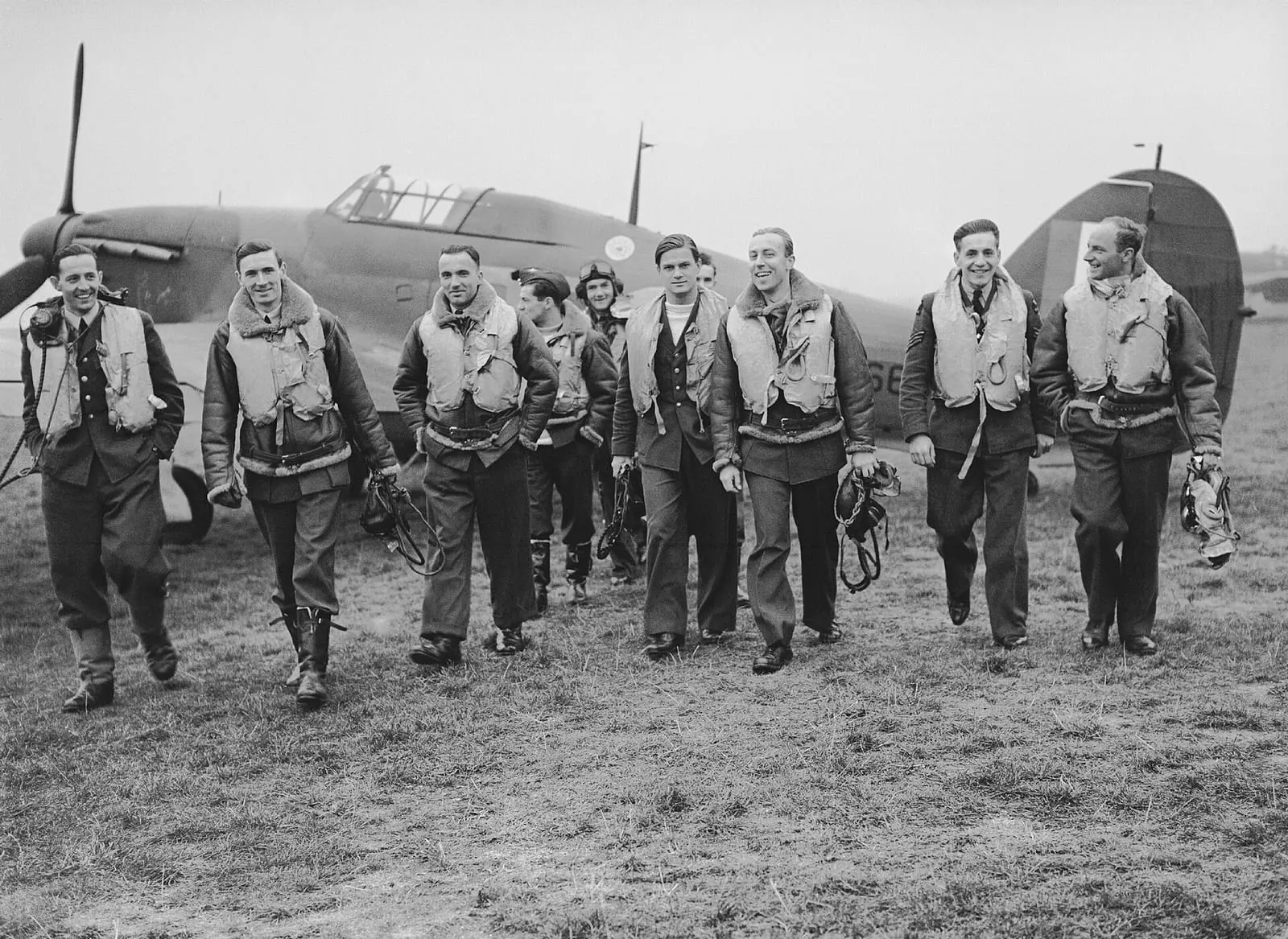
The Hawker Hurricane was the aircraft that carried the heaviest share of Britain’s defence in 1940, even though the faster and better-looking Spitfire took the glory. Simple to build and easy to repair, it reached the squadrons earlier and in greater numbers, and in the Battle of Britain it shot down more German aircraft than any other British fighter. When it began to lose out to the new Messerschmitts, it did not disappear from the front: it defended Malta, fought over the desert, in South-East Asia and in the Arctic, was launched from catapults on merchant ships, and as a ground-attack aircraft destroyed tanks right up to 1945.
A monoplane from a biplane
The design grew out of the Hawker Fury (PL) biplane. The chief designer of Hawker Aircraft (PL), Sydney Camm (PL), proposed a monoplane version of it in the early 1930s, with an enclosed cockpit and retractable undercarriage, and replaced its engine with the new Rolls-Royce Merlin. The Air Ministry long preferred biplanes, but at the end of 1934 it ordered a prototype. K5083 took to the air on 6 November 1935 at the Brooklands track near London, flown by the company’s test pilot P.W.S. “George” Bulman.
Camm kept a traditional structure: a framework of steel tubes, largely covered with fabric. That made the aircraft less modern than the Spitfire, but it could be built quickly, and squadron mechanics repaired damage themselves that elsewhere would have needed a factory. With eight machine guns in its wings it was a steady gun platform. In December 1937 the first aircraft went to No. 111 Squadron at Northolt; it was the first RAF fighter to exceed 300 mph, about 480 km/h, in level flight. Rearmament had not yet made up for lost time: when Hugh Dowding counted his forces during the Munich crisis, he had only a few Hurricane squadrons. By September 1939 there were eighteen. At the end of August 1939 fourteen Hurricanes were shipped to Poland, but they never got there and ended up in Turkey.
The Battle of Britain
The first Hurricane squadrons went to France in the autumn of 1939 with the British Expeditionary Force. In May 1940 they suffered heavy losses there, and Dowding firmly refused to send more. Other Hurricanes fought in Norway, from where the surviving aircraft of No. 46 Squadron were taken off by the carrier Glorious, sunk on the way home with them on board.
In the summer of 1940 Hurricanes made up roughly two-thirds of the fighter squadrons of RAF Fighter Command. They were slower than the Spitfire and the Messerschmitt Bf 109 and less capable at height, but they took punishment well and turned tightly. The commander of No. 11 Group, Keith Park, therefore preferred to send them against the bombers and the Spitfires against the escorting fighters. According to British tallies, Hurricanes accounted for about 60 per cent of the losses inflicted on the Luftwaffe at the time. The most victories in all of Fighter Command were claimed by the Polish No. 303 Squadron, flying Hurricanes from Northolt from August: 126 in six weeks, although post-war research cut that figure roughly in half. No. 302 Squadron also fought on Hurricanes, and in the following year further Polish fighter units started out on them.
Malta, the desert and Asia
From August 1940 Hurricanes, brought by aircraft carriers and flown off near the island, defended Malta; the first twelve arrived during Operation Hurry. They were good enough against the Italians, but from February 1941 German Bf 109s from Sicily ranged over the island and Malta’s defence suffered painful losses. The carriers brought further batches, as many as 43 aircraft in Operation Rocket in June 1941, but against the Bf 109F of early 1942 the Hurricane was clearly weaker, and on the island it gave way to Spitfires.
In North Africa Hurricanes fought from 1940, including in the defence of Tobruk. From mid-1941 American Tomahawks and Kittyhawks, that is the Curtiss P-40, took over the fighter role from them, but the Mk IIC, with four 20 mm cannon and bombs, became a successful ground-attack aircraft. The Mk IID, with two 40 mm guns, hunted German tanks, and in the battle of the Mareth Line anti-tank Hurricanes attacked gun positions and vehicles from low level.
Hurricanes reached the Far East too late and in too small numbers. On 13 January 1942 about fifty crated aircraft arrived in Singapore, and the last of them were still fighting in February during the battle of Singapore. In April 1942 on Ceylon they defended Colombo and Trincomalee against the airmen of the Japanese carriers and were outclassed by the Zero. In Burma they flew until the end of the war, mainly in support of the ground forces.
At sea and in the Arctic
The Hurricane was the first aircraft Britain handed over to the Soviet Union under Lend-Lease. In August 1941 two British squadrons with Hurricanes arrived off Murmansk on the carrier Argus, and dismantled aircraft also came with the first Arctic convoy. By 1944 the USSR had accepted nearly 3,000 Hurricanes, more than any other British aircraft.
The naval version, the Sea Hurricane, started out as a single-use fighter: the aircraft was launched from a catapult on the bow of a merchant ship, and after the fight the pilot ditched or baled out, hoping to be picked up by the escort. Later, Sea Hurricanes with arrester hooks flew from the carriers of the Fleet Air Arm, covering Malta convoys, as in Operation Pedestal in August 1942, and Arctic ones, such as PQ 18 in September that year.
End of service
Production ended in July 1944. According to the most commonly cited figures, 14,487 Hurricanes were built in Britain and Canada, where Canadian Car and Foundry produced more than 1,400; small batches were also built under licence in Belgium and Yugoslavia. The last one, PZ865, still flies today with the RAF’s Battle of Britain Memorial Flight. The Hurricane lacked the development potential that kept the Spitfire in the front line throughout the war, but it was the one at hand in 1940, when every aircraft counted.
Sources
Battles
(11)- 9 April – 8 June 1940Battles of NarvikFrom 9 April to 8 June 1940 Dietl’s Germans fought British, Norwegians, French and Poles for the iron-ore port. The Allies retook Narvik on 28 May.
- 26 May – 4 June 1940Battle of DunkirkFrom 26 May to 4 June 1940 the Allies held a perimeter around Dunkirk while a fleet of over 800 vessels evacuated 338,000 troops to England.
- 11 June 1940 – 20 November 1942Siege of MaltaFrom June 1940 to November 1942 Italy and Germany bombed and blockaded Malta. The island held out and became a base for attacks on Axis convoys to Africa.
- 10 July – 31 October 1940Battle of BritainFrom 10 July to 31 October 1940 the Luftwaffe tried to destroy the RAF ahead of an invasion of Britain. It failed, and Hitler postponed the landing.
- 9 December 1940 – 9 February 1941Operation CompassFrom 9 December 1940 to 9 February 1941 the Western Desert Force destroyed Italy's Tenth Army at Sidi Barrani, Bardia, Tobruk and Beda Fomm and took Cyrenaica.
- 10 April – 27 November 1941Siege of TobrukFrom 10 April to 27 November 1941 Australians, Britons, Poles and Czechoslovaks held Tobruk against Rommel. Supplied by sea, the fortress never fell.
- 15–17 June 1941Operation BattleaxeOn 15–17 June 1941 the British tried to defeat Rommel on the Egyptian frontier and relieve Tobruk. They lost more than 90 tanks and fell back.
- 8–15 February 1942Battle of SingaporeFrom 8 to 15 February 1942 the Japanese 25th Army took Singapore. Percival surrendered some 80,000 men in the largest capitulation in British military history.
- 31 March – 10 April 1942Indian Ocean raidFrom 31 March to 10 April 1942 Nagumo's carriers struck Ceylon and sank Hermes and two cruisers, but Somerville's Eastern Fleet survived.
- 10–15 August 1942Operation PedestalOn 10–15 August 1942 the Pedestal convoy fought its way to Malta. Five of 14 ships arrived, including the tanker Ohio, and their cargo saved the island.
- 20–28 March 1943Battle of the Mareth LineOn 20–28 March 1943 Eighth Army attacked the Mareth Line. The frontal assault failed, but an outflanking move through the Tebaga Gap forced Messe to retreat.
In the chronicle
(43)1940
- 14 February 1940Volunteers for Finland
- 16 May 1940Churchill in Paris
- 26 May 1940Operation Dynamo
- 4 June 1940“We shall fight on the beaches”
- 8 June 1940The sinking of HMS Glorious
- 11 June 1940The siege of Malta begins
- 15 June 1940Operation Aerial
- 10 July 1940The Battle of Britain begins
- 1 August 1940Operation Hurry
- 15 August 1940Black Thursday
- 10 September 1940The Corpo Aereo Italiano
- 13 September 1940The Italians invade Egypt
- 16 November 1940British aid to Greece
1941
- 10 January 1941The attack on HMS Illustrious
- 31 January 1941The Battle of Agordat
- 10 February 1941Malta under the bombs
- 28 February 1941Raids on Asmara and fighting at Keren
- 27 April 1941New Hurricanes for Malta
- 2 May 1941The Anglo-Iraqi War begins
- 13 May 1941Fliegerführer Irak at Mosul
- 16 May 1941Operation Brevity
- 6 June 1941Operation Rocket
- 17 July 1941Operation Substance
- 11 August 1941Malta in August 1941
- 30 October 1941Lend-Lease for the USSR
- 13 November 1941The sinking of the Ark Royal
1942
- 7 January 1942Malta under air attack in January 1942
- 11 January 1942The Japanese take Kuala Lumpur
- 31 January 1942The retreat to Singapore
- 9 February 1942The Japanese land on Singapore
- 7 March 1942The first Spitfires over Malta
- 5 April 1942The Easter Sunday raid on Colombo
- 9 April 1942The attack on Trincomalee
- 11 June 1942Operation Harpoon
- 11 August 1942The sinking of HMS Eagle
- 19 August 1942The Dieppe Raid
- 14 September 1942Convoys PQ 18 and ON 127
- 29 September 1942The Eagle Squadrons join the USAAF
- 23 December 1942Japanese air raids on Calcutta