Equipment
Messerschmitt Bf 109
The Luftwaffe's standard fighter from Spain to the last day of the war, the most-built fighter in history, growing heavier with each new version.
- Role:
- fighter
- State:
- Germany
- Maker:
- Bayerische Flugzeugwerke (Messerschmitt AG)
- First flight:
- 28 May 1935
- Built:
- about 34,000 (between 33,984 and 34,248, depending on the count)
- Author:
- Łukasz
- Updated:
- 1 November 2026
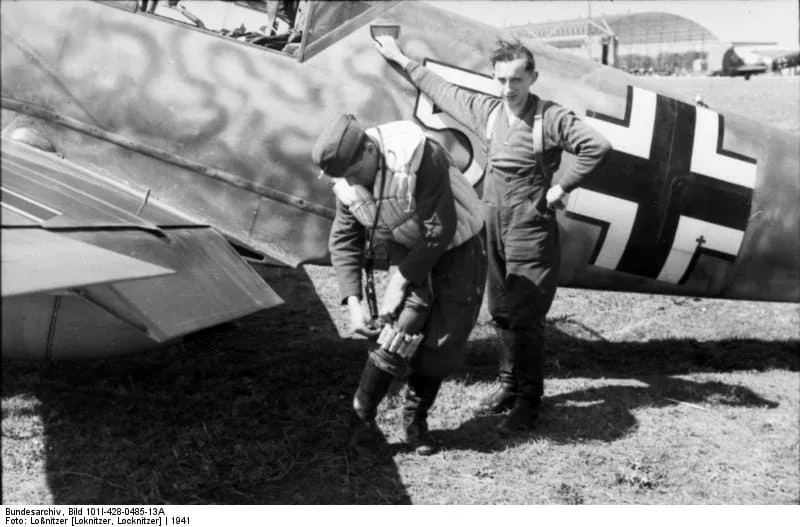
The Messerschmitt Bf 109 was the fighter with which Germany went into the war and with which it ended it. When it appeared in the mid-1930s it was one of the most modern aircraft in the world: an all-metal monoplane with an enclosed cockpit, retractable undercarriage and an inline engine. Throughout the war it was improved and up-gunned until it became the most-built fighter in history. The pilots credited with the most victories in the history of aviation flew it, and it was the Bf 109 that RAF airmen had to face in 1940 and American bomber crews in 1943–1944.
The new Luftwaffe’s aircraft
In 1934 the Reich Air Ministry called for designs for a single-seat fighter to replace the Arado and Heinkel biplanes. The small Bayerische Flugzeugwerke of Augsburg, where Willy Messerschmitt and Robert Lusser worked, offered an aircraft as light and small as possible, built around a powerful engine. German engines were not yet ready, so the prototype flew at the end of May 1935 with a British Rolls-Royce Kestrel; the date most often given is 28 May, some sources say 29 May. In comparative trials Messerschmitt’s aircraft beat the Heinkel He 112 and went into production for the Luftwaffe, which Hitler had unveiled a few weeks earlier.
From the start the design had two flaws that stayed with it to the end. The narrow track of the wheels, convenient for production, made the aircraft prone to getting out of control on take-off and landing; hundreds were wrecked this way on airfields. The small fuselage held little fuel, which in 1940 was to prove a serious problem.
Spain, Poland, France
In the spring of 1937 the first production Bf 109s reached the Condor Legion’s fighters and went into action in the Spanish Civil War. Spain was a proving ground for the Luftwaffe: pilots there, among them Werner Mölders, abandoned tight three-aircraft formations and worked out the loose formation of pairs and fours that other air forces adopted only during the war.
By September 1939 the Bf 109 was already the Luftwaffe’s standard fighter. In the September campaign it clearly outclassed the Polish PZL P.11 (PL) in speed and armament, although the Germans kept a large part of their Bf 109 units in the west. In December 1939, together with the twin-engined Bf 110, it broke up a raid by British Wellingtons in the Battle of the Heligoland Bight. In May 1940 dozens of Bf 109s covered the German crossings at Sedan, and the French and British bombers that tried to destroy the bridges died under the guns of the fighters and the flak.
The Battle of Britain
In the summer of 1940 the main version was the Bf 109E, the “Emil”, with a Daimler-Benz engine and 20 mm cannon. Against the Spitfire it was roughly an equal, and over the Hurricane it had the advantage in speed and climb. From airfields on the Channel, however, it reached London at the limit of its range and could fight over England for only some fifteen minutes. On Battle of Britain Day, 15 September, the Messerschmitts turned back over the capital’s suburbs and left the bombers on their own.
On top of that Hermann Göring, angered by bomber losses, ordered most of the fighters in August to stay close to the aircraft they were escorting, which took away their initiative. Unit commanders such as Adolf Galland considered the order a mistake. In the autumn Bf 109s with a bomb slung underneath flew over England as fighter-bombers, which did little damage but wore down the defence until the invasion was put off.
From “Friedrich” to “Gustav”
The F version, the “Friedrich”, with improved aerodynamics, reached the units at the turn of 1940 and 1941 and was then regarded as one of the best fighters in the world. From February 1941 Bf 109s from Sicily ruled the daytime skies over Malta; in the spring they fought in Yugoslavia, where the Yugoslav air force had them too, and over Crete, and in June they went east in Operation Barbarossa. Over North Africa it was flown by Hans-Joachim Marseille (PL), who was credited with 158 victories.
From 1942 the Focke-Wulf Fw 190 took over some of its tasks in the west, but the Bf 109 remained the mainstay of the Luftwaffe. The G version, the “Gustav”, with the more powerful DB 605 engine, introduced in mid-1942, was built in the largest numbers. Each new version was heavier and harder to fly, and experienced pilots complained that the “Friedrich” had been turned into an aircraft for aces rather than for youngsters straight out of short training. On the Eastern Front, in Jagdgeschwader 52, it was flown by Erich Hartmann (PL), who was credited with 352 victories; these figures are claims, not results verified after the war. Bf 109s also flew with the air forces of Finland, Romania, Hungary, Bulgaria, Slovakia, Croatia and Italy.
Defence of the Reich and the end
When American B-17s began bombing Germany by day, Bf 109s were weighed down with underwing cannon and rockets, which made them dangerous to bombers but defenceless against escort fighters. The factories at Regensburg, where a large share of the Bf 109s was built, were the target of the raid of 17 August 1943 and, in February 1944, of the whole series of raids of Big Week. Production was dispersed and increased, and more and more concentration camp prisoners were forced to work on it, among others at Flossenbürg and Mauthausen-Gusen. Once P-51 Mustangs appeared over the Reich, German pilot losses became impossible to make good. On 1 January 1945 hundreds of Bf 109s and Fw 190s took part in Operation Bodenplatte, the last great blow by the German fighter arm, which cost the Luftwaffe yet more irreplaceable pilots.
The last wartime version was the K-4, which could exceed 700 km/h. Depending on the count, between 33,984 and 34,248 were built. After the war Czechoslovakia produced a version with a different engine, the Avia S-199, on which the first pilots of the Israeli air force flew in 1948, and in Spain licence-built aircraft with Merlin engines served into the 1960s and played Messerschmitts in films about the Battle of Britain.
Sources
Battles
(05)- 17 July 1936 – 1 April 1939The Spanish Civil WarFrom July 1936 to April 1939 Franco's Nationalists, backed by Germany and Italy, fought the Soviet-supported Republic. Hundreds of thousands died.
- 12–15 May 1940Battle of Sedan (1940)On 12–15 May 1940 Guderian’s panzer corps forced the Meuse at Sedan after hours of Luftwaffe bombing, repelled counter-attacks and tore open the French front.
- 11 June 1940 – 20 November 1942Siege of MaltaFrom June 1940 to November 1942 Italy and Germany bombed and blockaded Malta. The island held out and became a base for attacks on Axis convoys to Africa.
- 10 July – 31 October 1940Battle of BritainFrom 10 July to 31 October 1940 the Luftwaffe tried to destroy the RAF ahead of an invasion of Britain. It failed, and Hitler postponed the landing.
- 6–17 April 1941Invasion of YugoslaviaBetween 6 and 17 April 1941 Germany, Italy and Hungary crushed the Yugoslav army in eleven days. Belgrade was bombed and the kingdom carved up by the victors.