1941: The Middle East campaign
Anglo-Iraqi War
- Dates:
- 2–31 May 1941
- Front:
- Middle East
- Location:
- Central and southern Iraq: RAF Habbaniya on the Euphrates and the plateau above it, Fallujah and Ramadi, the desert road from Transjordan through Rutba, the approaches to Baghdad with the Washash canal and Kadhimiya, the Basra and Shaibah area; airfields at Mosul, Kirkuk and in Vichy SyriaOn the battle map →
- Sides:
- United Kingdom, British India and TransjordanArchibald Wavell, Edward Quinan, John ClarkIraq (with air support from Nazi Germany and Italy)Rashid Ali al-Gaylani, Amin Zaki Sulaiman
- Result:
- British victory. A flying school and a handful of infantry held the base at Habbaniya, and a column sent from Palestine took Fallujah and advanced to the outskirts of Baghdad. Rashid Ali, the Mufti of Jerusalem and the leaders of the Golden Square fled to Iran, an armistice was concluded outside Baghdad on 31 May, and on 1 June the Regent, Abd al-Ilah, returned to the capital. German and Italian air support, sent by way of Vichy Syria, came too late and was too weak to change anything.
- Author:
- Łukasz
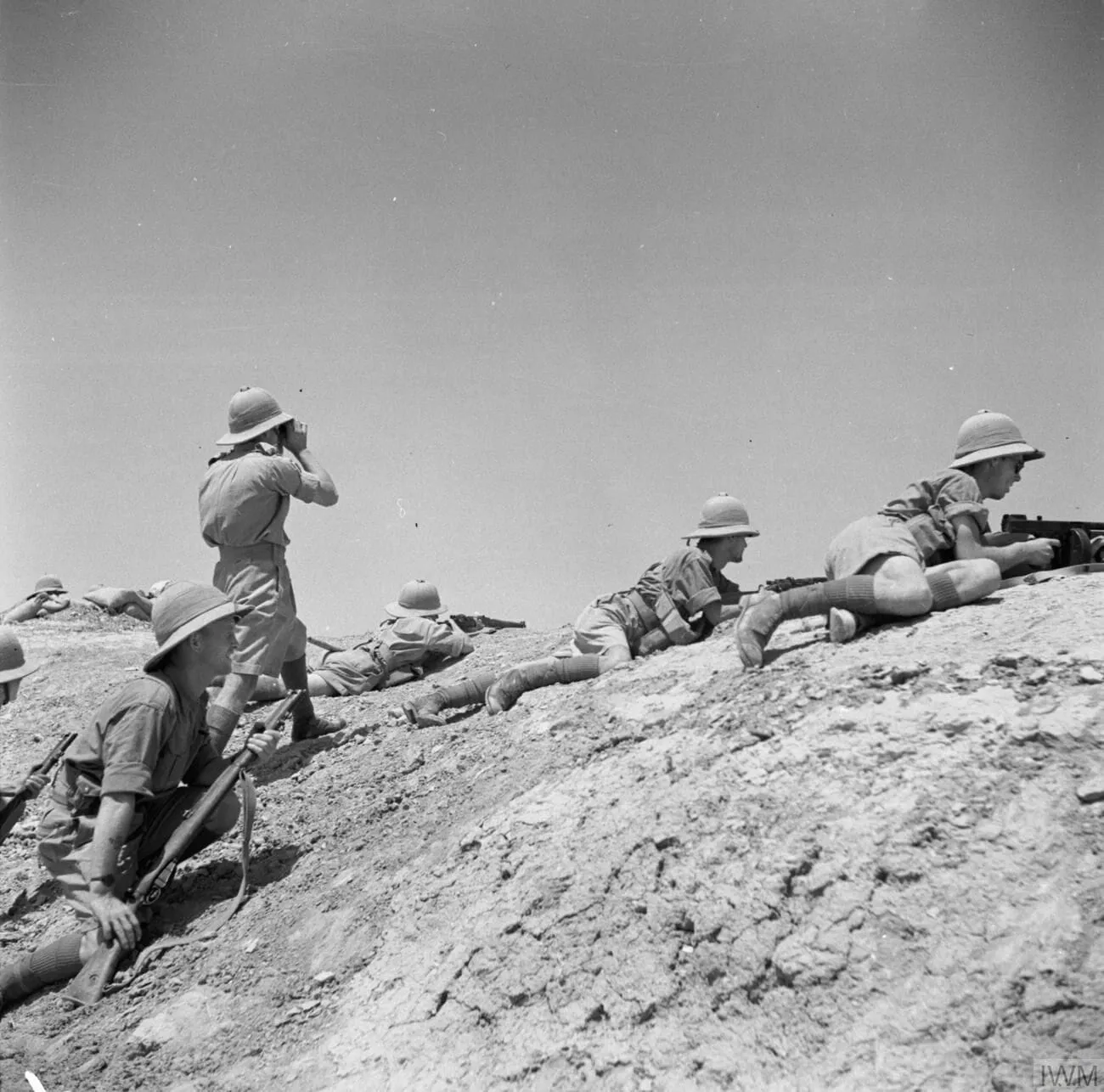
The Anglo-Iraqi War lasted less than a month and was fought with forces that anywhere else would have been thought absurdly small. On one side stood the army of Iraq, some 60,000 men in four divisions, with an air force that on paper had more than a hundred aircraft. On the other were an RAF flying training school at Habbaniya on the Euphrates, whose instructors and pupils flew obsolete biplanes, a single battalion of British infantry, a few companies of Assyrian auxiliaries and, later, a column hastily assembled in Palestine that crossed almost 900 kilometres of desert. There was indeed an Indian brigade, and later an Indian division, at Basra, but floods and wrecked railway lines kept it in the south almost until the end of the fighting.
The war was brought on by the government of Rashid Ali al-Gaylani, who at the beginning of April had seized power in Baghdad with the help of four anti-British colonels, and who on 30 April surrounded the Habbaniya base with troops. At dawn on 2 May the British struck first, from the air. After five days the Iraqis abandoned their positions above the base; after three weeks the British took Fallujah and its bridge over the Euphrates; and at the end of May they stood in the suburbs of Baghdad. On 29 and 30 May the leaders of the coup fled to Iran, and on 31 May an armistice was signed. Iraq, its oil and the overland route from the Persian Gulf to the Mediterranean remained on the Allied side.
Name and dates
In Polish writing the conflict is called the Anglo-Iraqi War or the Iraqi campaign of 1941; some accounts describe it under the name Operation Sabine, although Sabine was in fact the codename for the movement of troops from India to Basra in April. The British official history speaks of the “revolt in Iraq”. The British battle honour “Iraq 1941” covers the period from 2 to 31 May.
The opening and closing dates are certain: the British air attack on the plateau above Habbaniya at about 5 a.m. on 2 May, and the armistice concluded outside Baghdad on 31 May; the siege of the base had begun on 30 April, and operations against scattered units dragged on into June. On the details, the sources differ. According to the British official history and to the report that General Archibald Wavell submitted as Commander-in-Chief in India, the Iraqis abandoned the plateau on 6 May, and on the same day an Iraqi column advancing from Fallujah was smashed from the air; Wavell’s earlier report from Cairo and many chronologies give 7 May. According to the official history, the armistice was signed after a meeting on the bridge at 4 a.m.; according to Wavell’s report from India, at 3 p.m.
Background
Iraq had been formally independent since 1932, but the treaty of 1930, which followed on from the agreement of 1927, left the RAF two bases, at Shaibah near Basra and at Habbaniya, and gave Britain the right to move troops across the country. Through Iraq ran the overland route from Basra to Palestine and the pipelines from the Kirkuk oilfields to the Mediterranean.
In September 1939 Iraq broke off relations with Germany, but not with Italy, whose legation in Baghdad became a centre of Axis propaganda. Nationalists and officers of the so-called Golden Square gathered around the Grand Mufti of Jerusalem, Mohammed Amin al-Husseini, who had taken refuge in Baghdad in 1939. During the night of 1–2 April 1941 the colonels forced the Prime Minister, Taha al-Hashimi, to resign; the Regent, Abd al-Ilah, fled the country, and Rashid Ali’s “Government of National Defence” took power. Britain refused to recognise it.
The Prime Minister, Winston Churchill, wanted to act quickly, but Wavell, as Commander-in-Chief Middle East, had his hands full with the retreat in Cyrenaica, the campaign in Greece and the dying embers of the fighting in East Africa. The troops therefore came from India. On 17 April aircraft flew a battalion of the King’s Own Royal Regiment into Shaibah, and on 18 April the 20th Indian Infantry Brigade landed at Basra. London had no intention of withdrawing them, so when further transports arrived at Basra at the end of April, Rashid Ali decided to show his strength where the British were weakest. On 30 April Iraqi troops from Baghdad occupied the plateau above Habbaniya and demanded that flying stop. Air Vice-Marshal Harry Smart replied that he would regard any interference with training as an act of war. On 1 May permission to strike arrived from London, with Churchill’s note: “If you have to strike, strike hard.” Smart decided to attack at dawn without an ultimatum.
Forces
The Iraqi army numbered about 60,000 men. Two of its four infantry divisions, the 1st and 3rd, were in and around Baghdad, the 2nd at Kirkuk and the 4th at Diwaniya on the railway from Baghdad to Basra. Also stationed in the capital was an independent mechanised brigade with a company of Italian L3/35 tankettes and a company of Crossley armoured cars. The Chief of the General Staff was General Amin Zaki Sulaiman, who had held the post since February 1940, but in practice the army was run by the colonels of the Golden Square: Salah al-Din al-Sabbagh, Kamil Shabib, Fahmi Said and the air force commander, Mahmud Salman. According to British sources the Iraqi air force had 116 aircraft, of which 50–60 were serviceable, most of them at Rashid air base near Baghdad and at Mosul. Alongside the army there were the police and volunteer units, among them several hundred men of Fawzi al-Qawuqji, a commander from the days of the Arab revolt in Palestine, who operated in the desert between Rutba and Ramadi.
By the evening of 1 May, according to British estimates, some 9,000 troops had gathered around Habbaniya with about 50 guns, armoured cars and light tanks.
The base at Habbaniya, about 80 kilometres west of Baghdad, was militarily almost defenceless: the airfield lay at the foot of a plateau only a few hundred metres away, and the cantonment was surrounded by nothing more than an iron fence. Living there were about a thousand airmen, about 1,200 men of the auxiliary units known as the Iraq Levies, recruited mainly from among the Assyrians, and some 9,000 civilians. About 2,500 men were available for its defence, including some 300–350 soldiers of the 1st Battalion, King’s Own Royal Regiment, flown in from Shaibah, and No. 1 Armoured Car Company RAF with eighteen old Rolls-Royces. There was no artillery at all. From 1 May the ground forces were commanded by Colonel Ouvry Roberts, chief of staff of the 10th Indian Infantry Division, who had flown in to assess the situation and stayed.
The main weapon was No. 4 Flying Training School RAF. According to the official history it had 78 aircraft, including 32 Hawker Audax biplanes, 8 Fairey Gordons, 29 Airspeed Oxford trainers, a few Gladiators and a single Blenheim; a few fighters had flown in during April. The Audaxes and Gordons were modified to carry two 250 lb bombs each, and the Oxfords eight small bombs. There were hardly any real combat pilots; the aircraft were flown by instructors, pupils and a few Greek airmen who were training at the base. Eighteen Vickers Wellington bombers were sent from Egypt to Shaibah.
In the south, around Basra, Major General William Fraser had the 20th Indian Infantry Brigade with two battalions of Gurkhas and a Sikh battalion, and on 6 and 7 May the 21st Brigade came ashore. On 7 May Lieutenant General Edward Quinan flew in from India and took command of all land forces in Iraq (known as Iraqforce).
Course of the war
The Battle of Habbaniya (2–6 May)
On 2 May, before dawn, every aircraft at Habbaniya that could fly was circling over the plateau. At 5 a.m. 33 of them, together with eight Wellingtons from Shaibah, began bombing and strafing the Iraqi positions. The attack took the Iraqis by surprise; many of them thought they were taking part in an exercise. After a few minutes the Iraqi artillery opened fire on the airfield and the cantonment, and during the day the Iraqi air force appeared over the base. On the first day the school flew 193 sorties; it lost five aircraft and several others were damaged, while 13 people were killed at the base and 29 wounded, nine of them civilians. British aircraft also attacked the airfields near Baghdad and, according to some sources, destroyed 22 Iraqi aircraft on the ground there.
The Iraqis did not withdraw, but their artillery proved less dangerous than had been feared. Smart concluded that there would be no assault on the base, and from 3 May he turned part of his strength against the Iraqi air force and the supply routes from Baghdad. That day the Iraqi authorities dismantled the radio station of the British embassy in Baghdad, where some 350 British subjects had taken refuge; the ambassador, Sir Kinahan Cornwallis, was cut off from the outside world for the next four weeks. On 4 May Wellingtons and Blenheims attacked the airfields at Baghdad and Mosul. By 7–8 May the Iraqi air force had practically ceased to exist.
In Baghdad the news of the attack came as a shock. Rashid Ali and the colonels had expected the base to surrender or London to open negotiations, and the Mufti al-Husseini proclaimed a jihad against Britain; Baghdad radio broadcast the formal fatwa on 9 May. Oil stopped flowing through the pipeline to Haifa, and Iraqi police occupied the fort at Rutba on the road to Transjordan, where they had already fired on British road workers on 1 May. Turkey offered to mediate and Wavell advised accepting, but the Defence Committee in London refused: the situation in Iraq had to be restored by force.
On 5 May Smart was injured in a car accident and evacuated to Basra and then to India. Command of the air forces in Iraq passed to Air Vice-Marshal John D’Albiac, who had returned from Greece; the defence of the base was directed by Colonel Roberts. During the night of 5–6 May patrols of the King’s Own and the Assyrian Levies attacked the positions above the base, supported by armoured cars and two howitzers from the First World War, which until then had adorned the entrance to the officers’ mess and had now been restored to working order. At dawn on 6 May it turned out that the Iraqis had abandoned the plateau, leaving behind their weapons and equipment.
The RAF armoured cars then ran into a strong force covering the retreat in the village of Sin el Dhibban on the road to Fallujah. After a short fight, in which Audaxes gave air support to the King’s Own and the Levies, the Iraqis were driven out. During the day, according to Wavell’s report, 26 officers and 408 other ranks were taken prisoner. In the afternoon airmen spotted a column coming from Fallujah to relieve the besiegers. On the road between Habbaniya and Fallujah, a few kilometres from the base, some forty aircraft fell upon it. They left behind them, in the words of the official history, “a tangle of exploding ammunition and burning lorries”; the British estimated Iraqi losses at more than a thousand men. Six howitzers, ten armoured cars and 79 lorries were captured. That same afternoon the Iraqi air force bombed the base three times, but the siege was over. Churchill cabled to Smart, of whose accident he did not yet know: “Your vigorous and splendid action has largely restored the situation.”
Basra and the dispute over command
In the south there was little fighting. Troops of the 20th Brigade occupied the airport, the docks and the power station at Ma’qil in Basra, but did not have the strength to hold the whole city at once. The Iraqi units agreed to leave Basra on 2 May but failed to do so, and withdrew northwards only after artillery fire and bombing. On 7 May the Gurkhas occupied the commercial district of Ashar. According to Wavell’s report the resistance was weak; according to other descriptions the policemen and armed civilians defending it inflicted considerable losses on the attackers. Resistance around Basra continued until the middle of May. There was no going further north: it was the flood season, roads and railway tracks were under water, and the Iraqis had occupied points along the Tigris and the railway line.
The war also upset British command arrangements. In March Wavell had handed responsibility for Iraq to India, which had provided the troops for Basra. When the fighting began on 2 May, it became clear that only Cairo could send immediate help to Habbaniya. Wavell protested: the column he could form in Palestine would, in his view, be “too weak and too late” and would rob him of his only reserve in the event of a crisis in Syria. He advised negotiating with Baghdad. The Chiefs of Staff replied that there could be no question of talks unless the Iraqis backed down, and took upon themselves the responsibility for sending troops. On 5 May Wavell, against his will, took over command in northern Iraq, and on 8–9 May in the south as well. “A nice birthday present you have given me,” he wrote to the Chief of the Imperial General Staff.
Wavell gave Quinan the task of securing Basra and building up a base there, and of not advancing inland until he had secured the cooperation of the tribes. In mid-May Major General William Slim took over command of the 10th Indian Infantry Division from the ailing Fraser. On 23 May Wavell met the Commander-in-Chief in India, General Claude Auchinleck, at Basra and ordered Quinan to move on Baghdad. On 27 May the 20th Brigade set out from Shaibah along the railway up the Euphrates, but because of floods and broken track it reached Baghdad only on 12 June, long after the fighting had ended.
The Germans and Italians in Iraq
Axis help was late from the very start. In April Berlin assured Rashid Ali of its “full sympathy” and promised arms, but was unable to deliver them: the routes through the USSR and Turkey were closed. The outbreak of fighting on 2 May took the Germans by surprise. On 3 May Joachim von Ribbentrop persuaded Hitler to send the former minister in Baghdad, Fritz Grobba, on a diplomatic mission. The key turned out to be Syria, ruled by Vichy France. On 6 May, during Admiral François Darlan’s talks with the Germans in Paris, Vichy agreed to hand over to the Iraqis some of the weapons in the sealed depots in Syria, to let German transports through and to make airfields in northern Syria available to the Luftwaffe. On 13 May the first train carrying arms reached Mosul from Aleppo.
On that same 6 May an air force for Iraq was created on Hitler’s orders. Colonel Werner Junck, appointed air commander Iraq (Fliegerführer Irak), was, according to the official history, to receive 14 Messerschmitt Bf 110 heavy fighters from Zerstörergeschwader 76 and 7 Heinkel He 111 bombers from Kampfgeschwader 4, together with transport aircraft. All the machines were painted with Iraqi markings. They flew via Rhodes and the Syrian airfields and landed at Mosul between 11 and 15 May; the main body arrived on 13 May. Major Axel von Blomberg, son of Field Marshal Werner von Blomberg, who was to coordinate operations with the Iraqis, was killed over Baghdad by fire from Iraqi soldiers (on 12 May according to the official history, on 15 May according to other accounts). Command of the military mission, called Sonderstab F, was then taken over by General Hellmuth Felmy, and on 23 May Hitler issued Directive No. 30, in which he proclaimed the “Arab freedom movement” Germany’s natural ally, but postponed any decision on an offensive against the British positions between the Mediterranean and the Persian Gulf until after the planned attack on the USSR. On 27 May twelve Italian Fiat CR.42 fighters flew in to Mosul.
Fliegerführer Irak attacked Habbaniya and the British columns, but it was short of spare parts, bombs and good fuel, and the British bombed its airfields. On 14 May the Chiefs of Staff authorised the RAF to strike at German aircraft on airfields in Syria as well, knowing that French aircraft would suffer too. By 18 May Junck had only eight Bf 110s and four He 111s left. By the end of the month he had not a single serviceable fighter, and two Heinkels with four bombs. The German mission left Iraq on 29 May, Grobba a day later.
Habforce and Kingcol
The force that Wavell assembled in Palestine was named Habforce (from Habbaniya Force). It was commanded by Major General John George Walters Clark, commander of the 1st Cavalry Division, which had been stripped of its artillery, engineers and transport for the benefit of other fronts. Its core was Brigadier James Kingstone’s 4th Cavalry Brigade (the Household Cavalry Regiment and two yeomanry regiments), with the 60th Field Regiment, Royal Artillery, and the 1st Battalion of the Essex Regiment. A squadron of the Arab Transjordan Frontier Force refused to fight the Iraqis and was disarmed. The Arab Legion of Emir Abdullah of Transjordan, on the other hand, served loyally under the command of John Bagot Glubb, known as Glubb Pasha.
The first task was to recover the fort at Rutba, the last reliable source of water on the road from Haifa to Baghdad. From 8–9 May the fort was attacked by Blenheims and a detachment of the Legion, but its defenders, the Iraqi desert police, had been reinforced by Qawuqji’s men. Only when the RAF armoured cars arrived on 10 May and, after a day-long skirmish, Qawuqji’s lorries drove off, did the police abandon the fort during the night.
The spearhead of Habforce, named Kingcol after its commander, consisted of about 2,000 men with 500 vehicles: the brigade headquarters, the Household Cavalry Regiment, a battery of 25-pounder guns, two companies of the Essex Regiment and eight RAF armoured cars. Contrary to an often repeated view, it was not a mounted column but a motorised one. It carried food for twelve days and water for five. On 13 May it crossed the Iraqi border and reached Rutba that evening. On 15 May it was attacked by the first German aircraft. The next day its lorries sank into soft sand in heat approaching 50 degrees in the shade; the column had to turn back and find a way round. Guided by men of the Legion, it skirted Lake Habbaniya to the south via the bridge at Mujara and on 18 May entered the base, twelve days after the siege had ended. Clark and D’Albiac flew in the same day.
Fallujah (19–22 May)
Fallujah, with its bridge over the Euphrates, here about 270 metres wide, barred the road to Baghdad. It was held by a garrison the size of a brigade; a second Iraqi brigade sat in Ramadi, west of the base, but it had breached the dykes and cut itself off with floodwater, so the British decided to bypass it. The attack had been prepared by Colonel Roberts, and Clark and D’Albiac left him a free hand. The troops used were units from Habbaniya, a battalion of Gurkhas flown in from Basra, and Kingcol’s artillery. On the evening of 18 May three columns moved off. The first crossed on a cable ferry at Sin el Dhibban and approached the town from the north-west; aircraft landed a company of the King’s Own on the Baghdad road beyond the town; and the third, Captain Alastair Graham’s Assyrian company of Levies, was supported by Kingcol’s guns.
From 5 a.m. on 19 May 57 aircraft bombed the Iraqi positions in and around Fallujah, sparing the town itself for the sake of its inhabitants. Leaflets dropped calling for surrender went unanswered. At 2.45 p.m., after a ten-minute air attack on the trenches by the bridge, the Assyrians advanced across marshy ground and half an hour later were on the far side. The bridge was taken intact, some 300 Iraqis surrendered and, according to the official history, the British did not lose a single man. The response was a German air raid on Habbaniya that destroyed several aircraft.
During the night of 21–22 May, at about 2.30 a.m., the Iraqi 6th Brigade of the 3rd Division, supported by light tanks, attacked Fallujah, which was held by two companies of the King’s Own and the Levies. The Iraqis broke into the outskirts, and two tanks drove into the town. Counter-attacks from house to house by the Assyrians and by companies of the Essex Regiment brought up from Habbaniya had driven them out by evening; six light tanks were captured. The Assyrians lost twelve men, the King’s Own nearly forty killed and wounded. Iraqi reserves moving up were broken up by aircraft. This was the last Iraqi attempt to retake the crossing; Fliegerführer Irak, whose support might have made a difference, appeared over the town only the following day.
The march on Baghdad and the armistice
At Fallujah Clark had about 1,200–1,450 men, eight guns and a few armoured cars; in Baghdad stood almost an entire Iraqi division, and in Ramadi, in his rear, another brigade. He nevertheless decided to press on, counting on the Iraqis not knowing how weak he was. An approach from the south would have led through the holy city of Karbala, which would have inflamed the population, so he advanced from the west in two columns. During the night of 27–28 May the northern column under Lieutenant Colonel A. H. Ferguson of the Household Cavalry, guided by the Arab Legion, which had earlier cut the railway from Baghdad to Mosul, crossed the Euphrates at Sin el Dhibban and vanished into the desert. On 28 May Kingstone’s southern column set off along the main road and, after a skirmish at Khan Nuqta, halted a dozen or so kilometres short of Baghdad at a canal over which the Iraqis had blown the bridge. An interpreter who found a working Iraqi telephone talked down the line about the might of the approaching British, and at the headquarters of the 3rd Division it was concluded that “the presence of British tanks has been confirmed”. Ferguson’s column beat off a night attack and was held up in front of Kadhimiya, a holy city of the Shia, which could not be shelled. On 29 May the southern column seized a bridgehead, and on 30 May it threw a bridge across and reached the Washash canal on the western outskirts.
Clark was advancing slowly and had no reinforcements within reach, but Baghdad was already falling apart. Rumour credited the British with hundreds of tanks, and on 28 May a German diplomat reported to Berlin that there were “more than a hundred”. On 29 May Rashid Ali, the Mufti, the colonels of the Golden Square and Grobba left Baghdad, some of them crossing the Iranian border near Khanaqin only on 30 May. In the capital a Committee of Internal Security was formed, headed by the mayor of Baghdad, Arshad al-Umari; it was he who asked for terms. At 7 p.m. on 30 May Clark learned from Cairo of Rashid Ali’s flight, and soon afterwards came the first message in four weeks from Ambassador Cornwallis, asking him to receive Iraqi envoys. The meeting was fixed for 4 a.m. on 31 May on the bridge over the Washash canal. In the ambassador’s presence the armistice was signed by Clark, D’Albiac and Iraqi officers; the Iraqi historian Majid Khadduri dates the agreement to 30 May. The city was not formally surrendered, and British troops did not enter it.
The terms were mild and brief, for the British cared above all about the rapid formation of a friendly government. The fighting was to stop, British prisoners were to be returned, German and Italian personnel interned, and the Iraqis were to leave Ramadi. The Iraqi army kept its weapons and had only to return to barracks. The Chiefs of Staff in London were displeased that no right to occupy key points had been reserved, but the new authorities agreed to the dispatch of a small British detachment to Mosul. On 1 June the Regent, Abd al-Ilah, returned to the capital, and on 1 and 2 June, in the power vacuum of those days, a pogrom of the Jews took place in Baghdad, known as the Farhud. The figure most often given is about 180 Jews killed; the Holocaust Encyclopedia speaks of 128, and other sources of a far higher number.
Losses
British losses were small; Wavell described them in his report as “slight”, without giving figures. According to the official history, the RAF lost 34 killed and 64 wounded in Iraq in May, and 28 aircraft shot down or destroyed. Losses among the land forces ran into dozens: the heaviest were borne by the King’s Own battalion and the Assyrian Levies in the defence of Habbaniya and the fighting for Fallujah. According to Wavell, the Iraqi army admitted to 1,750 killed and wounded, 500 of them killed; several hundred soldiers were taken prisoner at Habbaniya and Fallujah. The Iraqi air force was almost entirely destroyed. The Germans lost 14 Bf 110s and 5 He 111s, the Italians 3 CR.42 fighters.
Significance
The Anglo-Iraqi War was one of the few bright spots of the British spring of 1941, when Greece had to be evacuated, the army in Cyrenaica was falling back before Rommel and, at the end of May, the Battle of Crete was being lost. The British official history acknowledged that it was London, against Wavell, that had been right in demanding swift and bold action, but also that the Iraqis would not have collapsed so quickly had the flying school at Habbaniya not taken the offensive on its own.
For the Axis it was a lost opportunity: the Germans, absorbed in preparations for the attack on the USSR and in the landing on Crete, sent too little to Iraq, too late. Wavell believed that had the Germans given the Iraqis even a single success, the whole country might have risen against the British. The defeat in Iraq also showed Arab nationalists that they could not count on real military help from the Axis. Rashid Ali and the Mufti made their way through Iran, Turkey and Italy to Berlin, where they remained Hitler’s guests until the end of the war; the four colonels were caught and hanged between 1942 and 1945.
The most important consequences followed quickly. Because of the help Vichy had given the Luftwaffe in Syria, on 8 June 1941 British, Australian, Indian and Free French troops entered Syria and Lebanon, some of them setting out from Iraq. In August troops advancing from Iraq joined the Red Army in occupying Iran. Basra became a great supply base, and a considerable share of the deliveries to the USSR later passed through Iraq and Iran. The British remained in Iraq until 1947, and in Iraq itself the memory of May 1941 long divided the country: to the nationalists the colonels were martyrs; to their opponents and to Iraqi Jews, May 1941 marked the beginning of a tragedy.