Equipment
North American P-51 Mustang
A fighter built for the RAF which, with the British Merlin engine, became an escort able to fly with bombers to Berlin and bleed the Luftwaffe white in 1944.
- Role:
- escort fighter
- State:
- United States
- Maker:
- North American Aviation
- First flight:
- 26 October 1940
- Built:
- 15,000–15,700, depending on the source
- Author:
- Łukasz
- Updated:
- 1 November 2026
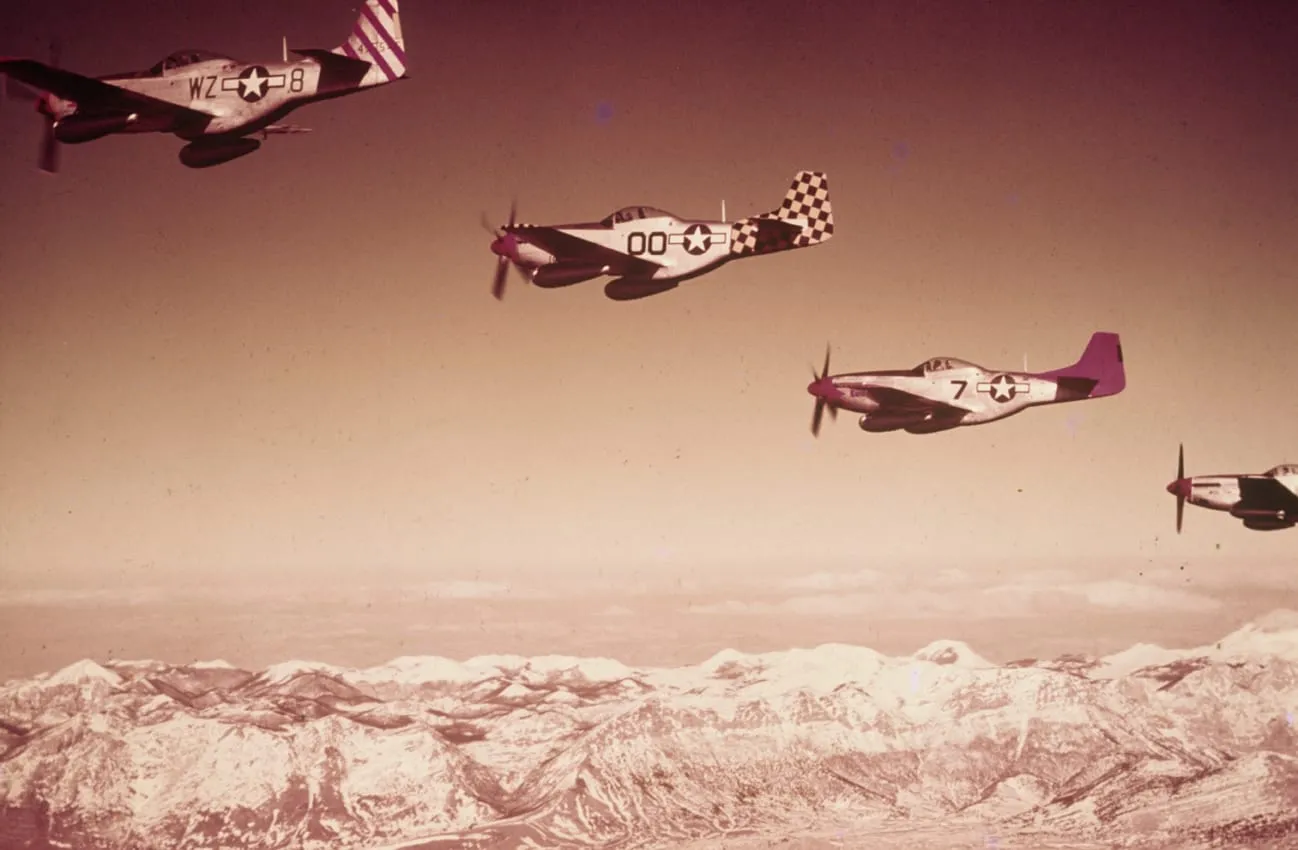
The North American P-51 Mustang solved a problem the American command had been unable to crack throughout 1943: the lack of a fighter able to accompany the heavy bombers deep into Germany and fight the German fighters there on equal terms. Designed to a British order and long neglected by the US Army Air Forces, it only showed what it could do once fitted with the British Rolls-Royce Merlin engine. From the spring of 1944 Mustangs flew with the bombers to Berlin and back, and by hunting fighters in the air and on their airfields they took from the Luftwaffe control of its own skies. In 1945, flying from Iwo Jima, they escorted B-29s over Japan.
A British order
In the spring of 1940 the British purchasing mission in the United States wanted North American Aviation (PL) to build Curtiss P-40s under licence for the RAF. The company’s management offered an entirely new fighter instead, and the British ordered 320 before even a prototype existed. The NA-73X was ready in September and took to the air on 26 October 1940. It had a low-drag laminar-flow wing and a radiator tucked under the fuselage behind the cockpit, which made it fast and economical with fuel. It was the British who named it the Mustang.
Its weak point was the Allison V-1710 (PL) engine with a single-stage supercharger, which lost power above roughly 4,500 metres (15,000 ft). So from January 1942 the RAF sent its Mustang Is not to Fighter Command but to the army co-operation squadrons, for reconnaissance and low-level ground attack. Four Mustang squadrons covered the Dieppe raid in August 1942. The Polish No. 309 Squadron (PL) also flew Mustang Is, receiving its first aircraft in June 1942 and patrolling the North Sea with them. Meanwhile the US Army Air Forces ordered a dive-bomber version, the A-36 Apache (PL), used in Sicily and Italy in 1943.
The Merlin
In the spring of 1942 the Rolls-Royce test pilot Ronald Harker, after flying a Mustang, proposed fitting it with the two-stage Merlin, the engine of the Spitfire Mk IX. British trials from October 1942 and parallel work in the United States produced an aircraft nearly 160 km/h (100 mph) faster at altitude. The American air attaché in London, Thomas Hitchcock, wrote in the autumn of 1942 that the Mustang was perhaps the best fighter airframe of the war and advised “cross-breeding” it with the Merlin. Within weeks General Henry Arnold was reporting to President Roosevelt that the Army had ordered some 2,200 aircraft. The engine was built under licence in the United States by Packard. The Army Air Forces’ official history admits that the delay in recognising the Mustang very nearly became the air arm’s costliest mistake of the war.
Over Berlin
The first P-51B group, the 354th Fighter Group, arrived in Britain in November 1943, and on 13 December it flew with the bombers to Kiel and back: the longest escort yet. With drop tanks the Mustang could reach Berlin and still fight there. In January 1944 James Doolittle took command of the Eighth Air Force; he freed the fighters from having to stay close to the bombers and sent them to hunt down German aircraft. During “Big Week” in February 1944 a few Mustang groups covered the bombers on the most distant stretches of their routes, and on 6 March more than 900 fighters of various types accompanied over 800 bombers to the Reich’s capital. By the end of 1944 the Eighth Air Force had re-equipped every fighter group but one with Mustangs, and from August P-51 output exceeded that of the Thunderbolt.
In the spring of 1944 Mustangs and Thunderbolts inflicted losses in pilots that the Luftwaffe could no longer make good, and before the Normandy landings the Allies ruled the skies of western Europe. The P-51D, with a bubble canopy and six 12.7 mm machine guns, became the most numerous version. In February 1945 several hundred Mustangs escorted the raid on Berlin of 3 February, and German fighters barely showed themselves. The Mustang groups of the Eighth, Ninth and Fifteenth Air Forces claimed some 4,950 aircraft shot down and more than 4,100 destroyed on the ground. The black pilots from Tuskegee also flew Mustangs; Fifteenth Air Force bomber crews in Italy knew them by their red tails.
The Polish squadrons
In the RAF the Merlin-engined Mustang was designated the Mustang III. In March 1944 it went to No. 316 Squadron (PL), while Nos. 306 and 315 Squadrons became part of No. 133 Wing, commanded from April by Stanisław Skalski. Polish Mustangs fought over Normandy in June 1944 and from July, stripped of unnecessary equipment, chased V-1 flying bombs over England, which only the fastest aircraft could catch. In the autumn they returned to escorting bomber raids over the Reich, and No. 309 Squadron moved from Mustang Is to Mustang IIIs. In 1945 No. 303 Squadron also received Mustang IVs.
The Pacific and the end of the war
In the Far East P-51As fought from 1943 in Burma and China, among other places in the raid on Rangoon in November 1943. Their most important task in the Pacific, however, was escorting the B-29s. The capture of Iwo Jima was meant to give them a base closer to Japan: the first P-51s landed there on 6 March 1945, and on 7 April they escorted B-29s for the first time, in a daylight attack on aircraft factories near Tokyo, part of the series of raids that led up to the night attack of 13–14 April. On 29 May 101 Mustangs accompanied the B-29s over Yokohama. The round trips covered some 2,400 kilometres of open sea, and the most dangerous enemy was often the weather.
Depending on the source, between about 15,000 and over 15,600 Mustangs were built; at the end of the war the Army’s air arm had more than 5,500 of them. The P-51 went on to fight in Korea. It is remembered as the fighter that gave the American bombing offensive what it lacked most: protection all the way to the target and back.