Equipment
The Boeing B-29 Superfortress
America’s costliest aircraft of the war: it disappointed from India and China, burned Japan’s cities from the Marianas and dropped the atomic bombs.
- Role:
- long-range heavy bomber
- State:
- United States
- Maker:
- Boeing
- First flight:
- 21 September 1942
- Built:
- about 3,970
- Author:
- Natalia
- Updated:
- 1 November 2026
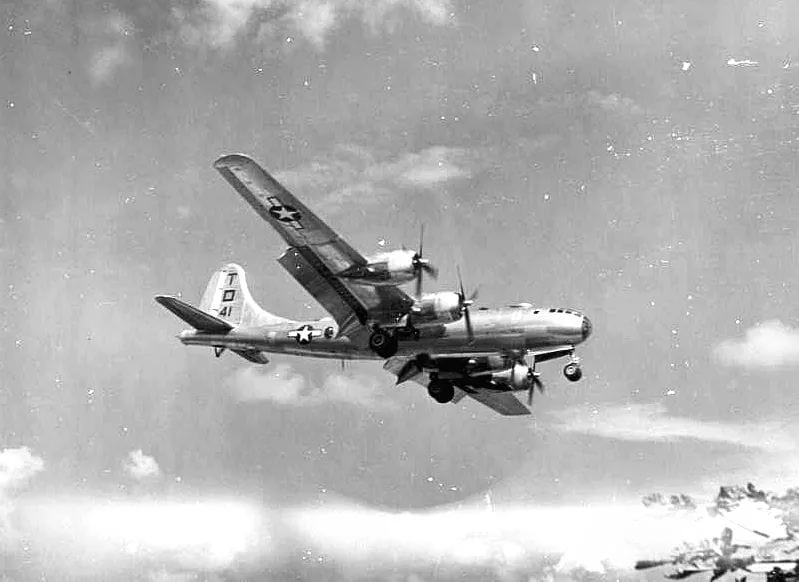
The Boeing B-29 Superfortress was the most advanced and most expensive aircraft the United States built during the war. It had pressurised cabins, remotely controlled gun turrets and the range to carry several tons of bombs more than two and a half thousand kilometres. It was meant from the start for the war against Japan, and it was the B-29 that carried the air war over the home islands: first from China, then from the Marianas. Its story is also that of how American air power abandoned the precision bombing of factories in favour of burning whole cities, and in August 1945 turned to the atomic bomb.
The three-billion-dollar gamble
In November 1939 General Henry Arnold, chief of the Army Air Corps, asked for authority to develop a bomber that would outdo the B-17 and B-24 in range and load. Boeing won the competition, and on 17 May 1941, more than a year before the first flight, the army ordered the first production aircraft. The official history of the Army Air Forces called the decision a three-billion-dollar gamble: that was roughly what the whole programme cost, clearly more than the atomic bomb project. At the same time the army was paying for an even larger bomber, the B-36, but against Japan it staked everything on the B-29.
The first prototype took off from Boeing’s airfield in Seattle on 21 September 1942. The trouble began at once. On 18 February 1943 the second prototype caught fire in the air and came down on a meat-packing plant, killing chief test pilot Edmund Allen, a crew made up of the programme’s best engineers, and some twenty workers on the ground. The cause lay in the new Wright R-3350 engines, which overheated and caught fire until the end of the war. Even so, production started in four huge plants: Boeing’s at Wichita and Renton, Bell’s at Marietta and Martin’s near Omaha. One of the pilots who logged the most hours on the B-29 during its trials was Paul Tibbets.
Over the Himalayas: India and China
The Marianas were still in Japanese hands, so the first B-29s went to Asia. Under the Matterhorn plan, General Kenneth Wolfe’s XX Bomber Command was based on airfields in India and was to fly over Japan from four forward airfields around Chengdu, built almost by hand by hundreds of thousands of Chinese peasants. The whole plan is described in more detail in the article on the B-29 raids from China. Fuel and bombs had to be carried across the Himalayas, much of it in the bombers themselves, so each combat sortie required several supply flights over the mountains. The Japanese considered the bases so dangerous that one of the aims of their great Ichi-Go offensive was to take the airfields in China away from the Americans.
The baptism of fire was a disappointment. On 5 June 1944, 98 bombers took off from India for the railway workshops in Bangkok; 77 bombed the target and five were lost in accidents. On 15 June, 47 of the 68 aircraft sent from around Chengdu reached the steelworks at Yawata, the first target in the Japanese home islands since the Doolittle Raid. Later missions reached the Palembang refineries in Sumatra and the Singapore docks, but the results remained modest. From August 1944 XX Bomber Command was led by Curtis LeMay, who improved training and maintenance but could not change geography. Several damaged B-29s landed in the Soviet Far East; the USSR never returned them, and after the war copied them as the Tu-4.
From the Marianas over Tokyo
The B-29 got a real base only with the capture of Saipan in July 1944. From the Marianas to Tokyo was about 2,400 kilometres, and supplies arrived by ship straight from the United States. On 12 October the first B-29 landed on Saipan, and on 24 November 111 bombers of General Haywood Hansell’s XXI Bomber Command struck Tokyo for the first time. Precision daylight raids from eight or nine kilometres up were a disappointment: the jet stream blew the bombs off target, clouds covered Japan, and engines overloaded by the long climb failed, so that many aircraft ditched on the way home. That was one of the reasons for taking Iwo Jima, where, according to American figures, 2,251 B-29 landings were recorded by the end of the war.
In January 1945 Arnold replaced Hansell with LeMay. LeMay had most of the defensive armament removed from the bombers and sent them in at night, at heights of between one and a half and just under three kilometres, loaded with incendiaries. On the night of 9–10 March 1945 more than 300 B-29s started a fire in Tokyo that killed between 80,000 and 100,000 people; the Americans lost fourteen aircraft. Within ten days similar blows fell on Nagoya, Osaka and Kobe, and by the summer the campaign had spread to dozens of smaller cities. By May LeMay had about a thousand B-29s. The bombers also dropped mines in harbour approaches and straits, which all but paralysed Japan’s coastal shipping.
Hiroshima and Nagasaki
The choice of the B-29 to carry the atomic bomb was agreed between Arnold and General Leslie Groves, who ran the project. In December 1944 the 509th Composite Group was formed under Tibbets, equipped with specially modified bombers from the Martin plant. On 6 August 1945 the B-29 Enola Gay, flying from Tinian, dropped the uranium bomb on Hiroshima, and three days later Major Charles Sweeney’s Bockscar dropped the plutonium bomb on Nagasaki. Conventional raids went on to the end: on 14 August another 828 B-29s were sent over Japan.
By 1946 about 3,970 Superfortresses had been built (the Polish Wikipedia gives 3,960), more than two thousand of them before Japan’s surrender. After the war B-29s bombed Korea, flew in Britain as the Washington, and the USSR produced more than eight hundred copies. The war also showed how far theory and practice could diverge: an aircraft designed to hit factories accurately from great height achieved its greatest effect when it flew low, at night, and burned cities together with their inhabitants. Judging that campaign, which killed hundreds of thousands of Japanese civilians, remains one of the hardest arguments about this war.
Sources
Battles
(04)- 17 April – 10 December 1944Operation Ichi-GoFrom 17 April to 10 December 1944 the Japanese drove from Henan through Hunan to Guangxi, took US air bases and linked their front in China with Indochina.
- 15 June – 9 July 1944Battle of Saipan15 June – 9 July 1944. The US took Saipan in the Marianas; nearly all the garrison and thousands of civilians died, and B-29s won bases within reach of Japan.
- 21 July – 10 August 1944Battle of Guam (1944)21 July – 10 August 1944. The Americans retook Guam, lost in December 1941. Nearly 18,000 Japanese died, and the island became a huge fleet and B-29 base.
- 19 February – 26 March 1945Battle of Iwo Jima19 Feb – 26 Mar 1945: US Marines took Iwo Jima, which Kuribayashi defended from tunnels. Total American casualties exceeded Japanese ones.
In the chronicle
(35)1944
- 23 February 1944The first raid on the Marianas
- 17 April 1944Operation Ichi-Go begins
- 12 June 1944Strikes on the Marianas
- 15 June 1944The landing on Saipan
- 19 June 1944The Battle of the Philippine Sea
- 9 July 1944The end of the fighting on Saipan
- 10 July 1944B-29 raids from China
- 18 July 1944The fall of the Tōjō cabinet
- 21 July 1944The landing on Guam
- 24 July 1944The landing on Tinian
- 1 August 1944The end of the fighting on Tinian
- 10 August 1944The raid on Palembang
- 23 October 1944B-29s in the Marianas
- 5 November 1944The raid on Singapore
- 24 November 1944B-29s over Tokyo
1945
- 2 January 1945The B-29 raid on Bangkok
- 6 January 1945B-29 raids on Japan in January 1945
- 25 January 1945The shelling of Iwo Jima
- 2 February 1945The destruction of the Singapore dock
- 19 February 1945The landing on Iwo Jima
- 25 February 1945The incendiary raid on Tokyo of 25 February
- 9 March 1945The Tokyo raid of 9–10 March
- 11 March 1945The incendiary raid on Nagoya
- 16 March 1945The end of the fighting on Iwo Jima
- 14 April 1945The Tokyo raid of 13–14 April
- 14 May 1945The Nagoya raid of 14 May
- 15 June 1945The Osaka raid of 15 June
- 16 July 1945The Trinity test
- 30 July 1945Attacks on Kobe and Nagoya
- 6 August 1945The atomic bombing of Hiroshima
- 14 August 1945The last raids on Japan