Equipment
Republic P-47 Thunderbolt
The heaviest single-engine fighter of the war: it first escorted bombers towards the Reich, then as a fighter-bomber destroyed bridges, trains and columns.
- Role:
- fighter and fighter-bomber
- State:
- United States
- Maker:
- Republic Aviation
- First flight:
- 6 May 1941
- Built:
- about 15,600–15,700
- Author:
- Łukasz
- Updated:
- 1 November 2026
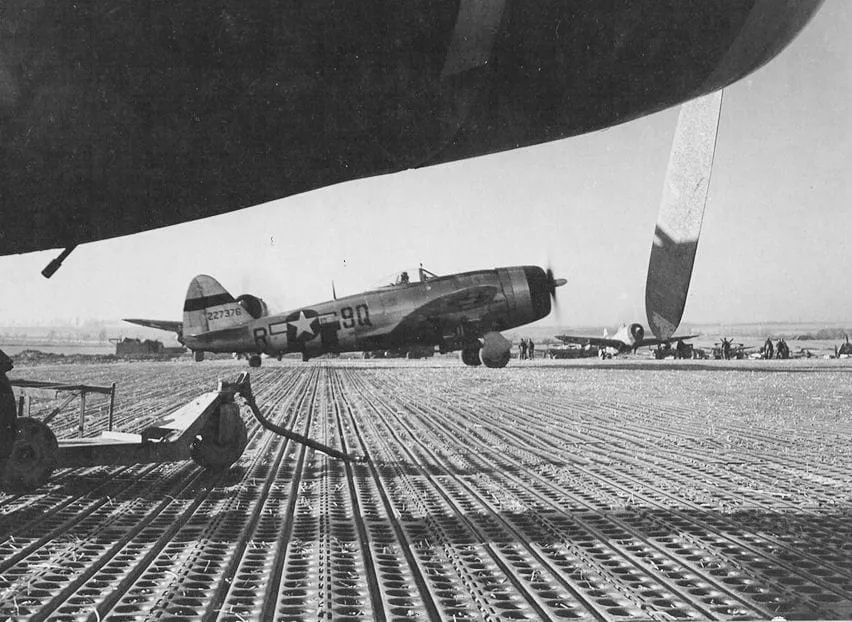
The Republic P-47 Thunderbolt, known to American pilots as the “Jug”, was the largest and heaviest single-engine fighter used in this war: fully loaded, it weighed more than six tonnes. It began as an escort for the heavy bombers of the Eighth Air Force, but throughout 1943 it lacked the fuel to reach deep into Germany. It won its fame in a second role: from the spring of 1944, as a fighter-bomber, it destroyed bridges, trains and armoured columns from Normandy to the Rhine. It was flown by Americans, British, French, Brazilians and Mexicans, and in one American group by Poles as well.
An engine with wings
Republic Aviation (PL) of Farmingdale, Long Island, grew out of the Seversky company in 1939, and its chief designer was a Georgian émigré, Alexander Kartveli. His earlier fighters, the P-35 and P-43, were light and poorly armed; reports of the fighting over France and England in 1940 convinced the Air Corps that such machines would be no match for the Messerschmitts. So Kartveli built a new aircraft around the most powerful radial engine available, the eighteen-cylinder Pratt & Whitney R-2800 (PL) of some 2,000 hp. He placed the turbosupercharger in the rear fuselage and ran the air and exhaust ducts under the cockpit, hence the portly outline. The XP-47B prototype took to the air on 6 May 1941. Eight 12.7 mm (.50-calibre) machine guns in the wings gave it a weight of fire no other American fighter could match.
The road to the front was long. The Army accepted the first production aircraft in December 1941, the first fighter group received Thunderbolts in November 1942 and reached England in January 1943. Curing faults in the engine and the radio took another two months; the first combat sorties over France were flown in the spring, and the first air victory came on 15 April 1943.
Escort on a short leash
At high altitude the P-47 was fast, and no German fighter could escape it in a dive, but it climbed slowly and drank fuel like a bomber. On its internal tanks it could accompany raids no further than the border of the Reich. During the raid on Kiel in June 1943 the Flying Fortresses had to defend themselves from there on; in August, over Schweinfurt and Regensburg, the escort turned back near Eupen; and on Black Thursday, 14 October, the story repeated itself with disastrous results for the bombers. The remedy was drop tanks, makeshift at first and then ever larger, together with bigger internal tanks in later production blocks. During “Big Week” in February 1944 Thunderbolts with drop tanks were already reaching western Germany and still carried the main burden of escort, before Mustangs took over.
The most famous unit on the type was Colonel Hubert Zemke’s 56th Fighter Group. It produced the two highest-scoring American aces in Europe: Francis Gabreski (PL), with 28 victories, and Robert S. Johnson, with 27. Gabreski, the son of immigrants from near Frampol, had flown with the Poles of No. 315 Squadron early in 1943, and in February 1944 he brought two of them into his group. In April the 61st Squadron took in five more pilots of the Polish Armed Forces, forming the so-called Polish flight; one of them, Bolesław Gładych (PL), added further victories in the Thunderbolt. Gabreski himself clipped the ground with his propeller on 20 July 1944 while strafing a German airfield, crash-landed and spent the rest of the war in a prison camp.
Fighter-bomber
The Thunderbolt found its true calling close to the ground. Its massive airframe could take hits that would have brought down a lighter machine, and its air-cooled engine kept running even with cylinders shot through, whereas a single bullet in the radiator would stop an in-line engine. It carried about a tonne of bombs and later rockets too. In the spring of 1944 Ninth Air Force P-47s took part in the bombing before the invasion, knocking down bridges over the Seine, while aircraft returning from escort duty dropped down over the railways and hunted locomotives. The American official air history holds that the Thunderbolt deserves to be remembered above all for its work as a Ninth Air Force fighter-bomber after the Normandy landings. According to pilots’ tallies, between D-Day and the German surrender the type destroyed some 9,000 locomotives, 86,000 railway wagons and 6,000 armoured vehicles; these are claims from the cockpit, probably inflated, but they convey the scale.
In the autumn Thunderbolts supported the advance in Lorraine. From 21 September they attacked German armoured columns near Nancy; on 27 September they dropped bombs and napalm on a fort at Metz; and in October they bombed targets marked by the infantry in Aachen. When the sky over the Ardennes finally cleared in December, the P-47 and the P-38 became the main striking force against columns on the snowbound roads. The Germans answered on 1 January 1945 with Operation Bodenplatte, destroying more than twenty Thunderbolts on the airfield at Metz. The Americans quickly replaced the aircraft; the Luftwaffe no longer had anyone to replace the pilots it lost.
Other fronts, other flags
In New Guinea Thunderbolts reached General George Kenney’s Fifth Air Force in 1943. The commander of the 348th Fighter Group, Colonel Neel Kearby, received the Medal of Honor for a fight over Wewak on 11 October 1943 and was killed in the same area in March 1944. The British sent their Thunderbolts to Burma, where in 1945, with No. 221 Group RAF, they supported the Fourteenth Army at Meiktila and Mandalay. The Free French received several hundred P-47Ds from 1943, and the Soviet Union, under Lend-Lease, between one and two hundred, depending on the source, which saw little combat. The black airmen from Tuskegee also started out on the P-47. The Brazilian 1st Fighter Group flew over northern Italy from the autumn of 1944 as part of the corps Brazil sent to the front, and from June to August 1945 the Mexican Squadron 201 supported the troops on Luzon: it was Mexico’s only combat role in the war.
The balance
By 1945, according to various tallies, between 15,600 and 15,700 Thunderbolts had been built, almost as many as Mustangs. Apart from 354 built in Curtiss’s factories, all came from Republic, and output rose from 532 aircraft in 1942 to more than 7,000 in 1944. From January 1944 groups flying the P-47 made up more than 40 per cent of the American fighter groups overseas. According to the National Air and Space Museum in Washington, more than 5,200 were lost in all, over 1,700 of them in accidents unconnected with combat, and losses ran at about 0.7 per cent per sortie. It was neither elegant nor nimble, but it was tough, heavily armed and available in enormous numbers – and it was the Thunderbolt, not the more famous Mustang, that did the largest share of the dirty work over the battlefield.
Sources
Battles
(03)- 27 September – 13 December 1944Battle of MetzFrom 27 September to 13 December 1944 the US Third Army fought for the fortress of Metz. The city fell on 22 November; the last fort held out until 13 December.
- 16 December 1944 – 25 January 1945Battle of the Bulge16 December 1944 – 25 January 1945. Germany tried to reach Antwerp via the Ardennes; resistance at Elsenborn, St. Vith and Bastogne halted it before the Meuse.
- 14 January – 28 March 1945Battle of Meiktila and MandalayJanuary–March 1945. Slim's Fourteenth Army crossed the Irrawaddy, took Meiktila and Mandalay and shattered the Japanese armies in central Burma.
In the chronicle
(20)1943
1944
- 26 February 1944Big Week
- 17 March 1944The raid on Vienna
- 3 April 1944The raids on Budapest and Bucharest
- 6 May 1944The bombing before the invasion
- 21 May 1944The locomotive hunt
- 16 July 1944Brazilians in Italy
- 15 September 1944The liberation of Nancy
- 2 October 1944The attack on Aachen
- 21 October 1944The capture of Aachen
- 23 December 1944Clear skies over the Ardennes