- Category:
- Military operations
- Front:
- Western Front
- Date:
- 19 August 1942
- Author:
- Łukasz
- Tags:
- Canada, United Kingdom, RAF, Wehrmacht
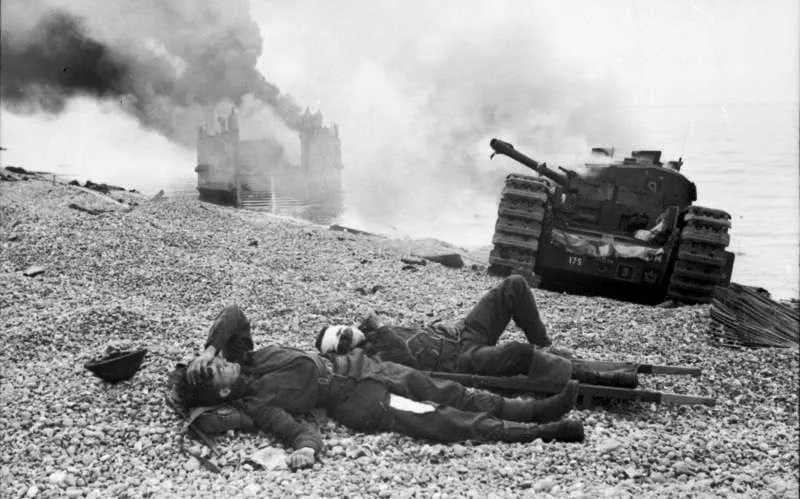
At dawn on 19 August 1942 more than 230 warships and landing craft appeared off the coast of Normandy. On the beaches around the port of Dieppe they put ashore just over 6,000 troops, the overwhelming majority of them Canadians. This was the Dieppe Raid, Operation Jubilee, the largest Allied amphibious operation in western Europe since the evacuation from Dunkirk. The port was to be held for a dozen or so hours and its installations destroyed, and the whole operation was to test whether a heavily defended port could be taken from the sea. It ended in disaster. Of the six landing sectors, only at one, near Varengeville, did British commandos accomplish their task. On the main beach in front of the town the Canadian infantry and tanks were stopped at the sea wall and on the shingle. After less than nine hours the operation was called off. Of nearly 5,000 Canadians, 3,367 were killed, wounded or taken prisoner. Over Dieppe one of the largest single-day air battles of the war was also fought, in which five Polish fighter squadrons took part, while at sea the Polish destroyer ORP Ślązak was in action.
The common assertion that most of those who took part were killed or captured needs refining: of all 6,086 men who set out to land, 3,623 became casualties (killed, wounded and prisoners), or about 60 per cent; roughly one in six was killed. Among the Canadians, however, losses reached 68 per cent, and some battalions practically ceased to exist.
The second front and Operation Rutter
From the first weeks of Germany’s attack on the USSR, Joseph Stalin had been demanding that the British, and later the Americans too, open a “second front” in France. In May and June 1942, during Molotov’s visit to London and Washington, the Allies announced agreement “with regard to the urgent tasks of creating a Second Front in Europe in 1942”, without committing themselves to any date. The British, however, judged the American plan for a limited landing that same year, Operation Sledgehammer, to be impracticable, and in July the decision was taken to land in French North Africa instead. A large raid on the French coast was meanwhile supposed to show Moscow and public opinion at home that the Allies were not standing idle, and to give the planners of the future invasion experience they did not have.
The raid was planned by Combined Operations Headquarters under Vice Admiral Lord Louis Mountbatten, which already had the Vågsøy raid and the St Nazaire raid behind it. This time, though, it was not a matter of a few hundred commandos but of a whole division with tanks. Dieppe was chosen because it lay within range of British fighters flying from southern England. The town sits behind a shingle beach between two high cliffs, and German coastal batteries stood on either side of it.
South-Eastern Command under Lieutenant General Bernard Montgomery also took part in the planning. It was on his initiative that a frontal assault on the main beach replaced an outflanking of the town. The 2nd Canadian Infantry Division under Major General John Hamilton Roberts was assigned to the operation. The Canadians, who had been sitting idle in England since 1939, wanted to fight. The commander of the First Canadian Army, General Andrew McNaughton, and his subordinate Lieutenant General Harry Crerar gave their consent, and the government of William Lyon Mackenzie King, criticised for letting the Canadian army sit idle, raised no objection. Roberts is said to have called the task “a piece of cake”.
Step by step, the elements that were to provide firepower were taken out of the plan. Sir Dudley Pound, the First Sea Lord, refused to send a battleship or cruisers into waters where the Luftwaffe could attack them; support from the sea was reduced to a few Hunt-class escort destroyers with 4-inch (102 mm) guns. A heavy bombing of the town before the landing was abandoned, because Winston Churchill feared casualties among French civilians, Arthur Harris’s Bomber Command did not want to divert forces from the raids on Germany, and the army believed the rubble would block the streets to tanks. At the beginning of July the troops were already embarked, but bad weather and a German air attack on two ships in the Solent led to the cancellation of Operation Rutter on 7 July. Soon afterwards Mountbatten revived it under the new code name Jubilee; the paratroops who were to knock out the batteries on the flanks were replaced by commandos. For the sake of secrecy the decisions were scarcely documented, and it is still unclear who formally approved the revived plan. After Rutter was cancelled Montgomery advised against repeating it, and in August he left for Africa. On the day of the raid Churchill was on his way back from Moscow via Cairo.
The forces on both sides
On the evening of 18 August 237 warships and landing vessels under Captain John Hughes-Hallett sailed from the ports of southern England. The landing was to involve 6,086 men: 4,963 Canadians, about 1,075 British (Army commandos and Royal Marines) and 50 American Rangers of the newly formed 1st Ranger Battalion, attached to British units, as well as a dozen or so Frenchmen from the inter-Allied No. 10 Commando. Armoured support was to come from the 14th Army Tank Regiment (The Calgary Regiment) with Churchill tanks, going into action for the first time. Roberts commanded from the destroyer HMS Calpe.
The air forces were directed from the operations room of No. 11 Group at Uxbridge by Air Vice-Marshal Trafford Leigh-Mallory. He had at his disposal 56 fighter squadrons of Spitfires, Hurricanes and Typhoons, and several reconnaissance and bomber squadrons, including units of the Royal Canadian Air Force. RAF Fighter Command hoped that the landing would force the Luftwaffe to fight on terms favourable to the British; since the spring of 1942 German Focke-Wulf Fw 190 fighters, superior to the Spitfire Mk V, had been inflicting painful losses on the RAF over France.
Dieppe was defended by the 302nd Infantry Division under Generalmajor Konrad Haase, a static division made up largely of older age groups and stretched along a long stretch of coast; in the landing area itself it had about 1,500 men. Allied intelligence also failed to identify the gun positions cut into the cliffs on either side of the beach or their real strength; the gradient and the ground of the beach were assessed partly from pre-war holiday snapshots. The Germans did not know the target or the date of the raid (this is the conclusion of most historians who have studied the German records), but they expected some landing in the summer. The Commander-in-Chief West, Field Marshal Gerd von Rundstedt, had put his troops on a high state of readiness, commanders on the coast declared alerts during periods of tides favourable to a landing, and on 10 August the commander of the 15th Army, General Curt Haase, warned his troops that the Allies, under pressure from the plight of the Russians, would soon attack in the west.
The flanks: Berneval, Varengeville, Puys and Pourville
The landing was planned on six beaches, named from east to west Yellow, Blue, Red, White, Green and Orange. The flank units were to go in first, at 4.50 a.m. An hour earlier, at about 3.48 a.m., the landing craft carrying Lieutenant Colonel John Durnford-Slater’s British No. 3 Commando to the eastern flank ran into a small German convoy with its escort. In the night-time firefight the craft were scattered, and the shooting alerted the coastal defences. The escorting destroyers, ORP Ślązak and HMS Brocklesby, saw the gunfire but took it for fire from the shore and did not come to help. Only some of the landing craft reached Berneval. The commandos put ashore on one stretch were pinned down and had to surrender. On the other, just 18 men under Major Peter Young landed. They had nothing with which to destroy the guns, but for several hours they sniped at the battery with small arms, harassing the crews so effectively that their fire was inaccurate. Then they managed to get away by sea.
On the western flank Lieutenant Colonel Lord Lovat’s No. 4 Commando landed on two beaches near Varengeville, worked round a battery of six 150 mm guns and took it in a bayonet charge. At about 7.30 a.m. the commandos re-embarked as planned, taking their wounded and prisoners with them. This was the only wholly successful part of the operation, and it later became a model for commando actions during the great landings. Captain Patrick Porteous, wounded twice during the assault, received the Victoria Cross.
Things went worst at Puys (Blue Beach), east of the town. The Royal Regiment of Canada, with three platoons of the Black Watch, was about 20 minutes late. It was already light, the smoke screen had blown away, and the defenders, alerted by the firing at sea, were waiting in their positions. The men climbing out of the landing craft onto the narrow beach beneath the cliff were pinned against the sea wall by machine-gun fire, including from a pillbox enfilading the wall. The battalion ceased to exist: of its 556 men about 200 were killed and 264 taken prisoner. A few dozen got back to England.
At Pourville (Green Beach), in the commune of Hautot-sur-Mer west of Dieppe, the South Saskatchewan Regiment landed unobserved at 4.52 a.m., but mostly on the wrong side of the River Scie. To reach the heights east of the village it had to cross the only bridge, which the Germans quickly brought under fire. The battalion commander, Lieutenant Colonel Charles Merritt, crossed the bridge several times under fire, calling out that it could be done, and led his men on. For this he received the Victoria Cross; he himself was taken prisoner while covering the withdrawal. Behind the Saskatchewans came the Queen’s Own Cameron Highlanders of Canada, who pushed about three kilometres inland but did not reach their objectives.
The beaches in front of the town
The main assault, on Red and White beaches in front of Dieppe itself, went in at about 5.20 a.m., half an hour after the flank landings. Several destroyers shelled the shore, and five squadrons of Hurricanes attacked the positions on the heights and laid a smoke screen. The Essex Scottish Regiment and the Royal Hamilton Light Infantry, however, landed without the tanks, which arrived late. The infantry found themselves on an open, steep shingle beach swept by fire from both cliffs, from the buildings along the promenade and from fortifications in the sea wall itself. They could not get through the wire and over the sea wall. The Royal Hamilton Light Infantry took the casino building by the beach, and a few small groups got into the town, where they were quickly broken up.
When the tanks finally arrived, 29 Churchills tried to get ashore. Two sank in deep water, a dozen or more bogged down in the shingle or lost their tracks, and those that got over the wall onto the promenade were stopped by concrete roadblocks in the streets leading into the town. The sappers who were to blow them up lay pinned down on the beach. The tanks went back down to the beach and gave the infantry covering fire; according to some historians it was they that made the evacuation of some of the men possible. Not a single tank returned to England, and their crews were killed or captured.
Roberts, who could see little through the smoke from the deck of Calpe and was receiving incomplete and misleading reports (one suggested that the Essex Scottish had got into the town), sent his reserve onto the beach. At about 7 a.m. the Fusiliers Mont-Royal under Lieutenant Colonel Dollard Ménard, a French-speaking battalion from Montreal, went in aboard 26 landing craft. They were massacred as they landed; some were carried onto a narrow beach beneath the cliff, from which they could neither get off nor fight. Roberts then sent in a unit of Royal Marines, which transferred to landing craft under fire. Its commander, Lieutenant Colonel Joseph Phillipps, stood up in the stern of his craft and signalled the others to turn back; he was killed moments later. Among those left with the wounded on the beach was the chaplain of the Royal Hamilton Light Infantry, Captain John Weir Foote, who for several hours carried and tended the wounded and, when the time came to withdraw, stepped off the landing craft and went into captivity with them of his own free will. He was the only Canadian chaplain to receive the Victoria Cross.
At about 9 a.m. Roberts concluded that the operation had failed. The evacuation, code-named Vanquish, was set for 10.30 a.m., then put back to 11.00. The landing craft came in to the shore under heavy fire behind a smoke screen; many were sunk, and others capsized under the weight of men clambering aboard from the water. The evacuation was called off in the early afternoon, and at about 2 p.m. the last Canadians on the beach surrendered. Of the 553 men of the Essex Scottish, 52 returned to England unhurt.
The air battle and the Polish part
In the air the RAF got what it wanted – a big battle – but not the result it had hoped for. Fighter Command flew some 2,500 sorties that day. Boston bombers laid smoke screens and attacked the batteries on the cliffs, and before noon American B-17 bombers, which two days earlier had attacked a target in France for the first time, bombed the airfield at Abbeville. The fighter umbrella effectively shielded the ships and beaches from German bombers, which did, however, sink the destroyer HMS Berkeley on the way back. The RAF, together with the Canadian air force, lost 106 aircraft, 88 of them fighters; several dozen pilots were killed or captured. The RAF pilots’ claims were roughly double the Luftwaffe’s actual losses, which according to post-war research amounted to 48 aircraft, including some 20 Fw 190 fighters. Leigh-Mallory regarded the battle as a success for the air force.
The whole of No. 1 Polish Fighter Wing fought over Dieppe, with its five squadrons: No. 302 “City of Poznań”, No. 303 “Warsaw”, No. 306 “City of Toruń”, No. 308 “City of Kraków” and No. 317 “City of Wilno”, flying Spitfire Mk Vs from Northolt, Heston and Redhill. According to Polish records the wing flew 224 sorties and claimed 15 aircraft destroyed and 5 probables, the best result among the RAF wings that day; No. 303 Squadron claimed the most. Like all the claims of that day, these figures were inflated compared with the Luftwaffe’s actual losses. The Poles lost several aircraft; among the airmen killed was Lieutenant Adam Damm.
At sea the escort destroyer ORP Ślązak, in Polish service since April 1942, was in action under Lieutenant Commander Romuald Nałęcz-Tymiński (PL). For many hours the ship shelled the batteries on shore and fought off air attacks; Polish accounts credit her with shooting down four aircraft. During the evacuation she closed the beach and picked up Canadian soldiers from the water and from landing craft; their number in Polish accounts ranges from several dozen to more than 80. She herself was hit and had men killed. Nałęcz-Tymiński received the British Distinguished Service Cross. The start of the action had gone less well: during the night, as already noted, the ship failed to recognise the clash between No. 3 Commando’s landing craft and the German convoy and did not come to their aid.
The balance
For Canada, 19 August 1942 was the bloodiest day of the entire war. According to official Canadian figures, of 4,963 Canadians 3,367 were killed, wounded or taken prisoner. Of these, 916 lost their lives (including those who died of wounds or in captivity; the number killed on the day of the battle itself is about 907), and 1,946 were taken prisoner; according to Canadian studies, that is more prisoners than in the whole eleven months of the campaign in north-west Europe in 1944–1945. The British commandos lost 247 men; the Royal Navy lost the destroyer Berkeley, 33 landing craft and some 550 killed and wounded; the American Rangers lost about a dozen men (six killed). German losses came to about 590 men, more than 300 of them killed, and 48 aircraft.
Among the prisoners was Brigadier William Southam, who had taken a copy of the operation order ashore. In it the Germans found an instruction to tie the hands of prisoners “so that they could not destroy documents”. In the autumn, in reprisal, they began shackling the prisoners taken at Dieppe. Hitler cited both incidents in October 1942 when issuing the Commando Order, which directed that captured commandos be killed.
Joseph Goebbels’s propaganda presented the raid as a failed invasion and proof that the Allies were incapable of opening a second front; photographs of abandoned tanks and the dead on the beach went round the press of all Europe. Marshal Philippe Pétain congratulated the German command on “cleansing French soil of the invader” and offered French troops to take part in defending the coast, an offer that came to nothing; after the war this letter was used by the prosecution at his trial. Adolf Hitler rewarded the town for the calm of its inhabitants, who had not supported the landing (the leaflets scattered by the Canadians had in fact asked them not to get involved): according to communiqués of the time he released some 750 prisoners of war from Dieppe and gave the town 10 million francs to repair the damage.
The Canadian historian David O’Keefe argues that an important aim of the raid was to seize in Dieppe a new four-rotor Enigma and code documents, in an operation prepared among others by Ian Fleming of Naval Intelligence; others, such as Eric Grove, regard this as one of the secondary objectives. In any case, the unit that was to enter the harbour never got there.
Place in the war
The Dieppe Raid became a textbook example of what not to do in an amphibious operation: no heavy fire support from the sea and the air, poor reconnaissance, and a frontal assault on a fortified port. The Allies drew lessons from it that they applied in the Normandy landings in June 1944: they gave up trying to seize a port in the first phase of the invasion in favour of landing on open beaches and using towed artificial harbours, built special armoured vehicles for the engineers, surveyed the ground of the beaches, and organised fire-support ships and tactical air forces working with the ground troops. After the war Mountbatten said that the Battle of Normandy had been won on the beaches of Dieppe and that every man who died at Dieppe had saved at least ten soldiers in 1944. Many historians and veterans reject this claim as an attempt to justify a defeat; Porteous, the only Briton awarded the Victoria Cross for Dieppe, said that just as much could have been learned in Weymouth Bay.
The Germans drew lessons too. They were confirmed in their belief that an invasion would have to begin with an attack on a port, and from the autumn of 1942 they accelerated the construction of the coastal defences soon known as the Atlantic Wall, concentrating them precisely around the ports. For Moscow the raid was proof that there would be no second front in 1942. In Canada the defeat came as a shock and gave rise to a decades-long dispute over the responsibility of the commanders. The Canadians returned to Dieppe on 1 September 1944, when soldiers of the same 2nd Division entered the town without a fight; those killed in 1942 were buried in the war cemetery near Dieppe.
Sources
Meanwhile
(04)Elsewhere, within a week.
- 22 August 1942 · DiplomacyBrazil declares war on Germany and ItalyAfter U-507 sank five ships with over 600 dead, Brazil recognised on 22 August 1942 that it was at war with Germany and Italy.
- 22 August 1942 · PolandThe massacre of Jews in StanisławówOn 22 August 1942, in a “reprisal action”, the Germans shot over 1,000 Jews in Stanisławów and hanged the Judenrat chairman and about 20 policemen.
- 15 August 1942 · MediterraneanThe Ohio reaches MaltaOn 15 August 1942 the sinking tanker Ohio, last of the five Pedestal ships to arrive, was brought into Valletta. Her fuel saved Malta.
- 23 August 1942 · Eastern FrontThe bombing of StalingradOn 23 August 1942 German tanks reached the Volga north of Stalingrad and the Luftwaffe reduced much of the city to ruins. The Battle of Stalingrad had begun.
Related events
(04)The same battle, people or subject.
- 5 August 1942 · MilitaryPlanning Operation TorchIn August 1942 the Allies began planning a landing in North Africa. Patton moved from Washington to Eisenhower's headquarters in London.
- 17 August 1942 · Western FrontThe first B-17 raid on RouenOn 17 August 1942 twelve American B-17s of the 97th Bombardment Group bombed a rail junction near Rouen by day. All returned to England.
- 28 March 1942 · Western FrontThe bombing of LübeckOn the night of 28–29 March 1942, 234 RAF bombers burned the western part of Lübeck's old town. Over 300 died. Hitler demanded revenge on English cities.
- 31 December 1942 · PoliticsThe balance of 1942The year 1942 began with Allied defeats and ended with Midway, El Alamein, Torch, encirclement at Stalingrad and Japan's decision to abandon Guadalcanal.