Equipment
Curtiss P-40 Warhawk
An American fighter that was never the best but was always at hand: it fought over the desert, in China, in the Pacific and in the USSR from 1941 to 1945.
- Role:
- fighter, fighter-bomber
- State:
- United States
- Maker:
- Curtiss-Wright
- First flight:
- 14 October 1938
- Built:
- 13,738
- Author:
- Natalia
- Updated:
- 1 November 2026
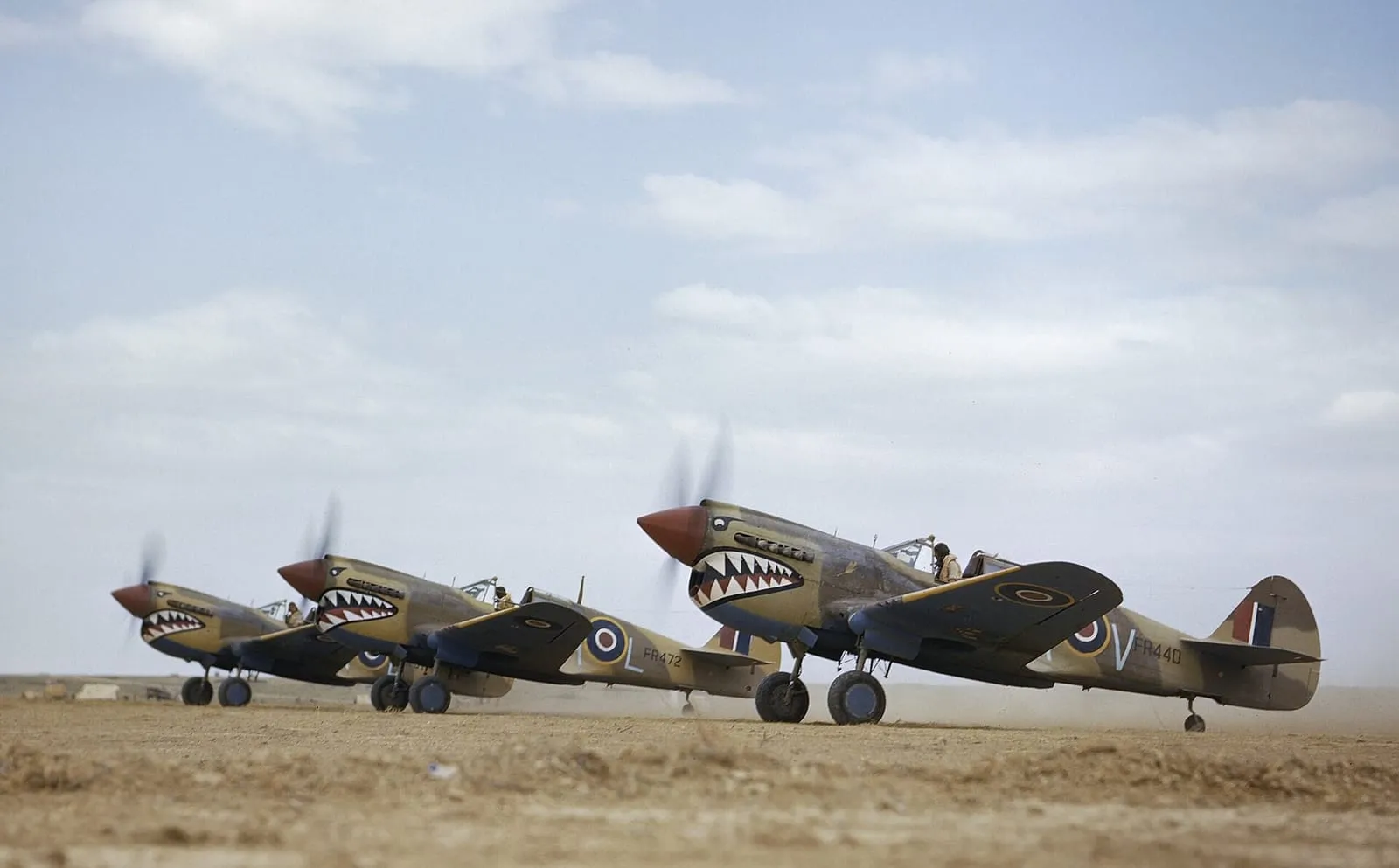
The Curtiss P-40 was a fighter nobody considered the best, yet it turned up wherever the Allies most needed aircraft in 1941–1942. It could not match the Messerschmitts at altitude, nor the Japanese Zero in a tight turn, but it was rugged, cheap and ready in large numbers while more modern designs were only just entering production. It fought over the desert of North Africa, over China and Burma, over Pearl Harbor, the Philippines and Australia, in the Aleutians and near Moscow. Before better fighters displaced it, it had become one of the most numerous American aircraft of the war.
A quick answer
The Curtiss-Wright (PL) works in Buffalo did not design a new aircraft from scratch. They took the airframe of their P-36 Hawk fighter and replaced its radial engine with an inline, liquid-cooled Allison V-1710 (PL). The company’s pilot Edward Elliott flew the XP-40 prototype on 14 October 1938. In April 1939 the Army ordered 524 aircraft, at the time the largest fighter contract in the history of American aviation. France ordered the aircraft too, and after its fall in 1940 the British took over the order.
The Allison had a single-stage supercharger, so above roughly four kilometres the P-40’s performance fell away markedly. The aircraft climbed slowly and lost out in the turn to the light Japanese fighters. On the other hand it had a strong airframe that could absorb many hits, armour protection for the pilot, a long range, and it dived superbly. Pilots who learned to fight with its strengths rather than against its weaknesses did well in it.
Over the desert
In British service the early versions were named Tomahawk and the later ones, with six 12.7 mm (.50 in) machine guns, Kittyhawk. They went into action in North Africa in June 1941, during Operation Battleaxe, and gradually replaced the Hurricanes as the main fighter of the desert air force, commanded from July that year by Arthur Coningham. British, Australian and South African squadrons suffered heavy losses fighting Messerschmitt Bf 109s, but they also inflicted many. The Australian Clive Caldwell, the most successful pilot on the type, claimed 22 victories in it. It was in No. 112 Squadron RAF that the Tomahawks got their painted shark’s mouth, copied from German Bf 110s.
From 1942 bomb-carrying Kittyhawks, known as “Kittybombers”, increasingly attacked ground targets: in the battle of Alam Halfa they escorted bombers, and in March 1943, during the breakthrough at the Mareth Line, they bombed German positions wave after wave. In the spring of 1943 American P-40s broke up the German air bridge to Tunisia over Cape Bon; on 18 April, in the “Palm Sunday Massacre”, 24 Ju 52s were shot down for the loss of six P-40s. The 99th Fighter Squadron, the first unit of Black American pilots, began its combat career on the P-40.
The Flying Tigers
In China the P-40 became a legend thanks to Claire Chennault. In 1941 he obtained permission to buy a hundred Tomahawks and recruit American volunteers, who formed the American Volunteer Group, known as the Flying Tigers. The aircraft were assembled in Burma at the end of 1941. Chennault forbade his pilots to get into turning fights with the Japanese: they were to attack from above, fire and break away in a dive. The group claimed nearly three hundred victories, a figure now considered inflated, but at a time when every other front brought nothing but defeats, its successes over Rangoon and Kunming were priceless to the Americans. In 1942 its tradition was taken over by American air force units, and later by the Fourteenth Air Force.
In the Pacific and in the USSR
On 7 December 1941 most of the American fighters on Hawaii were P-40s, and most of them were destroyed on the ground during the attack on Pearl Harbor; only a few pilots managed to take off. A day later the Japanese caught the air force in the Philippines by surprise in the attack on Clark Field, destroying 53 P-40s according to the American official history. On 19 February 1942 ten P-40s passing through Darwin tried in vain to defend the town during the first Japanese air raid on Australia.
After that things improved. Kittyhawks of Australian squadrons of the Royal Australian Air Force defended Port Moresby, and in August 1942, in the battle of Milne Bay, they supported the Australian infantry and helped to throw back the Japanese landing. In June 1942 P-40s from a hidden airfield in the Aleutians surprised Japanese aircraft returning from the attack on Dutch Harbor. Until mid-1943 P-40s made up more than half of the US Army Air Forces’ fighters, and Australian and American units were still flying them over New Guinea in 1944, although the Americans were already switching to the P-38 and the P-47.
The P-40 was also the first American fighter to reach the USSR, at first from British stocks and then under Lend-Lease. From October 1941 Tomahawks fought in the defence of Moscow, and by 1944 the Soviet Union had received 247 early and 2,178 later aircraft.
End of production
Production ended in November 1944 after 13,738 aircraft had been built, all of them in Buffalo. Among American fighters, only the P-47 and P-51 were built in greater numbers during the war. The last versions served mainly as fighter-bombers, and in China and Burma P-40s were still flying in combat over the Salween in the autumn of 1944.
Sources
Battles
(05)- 8 December 1941 – 8 May 1942Philippines campaign (1941–1942)From 8 December 1941 to May 1942 Japan conquered the Philippines. The defenders of Bataan and Corregidor held out longer than planned but were taken prisoner.
- 30 August – 5 September 1942Battle of Alam el HalfaOn 30 August – 5 September 1942 Rommel struck in Egypt for the last time. Short of fuel and under RAF bombs, he was repulsed at Alam el Halfa and fell back.
- 15 August – 7 October 1943Battle of Vella LavellaFrom 15 August to 7 October 1943 Americans and New Zealanders took Vella Lavella, bypassing strongly held Kolombangara – the first deliberate “leapfrog”.
- 22 April – 6 June 1944Landings at Hollandia and Aitape22 April – 6 June 1944. US troops landed at Hollandia and Aitape far behind the New Guinea front, cutting off the Japanese 18th Army and winning a major base.
- 11 May 1944 – 27 January 1945Salween offensiveFrom May 1944 to January 1945 China's Expeditionary Force in Yunnan crossed the Salween, took Song Shan, Tengchong and Longling and reopened the road to China.