Soviet Union
Semyon Budyonny
Commander of the 1st Cavalry Army (1919–1923), Inspector of Cavalry of the Red Army (1924–1937), Marshal of the Soviet Union (from 1935), commander of the South-Western Direction (1941)
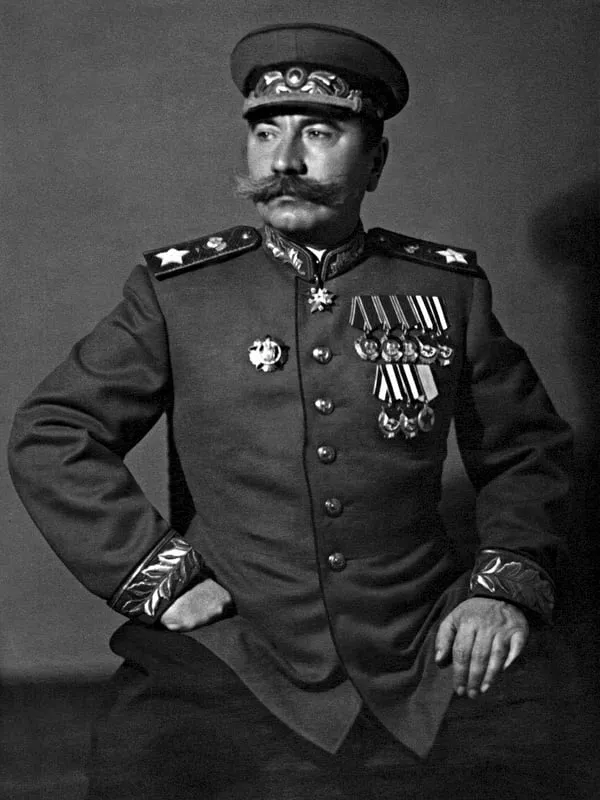
- Born:
- 25 April 1883, Kozyurin khutor, Platovskaya stanitsa, Don Host Oblast (Russian Empire)
- Died:
- 26 October 1973, Moscow (USSR)
- Author:
- Natalia
- Photo:
- autor nieznany, CC BY 4.0, Wikimedia Commons

Semyon Budyonny was the most famous cavalryman of the Red Army and one of its symbols. The son of poor peasants from the Cossack lands on the Don, and a tsarist sergeant-major who held the full set of St George Crosses, in the Civil War he created and led the 1st Cavalry Army, which routed the Whites and in 1920 broke through the Polish front in Ukraine. His quarrel with Mikhail Tukhachevsky over who was to blame for the defeat at Warsaw, and his friendship with Joseph Stalin and Kliment Voroshilov, shaped the rest of his life. He survived the Great Purge, in which he himself sat in judgement on Tukhachevsky, and in 1941, as one of the Red Army’s most senior commanders, he lived through the catastrophe at Uman and Kiev. He died in 1973, surrounded by the state cult of a Civil War hero.
A boy from the Don and a tsarist cavalryman
He was born on 25 April 1883 (13 April in the Julian calendar) at the Kozyurin khutor (farmstead) in the Platovskaya stanitsa (Cossack settlement) in the Don Host Oblast. His parents were so-called inogorodnye, peasants who had come to the Cossack lands from Voronezh Governorate and had neither Cossack rights nor land. From childhood Semyon worked as a farmhand and herdsman. In the autumn of 1903 he was called up into the army. During the Russo-Japanese War he served in a Don Cossack regiment in the Far East, and then in the Primorsky Dragoon Regiment. He was an outstanding horseman, and in 1907 he was sent on a course for non-commissioned officers at the Officers’ Cavalry School in St Petersburg.
In the First World War, as a senior NCO of the 18th Seversky Dragoon Regiment, he fought the Germans in Poland, among other places at Brzeziny during the Łódź operation, and then the Turks on the Caucasus front. He won all four classes of the St George Cross, the highest decoration for private soldiers. One of the crosses was taken from him for a time after he struck a superior. In 1917, when his regiment was stationed in Minsk, the soldiers elected him to the regimental committee, and during the revolt of General Lavr Kornilov he took part in disarming Kornilov’s units at Orsha.
Creator of the Red cavalry
After the October Revolution he returned to the Don. In early 1918 he organised a mounted detachment in Platovskaya that fought Ataman Krasnov’s Cossacks and the Whites. His detachment was incorporated into Boris Dumenko’s formation, and during the defence of Tsaritsyn on the Volga Budyonny met Stalin and Voroshilov, who backed his plans to create large Red cavalry formations against the scepticism of the Commissar for War, Leon Trotsky. In 1919 he joined the Bolshevik party. In June 1919 the 1st Cavalry Corps was formed under his command, and in the autumn, at Voronezh and Kastornoye, it routed the Cossack corps of Generals Mamontov and Shkuro, one of the main forces of General Anton Denikin’s army marching on Moscow. On 19 November 1919 the corps was expanded into the 1st Cavalry Army, the first cavalry formation of that size in Russian history. In early 1920 Budyonny’s troops took Rostov-on-Don and fought in the Kuban, where the Whites finally collapsed.
The Konarmiya, as it was known, was an army of Cossacks, peasants and former NCOs – combative and highly mobile, but also poorly disciplined. Its strength lay in rapid charges and tachankas, light carts mounting machine guns. Its weakness was looting and violence against civilians.
The war with Poland
In the spring of 1920 the 1st Cavalry Army was transferred from the Caucasus to the Polish front. It set out from Maykop at the beginning of April and, after a march across Ukraine in which it defeated the forces of the anarchist Nestor Makhno along the way, went into action at the end of May south of Kiev as part of the Southwestern Front of Alexander Yegorov, whose commissar was Stalin. On 5 June 1920 Budyonny’s cavalry broke through the Polish front at Samhorodok and got into the rear of the Polish forces. On 7 June it took Żytomierz (Zhytomyr), where it cut down the Polish garrison, and Berdyczów (Berdychiv), where, according to Polish accounts, it burned a hospital full of wounded. The Poles had to abandon Kiev and begin retreating west. In July Budyonny took Równe (Rivne) and fought at Brody, and in August he advanced on Lwów (Lviv).
In mid-August the Red Army’s Commander-in-Chief, Sergei Kamenev, ordered the 1st Cavalry Army to be moved north to support Tukhachevsky’s Western Front, which was just then losing the battle of Warsaw. Budyonny, with the consent of Stalin and Yegorov, went on assaulting Lwów for several more days. On 17 August at Zadwórze one of his divisions fought all day against a Polish volunteer battalion, which was almost entirely wiped out. When the Konarmiya finally moved north on 20 August, Tukhachevsky’s armies were already retreating. It was held up for several days at Zamość, and on 31 August 1920 at Komarów the Polish 1st Cavalry Division under Colonel Juliusz Rómmel defeated it in what has been called the greatest cavalry battle of the 20th century. Budyonny barely managed to lead the remnants of his army back across the Bug. In the autumn, during the retreat, units of the Konarmiya, especially the 6th Cavalry Division, carried out a series of pogroms against Jews in Ukraine. The Soviet authorities disarmed three regiments of the division, and several hundred perpetrators were brought before a tribunal.
The dispute over 1920 dragged on for years. Tukhachevsky blamed the command of the Southwestern Front and Budyonny for failing to come to his aid, while Budyonny and Voroshilov, a member of the 1st Cavalry Army’s revolutionary military council, accused Tukhachevsky of recklessness. In the Polish–Soviet War the Konarmiya experienced both its greatest triumph and its greatest defeat. In the autumn of 1920 it went on to fight General Pyotr Wrangel in the Crimea, and in 1921 Makhno.
Babel’s Red Cavalry
In 1920 the writer Isaac Babel rode with Budyonny’s army as a correspondent. His diary and experiences gave rise to the short-story collection Red Cavalry (Konarmiya), published in 1926 and one of the masterpieces of 20th-century Russian literature. Babel depicted the war in Galicia and Volhynia without embellishment: the cruelty of the soldiers, the looting, the murder of prisoners and the poverty of the Jewish shtetls. Budyonny regarded the book as slander and in 1924 publicly attacked its author. Maxim Gorky came to Babel’s defence. Babel was arrested in 1939 and shot in 1940.
Marshal and the purge
After the Civil War Budyonny was deputy commander of the North Caucasus Military District, and from 1924 to 1937 Inspector of Cavalry of the Red Army. He devoted himself to horse breeding, which produced the Budyonny breed named after him, and in 1932 he graduated from the Frunze Military Academy. He was a figure of songs and posters, and the pointed cap of the Red Army men is still called the budyonovka. On 20 November 1935 he became one of the first five Marshals of the Soviet Union, alongside Voroshilov, Tukhachevsky, Yegorov and Vasily Blyukher.
In the disputes over the shape of the army Budyonny sided with Voroshilov and the traditional cavalry against Tukhachevsky, who placed his faith in tanks and aircraft. In the Great Purge he proved one of Stalin’s most loyal men. In 1937 he took command of the Moscow Military District; in May he signed the request for Tukhachevsky’s arrest, and on 11 June 1937 he sat on the special court that sentenced him and seven other commanders to death. Of the first five marshals, Tukhachevsky, Yegorov and Blyukher perished in the purge; only Voroshilov and Budyonny survived. The repression also struck his family. His second wife, the Bolshoi Theatre singer Olga Mikhailova, was arrested in 1937 and spent many years in prisons and labour camps. Budyonny married for a third time.
The Second World War
In 1939 Budyonny became deputy, and in 1940 first deputy, People’s Commissar for Defence. In the first weeks of the war with Germany Stalin gave him command of the South-Western Direction, to which the fronts in Ukraine were subordinated. In August the Germans encircled Soviet armies at Uman, and in September at Kiev, where, in the largest encirclement in the history of warfare, several hundred thousand Soviet soldiers were taken prisoner. Budyonny proposed in good time that the troops be withdrawn from the Kiev salient, but Stalin rejected the proposal and on 12 September 1941 replaced him with Marshal Semyon Timoshenko. In October 1941 Budyonny briefly commanded the Reserve Front during the catastrophe at Vyazma. On 7 November 1941 he took the salute at the famous parade on Red Square, from which the troops marched straight to the front outside Moscow. In 1942 he commanded the North Caucasus Direction and then the North Caucasus Front, but after further setbacks he was recalled and held no further front-line command for the rest of the war. From 1943 he was Commander of the Cavalry of the Red Army.
Last years and significance
After the war he was Deputy Minister of Agriculture for horse breeding, a deputy to the Supreme Soviet and a member of the Central Committee. Three times – in 1958, 1963 and 1968 – he was awarded the title of Hero of the Soviet Union. He wrote multi-volume memoirs, The Path Travelled. He died in Moscow on 26 October 1973 at the age of 90 and was buried by the Kremlin Wall.
Budyonny was a living monument to the Civil War, but many historians and commanders judged him harshly. According to the Yugoslav communist Milovan Djilas, Marshal Ivan Konev said of him that he had never learned anything and had proved completely incompetent in the war. His career shows how Stalin built the army before the Second World War: men from the “Tsaritsyn group” and the 1st Cavalry Army, personally devoted to him, replaced the advocates of modern warfare murdered in the purge. For Poles, Budyonny remained above all the commander of the cavalry that in the summer of 1920 broke through the front in Ukraine and threatened Lwów, and was then defeated at Komarów.
Sources
Commanded in battles
(03)Mentioned in battles
(04)Often appears with
People who appear in the same events.