- Category:
- Military operations
- Front:
- Pacific
- Date:
- 22 April 1944
- Author:
- Natalia
- Battle:
- Landings at Hollandia and Aitape
- Tags:
- United States, Japan, Douglas MacArthur, Australia
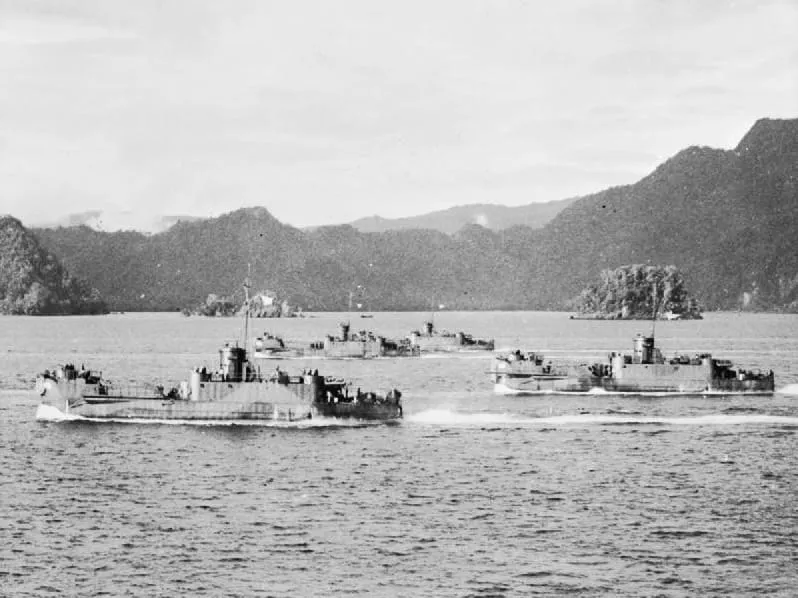
At dawn on 22 April 1944 American and Australian cruisers opened fire on two stretches of the northern coast of New Guinea at once. In Humboldt Bay and Tanahmerah Bay, on either side of the port of Hollandia in Dutch New Guinea, regiments of two American divisions began to come ashore. At the same time, some 200 kilometres to the east, a third force was landing at Aitape in the Australian Territory of New Guinea. The operations were code-named Reckless and Persecution. It was the largest amphibious operation in the South West Pacific so far and the longest leap General Douglas MacArthur had dared to make.
The shorthand that often accompanies this date – that the Americans landed at Hollandia and Aitape “to cut off the Japanese forces at Wewak” – is accurate. The landing bypassed the large concentration of Lieutenant General Hatazō Adachi’s Japanese 18th Army, massed at Hansa Bay and around Wewak, and closed its road to the west. It is worth adding, however, that the main objective was not Wewak itself but the airfields by Lake Sentani near Hollandia – a base from which the Allies could reach further, towards western New Guinea and the Philippines. The length of the leap is given variously: Hollandia lay some 700 kilometres in a straight line from Saidor, the westernmost American beachhead on the coast, and more than 600 kilometres from the Australian spearheads then approaching Madang.
The road to the leap
At the beginning of 1944 the Allies were advancing slowly along the northern coast of New Guinea, step by step: after taking the Huon Peninsula the Australians moved west along the shore, and on 2 January the Americans landed at Saidor. Further on, at Hansa Bay and Wewak, the main forces of the 18th Army were waiting. Taking these positions one after another would have meant many months of fighting in swamp and jungle.
The situation was changed by events at the turn of February and March. The landing on Los Negros and the capture of Manus closed the ring around Rabaul and gave the Allies Seeadler Harbour – a huge anchorage from which convoys could sail westward. On 12 March 1944 the American Joint Chiefs of Staff cancelled the planned landing at Kavieng, agreed to bypass Rabaul, and directed MacArthur to leap over Hansa Bay and Wewak and strike directly at Hollandia. Admiral Chester Nimitz was to support the operation with the carriers of the Pacific Fleet.
Intelligence decided the choice of Hollandia. In January 1944, at Sio, in a camp abandoned by the Japanese 20th Division, the Australians found a trunk of Japanese army code books. Thanks to this find, American and Australian cryptanalysts were from February reading Japanese army messages on a large scale – material code-named Ultra, obtained through cryptanalysis. The decrypted signals showed that Adachi expected the next landing at Hansa Bay and was concentrating his troops there, while Hollandia, an air and supply base, had very few combat units. The American historian Edward Drea later called this operation MacArthur’s finest hour of the Second World War and Ultra’s greatest single contribution to his strategy in the Pacific.
The Japanese command was not wholly unaware of the threat. The Second Area Army, to which the 18th Army had been subordinated since March, ordered Adachi to move forces from the Madang and Hansa Bay area to Hollandia. Adachi hesitated: he believed the Allies would strike at Hansa Bay first and wanted to give battle there. Only under pressure from the area army’s chief of staff, sent to him with the order, did he assign the 66th Infantry Regiment to march west, due to reach Hollandia in June. The Allies reinforced his conviction: aircraft and warships shelled the coast near Wewak, and dummy reconnaissance patrols were put ashore.
Preparations
At the end of March MacArthur and Nimitz met in Brisbane. MacArthur wanted the Pacific Fleet’s big carriers to cover the landing for eight days; Nimitz agreed only to a short period after the landing, because he needed them for further operations in the Central Pacific. To fill the gap until the airfields at Hollandia were working, it was decided to seize Aitape at the same time, where the Japanese had the Tadji airfield, which could quickly be brought into use. Eight escort carriers were to support both landings. The landing date, originally set for 15 April, was put back to 22 April.
From 30 March to 3 April aircraft of General George Kenney’s American Fifth Air Force attacked the airfields on the Sentani plain. The Japanese, convinced that Hollandia lay beyond the range of Allied fighters, had crowded the aircraft of their 6th Air Division there. By American estimates some 400 machines were destroyed on the ground and in the air. Japanese air power in New Guinea ceased to count. At the same time the carriers of Vice Admiral Marc Mitscher’s Task Force 58 struck Japanese bases in the Palau Islands, while aircraft and submarines, guided by decrypted signals, sank ships carrying reinforcements to Wewak and Hollandia. On 19 April a British–American carrier force of the Eastern Fleet attacked Sabang in Sumatra to tie down Japanese air power in the west.
Some 84,000 men were assembled for the operation, including more than 50,000 combat troops, together with more than 200 warships and vessels of the Seventh Fleet, with Rear Admiral Daniel Barbey’s Task Force 77 as the amphibious force. The land forces as a whole were commanded by General Walter Krueger, commander of the Sixth Army, operating as “Alamo Force”. At Hollandia the fighting was to be done by General Robert Eichelberger’s I Corps (“Reckless Task Force”): two regimental combat teams of the 24th Infantry Division at Tanahmerah Bay and two teams of the 41st Infantry Division at Humboldt Bay. At Aitape the 163rd Regimental Combat Team of the 41st Division landed under Brigadier General Jens Doe (“Persecution Task Force”). The shore bombardment was carried out by two cruiser forces – an Australian one, commanded by the British Rear Admiral Victor Crutchley, with HMAS Australia and HMAS Shropshire, and an American one under Rear Admiral Russell Berkey.
The Allies estimated the Japanese in the Hollandia area at about 14,000. In fact there were about 11,000, but almost all of them were air force personnel, sailors, rear-service troops and anti-aircraft crews; units capable of fighting in the field numbered a few hundred men. The command changed every few weeks: Major General Toyozō Kitazono arrived shortly before the landing, and the commander of the 6th Air Division had been recalled after his aircraft were destroyed. No defence plan was ready.
The landing
The convoys sailed from Finschhafen, Cape Cretin and Goodenough Island on 16–18 April, joined up with the force from Seeadler Harbour and on 20 April met the escort carriers north of Manus. They steered a roundabout course west of the Admiralty Islands to avoid Japanese aircraft, then turned towards the coast. From 21 April TF 58’s aircraft bombed the airfields at Hollandia, on Wakde and at Sarmi. On the night of 21–22 April the eastern force broke away towards Aitape, and the rest split into two groups heading for Tanahmerah and Humboldt Bays.
At Tanahmerah Bay, behind the ridge of the Cyclops Mountains, the 19th and 21st Regiments of the 24th Division came ashore almost unopposed. The problem turned out to be the terrain, which had not been reconnoitred because an Australian patrol landed from a submarine in March had been destroyed. One of the beaches ended in a swamp thirty metres from the water, the other was narrow, and the roads the planners had expected to find did not exist. Equipment piled up on the shore, so the follow-up echelons were diverted to Humboldt Bay, while the infantry pushed inland along a narrow track towards the Sentani plain.
At Humboldt Bay the 162nd and 186th Regiments of the 41st Division likewise took the defenders by surprise. After a bombardment by the cruisers and a rocket attack from landing craft, the hill overlooking the beach was taken; most of the Japanese anti-aircraft crews abandoned their positions and fled inland. On 22 April alone several thousand tons of supplies and more than 300 vehicles were landed. The beach, however, was congested, because before the landing it had housed a Japanese supply dump, which was burning after the bombing. On the evening of 23 April a lone Japanese bomber, guided by the fire, bombed the beach: 24 people were killed, about a hundred were wounded, and the blaze consumed most of the ammunition and food landed in the first days. For a time the infantry inland had to rely on air drops.
Even so, the advance went quickly. The 162nd Regiment took the port of Hollandia itself, while the 186th Regiment, supported by amphibious tractors ferried across Lake Sentani, captured the airfields in the eastern part of the plain on 26 April and that same day linked up with units of the 24th Division arriving from the west. MacArthur watched the landing from the cruiser USS Nashville, and on 22 April went ashore himself at both bays.
At Aitape the landing craft, confused by smoke from the fires, came ashore at a different spot from the one planned, though still near the Tadji airfield. Resistance was negligible: most of the roughly one thousand Japanese were anti-aircraft crews and rear units, and the soldiers withdrew into the hills. The airfield was taken by midday on 22 April. Airfield engineers of No. 62 Works Wing of the Royal Australian Air Force worked round the clock, and as early as 24 April P-40 fighters of the Australian No. 78 Wing landed on the Tadji strip. By 4 May the Americans had lost 19 killed and 40 wounded at Aitape, and the Japanese, by American estimates, some 525 killed.
A shattered garrison and an army cut off
Organised resistance at Hollandia effectively ceased within a few days, though mopping up the area went on until 6 June. According to the American official history the Japanese lost some 3,300 killed and 611 prisoners; American losses amounted to about 150 killed and about a thousand wounded (the figures vary with the source and the period counted). Most of the garrison – some 7,000 men – gathered west of Lake Sentani, at Genjem, and set off through the jungle towards Sarmi, more than 200 kilometres to the west. Most of them were airmen, sailors and service troops, without food, medicine or experience of marching through the jungle. Many died of starvation, exhaustion and tropical disease. Estimates of how many reached Sarmi range from a few hundred (Japanese calculations put it at about 7 per cent) to about a thousand.
For the 18th Army the loss of Hollandia and Aitape meant being cut off. More than 50,000 of Adachi’s soldiers at Wewak and Hansa Bay found themselves between the Australians in the east and the Americans in the west, with no hope of supply by sea. The Japanese command first ordered them to bypass Hollandia and Aitape through the jungle and join Lieutenant General Fusatarō Teshima’s Second Army in western New Guinea, then changed its mind and allowed Adachi to counter-attack. Preparing for it took more than two months of marching along ruined roads.
Place in the war
The landings at Hollandia and Aitape were among the most successful amphibious operations of the Pacific War. At little cost to himself, MacArthur bypassed the strongest Japanese concentration in New Guinea in a single move and shifted the front hundreds of kilometres to the west. The Japanese defensive line on Wakde and at Sarmi lost its purpose; the command had to move the defence further back, to Biak and to Manokwari on the Vogelkop (Bird’s Head) Peninsula. The operation also confirmed the effectiveness of the method the Americans had been using in the Central Pacific since Operation Hailstone: Mitscher’s carriers could carry air superiority for a few days to places beyond the reach of land-based aircraft. After leaving Hollandia, TF 58 struck Truk once more.
In the following months the Allies moved along the coast even faster: in May they landed on Wakde and Biak, in July on Noemfoor and at Sansapor on the Vogelkop, and in September on Morotai. At Aitape, where Major General Charles P. Hall’s XI Corps took over the defence, some 20,000 men of the 18th Army attacked across the Driniumor River in July and August 1944. In several weeks of fighting the Japanese lost an estimated 8,000–10,000 killed, and their army never regained the capacity for larger operations. The remnants of the 18th Army, starving and decimated by disease, held out near Wewak until the end of the war; from the end of 1944 the Australians fought them there. Adachi surrendered in September 1945.
Hollandia became one of the largest Allied bases in the Pacific, known as Base G. A port, fuel and ammunition dumps and workshops grew up on Humboldt Bay, and bomber squadrons were stationed on the Sentani airfields. The headquarters of the Sixth Army, the Fifth Air Force and the Seventh Fleet moved there, and in September 1944 so did MacArthur’s advanced general headquarters, with his quarters on a hill above Lake Sentani. In October 1944 convoys sailed from Hollandia and from Seeadler Harbour on Manus carrying MacArthur’s troops to Leyte and opening the way to the Battle of Leyte Gulf. The leap of 22 April, prepared thanks to decrypted signals and a daring that the code name Reckless did nothing to hide, was the first great step on that road to the Philippines.
Sources
Meanwhile
(04)Elsewhere, within a week.
- 21 April 1944 · MediterraneanThe second Badoglio governmentIn April 1944 Badoglio resigned and formed a government of national unity in Salerno with the anti-fascist parties, including Togliatti's Communists.
- 25 April 1944 · Western FrontPatton at KnutsfordOn 25 April 1944, at a welcome club in Knutsford, General Patton said the British and Americans would rule the world. He very nearly lost his command.
- 17 April 1944 · Far EastOperation Ichi-Go beginsOn 17 April 1944 the Japanese crossed the Yellow River in Henan. Operation Ichi-Go began – the largest land offensive ever mounted by the Japanese army.
- 27 April 1944 · Western FrontThe Slapton Sands disasterOn 27 April 1944 US troops rehearsed the Normandy landing in Devon. That night German E-boats torpedoed convoy T-4, killing at least 749 soldiers and sailors.
Related events
(04)The same battle, people or subject.
- 18 May 1944 · PacificThe end of the fighting in the Admiralty IslandsOn 18 May 1944 General Krueger declared the Admiralty Islands operation over. Japanese stragglers still hid in the jungle; Seeadler Harbour became a fleet base.
- 15 March 1944 · PacificThe capture of ManusOn 15 March 1944 US cavalry landed on Manus. Lorengau fell on 18 March, and Seeadler Harbour became one of the largest fleet bases in the Pacific.
- 29 February 1944 · PacificThe landing on Los NegrosOn 29 February 1944 a thousand US cavalrymen landed on Los Negros in the Admiralty Islands. MacArthur came ashore and ordered the airstrip held at any cost.
- 6 March 1944 · PacificThe alarm in Western AustraliaOn 6 March 1944 the submarine USS Haddo reported Japanese warships near the Lombok Strait. The Allies put Perth and Fremantle on alert – in vain.