- Category:
- Military operations
- Front:
- Western Front
- Date:
- 27 April 1944
- Author:
- Łukasz
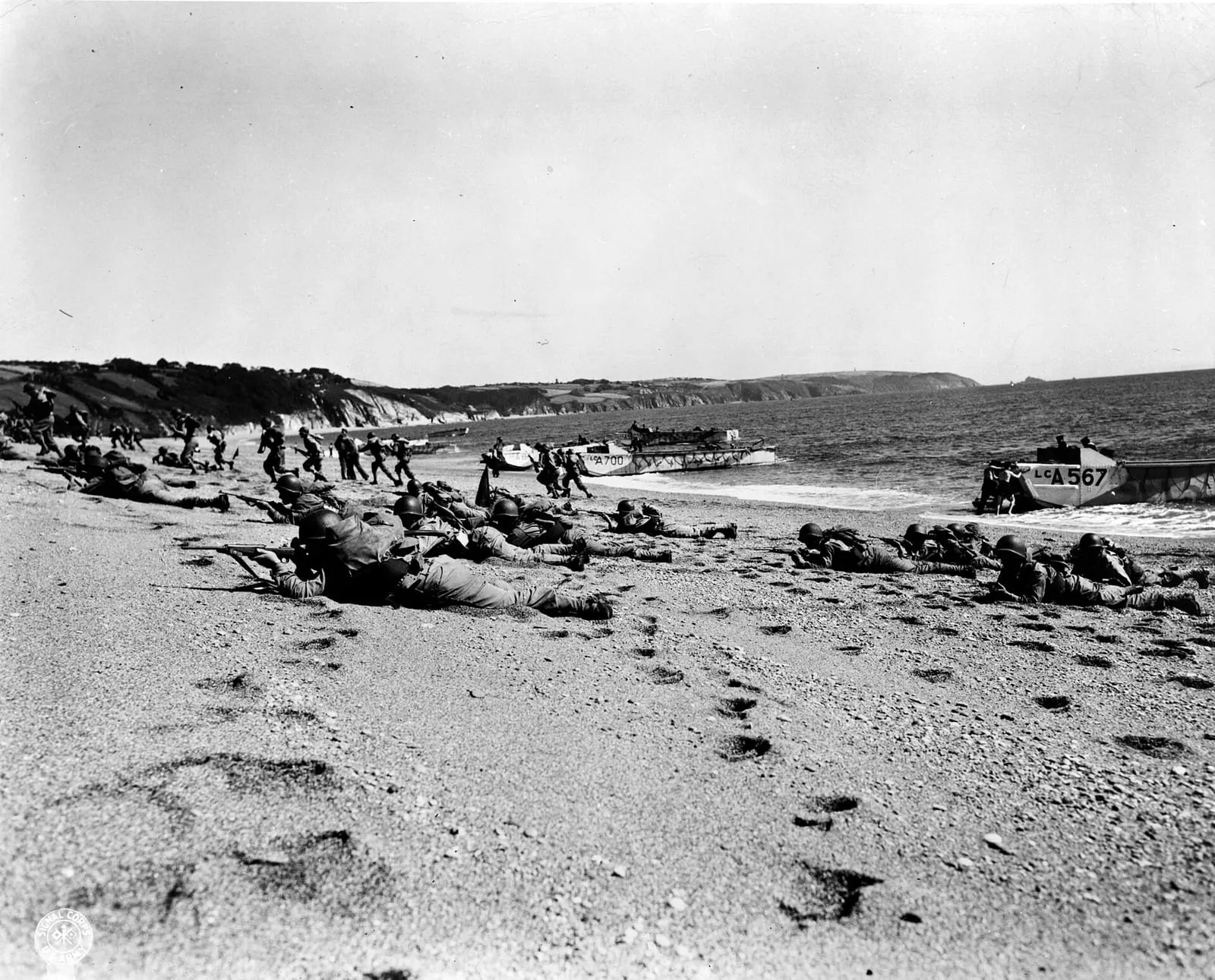
On the morning of 27 April 1944 the first waves of American infantry came out of the sea onto the shingle beach of Slapton Sands in Devon. It was the climax of Exercise Tiger – a full rehearsal of the landing that five weeks later the American VII Corps was to carry out on the beach code-named Utah in Normandy. The exercise went wrong from the start: some of the landing craft touched down at the wrong time, straight into a bombardment with live ammunition. But the worst came the following night. In the early hours of 28 April German torpedo boats out of Cherbourg fell upon a convoy of landing ships in Lyme Bay that was carrying the exercise’s second echelon. Two ships went down, and according to American figures at least 749 soldiers and sailors died in the icy water – several times more than the losses that the seaborne troops landing on Utah Beach would suffer on 6 June.
It is often written that hundreds of American soldiers and sailors were killed “over two days” of exercises in Devon. This needs to be made more precise. The vast majority of the victims did not die in a training accident but in a regular combat action by the enemy, in less than two hours on the night of 27–28 April. The victims of friendly fire during the landing on 27 April are a separate and far less well documented matter: their number is not known, and the figures running into the hundreds that have circulated for years have no basis in the surviving documents.
A training ground on Start Bay
The invasion of France, prepared from the beginning of 1944 by General Dwight Eisenhower’s headquarters – SHAEF – required hundreds of thousands of soldiers to be trained in something most of them had never done: landing from the sea on a defended shore. The American divisions brought to Britain from the autumn of 1943 were mostly stationed in south-west England, from where they were to sail for Normandy – the American corps in Britain were deployed so that the ports of Devon and Cornwall would serve the American troops in particular. The closest thing to real conditions could be found on Start Bay in south Devon. A long strip of shingle beach between the villages of Slapton and Torcross, with a narrow bank behind it and the freshwater lake of Slapton Ley – this layout resembled the coast at the base of the Cotentin Peninsula, where behind Utah Beach lay meadows that the Germans had flooded.
At the end of 1943 the British authorities took over an area of some 120 km² behind the beach for military use. About 3,000 inhabitants of several parishes in the South Hams district had to leave their homes, farms, churches and schools by Christmas, taking their belongings and livestock with them; some of them had never before left their village. From January 1944 a series of amphibious exercises took place on the emptied land, exposing weaknesses at every level: from loading in the ports to fire control and traffic control on the beach.
Tiger was to be the largest of these rehearsals. It involved the forces earmarked for landing on Utah: Major General Raymond Barton’s 4th Infantry Division, units of Major General Joseph Lawton Collins’s VII Corps, the engineers of the 1st Engineer Special Brigade, which was to organise the beach and its rear area, and on the naval side Rear Admiral Don P. Moon’s Force U. According to various studies 25,000–30,000 soldiers and nearly 3,000 vehicles took part in the exercise. The first phase, from 22 to 25 April, covered the assembly of the troops in camps and their embarkation at Plymouth, Dartmouth and other ports. On the evening of 26 April the ships carrying the first echelon put to sea and – to simulate a Channel crossing – described a long arc around Lyme Bay so as to arrive off Slapton Sands at dawn on 27 April. Protection at sea was provided by the Royal Navy: destroyers, motor launches and gunboats patrolled the entrance to the bay, and motor torpedo boats kept watch off Cherbourg, the German E-boat base.
27 April: landing under friendly fire
The exercise was meant to be as close as possible to a real battle. In line with the Supreme Command’s guidelines that soldiers should get used to the noise, smoke and smell of the battlefield before the invasion, ships of the bombardment group, among them the British cruiser HMS Hawkins, shelled the beach with live ammunition before the landing, and units ashore were to fire over the heads of the approaching infantry. The naval bombardment was scheduled for roughly an hour before H-Hour, set for 7.30 a.m.; the engineers were then to check the beach, and only after that were the landing craft to go in.
In the morning it turned out that some of the landing ships were late. Rear Admiral Moon decided to postpone H-Hour by an hour, to 8.30. But the order did not reach every unit. Some of the landing craft beached at the original time, and the soldiers found themselves on the beach while shells were still falling on it. How many were killed or wounded is not known: the records of the exercise do not list these casualties separately, and rumours of several hundred dead, never confirmed, quickly spread among the crews and the troops. Some historians believe the victims of friendly fire were few; others think their number was concealed along with the whole affair. All that is certain is that the landing of 27 April exposed the same weaknesses that a dozen or so hours later would take a far heavier toll: unreliable communications and a lack of coordination between the ships and the land forces.
Ashore the exercise went on. Units of the 4th Division crossed the bank behind the beach and advanced into the deserted countryside, practising what in Normandy was to follow once they left the beach: getting onto the few roads and causeways behind the coastal strip. According to many accounts, senior Allied commanders watched the exercise, among them General Omar Bradley, commander of the American First Army. Meanwhile the second echelon was heading for the bay – convoy T-4, which was to unload equipment and engineers on Slapton Sands on 28 April.
Night in Lyme Bay
Convoy T-4 consisted of eight large tank landing ships – LSTs (Landing Ship, Tank), slow, flat-bottomed vessels that could run their bows onto a beach and unload vehicles through opening doors. They carried lorries, DUKW amphibians, engineering equipment and several hundred men in each ship – mostly soldiers of the 1st Engineer Special Brigade and service troops of the 4th Division and VII Corps. They sailed in single line ahead, one behind the other, on a long arc across Lyme Bay. Two British warships were to protect them, but only one was present: the Flower-class corvette HMS Azalea, leading the column. The old destroyer HMS Scimitar, a veteran of the First World War, had earlier collided with a landing craft and remained in Plymouth with a damaged hull. The Americans did not know this – the landing ships transmitted and received on a different radio frequency from the British shore headquarters and the escort. The destroyer HMS Saladin, sent as a replacement, did not arrive in time.
That night nine German torpedo boats (PL) – fast Schnellboote, which the Allies called E-boats – of the 5th and 9th Flotillas put out from Cherbourg under Korvettenkapitän Bernd Klug and Kapitänleutnant Götz von Mirbach. They were on a routine patrol against shipping off the English coast, and the Germans had already noticed increased traffic in the Lyme Bay area. They slipped past the British patrols and at about 1.30 a.m. sighted a line of dark, strange-looking silhouettes. The Germans were not sure what they were dealing with; they took them for some kind of shallow-draught landing vessels, which explained why the first torpedoes passed under their hulls.
At about 2 a.m. a torpedo hit LST-507. A fire broke out that could not be brought under control, and the crew and soldiers began to abandon ship. A few minutes later two torpedoes tore into LST-531, which capsized and sank within minutes – the greatest loss of life was aboard her. LST-289, hit in the stern, caught fire but managed to reach the shore. In the darkness and confusion the landing ships opened fire with their anti-aircraft guns; rounds from LST-496, aimed at a boat that had darted between the ships, hit the neighbouring LST-511 and wounded a dozen or so men. The rest of the convoy scattered, and some of the ships made for the shore. The German boats, under fire and unsure of the situation, broke off behind a smokescreen; two of them collided in the process, but none was sunk. The attack was over before dawn. Both flotilla commanders were named in the German High Command’s daily communiqué – the Wehrmachtbericht – of 28 April, and they were also highly decorated.
The victims
Most of the dead were killed not by the explosions themselves but in the water. The April sea in the Channel was only a few degrees Celsius; men who jumped from the burning ships died of cold and exhaustion before help arrived. Many of the army soldiers had never been shown how to put on a life belt. They fastened it round the waist, because their packs prevented them from wearing it higher – and once they were in the water, the weight of their equipment turned them head down. Help came after several hours; the boats and ships that reached the scene in the morning mostly pulled bodies from the sea.
The US Navy stated that 749 men had died in Exercise Tiger: 551 army soldiers and 198 sailors. The heaviest loss of life came with the sinking of LST-531 (more than 400 dead according to Navy tallies) and LST-507 (more than 200); 13 sailors were killed aboard the damaged LST-289. The 1st Engineer Special Brigade suffered the heaviest losses. More than 300 men were wounded. These figures too are uncertain: the logbooks of the sunken ships went to the bottom, and the records of the soldiers on board were incomplete – as late as 1988 the US Department of Defense admitted that they had been kept carelessly. Rear Admiral Moon reported 749 dead as early as 30 April, but a SHAEF communiqué of August 1944 gave 639. Ken Small, a resident of the Slapton area who years later campaigned for the victims to be remembered, put 946 dead in the title of his book – and some publications repeat that figure. According to most historians, a minimum of about 750 dead is beyond dispute.
The recovered bodies – 248 according to surviving records – were taken on 29 April to Brookwood Cemetery in Surrey. Many rumours grew up about the fate of the rest, including tales of mass graves in the fields of Devon, which have never been confirmed.
Secrecy and the BIGOT officers
News of the attack reached Eisenhower on 29 April. According to those around him he was furious: about a convoy sailing in a dead straight line, about the lack of an escort, about the lost landing ships, which were in short supply for the whole invasion plan anyway – LSTs were at the time the most valuable and scarcest equipment of the Allied amphibious fleet. But something else worried him most. Among the missing were ten officers of the 1st Engineer Special Brigade with BIGOT clearance – the highest level of secrecy, meaning knowledge of the place and date of the invasion. They knew the plans for the landings on Utah and the neighbouring Omaha Beach, and the equipment prepared for, among other things, the assault on the cliffs of Pointe du Hoc. Had any of them been picked up by the German boats and taken prisoner, the whole operation might have been compromised; some accounts speak of boats searching the scene of the disaster with searchlights after the attack. Search parties were ordered to find the missing men. The bodies of all ten officers were found, and the command could breathe again: the secret of the invasion had not leaked.
From then on the Slapton Sands affair was shrouded in silence. Survivors and witnesses were ordered not to tell anyone what they had seen; according to the accounts of doctors and nurses who received the wounded and the hypothermic, they too were forbidden to ask questions or talk about where their patients had come from. It was not only a matter of the commanders’ embarrassment. The Allies were determined to hide from the Germans anything that might indicate where and how they would land – and the news that American units were practising landings on a beach with a lake behind its bank could have been valuable to German intelligence. The historian Stephen E. Ambrose even suggested that Hitler, who in May insisted on strengthening the defences of Normandy, might have noticed the resemblance between Slapton Sands and the Cotentin coast – but that is only a hypothesis.
Lessons
Although the affair was hushed up, lessons were drawn quickly. The radio frequencies of the landing ships, the escorts and the shore headquarters were standardised so that a report of the enemy would reach every ship in a convoy. Army soldiers began to be taught how to put on life jackets and life belts properly. For the day of the invasion, small craft were designated whose sole task was to pick up survivors from the water.
The commander of the American naval forces earmarked for the invasion, Rear Admiral Alan G. Kirk, at once grasped what a few torpedo boats could do to slow, lightly armed landing ships crowded in an anchorage. On 4 May, in a signal to Admiral Bertram Ramsay, who commanded the invasion’s naval forces as a whole, he demanded that the E-boats be destroyed or driven out of Cherbourg before D-Day: the only effective defence against torpedo boats, in his view, was to sink them before they reached their attack positions. The loss of three LSTs – two sunk and one badly damaged – was a painful blow to planners for whom the number of landing ships had for months set the limits of the whole operation. The missing ships had to be replaced from the reserve.
Place in the war
The Lyme Bay tragedy is regarded as the bloodiest episode in the preparations for the invasion in the British Isles. It did not change the plan or the date of the operation, and its victims died in an exercise that to a large extent fulfilled its purpose. On 6 June 1944 Rear Admiral Moon’s Force U put the 4th Infantry Division ashore on Utah Beach, where – unlike on neighbouring Omaha – the landing went smoothly; according to American figures, the troops who came ashore there from the ships lost about 200 men killed and wounded. Moon himself did not live to see the end of the summer: in August 1944, during preparations for the landing in southern France, he took his own life, which was attributed to exhaustion and the burden of responsibility.
SHAEF did not announce the casualty figures until August 1944, together with the losses in Normandy; the communiqué passed almost unnoticed, although it was reported by the forces newspaper Stars and Stripes, and the affair was mentioned in post-war memoirs, among them those of Eisenhower’s aide Harry Butcher (1946). That is why Tiger gained a reputation as a hidden tragedy. Ken Small, who from the early 1970s collected debris from the exercise on the beach, found on the seabed a Sherman tank of the 70th Tank Battalion that had sunk during pre-invasion exercises; in 1984 it was raised and set up at Torcross as a memorial to the victims. Small later wrote that the affair had not been covered up but “conveniently forgotten”. In time further memorials were erected – among them a plaque at Arlington Cemetery and one on Utah Beach in Normandy – and in 2013 a plaque bearing the names of all the dead was placed at the Torcross memorial. The inhabitants of the evacuated villages, meanwhile, returned to their damaged homes; their sacrifice too became part of the memory of how the Normandy landings were prepared.
Sources
Meanwhile
(04)Elsewhere, within a week.
- 24 April 1944 · PacificThe relief of KohimaRelief from Dimapur reached Kohima's defenders on 18 April 1944. In late April the fight for the ridge went on and the road to besieged Imphal stayed shut.
- 30 April 1944 · PacificThe second raid on TrukOn 29–30 April 1944 Mitscher's carriers struck Truk again and warships shelled Satawan and Ponape. The Japanese base in the Carolines ceased to count.
- 22 April 1944 · PacificThe landings at Hollandia and AitapeOn 22 April 1944 US troops landed at Hollandia and Aitape in New Guinea, hundreds of kilometres behind the front, cutting off the Japanese 18th Army at Wewak.
- 21 April 1944 · MediterraneanThe second Badoglio governmentIn April 1944 Badoglio resigned and formed a government of national unity in Salerno with the anti-fascist parties, including Togliatti's Communists.
Related events
(04)The same battle, people or subject.
- 15 May 1944 · Western FrontThe St Paul's School briefingOn 15 May 1944, at St Paul's School in London, the King, Churchill and the invasion commanders heard the last joint presentation of the Normandy landing plan.
- 6 June 1944 · Western FrontD-Day: the Normandy landingsOn 6 June 1944 some 156,000 Allied troops landed in Normandy by sea and air. Five beachheads were taken, but Caen remained in German hands.
- 16 January 1944 · Western FrontEisenhower in LondonOn 16 January 1944 General Eisenhower, newly arrived in London, took command of US forces in Europe (ETOUSA) while building SHAEF, the invasion staff.
- 24 December 1943 · Western FrontEisenhower to command the invasionOn 24 December 1943 Roosevelt announced on the radio that General Dwight Eisenhower would command the invasion of France. Marshall stayed in Washington.