- Category:
- Crimes and repression
- Date:
- 15 September 1935
- Author:
- Natalia
- Tags:
- antisemitism, Third Reich, Holocaust, Adolf Hitler
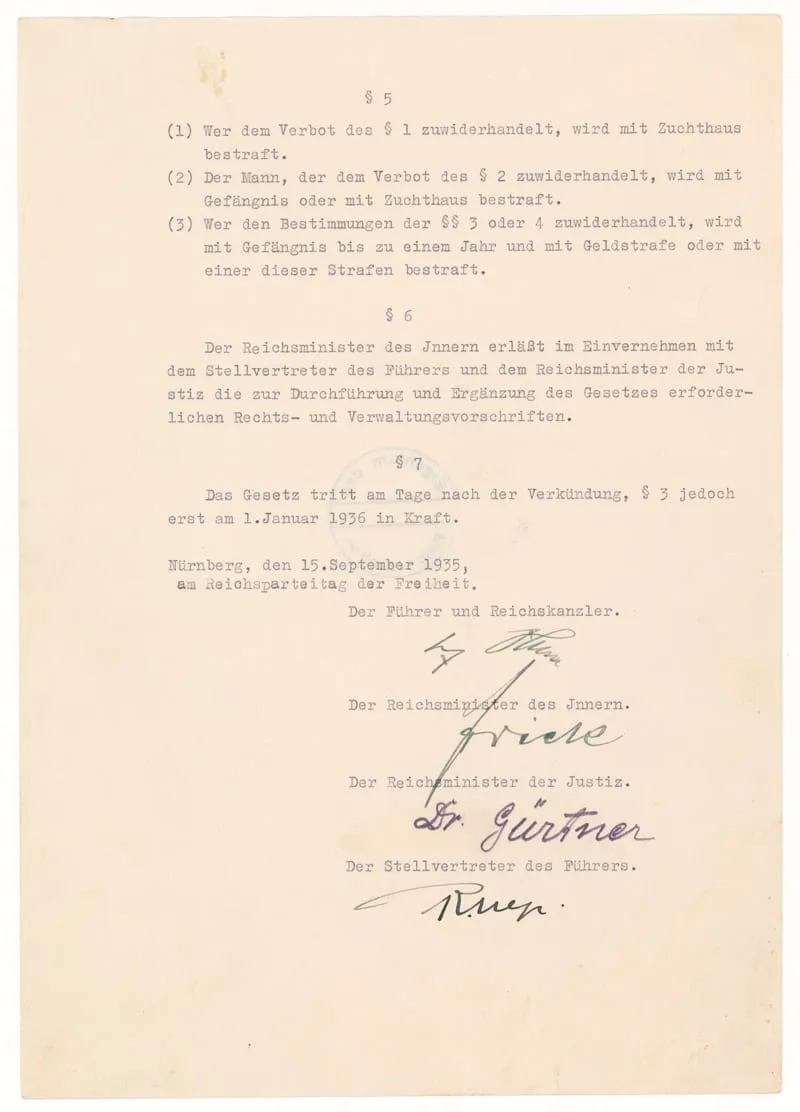
On the evening of Sunday 15 September 1935 the Reichstag convened in the hall of the Industrial and Cultural Society in Nuremberg. Its deputies had been summoned there by telegram two days earlier; it was the only session of the Third Reich’s parliament ever held outside Berlin. After a speech by Adolf Hitler, the President of the Reichstag, Hermann Göring, read out the texts of three laws, which the chamber passed unanimously and without debate: the Reich Flag Law, the Reich Citizenship Law and the Law for the Protection of German Blood and German Honour. The last two went down in history as the Nuremberg Laws. They stripped German Jews of their political rights, forbade them to marry or have sexual relations with “Germans” and made them second-class people in their own country. The laws are often described as having “institutionalised discrimination against Jews and created the legal framework for their systematic persecution”. The description is apt: from September 1935 antisemitism was no longer merely a party programme and the violence of street thugs, but the binding law of the state.
Exclusion from the very first weeks
The persecution did not begin in Nuremberg. The NSDAP programme of 1920 had declared that no Jew could be a German citizen, and from the moment Hitler became Chancellor the new authorities steadily pushed Jews out of public life. The boycott of Jewish shops on 1 April 1933 was followed by the Law for the Restoration of the Professional Civil Service of 7 April. Its “Aryan paragraph” required officials of “non-Aryan descent” to be removed from state service. At the insistence of President Paul von Hindenburg, exceptions were made for front-line veterans, for those whose fathers or sons had fallen in the war, and for officials employed before 1914. Further regulations restricted Jewish access to the bar, medicine, schools and universities, the press, culture and sport. Many, above all the younger and better-off, chose to emigrate, some of them to Palestine thanks to the Haavara Agreement.
The year 1934 brought a relative lull. The regime, preoccupied with its conflict with the SA and with consolidating power, curbed the street excesses that were damaging the economy and Germany’s image. In the spring and summer of 1935 the wave of violence returned. Party activists and SA men, frustrated that the “Jewish question” had still not been “solved”, daubed slogans on shops, picketed them and publicly pilloried “race traitors” who had dealings with Jews. Julius Streicher’s weekly Der Stürmer waged an obsessive campaign against “racial disgrace”. On 15 July 1935 Nazi thugs beat up Jewish passers-by on Berlin’s Kurfürstendamm. Some register offices refused on their own initiative to marry “mixed” couples.
The leadership of the state found itself in a quandary. Hjalmar Schacht, Minister of Economics and President of the Reichsbank, warned that unauthorised actions were harming exports and foreign credit. The Interior Minister, Wilhelm Frick, announced on 25 July that marriages between Jews and non-Jews would soon be banned by law, and advised officials to stop performing such weddings. On 8 August Hitler ordered an end to “individual actions”, and on 20 August ministers and party representatives agreed that the “Jewish question” must be settled by law, not by violence on the streets. Historians have long debated whether the Nuremberg Laws were an improvisation or the realisation of an old plan. The prevailing view today is that the two strands intertwined: drafts of a marriage ban and a new citizenship law had been circulating in the ministries since 1933, while pressure from party radicals and the need to calm the streets decided when and in what form they were announced.
The “Rally of Freedom”
The seventh Nazi Party rally was held in Nuremberg from 10 to 16 September 1935 under the slogan “Reichsparteitag der Freiheit”. It was meant to celebrate the recovery of “freedom” from the restrictions of Versailles, above all the reintroduction of universal conscription in March and the building of the Wehrmacht. Anti-Jewish laws were not on the programme. On 12 September the Reich Physicians’ Leader, Gerhard Wagner, unexpectedly announced in a speech a law “for the protection of German blood”. The next day Hitler decided to summon the Reichstag to Nuremberg for the last day of the rally and instructed Interior Ministry officials to prepare a draft.
The work was done in haste. State Secretary Hans Pfundtner and Wilhelm Stuckart brought the ministry’s racial affairs experts from Berlin, among them Bernhard Lösener, who arrived on 14 September. That same evening Hitler demanded that a new citizenship law also be ready by the morning. The drafts were written overnight in a hotel and party lodgings. Around midnight Frick presented Hitler with four versions of the blood protection law, differing mainly in the severity of the penalties. Hitler chose the mildest, but according to Lösener’s account he personally struck out of it the sentence stating that the law applied only to “full Jews”, allowing it to appear only in a press release meant to reassure the public. The question of who exactly was to count as a Jew he left open. After the war Lösener and other officials presented their part as a matter of softening the party’s demands; present-day scholars treat these accounts with great caution.
In his speech to the Reichstag Hitler called the laws an attempt at a “legal regulation” of the problem, and threatened that if it failed the problem would have to be handed over to the party for a “final solution”. At the time the words sounded like a propaganda threat. From the vantage point of the 1940s they read differently.
Three laws
The Reich Flag Law declared that the colours of the Reich were black, white and red, and that the swastika flag was the state, national and merchant flag. Until then two flags had been used side by side: the black-white-red flag of the imperial era and the party’s swastika flag. The pretext for the hasty change was an incident in July 1935, when demonstrators in New York tore the swastika flag from the German liner Bremen, and a local judge, releasing some of those arrested, spoke of it in very critical terms. In his speech Göring presented the new flag as a symbol whose insult Germany would no longer tolerate.
The Reich Citizenship Law created two categories of people. A “subject of the state” (Staatsangehöriger) was anyone who belonged to the “protective association” of the Reich. A “citizen of the Reich” (Reichsbürger), “the sole bearer of full political rights”, could only be a subject “of German or kindred blood” who had shown by his conduct that he was willing and able “to serve the German people and Reich faithfully”. Jews thus formally became subjects without civil rights. The law did not yet say who was a Jew, leaving the details to implementing decrees. The promised “citizenship certificates” were never introduced, and the vague wording about “faithful service” made it possible in future to exclude political opponents as well.
The Law for the Protection of German Blood and German Honour opened with a preamble stating that “the purity of German blood is the prerequisite for the continued existence of the German people”. It forbade marriages between Jews and citizens “of German or kindred blood”; marriages contrary to the ban, including those concluded abroad to circumvent it, were void, and the spouses faced penal servitude. It forbade extramarital relations between Jews and “Germans” – only the man was liable to punishment – and the employment in Jewish households of German women under the age of 45. This last provision, which came into force on 1 January 1936, rested on the insulting assumption that a Jewish employer was a threat to his maid. Jews were also forbidden to fly the Reich flag or display the Reich colours. The law did not annul mixed marriages already concluded, although party radicals demanded compulsory divorces. It was signed by Hitler, Frick, the Justice Minister Franz Gürtner and the Deputy Führer, Rudolf Hess.
All three laws were published on 16 September in the Reich Law Gazette with the note “Nuremberg, 15 September 1935, at the Reich Party Rally of Freedom”.
Who is a Jew
For two months the ministry and the party argued over whom the new regulations would cover. The radicals, led by Wagner and Streicher, wanted people with a single Jewish grandparent to be treated as Jews too. Ministry officials warned that this would affect hundreds of thousands of people, including many soldiers and officials. Hitler long put off a decision. The First Supplementary Decree to the Reich Citizenship Law of 14 November 1935 adopted a middle course:
- a Jew was anyone with at least three “racially full Jewish” grandparents;
- a person with two Jewish grandparents was a “Jewish Mischling of the first degree”, but was counted as a Jew if he or she belonged to the Jewish religious community or was married to a Jew (such people were later called “Geltungsjuden”);
- a person with one Jewish grandparent was a “Mischling of the second degree”.
The paradox of this “racial” definition was that the “race” of the grandparents was determined by their membership of a religious community. The science the Nazis invoked could not point to any biological criterion, so officials turned to parish registers and the records of Jewish communities. Proving “Aryan” descent, for example with an Ahnenpass, became an everyday obligation for millions of Germans. Hitler reserved the right to grant exemptions; of more than ten thousand applications, few were approved.
The same decree deprived Jews of the vote and barred them from holding public office. Jewish officials who had been protected in 1933 by the front-line veterans’ privilege had to leave the service by 31 December 1935. The first decree under the blood protection law introduced marriage bans for “Mischlinge” and stipulated that such unions could take place only with special permission, which in practice was very hard to obtain. A circular from the Interior Minister of 26 November 1935 extended the marriage bans to unions that “endanger the purity of German blood”, explicitly naming Roma and Sinti, as well as Black people and their descendants. The Nuremberg Laws thus became one of the foundations of the persecution of the Roma, which ended during the war in their mass extermination (the Porajmos).
Reactions
According to reports by the Gestapo and the SS security service, most Germans greeted the laws with approval or indifference. Many were glad that “orderly” legislation would replace chaotic violence on the streets. Critical voices came from Catholic circles and from the underground Social Democratic opposition, which wrote of “emergency laws of a sexual-pathological character” that placed Jews outside humanity. Some German Jews deluded themselves that now their status had at last been defined in law, the daily harassment would at least come to an end. On 24 September the Reich Representation of German Jews (Reichsvertretung der Deutschen Juden) expressed the hope that the laws would allow a “tolerable” coexistence if the defamation and boycotts ceased. The hope proved illusory.
Abroad the protests were weaker than Schacht had feared. In the United States the campaign to boycott the 1936 Olympic Games in Berlin revived, but the American Olympic Committee rejected it. The German government allowed two athletes classed as “Mischlinge” – the fencer Helene Mayer and the ice hockey player Rudi Ball – to compete for the national team, which enabled it to rebut accusations of discrimination.
Law as an instrument of persecution
The blood protection law quickly became a basis for denunciations. Neighbours, colleagues and acquaintances informed on couples suspected of “racial disgrace” (Rassenschande). According to figures cited in the literature, 1,911 men were convicted of it between 1936 and 1940, and from 1938 the Gestapo often sent them to concentration camps after they had served their sentences. The special courts also passed death sentences; in 1942 the Nuremberg merchant Leo Katzenberger was executed in Munich, accused of an affair with a young neighbour that had never taken place.
In the years that followed, more than a dozen implementing decrees were issued under the Reich Citizenship Law. In 1938 they took away Jewish doctors’ right to practise medicine and Jewish lawyers’ right to practise law. After the annexation of Austria in March 1938 the laws were extended to hundreds of thousands more people. The Eleventh Decree of 25 November 1941 laid down that a Jew whose “habitual residence” was abroad lost his citizenship and his property to the Reich – which also applied to those deported to the east the moment they crossed the border. The minutes of the Wannsee Conference of 20 January 1942 recorded that the Nuremberg Laws were to form “in a certain sense the basis” of the planned “Final Solution”.
The Reich’s allies introduced similar laws on the German model: Benito Mussolini’s Italy in 1938, Hungary in 1938–1941, and Romania, Slovakia, Bulgaria and Croatia in 1940–1941. Some historians, notably the American legal scholar James Q. Whitman, have pointed out that while working on the laws Nazi lawyers studied American race laws, including the bans on mixed marriages then in force in many states; they themselves, however, considered them insufficiently consistent. A commentary on the laws was written in 1936 by Stuckart and the ministry official Hans Globke, who after the war became head of the Federal Chancellery under Konrad Adenauer – one of the most notorious examples of continuity of personnel in post-war Germany. The laws were repealed by the Allied Control Council on 20 September 1945.
On the road to the Holocaust
The Nuremberg Laws did not openly herald genocide. In 1935 the Nazis’ aim was to drive Jews out of Germany, and the laws were meant to isolate them from the rest of society, destroy their position and force them to emigrate. Yet they accomplished something without which the later crimes would have been far harder: they legally set apart a group of people, gave it an official definition and stripped it of the state’s protection. From then on every Jew in Germany could be registered, counted and marked according to criteria written into the law gazette. The same categories – “Jew”, “Mischling of the first degree”, “Mischling of the second degree” – were later used by officials when issuing passports stamped with the letter J, when confiscating property after Kristallnacht, when introducing the Star of David and when drawing up deportation lists. The road from the party rally in Nuremberg in 1935 to the gas chambers of the Holocaust was not predetermined, but it ran through offices that the Nuremberg Laws had taught to divide people by “blood”.
Sources
Related events
(04)The same battle, people or subject.
- 6 February 1936 · SocietyThe Winter Olympics in Garmisch-PartenkirchenOn 6 February 1936 Hitler opened the Winter Olympics in Garmisch-Partenkirchen. Antisemitic signs came down and the regime showed the world a gentle face.
- 1 August 1936 · SocietyThe Berlin OlympicsOn 1 August 1936 Hitler opened the Games of the XI Olympiad in Berlin. The regime staged a huge propaganda spectacle, and Jesse Owens won four gold medals.
- 2 August 1934 · PoliticsHitler becomes FührerPresident Hindenburg died on 2 August 1934. Under a law of 1 August Hitler took over his powers and became head of state as “Führer and Reich Chancellor”.
- 30 June 1934 · Crimes and repressionThe Night of the Long KnivesOn 30 June 1934 Hitler had the SA leadership under Röhm murdered, along with old opponents such as Schleicher. At least 85–90 people were killed.