Germany
Wilhelm Frick
Minister of the Interior of Thuringia (1930–1931), Reich Minister of the Interior (1933–1943), Protector of Bohemia and Moravia (1943–1945)
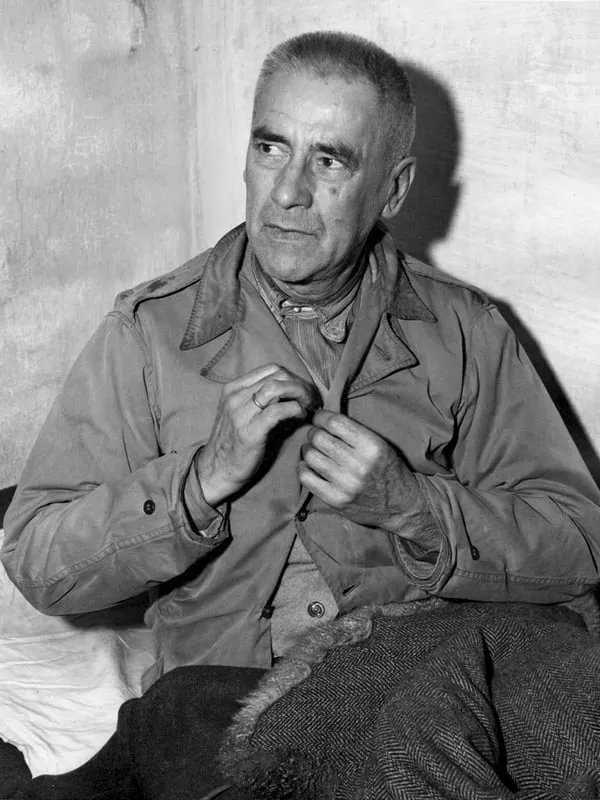
- Born:
- 12 March 1877, Alsenz (Kingdom of Bavaria, German Empire)
- Died:
- 16 October 1946, Nuremberg
- Author:
- Łukasz
- Photo:
- United States Army Signal Corps photographer, domena publiczna, Wikimedia Commons

Wilhelm Frick was a civil servant and lawyer who placed his expertise at the service of Adolf Hitler’s movement as early as the beginning of the 1920s and never turned away from it. As head of the Munich political police he shielded the young NSDAP; he took part in the Beer Hall Putsch; in 1930 he became the first Nazi minister in Germany; and in January 1933 he was one of only three Nazis in Hitler’s first cabinet. For ten years, as Reich Minister of the Interior, he drafted and signed the laws that abolished democracy, subordinated the federal states to Berlin, excluded the Jews from society and incorporated conquered territories into the Reich. He was neither an orator nor an ideologue but the dictatorship’s bureaucrat, who gave lawlessness the form of statutes. In 1946 the International Military Tribunal at Nuremberg sentenced him to death.
Youth and the Bavarian civil service
He was born on 12 March 1877 in Alsenz in the Palatinate, then part of the Kingdom of Bavaria, the youngest of the four children of a Protestant schoolteacher. He attended the classical grammar school in Kaiserslautern and, after his school-leaving examination in 1896, studied philology for a semester in Munich before switching to law, which he studied at Göttingen and Berlin. In 1901 he took his doctorate in law at Heidelberg. From 1903 he was an official of the Bavarian administration; from 1904 he worked at the police headquarters in Munich, and in 1907 he was transferred to the district office in Pirmasens, which he headed from 1914. He was not called up for military service because of poor health. In 1910 he married Elisabetha Nagel, with whom he had two sons and a daughter.
In 1917, at his own request, he returned to the Munich police. At first he dealt with combating wartime profiteering, and even then he gave expression to his antisemitism. After the revolution and the fall of the Bavarian Soviet Republic in 1919 he took charge of the political police. Under the protection of the police president, Ernst Pöhner, an extreme nationalist, the Munich police turned a blind eye to right-wing paramilitary groups and their crimes, and Frick, as German historians have established, helped among others a Freikorps member suspected of murder to escape by issuing him a false passport. In 1919 Pöhner introduced him to Hitler. Frick was generous in granting the NSDAP permits for rallies and posters. In Mein Kampf Hitler praised the two of them as the only senior officials who had had the courage to support his movement.
The putsch and the Reichstag
In 1923 Frick was one of the heads of the Munich criminal police. On the night of 8–9 November 1923, when Hitler, Erich Ludendorff and their men tried to overthrow the government of Bavaria and then of the Reich, Frick was to become the new police president. Sitting in police headquarters, he delayed alerting the state police. After the putsch collapsed he was arrested and tried together with Hitler. By the verdict of 1 April 1924 he was sentenced to 15 months’ fortress confinement for aiding and abetting high treason, but after several months in custody the sentence was suspended. A disciplinary court overturned his dismissal from the service, ruling that he had not acted with treasonable intent, and Frick returned to work at the Bavarian insurance office.
In May 1924 he entered the Reichstag on a joint list of the National Socialist radicals and members of the banned NSDAP. He remained a deputy until 1945. On 1 September 1925 he joined the re-founded NSDAP with membership number 10. After the 1928 elections he led the twelve-strong NSDAP group in the Reichstag. His speeches, full of attacks on Jews, “Marxists” and the “November criminals”, served the purpose he himself had announced: to destroy parliamentary government from within.
The first Nazi minister
On 23 January 1930, after elections in Thuringia, the NSDAP joined a right-wing coalition there, and Frick took over the ministries of the interior and of education. He was the first Nazi to hold a ministerial post in Germany, and he treated Thuringia as a testing ground. He removed communist teachers and mayors, dismissed Social Democratic officials and took Nazis into the police, so much so that the Social Democratic Reich Minister of the Interior, Carl Severing, suspended Reich subsidies for the Thuringian police for several weeks. Against the wishes of the University of Jena, Frick created a chair of social anthropology for the racist Hans F. K. Günther. He banned the novel All Quiet on the Western Front from schools, introduced Nazi school prayers, which a court ruled unconstitutional, and had works by Paul Klee, Oskar Kokoschka, Emil Nolde and Ernst Barlach removed from the museum in Weimar. In the summer of 1930 he also tried to give Hitler, who had been stateless since 1925, German citizenship by appointing him a gendarmerie commissioner in Hildburghausen. The idea provoked ridicule and came to nothing; Hitler obtained citizenship only in 1932, in Brunswick. On 1 April 1931 the Landtag passed a vote of no confidence in Frick and he lost his post.
Architect of the dictatorship
When on 30 January 1933 Paul von Hindenburg appointed Hitler chancellor, Frick became Reich Minister of the Interior – the only Nazi in the cabinet apart from Hermann Göring. The conservatives had let him have this ministry because they considered it weak: the police belonged to the federal states. Frick soon changed that. He drafted the decree of 4 February that allowed meetings and newspapers to be banned. After the Reichstag fire it was he who added to the Decree for the Protection of People and State the clause that allowed the Reich government to take over power in the states. On that basis, in the first days after the elections of 5 March, he appointed Reich commissioners in the states not governed by the Nazis. It was on his initiative that, before the vote on the Enabling Act, the Reichstag’s standing orders were changed so that deputies absent without excuse – including imprisoned communists – were counted as present.
The Enabling Act turned Frick’s ministry into the main workshop of the Third Reich’s legislation. His officials drafted the two laws on the coordination of the states with the Reich (31 March and 7 April 1933), which gave power in the states to Nazi Reich governors; the Law for the Restoration of the Professional Civil Service of 7 April, under which Jews and political opponents were dismissed; the Law against the Formation of New Parties of 14 July, which made the NSDAP the only party in Germany; and the Law for the Prevention of Hereditarily Diseased Offspring of the same day, under which some 400,000 people were forcibly sterilised. On 30 January 1934 the Law on the Reconstruction of the Reich abolished the state parliaments, and on 14 February the Reichsrat was abolished. For the first time in its history Germany became a centralised state, and the Reich governors of the states were subordinate to Frick. From 1 May 1934 he was also Prussian Minister of the Interior.
In February 1934 he divorced his first wife, and in March he married Margarete Schultze-Naumburg, the former wife of a Nazi architect and deputy. There is no evidence that he took part in preparing the Night of the Long Knives, but on 3 July 1934, together with Hitler and the Minister of Justice, Franz Gürtner, he signed the law that declared the murders of 30 June and the following days to be “lawful acts of self-defence by the state”. His signature also appeared on the law of 1 August 1934 under which, on Hindenburg’s death, Hitler became Führer of the Reich, combining the offices of president and chancellor.
The racial laws and the loss of the police
Frick was a convinced antisemite and racist. His ministry was responsible for “racial” policy and “national health”. In September 1935, together with Hitler, he signed the Nuremberg Laws, which stripped the Jews of their civil rights and prohibited “mixed” marriages, and then the decrees defining who was a Jew. It was long assumed, on the strength of accounts by his official Bernhard Lösener, that he himself had played little part in them, but more recent research suggests that he was more involved in their preparation. After Kristallnacht, on 11 November 1938, he issued a decree forbidding Jews to possess weapons.
Despite appearances, however, Frick was losing influence. He wanted to bring order to a state in which party and state offices overlapped, and to bring the police under his control as well. In 1933 and 1934 he even tried to curb the arbitrary use of “protective custody”. He lost to Heinrich Himmler and Reinhard Heydrich. On 17 June 1936 Hitler appointed Himmler Chief of the German Police “in the Reich Ministry of the Interior”. Formally Frick was his superior; in practice the SS and the police answered only to Hitler. Frick was left with administration, legislation and signatures. Hitler, who disliked any tidying up of responsibilities, received him less and less often.
Legislator of conquest
Frick nevertheless played an important part in preparing Germany for war. His ministry drafted the laws that reintroduced conscription and later extended it to the Reich’s new territories. Under the secret Reich Defence Law of May 1935 he became Plenipotentiary General for Administration, in charge of the civilian side of war preparations, and on 30 August 1939 he joined the six-member Council of Ministers for the Defence of the Reich, which acted as a war cabinet during the war. As Minister of the Interior he signed the acts by which the Reich absorbed one territory after another: the law on the Anschluss of Austria of 13 March 1938, the regulations on the Sudetenland, Memel and Danzig, the decree establishing the Protectorate of Bohemia and Moravia of 16 March 1939, and the decree of 8 October 1939 incorporating the western lands of Poland into the Reich, from which Reichsgau Wartheland (the Warthegau) and Reichsgau Danzig-West Prussia were created. His ministry built the German administration in these territories.
The health department under his authority supervised the psychiatric institutions in which, from 1939, the sick and disabled were murdered as part of Aktion T4. Frick knew about it, received complaints from relatives and clergy, and his ministry helped to organise the killings. Aktion T4 alone claimed some 70,000 victims, and the “euthanasia” programme as a whole many more. In July 1941 his younger son died in a field hospital on the Eastern Front.
Protector and Nuremberg
On 20 August 1943 Hitler replaced Frick as Minister of the Interior with Himmler. Frick remained a minister without portfolio and became Protector of Bohemia and Moravia. At first he refused, knowing that the post was ceremonial and that real power in Prague lay with the German Minister of State, Karl Hermann Frank. He spent much of his time at his villa on the Starnberger See in Bavaria. As Protector, however, he bore formal responsibility for the terror against the Czechs, forced labour and the deportation of Jews to the camps. Apart from Lutz Schwerin von Krosigk, he was the only member of Hitler’s government to serve in it continuously from January 1933 to the end.
After the war he was arrested by the Americans. He was held in the internment camp for leading Nazis at Bad Mondorf in Luxembourg, and from August 1945 in Nuremberg, where he stood trial among the major war criminals before the International Military Tribunal. He was one of two defendants, the other being Rudolf Hess, who refused to testify under oath. In his final statement he declared that his conscience was clear and that he had served his people and fatherland all his life. On 1 October 1946 the tribunal acquitted him of conspiracy but found him guilty of crimes against peace, war crimes and crimes against humanity. It found that Frick had built the legal foundations of the dictatorship and was responsible for the racial laws and for the camps to which opponents of the regime were sent, and, as Protector, for the crimes committed in Bohemia and Moravia. On 16 October 1946 he was hanged in Nuremberg prison. His last words were: “Long live eternal Germany.” His body was cremated and the ashes scattered in a tributary of the Isar near Munich.
Significance
Frick was not one of Nazism’s great orators or strategists, but without him the dictatorship would not have been built so quickly or so “legally”. It was he who, in the first months of 1933, turned Hitler’s will into decrees and statutes that allowed civil servants, judges and policemen to believe they were upholding the law. His signature stands beneath the acts that destroyed the republic, stripped the Jews of their citizenship and incorporated Austria, the Sudetenland and western Poland into the Reich.
His career also shows how the Nazi state treated those who had made it possible. Frick believed in a state that was strong but orderly, whereas Hitler and Himmler built a power based on arbitrary will and command. The lawyer who gave the dictatorship its form was pushed aside by it once form was no longer needed. For the many officials like him who in 1933 had thought that law could be reconciled with Hitler’s revolution, his fate was a warning that came too late.
Sources
Often appears with
People who appear in the same events.