United States
Arleigh Burke
Commander of Destroyer Squadron 23 (1943–1944), Chief of Staff to Admiral Mitscher (1944–1945), Chief of Naval Operations (1955–1961), Admiral
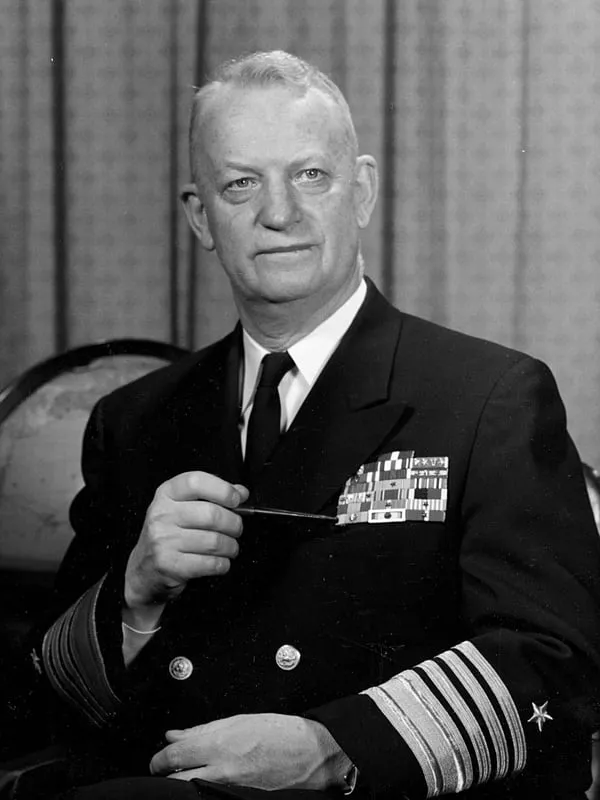
- Born:
- 19 October 1901, Boulder, Colorado (United States)
- Died:
- 1 January 1996, Bethesda, Maryland (United States)
- Author:
- Łukasz
- Photo:
- United States Navy, domena publiczna, Wikimedia Commons

Arleigh Burke spent the first year of the Pacific War behind a desk at the Navy’s gun factory in Washington, and only in 1943, after persistent efforts, was he posted to the front. Within a few months he became the most famous destroyer commander in the American fleet: his Destroyer Squadron 23, the “Little Beavers”, covered the landing on Bougainville, and on the night of 25 November 1943, at the Battle of Cape St. George, it sank three Japanese destroyers without losing a single ship. The nickname “31-knot Burke”, given to him at the time by the staff of Admiral William Halsey, stuck to him for the rest of his life. He later served as chief of staff to the commander of the Fast Carrier Task Force, took part in the armistice negotiations in Korea and, in 1955–1961, was Chief of Naval Operations, the US Navy’s highest-ranking officer. It was during his tenure that the Polaris submarine-launched ballistic missile system was created. The most numerous class of American destroyers now bears his name.
Youth and the interwar years
Arleigh Albert Burke was born on 19 October 1901 in Boulder, Colorado. His grandfather, a Swedish immigrant named August Björkgren, had changed his surname to the American-sounding “Burke”. When the schools in Boulder were closed in 1918 because of the influenza epidemic, the boy did not finish high school, but he won an appointment to the Naval Academy at Annapolis. He graduated in June 1923 as an ensign and shortly afterwards married Roberta Gorsuch, with whom he spent more than seventy years.
For the next eighteen years he served in battleships and destroyers – his first ship was the battleship Arizona – and in technical posts. In 1928 he was commended for rescuing survivors of a shipwreck, and in 1931 he took a master’s degree in chemical engineering at the University of Michigan, specialising in ordnance and explosives. In 1939 he received his first independent command, the destroyer Mugford, which under him won the fleet gunnery trophy with the highest score in years. The outbreak of war found him at the Naval Gun Factory in Washington, working on the development of naval armament. For an officer who longed for combat it was a frustrating assignment, and Burke lobbied for a long time for a transfer to the Pacific.
The Solomons 1943: the “Little Beavers”
Burke reached the South Pacific at the beginning of 1943 and successively commanded Destroyer Divisions 43 and 44, Destroyer Squadron 12 and, from October, Destroyer Squadron 23. This was the period in which American destroyers were learning to fight the Japanese at night; throughout 1942 the Japanese had won the engagements fought in darkness thanks to their excellent training and long-range torpedoes. Burke drew lessons from earlier defeats such as the Battle of Tassafaronga: he concluded that American commanders had lost through hesitation and by tying their destroyers to the cruisers’ formation. He had experienced such a moment himself in March 1943 at the Battle of Blackett Strait, when he delayed opening fire on a target picked up by radar. He later used to say that the difference between a good officer and a poor one was “about ten seconds”.
Out of these reflections grew the tactics Burke worked out for his destroyers: the squadron would split into two columns, one closing the enemy unseen, guided by radar, and firing torpedoes without giving itself away by gunfire, while the other covered it and joined the battle once the torpedoes had struck. The standing order was that destroyers would attack on making contact without waiting for orders from the task force commander. The concept was first applied in August 1943 by Commander Frederick Moosbrugger at the Battle of Vella Gulf, Burke having been transferred to another post just before it.
Destroyer Squadron 23, made up of modern Fletcher-class ships and known from its emblem as the “Little Beavers”, covered the Bougainville campaign from November 1943. In the first days of the operation it bombarded the airfields on Buka and the Shortland Islands, and on the night of 1–2 November it fought in the Battle of Empress Augusta Bay, in which Rear Admiral Aaron Merrill’s force drove the Japanese cruisers away from the beachhead. For this period Burke received the Navy Cross. On 24 November Halsey’s staff sent him to intercept Japanese destroyers returning from Buka with an order that began with the words “Thirty-one knot Burke” – the nickname was linked to a boiler defect that had limited the squadron’s speed to 31 knots. The following night, at the Battle of Cape St. George, the Little Beavers sank Ōnami, Makinami and Yūgiri without any losses. By February 1944 the squadron had fought more than twenty actions in all; it was credited with sinking a cruiser, nine destroyers, a submarine and several smaller vessels and with shooting down about 30 aircraft (according to American wartime tallies). It received the Presidential Unit Citation.
With Mitscher in the carriers
In March 1944 Burke became chief of staff to Vice Admiral Marc Mitscher, commander of the Fast Carrier Task Force (Task Force 58). The posting stemmed from an order by Admiral Ernest King that aviation commanders should have chiefs of staff from the surface navy, and surface force commanders should have aviators. Neither Mitscher nor Burke was pleased: the veteran aviator distrusted a “destroyer man”, and Burke did not want to leave his ships. In time Mitscher came to value his new chief of staff’s industry and talent for organisation, and Burke realised he had been given one of the most important posts in the fleet. As a commodore (a temporary rank) he took part in all the task force’s operations until June 1945: the raids on the Caroline Islands, the landings in the Marianas and the Battle of the Philippine Sea in June 1944, the Battle of Leyte Gulf, the air raids on Japan and the Battle of Okinawa. In May 1945 he was aboard Mitscher’s flagships – the carriers Bunker Hill and Enterprise – when both were hit by kamikaze aircraft within a few days of each other.
The post-war navy and the “Revolt of the Admirals”
After the war Burke reverted to his permanent rank of captain and served again as Mitscher’s chief of staff until the admiral’s death in 1947, then commanded the cruiser Huntington. In 1949 he headed a small section of the naval staff (OP-23) that prepared the Navy’s case in the dispute over the shape of the newly unified armed forces. The Navy was then defending its carriers and its own aviation against plans to base American defence almost entirely on the Air Force’s B-36 strategic bombers. The dispute, known as the “Revolt of the Admirals”, ended with the dismissal of the Chief of Naval Operations, while the Secretary of the Navy had the OP-23 office searched and struck Burke’s name from the list for promotion to rear admiral. The promotion was restored after the intervention of President Harry Truman, and Burke received his first admiral’s star.
Korea
After the outbreak of the Korean War the Chief of Naval Operations, Admiral Forrest Sherman, sent Burke to Japan as deputy chief of staff to the Commander, Naval Forces Far East. Burke then commanded Cruiser Division 5, and in July 1951 joined the United Nations delegation to the armistice negotiations with North Korea and China at Kaesong. After six months at the negotiating table he returned to Washington, where until 1954 he headed the Navy’s strategic plans division. His time in Japan left him with a lasting sympathy for his former enemies: he maintained close ties with Japanese naval officers and supported the creation of the post-war Japan Maritime Self-Defense Force. Japan later awarded him the Grand Cordon of the Order of the Rising Sun.
Chief of Naval Operations
In 1954 Burke took command of Cruiser Division 6, and in January 1955 of the Destroyer Force, Atlantic Fleet. In August 1955 President Dwight Eisenhower appointed him Chief of Naval Operations, the Navy’s most senior officer. The fifty-three-year-old rear admiral, who had never been a vice admiral, was promoted two ranks, over the heads of several dozen more senior admirals. He served three terms, until August 1961 – longer than anyone before him.
His tenure coincided with the most difficult years of the Cold War. He backed Hyman Rickover, demanding and inconvenient to many, in building a fleet of nuclear-powered submarines, and as early as 1955 he set up a special office under Rear Admiral William Raborn to develop a submarine-launched ballistic missile. Against sceptics within the Navy itself, he opted for a smaller solid-fuel missile rather than adapting a land-based rocket for use at sea. In July 1960 the submarine George Washington made the first submerged launch of a Polaris missile, and in November she sailed on the first deterrent patrol. Burke believed that undetectable missile submarines made the nuclear balance more stable than land-based launchers and bombers vulnerable to a first strike, and he criticised launch-on-warning strategies as dangerous. During his tenure the fleet intervened in Lebanon and during the Taiwan Strait crisis of 1958. In April 1961, during the Bay of Pigs invasion, he pressed President John F. Kennedy without success for wider support from Navy aircraft for the landing by Cuban exiles.
Last years and legacy
Burke retired on 1 August 1961. In 1962 he co-founded the Center for Strategic and International Studies (CSIS) in Washington, one of the most important American think tanks. In 1973, as a descendant of Swedish immigrants, he represented the United States at the funeral of King Gustaf VI Adolf of Sweden. In 1977 President Gerald Ford awarded him the Presidential Medal of Freedom.
In 1985 the Navy ordered the prototype of a new class of Aegis guided-missile destroyers and named it after him – only the fifth time since 1861 that a US Navy ship had been named after a living person. Burke, who in 1985 had carved his initials into a section of the keel, lived to see USS Arleigh Burke commissioned in 1991. The Arleigh Burke-class destroyers became the most numerous type of large surface combatant in the American fleet. He died on 1 January 1996 at the naval hospital in Bethesda at the age of 94 and was buried in the Naval Academy Cemetery at Annapolis.
For the history of the Second World War, Burke remains a symbol of the transformation the American fleet underwent in the Solomon Islands in 1943: from costly night defeats to victories won through radar, the initiative of individual commanders and boldness in attack. The Battle of Cape St. George, in which his destroyers sank three enemy ships without loss, is regarded as a model destroyer action of the war. As Chief of Naval Operations he in turn built one of the pillars of Cold War nuclear deterrence – the fleet of Polaris missile submarines.
Sources
Mentioned in battles
(02)Often appears with
People who appear in the same events.