Japan
Takeo Kurita
Commander of Cruiser Division 7 (1941–1942), Battleship Division 3 (1942–1943) and the Second Fleet (1943–1944), superintendent of the Naval Academy (1945), vice admiral
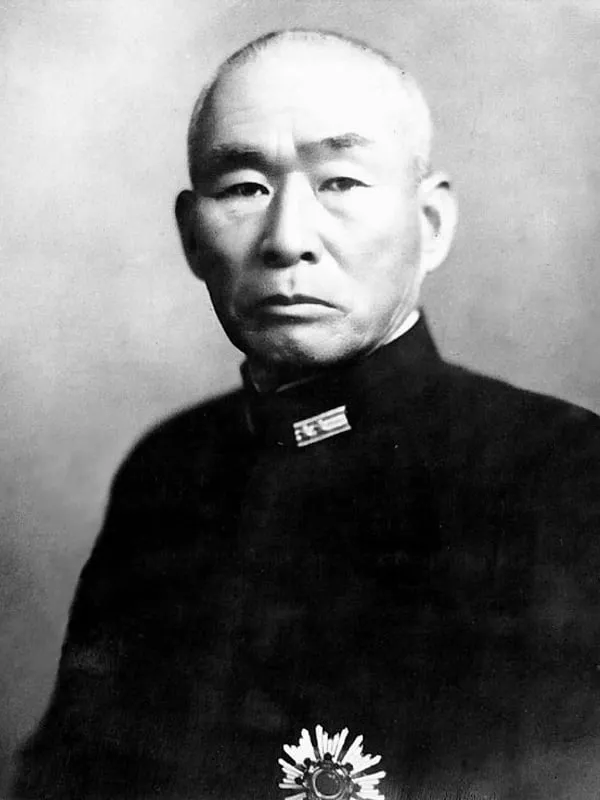
- Born:
- 28 April 1889, Mito, Ibaraki Prefecture (Japan)
- Died:
- 19 December 1977
- Author:
- Natalia
- Photo:
- autor nieznany, domena publiczna, Wikimedia Commons

Takeo Kurita was a sailor of the old school: for more than twenty years he commanded destroyers, cruisers and battleships rather than aircraft carriers, and to the end of the war he remained an admiral of surface ships. Between 1941 and 1944 he took part in almost every major operation of the Japanese fleet – from the invasions of Malaya and Java, by way of Midway and Guadalcanal, to the Philippine Sea. He went down in history, however, because of a single decision. On the morning of 25 October 1944, in the Battle of Leyte Gulf, his force, which included the super-battleship Yamato, surprised a weak group of American escort carriers off Samar, and after two hours of fighting, a few dozen miles from a gulf full of American ships, Kurita broke off the attack and turned back. That decision, which years later he once called a mistake and then disowned, is still debated by historians. After the war Kurita kept silent: he wrote no memoirs and gave almost no interviews.
Youth and career
Takeo Kurita was born on 28 April 1889 in Mito, Ibaraki Prefecture. In 1905, at the age of sixteen, he entered the Naval Academy at Etajima, from which he graduated in 1910, 28th out of 149 in the 38th class. As a cadet he sailed in the cruisers Kasagi and Niitaka, and after his commission as ensign in 1911 he served in the cruiser Tatsuta. In the years that followed he passed through the battleship Satsuma, the destroyer Sakaki and the armoured cruiser Iwate; in 1916 he became a lieutenant, and until 1919 he served in the cruiser Tone and the destroyers Kaba and Minekaze – in the last as torpedo officer.
Torpedoes and destroyers became his speciality. In 1920 he received his first independent command, the destroyer Shigure, and during the 1920s he commanded in turn the destroyers Oite, Wakatake, Hagi, Hamakaze and Urakaze, and then Destroyer Divisions 25 and 10. In a Japanese navy that was preparing for night torpedo attacks on a superior American fleet, this was highly prized experience. In 1932, by then a captain, he commanded Destroyer Division 12, then the light cruiser Abukuma, and from 1937 the battleship Kongō. On 15 November 1938 he was promoted to rear admiral. Unlike many of his colleagues, he never served on staffs or in the ministry and kept out of the navy’s political quarrels – he was regarded as a seagoing officer, taciturn and sparing with words.
Cruisers in the south
At the start of the Pacific War Kurita commanded Cruiser Division 7 – four modern heavy cruisers of the Mogami class: Kumano (the flagship), Suzuya, Mogami and Mikuma. In December 1941, as part of Vice Admiral Jisaburō Ozawa’s fleet, they covered the invasion convoys bound for Malaya and then the landings in the Dutch East Indies (the invasion of Java itself did not come until the turn of February and March 1942). During the Japanese invasion of Java Kurita’s cruisers covered the landing at the western end of the island; on the night of 28 February–1 March 1942 Mikuma and Mogami took part in the Battle of Sunda Strait, in which the American cruiser Houston and the Australian Perth were sunk.
At the beginning of April 1942, during the Indian Ocean raid, Kurita commanded one of the groups of Ozawa’s Malaya Force, which entered the Bay of Bengal and attacked shipping off the east coast of India. According to some accounts the cruiser force, together with the light carrier Ryūjō, sank ships totalling about 135,000 GRT – one of the heaviest blows dealt to Allied shipping in those waters. On 1 May 1942 Kurita was promoted to vice admiral, although he continued to command the same division.
Midway: Mikuma and Mogami
At the Battle of Midway Cruiser Division 7 formed part of Vice Admiral Nobutake Kondō’s force, which was to cover the landing on the atoll. When Chūichi Nagumo’s carrier force lost all four of its ships on 4 June 1942, Admiral Isoroku Yamamoto ordered Kurita’s cruisers to bombard Midway by night and then – when it became clear that they would not arrive before dawn – called the operation off. During the night the withdrawing cruisers ran into the American submarine Tambor; in a violent evasive manoeuvre Mogami rammed Mikuma. The two damaged ships fell behind and on 6 June came under attack by aircraft from the carriers and from Midway: Mikuma sank with most of her crew, while the badly damaged Mogami managed to escape. Kurita himself, with Kumano and Suzuya, had already made off to the west, leaving the damaged ships with an escort of two destroyers – a decision for which he was later reproached.
Battleships off Guadalcanal
In July 1942 Kurita took over Battleship Division 3, with the fast battleships Kongō and Haruna. During the Guadalcanal campaign he carried out the most effective bombardment of the American airfield in the whole campaign: on the night of 13–14 October 1942 his battleships shelled Henderson Field, firing, according to some accounts, 918 heavy-calibre shells. Most of the American aircraft on the island were destroyed or damaged and the fuel stocks were set on fire, which allowed a Japanese convoy to land troops and supplies the next day. At the end of October Kurita’s division formed part of Kondō’s force in the Battle of the Santa Cruz Islands.
In 1943 Kurita succeeded Kondō as commander of the Second Fleet – the main force of heavy surface ships, built around the heavy cruisers. At the beginning of November 1943, during the fighting for Bougainville, Admiral Mineichi Koga sent his cruisers to Rabaul to destroy by night the ships covering the American beachhead. Before they could put to sea, however, on 5 November carrier aircraft attacked Rabaul and damaged several heavy cruisers; Kurita’s force had to withdraw to Truk.
The Philippine Sea
In June 1944 the Second Fleet became part of Ozawa’s Mobile Fleet. In the Battle of the Philippine Sea Kurita commanded the Vanguard Force: three light carriers (Chitose, Chiyoda and Zuihō), screened by the battleships Yamato, Musashi, Kongō and Haruna and by heavy cruisers. The Vanguard was to move ahead of the main body and absorb the first blow of the American airmen; in practice the Japanese aircraft were massacred in the air and Ozawa’s fleet lost three carriers. Kurita’s ships came out of the battle without serious losses, but Japanese carrier aviation had practically ceased to count. In the next operation, therefore, the burden of the fighting fell on the battleships and cruisers – and so on Kurita.
Shō-Gō: an order he did not believe in
The Shō-Gō 1 plan, drawn up by the commander of the Combined Fleet, Admiral Soemu Toyoda, provided that after the American landing on Leyte Ozawa’s carriers would draw William Halsey’s Third Fleet away to the north, while two surface forces broke into Leyte Gulf from two directions and destroyed the invasion fleet. The main thrust, from the north through the San Bernardino Strait, was entrusted to Kurita’s Centre Force: five battleships (Yamato, Musashi, Nagato, Kongō, Haruna), ten heavy cruisers, two light cruisers and fifteen destroyers. Vice Admiral Shōji Nishimura’s force was to come in from the south. According to some accounts, Kurita and his staff believed that throwing the fleet without air cover against a gulf where, a few days after the landing, there would be mostly empty transports was a pointless sacrifice of ships and men. He nevertheless accepted the order, and before leaving Brunei he told his officers that the fleet had to take part in the decisive battle while it still existed.
The first losses came before any clash with the American fleet. At dawn on 23 October, in the Palawan Passage, the American submarines Darter and Dace sank the cruisers Atago and Maya and badly damaged Takao. Atago was Kurita’s flagship: the admiral had to swim for his life, was picked up by the destroyer Kishinami, and in the afternoon transferred his flag to Yamato, having lost part of his staff and communications (the sinking of Atago took place on the first day of the battle, not, as is sometimes stated, “six days before the battle”). On 24 October, in the Sibuyan Sea, the Centre Force spent the whole day beating off air attacks from Halsey’s carriers; the aircraft sank Musashi and damaged several other ships. In the afternoon Kurita turned west to get out from under the attacks, and only at about 5.15 p.m. did he head once more for San Bernardino. American airmen reported his withdrawal, and Halsey, convinced that the Centre Force had been shattered, took all his carriers and battleships north against Ozawa’s decoy. During the night Kurita passed through the strait unobserved.
Samar and the turn to the north
On the morning of 25 October, off the east coast of the island of Samar, the Japanese came upon Rear Admiral Clifton Sprague’s Taffy 3: six escort carriers, three destroyers and four destroyer escorts. Kurita took them for Halsey’s fleet carriers and, instead of putting his formation in order, ordered a general attack. For more than two hours his ships, harried by aircraft from the escort carriers and by torpedo attacks from the destroyers, pressed forward in disorder. The Battle off Samar cost the Americans the escort carrier Gambier Bay, the destroyers Johnston and Hoel and the destroyer escort Samuel B. Roberts; the Japanese lost the heavy cruisers Chōkai, Chikuma and Suzuya. At about 9.10 a.m. Kurita broke off the pursuit to gather his scattered ships, and after several hours of hesitation, at noon, he finally gave up the attempt to enter Leyte Gulf and turned north, and then west through San Bernardino. On 26 October aircraft caught his retreating force once more and sank the light cruiser Noshiro. On 28 October the remnants of the Centre Force reached Brunei.
The reasons for his decision are disputed. Kurita himself, questioned by the United States Strategic Bombing Survey (USSBS) in the autumn of 1945, explained that he had believed he was fighting fleet carriers, that the transports had already left the gulf while massed air attacks would await him inside it, and that he preferred to seek out the American carriers which, according to a report he had received (one that proved false), were to the north. He also knew by then of the destruction of Nishimura’s force in the night battle in the Surigao Strait. Historians point to the admiral’s exhaustion after three days with almost no sleep, the loss of his flagship and part of his staff, the lack of air reconnaissance and the chaos in communications. Others suggest that Kurita, like many naval officers, regarded a suicidal hurling of his ships against the transports as senseless. One thing is certain: thanks to this turn the American invasion fleet off Leyte survived, and Japan lost the Battle of Leyte Gulf in a way that ended the existence of its navy as a fighting force.
After Leyte
Opinion about Kurita in the Japanese navy was divided. Some officers accused him of not fighting to the end and of throwing away the only chance created by the sacrifice of Ozawa’s carriers; others felt that he had at least saved some of the ships and men. In December 1944 he was relieved of command of the Second Fleet, and early in 1945 he was appointed superintendent of the Naval Academy at Etajima – according to some sources partly to protect him from a possible assassination attempt by fanatical officers. The end of the war found him in that post. Yamato, in which he had led the Centre Force at Leyte, was sunk on 7 April 1945 on a suicide sortie towards Okinawa.
After the war
After the surrender Kurita lived with his daughter and her family; according to some sources he made his living as a clerk and a masseur. Soon after the war American naval officers tracked him down and interrogated him for the USSBS; one of them later recalled finding the admiral who had commanded the largest battleship force in history working in his back garden. Kurita wrote no memoirs and talked to no one about the war. The one exception was a brief conversation with the journalist Masanori Itō in 1954, in which he admitted that turning back at Leyte had been a mistake made in a state of extreme fatigue – although he later denied having put it that way. Twice a year he travelled to the Yasukuni shrine in Tokyo to pray for his fallen comrades. In 1966 he attended Ozawa’s funeral. He died on 19 December 1977 at the age of 88 and was buried in Tama Cemetery in Fuchū near Tokyo.
Assessment
Kurita was one of the most experienced commanders of surface ships in the Japanese navy, and the bombardment of Henderson Field in October 1942 was one of that navy’s most effective actions in the entire Guadalcanal campaign. His image, however, has been dominated by two hours off Samar. American writers long treated his turn as an inexplicable loss of nerve, one that saved the Leyte landing and relieved Halsey of the greater part of the blame for leaving San Bernardino unguarded. More recent work, especially that based on Japanese accounts, stresses instead the conditions in which he took his decision: no air power, the loss of his staff and communications, conflicting reports and a negligible chance of getting home. Either way, even the destruction of some of the transports in the gulf would not have changed the course of the war – and it would have been bought at the price of the almost certain annihilation of his force. At Leyte Kurita led the last great battleship fleet in history into action and brought its remnants home; it was also the last operation in which the Japanese navy acted as an organised fighting force.
Sources
Commanded in battles
(02)Mentioned in battles
(02)Often appears with
People who appear in the same events.