- Category:
- Military operations
- Front:
- Pacific
- Date:
- 19 June 1944
- Author:
- Łukasz
- Battle:
- Battle of the Philippine Sea
- Tags:
- United States, Japan, Raymond Spruance, Jisaburō Ozawa
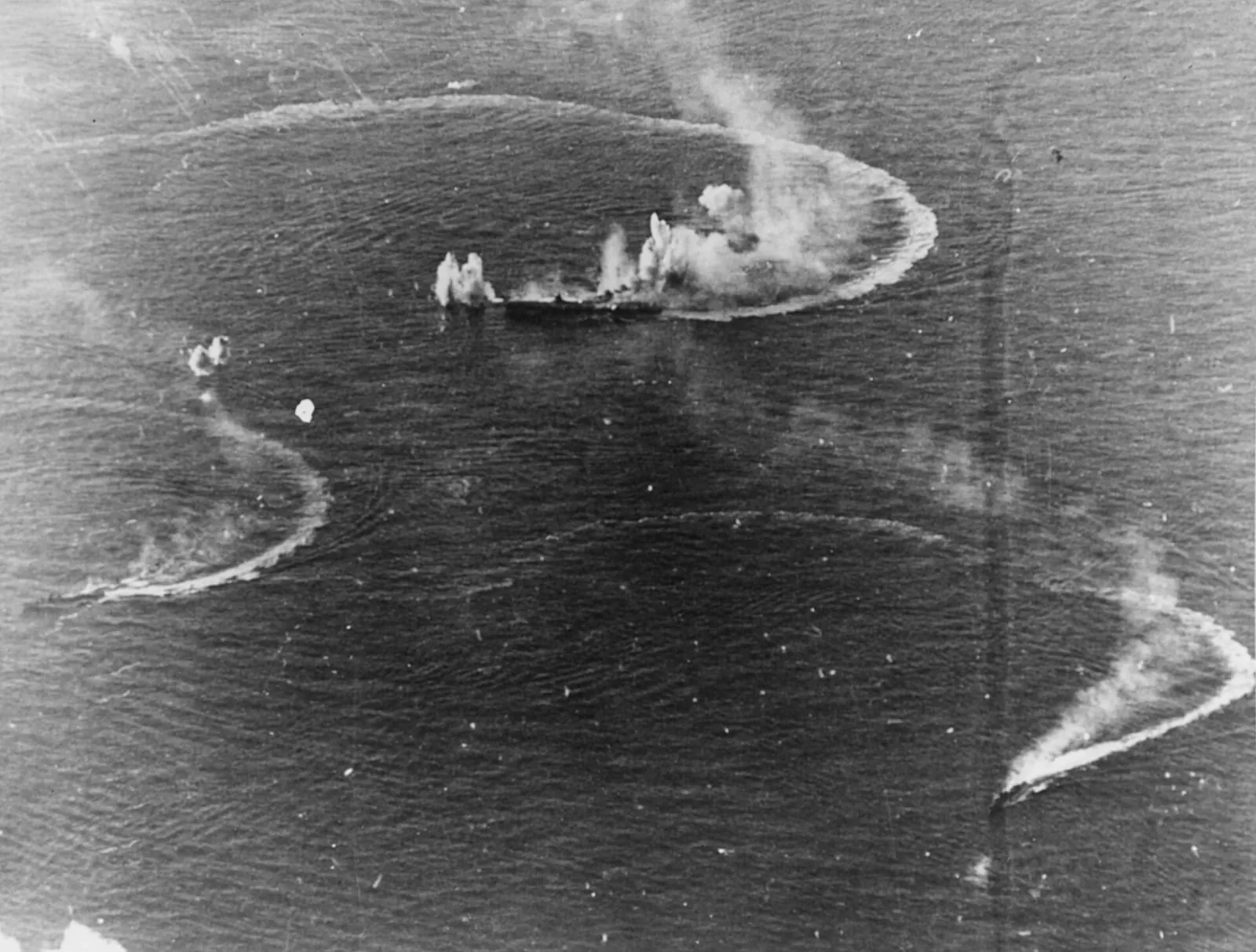
Shortly before noon on 19 June 1944, radar on American warships west of the Marianas picked up a large group of aircraft approaching from the west at a range of about 150 nautical miles. It was the first of four waves that the Japanese carriers sent that day against the American fleet covering the landing on Saipan. Several hundred fighters were scrambled to meet them. By evening the Japanese had lost some two thirds of the aircraft they had sent to attack, and not one of them had hit an American carrier. On the same day two American submarines sank the two largest Japanese carriers. The next day, in the last light, American airmen caught the retreating fleet and sank a third.
The Battle of the Philippine Sea, fought on 19 and 20 June 1944, was the largest carrier battle in history: 24 carriers took part – 15 American and 9 Japanese – with some 1,350 carrier aircraft. American pilots dubbed its first day the “Great Marianas Turkey Shoot”. The summary that often accompanies the date – that the US Fifth Fleet won a decisive victory, shooting down more than 200 Japanese aircraft for the loss of only 29 of its own in combat – is essentially accurate, but needs two additions. First, the figure for Japanese losses is too low: on 19 June alone the Japanese lost more than 300 carrier and land-based aircraft, and in the battle as a whole, depending on the tally, between about 550 and about 645. Second, the small American losses – about 30 aircraft, between 23 and 31 according to different tallies, so the figure of 29 should be treated as an approximation – refer only to the first day; on the second day, in the strike on the Japanese fleet and the night return to the carriers, the Americans lost about a hundred machines, most of them without any enemy involvement.
Plan A-Go
Since the start of the war the Japanese navy had sought a single decisive battle (kantai kessen) that would settle the war at sea. After the defeat at Midway and the exhausting fighting for the Solomon Islands, its carrier aviation had to be rebuilt almost from scratch. In the spring of 1944 the high command judged that it was ready for a showdown. On 1 March the Mobile Fleet (Dai-ichi Kidō Kantai) was formed, comprising almost all the carriers and most of the battleships, and its command went to Vice Admiral Jisaburō Ozawa, one of the architects of Japanese carrier doctrine. Admiral Mineichi Koga, who had succeeded Isoroku Yamamoto as commander of the Combined Fleet, was killed in an air crash on 31 March 1944; on 3 May 1944 his place was taken by Admiral Soemu Toyoda, who approved the plan for Operation A-Go.
The plan assumed that the American fleet would be drawn into battle at the southern edge of the Philippine Sea, between Palau and the western Carolines, where the Japanese fleet would be supported by land-based aircraft of Vice Admiral Kakuji Kakuta’s First Air Fleet, deployed in the Marianas, the Carolines and Palau. On paper this force numbered several hundred aircraft, which were to weaken the American carriers before the fleet went into action. Ozawa himself based his plan on the advantage he really did have: range. Japanese carrier aircraft, lacking armour and self-sealing tanks, could attack from about 300 nautical miles or more, while American aircraft usually operated at around 200 miles. Ozawa therefore intended to strike from beyond the enemy’s reach (Japanese literature calls the tactic “autorenji”, from the English outrange), and after the attack his aircraft were to land on Guam, refuel and rearm, and strike again on the way back. The easterly trade wind helped him: the Japanese carriers, steaming into the wind to launch aircraft, closed on their target, while the American carriers moved away from it.
The weakness of the plan lay in the men. Japan had lost its experienced airmen at Midway, over Guadalcanal and over Rabaul, and new ones were being trained in haste. Many of the Mobile Fleet’s pilots had only a few months of training and few deck take-offs behind them; American pilots, as is often stated, went through two years of training and several hundred flying hours before being sent to the front. From mid-May the fleet lay at the Tawi-Tawi anchorage in the Sulu Archipelago, close to the oil of Borneo, but the surrounding waters were patrolled by American submarines, which sank several destroyers there; Ozawa had to restrict training flights over the open sea. For lack of tankers the ships took on fuel from Tarakan – unrefined and highly volatile, which proved deadly when fires broke out.
The Americans did not do what was expected of them. After the landing on Biak the Japanese sent some of their battleships south, and on 11–12 June American carrier aircraft struck the Marianas, destroying much of Kakuta’s air strength. On 15 June, when the Americans landed on Saipan, Toyoda ordered A-Go to be carried out. That same evening the submarine USS Flying Fish sighted Ozawa’s carriers entering the Philippine Sea through the San Bernardino Strait, and USS Seahorse sighted Vice Admiral Matome Ugaki’s battleships turning back from Biak. On 16 June the two groups joined up, and on 17 June they completed refuelling and set off east.
Two fleets and Spruance’s decision
The Japanese faced the most powerful fleet ever put to sea. The forces invading the Marianas were commanded by Admiral Raymond Spruance, commander of the Fifth Fleet, and their core was Vice Admiral Marc Mitscher’s Task Force 58 (TF 58): seven large carriers, six of them of the new Essex class, eight Independence-class light carriers, about 900 aircraft, and also Vice Admiral Willis Lee’s seven fast battleships, more than a dozen cruisers and several dozen destroyers. Ozawa had nine carriers – five large or medium (Taihō, Shōkaku, Zuikaku, Jun’yō, Hiyō) and four light – with about 450 aircraft, as well as five battleships, including Yamato and Musashi. He organised them in three forces: a vanguard pushed about 100 miles ahead under Vice Admiral Takeo Kurita, with three light carriers and most of the battleships, and two main bodies, one of which, with the three largest carriers, he commanded in person from his new armoured flagship Taihō.
Spruance had a clear mission from Chester Nimitz: to take and hold the Marianas. He knew that the Japanese liked to use decoy forces to draw an enemy away while other forces struck elsewhere, and he feared that part of the Japanese fleet would get round TF 58 and fall on the transports off Saipan. On the evening of 18 June a radio direction-finding fix placed Ozawa’s main force about 350 miles west-south-west of TF 58. Mitscher proposed steaming west during the night and attacking at dawn. Lee, remembering the chaotic night action off Guadalcanal, advised against a night engagement of battleships. After an hour’s thought Spruance refused: TF 58 was to stay close to the Marianas. Mitscher’s chief of staff, Arleigh Burke, later recalled: “We knew we were going to get hit in the morning. We knew we couldn’t reach them. We knew they could reach us.”
This decision became the most contentious point of the battle. The airmen believed that Spruance – a surface-ship officer – had thrown away the chance to destroy the Japanese fleet. His defenders, among them the Commander-in-Chief of the US Fleet, Admiral Ernest King, pointed out that protecting the landing was the overriding task, and that Japanese plans did indeed provide for diversionary moves. The upshot was that on the morning of 19 June it was the Japanese who struck first – but against a fleet deployed for defence.
19 June: four waves
The day began over Guam. From dawn Japanese reconnaissance aircraft and bombers took off from there, and American Hellcats intercepted them over Orote airfield; in the first clashes they shot down several dozen machines for the loss of one. At about 10 a.m. radar picked up the first wave from the carriers – 68 aircraft from Kurita’s force, mostly Zero fighters carrying bombs. Mitscher recalled the fighters from over Guam (with the signal “Hey, Rube!”, the old circus call for help), launched all the rest and sent his bombers off to the east so that they would not be sitting on the decks with fuel in their tanks. The Japanese aircraft paused before the attack to re-form, and those few minutes were enough: the Hellcats caught them 70 miles from the fleet. Few machines got through to the ships; one bomb hit the battleship USS South Dakota, killing several dozen sailors, but she stayed in formation. The Japanese lost about 40 aircraft from the first wave.
At 11.07 a.m. the second and largest wave arrived – about 110 aircraft from the three largest carriers, including new Suisei dive bombers and Tenzan torpedo bombers. It was intercepted 60 miles short of the fleet; a few aircraft attacked the carriers Wasp, Bunker Hill and Enterprise, but scored no hits. Only a dozen or so machines from this wave returned – 97 were shot down or went missing. The third wave, 47 aircraft from the second main body, largely failed to find its target; the few aircraft that did attack caused no damage, and the wave lost 7 machines and returned empty-handed. The fourth, about 80 aircraft, also searched for the fleet in the wrong place. Some attacked Rear Admiral Alfred Montgomery’s carrier group without success, and most headed for Guam, where the Hellcats caught them as they came in to land: of 49 machines over Orote, 30 were shot down and the rest crashed on the bomb-cratered airfield or were destroyed on the ground.
According to tallies for that day, of 373 aircraft sent to attack from the carriers the Japanese lost 243, and 130 returned. Adding the aircraft destroyed over Guam and on the ground, and those that went down with the carriers, losses on 19 June exceeded 300, and according to some studies 350 machines. The Americans lost about 30 aircraft that day – tallies give between 23 and 31, most of them lost in combat – and several dozen airmen and sailors. After landing back on the carrier Lexington, one of the fighter pilots is said to have remarked that it had been like “an old-time turkey shoot” back home; the name for the whole day came from that remark.
Several factors together decided the outcome. American ships had radars that detected incoming formations at more than 100 miles, and combat information centres from which fighter-direction officers guided the fighters onto their targets at the right altitude. The Hellcat was faster, better armed and far more robust than the Zero, and its pilots were better trained and more numerous. Formations that got past the fighters ran into a barrage of anti-aircraft fire from Lee’s battleships, stationed ahead of the carriers, and American anti-aircraft shells already had the new proximity fuzes.
Submarines: Taihō and Shōkaku
While the Japanese waves were being shattered in the air, the fate of Ozawa’s carriers was being decided under water. In the morning the submarine USS Albacore under Lieutenant Commander James Blanchard moved into position to attack the nearest carrier. This was Taihō, which had just launched her aircraft in the second wave. Because his fire-control equipment had failed, Blanchard fired a spread of six torpedoes, aiming by eye. According to Japanese accounts one of the pilots, Sakio Komatsu, saw from his aircraft as it took off a torpedo heading for the ship, dived into it and was killed; another torpedo struck the hull. The damage seemed slight, but the aviation-fuel tanks had ruptured. The fumes spread through the hangars, and an order to ventilate the ship at full power carried them throughout the hull. At about 2.30 p.m. a series of explosions followed. Ozawa transferred to a destroyer and later to a cruiser, and Taihō sank soon afterwards; of a crew of about 2,150, some 1,650 were killed.
Around noon the submarine USS Cavalla hit the carrier Shōkaku – a veteran of the attack on Pearl Harbor and of the Battle of the Coral Sea – with three torpedoes as she was recovering and refuelling aircraft returning from the attack. Fire engulfed the hangar, and a few hours later an explosion of accumulated fuel vapour tore the ship apart. About 1,260 men were killed. In a single afternoon Ozawa had lost two of his three largest carriers without sighting a single enemy ship.
20 June: a strike at dusk
Ozawa’s fleet withdrew to the north-west to refuel, and on 20 June he shifted his flag to Zuikaku. From his airmen’s reports he concluded that the American carriers had been badly damaged and that many aircraft were waiting on Guam and Rota; he planned to resume his attacks on 21 June. In reality he had only about 150 serviceable machines left. TF 58, which this time had headed west, could not find him all day. Only at about 3.40 p.m. did a search plane from Enterprise report the Japanese fleet some 275 miles away – at the limit of the American aircraft’s range – with less than three hours to sunset.
Mitscher decided to strike, knowing that his aircraft would be returning after dark with almost empty tanks. About 230 machines took off; after launch it turned out that the Japanese were 60 miles further away than thought, so the second wave was held back, but the first was not recalled. The aircraft reached the target just before sunset. Some attacked the supply group and wrecked two oilers, which the Japanese later had to scuttle. Avenger torpedo bombers from the light carrier Belleau Wood torpedoed the carrier Hiyō; after an explosion of fuel vapour she sank that evening. Bombs damaged Zuikaku, Jun’yō, Chiyoda and the battleship Haruna. Japanese fighters and anti-aircraft fire shot down about 20 American aircraft.
The return flight took place in total darkness. The first aircraft reached TF 58 at about 8.45 p.m., and many pilots were running out of fuel. Rear Admiral Joseph J. Clark ordered his carrier Hornet lit up, and Mitscher – despite the submarine threat – ordered the whole force to do the same; according to his staff’s account his order was simply “Turn on the lights”. The ships switched on searchlights and deck lights, destroyers fired star shells, and aircraft were allowed to land on any carrier. Even so, about 80 machines crashed on landing or ditched when their fuel ran out. Destroyers and seaplanes searched the sea over the following days; about three quarters of the airmen from the lost aircraft were rescued. On the night of 20/21 June Toyoda ordered Ozawa to withdraw from the Philippine Sea. Ozawa offered his resignation, which was not accepted.
The balance
In the battle Japan lost three carriers – Taihō, Shōkaku and Hiyō – and two oilers, but above all its carrier aviation: after two days, according to American studies, Ozawa had only a few dozen serviceable aircraft left of the roughly 450 with which he had put to sea. Japanese naval air losses, including the land-based aircraft from Guam and Rota, are estimated, depending on the tally (among others Christopher Shores’s), at about 550–645 machines; most of the airmen whose training had taken the previous year and a half were also killed. The Americans lost about 123 aircraft over the two days, most of them during the night return on 20 June, and lost no ships; several dozen airmen and several dozen sailors were killed.
The dispute over Spruance’s decision went on long after the war. Vice Admiral John Towers, Nimitz’s deputy and one of the pioneers of naval aviation, even demanded that Spruance be relieved; Nimitz refused. The critics, mostly airmen, believed that bolder action on 18 June would have made it possible to destroy the entire Mobile Fleet. The defenders replied that Spruance had carried out his mission – the landing on Saipan was never endangered – and that the Japanese fleet’s air arm had ceased to exist in any case. Over time many historians came round to Spruance’s view, though the dispute never died out entirely. His decision was compared with that of Admiral William Halsey four months later, who set off in pursuit of the Japanese carriers and left the invasion fleet exposed.
Place in the war
The Battle of the Philippine Sea was the last of the five great carrier battles of the Pacific War – from the Coral Sea, through Midway, the Eastern Solomons and the Santa Cruz Islands, to the Marianas – and it ended them conclusively. Two years after Japan lost four carriers at Midway, its rebuilt carrier aviation was destroyed in two days. The Japanese fleet still had carriers, but no longer had the pilots to man them. The Japanese public learned of the battle, but not of the scale of the defeat.
The consequences soon became apparent. Without support from the sea the Saipan garrison was doomed; the island fell on 9 July, and the defeat in the Marianas led to the resignation of Hideki Tōjō’s cabinet on 18 July 1944. In the summer the Americans also took Guam and Tinian, and in the autumn B-29 bombers began attacking Japan from airfields in the Marianas. In October 1944, at the Battle of Leyte Gulf, Ozawa’s surviving carriers, with only about a hundred aircraft aboard, served merely as bait to draw the American fleet away from the landing area – and all four were sunk. When the trained airmen capable of attacking in the conventional way ran out, the Japanese navy turned to kamikaze suicide attacks. The Great Marianas Turkey Shoot was thus not merely a spectacular victory in the air but the end of Japanese carrier aviation as a force capable of waging war on the ocean.
Sources
Meanwhile
(04)Elsewhere, within a week.
- 20 June 1944 · MediterraneanThe capture of PerugiaOn 20 June 1944 the British 6th Armoured Division entered Perugia, which the Germans had abandoned. Three days earlier the Allies had entered Assisi.
- 22 June 1944 · Eastern FrontOperation Bagration beginsOn 22 June 1944, the third anniversary of Germany's attack on the USSR, four Soviet fronts opened an offensive in Belarus against Army Group Centre.
- 23 June 1944 · PoliticsThe declaration of the National Committee of the Estonian RepublicThe manifesto “To the Estonian people”, dated 23 June 1944, proclaimed Estonia's continuity as a state. Issued in Stockholm in July, in Estonia in August.
- 13 June 1944 · Western FrontThe first V-1 flying bombsOn the night of 12/13 June 1944 the Germans fired the first V-1s at England. The flying-bomb offensive killed about 6,000 people in Britain.
Related events
(04)The same battle, people or subject.
- 15 June 1944 · PacificThe landing on SaipanOn 15 June 1944 two US Marine divisions landed on Saipan. That evening American submarines sighted the Japanese fleet heading for the Marianas.
- 12 June 1944 · PacificStrikes on the MarianasOn 11–14 June 1944 Mitscher's carriers and US battleships hit Saipan, Tinian and Guam ahead of the landings. Admiral Toyoda began readying his fleet for battle.
- 20 October 1944 · PacificThe landing on LeyteOn 20 October 1944 the US Sixth Army landed on Leyte. General MacArthur waded ashore and told the Filipinos by radio: “I have returned”.
- 21 July 1944 · PacificThe landing on GuamOn 21 July 1944 US Marines landed on Guam on both sides of the Orote Peninsula. The island had been under Japanese occupation since December 1941.