United States
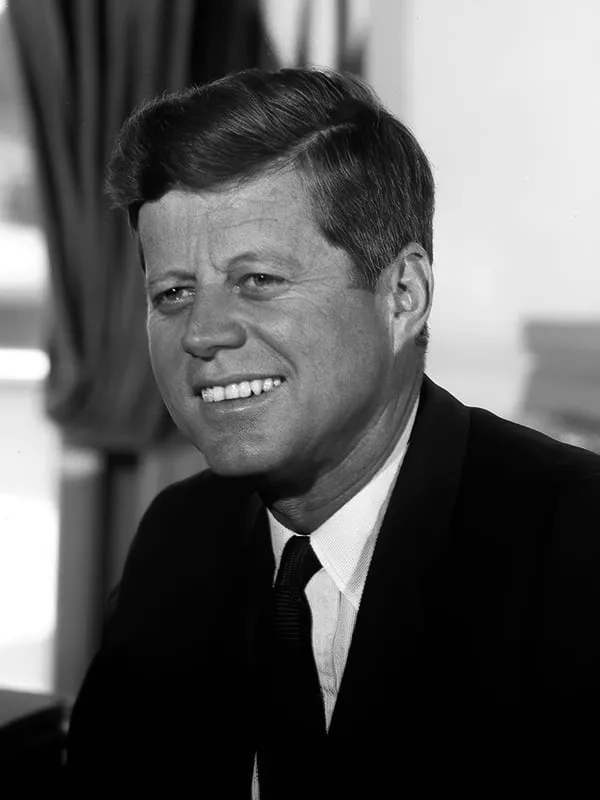
John F. Kennedy
Commander of the torpedo boats PT-109 and PT-59 (1943), congressman (1947–1953), senator from Massachusetts (1953–1960), President of the United States (1961–1963)
- Born:
- 29 May 1917, Brookline, Massachusetts (United States)
- Died:
- 22 November 1963, Dallas, Texas (United States)
- Author:
- Łukasz
- Photo:
- Cecil W. Stoughton, domena publiczna, Wikimedia Commons

John Fitzgerald Kennedy – known as Jack and later universally as JFK – was the 35th President of the United States, the youngest person ever elected to the office and the first Catholic in the White House. He matters to the history of the Second World War for two reasons. As the son of the American ambassador in London he watched the last months of peace in Europe at close quarters: in the summer of 1939 he was in Gdańsk and Warsaw, and on 3 September he sat in the gallery of the House of Commons as Britain went to war. Later, as a young officer in the US Navy, he commanded the torpedo boat PT-109 in the Solomon Islands until she was rammed by a Japanese destroyer in August 1943. The story of how her crew survived made him a war hero and became the foundation of a political career that took him to the White House – and into the crises of the Cold War, above all the Cuban one.
The ambassador’s son
He was born on 29 May 1917 in Brookline, near Boston, the second of nine children of Joseph P. Kennedy, a banker, businessman and Democratic politician, and Rose Kennedy, the daughter of a mayor of Boston. The family was wealthy, Irish Catholic and fiercely ambitious. From the start their father groomed his eldest son, Joseph Jr., for high politics, and John lived in his shadow. He was a sickly child: he had scarlet fever and stomach complaints, and later suffered from a spinal condition and Addison’s disease, which he concealed all his life. He went to private schools, spent a short time at the London School of Economics in the summer of 1935 and then studied at Harvard University, where he swam for the university team and sailed.
In 1937 he toured Europe by car with his friend Lem Billings, including Germany; in his diary he recorded both the impression that the propaganda made on him and his own prejudices. In 1938 Franklin Delano Roosevelt appointed his father ambassador in London. Joseph Kennedy, a supporter of Neville Chamberlain’s policy of appeasement, believed that Britain could not win a war against Germany and made no secret of it – which eventually ended his diplomatic career.
Europe in 1939 and “Why England Slept”
In 1939 John interrupted his studies to gather material for his undergraduate thesis. Drawing on his father’s contacts, he visited American missions in Paris, Central Europe, the Soviet Union, the Balkans and the Middle East, and in the summer he was in Gdańsk (Danzig) and Warsaw, where he talked to Polish officials and German Nazis. He wrote that the Free City was “completely Nazified” and predicted that if Germany decided on war, it would try to present Poland as the aggressor – which it soon did by staging the Gleiwitz incident. At the end of August he was in Berlin, from where he brought his father a confidential message from American diplomats that war would break out within days. He returned to London on 1 September, the day Germany invaded Poland. On 3 September he and his family listened to the speeches in the House of Commons after Britain and France declared war on Germany. A few days later his father sent him to Glasgow to look after the American survivors of the sinking of the Athenia.
His thesis examined why Britain had been unprepared to confront Hitler during the crisis that ended in the Munich Agreement. He blamed not only the politicians but also a democratic society unwilling to rearm in peacetime. Published as a book in July 1940 under the title Why England Slept, with a foreword by the press magnate Henry Luce, it became a bestseller – just as France had fallen and Britain was fighting alone. The title alluded to While England Slept, a collection of speeches by Winston Churchill.
Into the navy despite a bad back
After university Kennedy considered law and journalism, but the war was drawing ever closer to America. In 1941 the Army turned him down for officer candidate school because of his back, asthma and ulcers. His father then asked an acquaintance, the director of naval intelligence, to accept a certificate from a private doctor, and in October 1941 John was commissioned as an ensign in the US Naval Reserve and given a desk job in intelligence in Washington. After the attack on Pearl Harbor he was transferred to South Carolina – partly because his affair with the Danish journalist Inga Arvad, groundlessly suspected of espionage, had attracted the attention of the FBI.
Kennedy wanted to fight. In the summer of 1942 he completed officer training and then – thanks to his father’s intercession with John Bulkeley, the hero of the torpedo-boat actions in the Philippines – the course for torpedo-boat commanders at Melville, Rhode Island. When he was posted to a squadron that was to guard the Panama Canal, he asked Senator David Walsh, a family friend, to have him transferred to the front. In April 1943 he reached Tulagi in the Solomon Islands, and on 23 April he took command of PT-109.
PT-109
In the summer of 1943 his squadron supported the New Georgia campaign, operating from a makeshift base on Rendova, which the Americans had taken in the landing on Rendova. The boats went out at night to hunt Japanese barges and intercept the “Tokyo Express” destroyers carrying reinforcements to Kolombangara. On the night of 1–2 August 1943, in the action that ended with the sinking of PT-109, fifteen boats attacked four Japanese destroyers in Blackett Strait and failed to hit any of them. At around 2.30 a.m. PT-109, running on one engine so that her wake would not give her away, found herself in the path of the returning destroyer Amagiri, which cut her in two. Two sailors were killed and eleven survived. Kennedy towed the badly burned engineer Patrick McMahon several kilometres to an uninhabited islet, holding the strap of his life jacket between his teeth.
For six days the survivors hid on islets behind Japanese lines. At night Kennedy swam out into Ferguson Passage in the hope of meeting an American boat, and he searched the neighbouring islands for water and food. On 5 August they were found by Biuku Gasa and Eroni Kumana, scouts working for the Australian coastwatcher Arthur Reginald Evans. The two men carried a message that Kennedy had scratched on a coconut husk by canoe to the American base, and on 8 August PT-157 picked up the survivors.
Kennedy was awarded the Navy and Marine Corps Medal and the Purple Heart. He could have gone home but chose to stay. From the autumn he commanded PT-59, a boat converted into a gunboat, and on 2 November 1943 he helped evacuate Marines under fire from the island of Choiseul, taking ten of them on board. Worn down by malaria and back pain, he was relieved of his command in November and returned to the United States in January 1944. He underwent unsuccessful spinal surgery, and on 1 March 1945 he was discharged from the service as unfit, with the rank of lieutenant.
On 12 August 1944 his elder brother Joseph, a naval aviator, was killed when his explosives-laden bomber, intended for a remote-controlled attack on German V-weapon sites, blew up over England. A few weeks later the husband of his sister Kathleen, the Marquess of Hartington, was killed in action in Belgium. Their father’s political hopes now passed to John.
From reporter to senator
In 1945, as a correspondent for the newspapers of William Randolph Hearst, he covered the founding conference of the United Nations in San Francisco, the British general election that removed Churchill from power and the Potsdam Conference; at that time he toured the ruins of Berlin. In 1946 he won election to the House of Representatives from a Boston district, in a campaign accompanied by thousands of copies of John Hersey’s account of PT-109. In 1952 he defeated the Republican Henry Cabot Lodge Jr. in the election to the Senate. A year later he married Jacqueline Bouvier; her sister Lee later married Prince Stanisław Albrecht Radziwiłł. While he was recovering from further back operations he produced Profiles in Courage, a book about the courage of American politicians, which won the Pulitzer Prize in 1957 (the co-authorship of his adviser Ted Sorensen is now widely acknowledged). In 1956 he sought the vice-presidential nomination without success.
President
In the election of 8 November 1960, after the first televised debates in history, he narrowly defeated Vice President Richard Nixon. On 20 January 1961, at the age of 43, he took over from Dwight Eisenhower, the former Supreme Allied Commander in Europe. In his inaugural address he spoke of the torch being passed to “a new generation of Americans, born in this century, tempered by war” – the generation of Second World War veterans that came to power with him.
His presidency coincided with the most dangerous phase of the Cold War. In April 1961 the Bay of Pigs invasion, prepared by the CIA under Eisenhower, ended in disaster. His meeting with Nikita Khrushchev in Vienna in June 1961 produced no agreement, and in August the East German authorities began building the Berlin Wall. In October 1962, during the Cuban Missile Crisis, the world came closer to nuclear war than ever before. Kennedy resisted pressure to bomb Cuba, imposed a naval blockade and, through secret negotiations, secured the withdrawal of the Soviet missiles. A year later he gave his “Ich bin ein Berliner” speech in West Berlin, and in August 1963 the United States, the Soviet Union and Britain signed in Moscow a treaty banning nuclear tests in the atmosphere, in outer space and under water. Kennedy founded the Peace Corps and set the goal of landing a man on the Moon before the end of the decade, and in South Vietnam he increased the number of American military advisers to about 16,000. Towards the end of his term he put forward a civil rights bill.
On 22 November 1963 he was shot dead in Dallas while riding in an open car. The Warren Commission concluded that the assassin, Lee Harvey Oswald, had acted alone; Oswald was himself shot dead by Jack Ruby two days after the killing, and the circumstances of the assassination remain the subject of disputes and conspiracy theories to this day. Kennedy was buried in Arlington National Cemetery. The presidency passed to Vice President Lyndon B. Johnson.
Significance
Kennedy was the first president from the generation that lived through the Second World War as young servicemen rather than as commanders or politicians. The war shaped him in two ways. Europe in 1938–1939, seen from his father’s embassy, taught him to distrust appeasement and convinced him that democracies must be ready to defend themselves – a thread that runs from Why England Slept to the Cold War rhetoric of his presidency. Service in the Pacific gave him first-hand experience of war: the deaths of the men under him, the randomness of fate, the incompetence of command, and a belief that people of goodwill on both sides could come to terms. In 1952 he wrote to Kōhei Hanami, the commander of the destroyer that had sunk his boat, about friendship between Japan and the United States.
PT-109 also became part of a political myth. Kennedy’s family and staff carefully cultivated the story of the heroic commander, leaving out the part played by his executive officer Leonard Thom, the crew, the Australian coastwatcher and the two islanders who rescued the survivors. Historians today judge his conduct after the collision – his care for the injured and his long swims in search of help – as genuinely brave, and his part in the collision itself as typical of a chaotic action in which both command and equipment failed. As Kennedy himself put it when asked how he had become a war hero: “It was involuntary. They sank my boat.”
Sources
Mentioned in battles
(01)Often appears with
People who appear in the same events.