1943–1944: The Central Pacific offensive
Battle of the Philippine Sea
- Dates:
- 19–20 June 1944
- Front:
- Pacific
- Location:
- The Philippine Sea west of the Marianas – the waters between Guam, Rota and Saipan and an area some 500–700 km further west where the Japanese Mobile Fleet operated; air fighting also took place over Orote airfield on GuamOn the battle map →
- Sides:
- United StatesRaymond Spruance, Marc Mitscher, Willis LeeJapanJisaburō Ozawa, Takeo Kurita, Kakuji Kakuta
- Result:
- Decisive United States victory. The Japanese lost three carriers (Taihō and Shōkaku sunk by submarines, Hiyō by aircraft), two oilers and, according to various tallies, some 550–645 carrier and land-based aircraft together with most of their crews. The Americans lost about 123 aircraft, most of them during the night return on 20 June; none of their ships was seriously damaged. Japanese carrier aviation never recovered, but the main body of the Mobile Fleet escaped.
- Author:
- Natalia
Name and dates
The Battle of the Philippine Sea is the name given to the clash between the American Fifth Fleet and the Japanese Mobile Fleet (Dai-ichi Kidō Kantai), fought on 19 and 20 June 1944 in the waters west of the Marianas. The Japanese conducted it as Operation A-Go – the long-prepared “decisive battle” (kantai kessen) that was meant to turn the tide of the Pacific War. The Americans called the first day of the fighting the “Great Marianas Turkey Shoot”, after the words of a fighter pilot from the carrier Lexington who, after landing, likened the combat to an old-time country turkey shoot.
It was the largest carrier battle in history: 24 carriers with some 1,350 carrier aircraft fought on the two sides, not counting land-based aviation. It was also the last of the five great battles in which one side’s carrier fleet fought the other’s – after the Coral Sea, Midway and the two carrier battles of the Guadalcanal campaign (the Eastern Solomons and Santa Cruz). The ships of the two fleets never once sighted each other; the whole battle was fought by aircraft and submarines.
The battle lasted from 19 to 20 June 1944. The preceding days – the Japanese fleet’s departure from Tawi-Tawi, its detection by American submarines on 15 June and the mutual search of 17–18 June – were the preliminaries to the clash. On the evening of 20 June Admiral Soemu Toyoda, Commander-in-Chief of the Combined Fleet, ordered Ozawa to withdraw; the American pursuit on 21 June failed to regain contact. The battle ran in parallel with the fighting for Saipan, whose protection was the purpose of the entire American operation at sea.
Background: Plan A-Go
Since its defeat at Midway in June 1942 the Japanese navy had been rebuilding its carrier force in the hope of fighting one great decisive battle with the Americans at the right moment. The long struggles for the Solomon Islands and the base at Rabaul in 1942–1943, however, had consumed most of its experienced carrier aviators, and each new air group had to be trained from scratch, for ever shorter periods and with an ever more acute shortage of fuel. Meanwhile the Americans, after taking Tarawa and the Marshall Islands and wrecking the base at Truk in February 1944, were closing rapidly on the inner ring of Japan’s defences.
On 1 March 1944 the Japanese combined their main surface forces and carriers into the Mobile Fleet under Vice Admiral Jisaburō Ozawa, one of their most experienced experts in naval aviation. On 31 March the Commander-in-Chief of the Combined Fleet, Admiral Mineichi Koga, successor to Isoroku Yamamoto, was killed in an air crash; his chief of staff, Vice Admiral Shigeru Fukudome, came down in a second aircraft, and the documents of the so-called Z Plan fell into the hands of Filipino guerrillas and reached General MacArthur’s intelligence staff. The plan set out the Japanese concept of the decisive battle and helped the Americans to understand the enemy’s intentions better. The new Commander-in-Chief of the Combined Fleet, Admiral Soemu Toyoda, took up his post in May and early that month approved the plan for Operation A-Go, which in broad outline repeated Koga’s concept.
The plan assumed that the Americans would strike at Palau or the western Carolines. There Ozawa’s fleet was to be supported by several hundred land-based aircraft of Vice Admiral Kakuji Kakuta’s First Air Fleet, deployed on airfields in the Marianas, the Carolines and Palau. Before the battle the land-based aircraft were to destroy at least a third of the American carriers, and the rest were to fall victim to strikes from the Japanese carriers. For lack of fuel – tankers were reaching Japan from the Dutch East Indies less and less often – the Mobile Fleet assembled in May close to the oil sources, in an anchorage among the Tawi-Tawi islands in the southern Philippines. There, however, American submarines sank several destroyers and oilers, and the young pilots, unable to train ashore, hardly flew at all.
The first blow to the plan came from the operation on Biak. When the Americans landed on that island off New Guinea on 27 May, the Japanese saw it as a threat to Plan A-Go and launched Operation Kon – attempts to ship reinforcements there. Part of the First Air Fleet’s aircraft were transferred from the Marianas to New Guinea, where many machines were destroyed and the crews were laid low by malaria. In mid-June the battleships Yamato and Musashi, previously sent towards Biak, also had to be recalled to the Mobile Fleet.
The American target, however, was not Palau but the Marianas. On 11 and 12 June Vice Admiral Marc Mitscher’s carriers struck Saipan, Tinian and Guam, destroying much of the aircraft based there, and on 15 June the Marines landed on Saipan. The loss of the Marianas would open the way over Japan for long-range bombers, so on 15 June Toyoda ordered Operation A-Go to begin. The Mobile Fleet passed through the inland waters of the Philippines and the San Bernardino Strait into the Philippine Sea, where on 16 June it joined up with the battleship force returning from Biak and on 17 June refuelled.
On the evening of 15 June the submarine Flying Fish sighted Japanese carriers emerging from the San Bernardino Strait, and an hour later Seahorse sighted battleships steaming up from the south, east of Mindanao. Both submarines, under orders to report before attacking, sent their reports after dark. The commander of the Fifth Fleet, Admiral Raymond Spruance, concluded that a great battle was approaching. He postponed the landing on Guam planned for 18 June, sent east those transports that did not need to remain off Saipan, and recalled two carrier groups that had been sent north to strike the airfields on Iwo Jima and Chichi-jima. Mitscher’s force assembled west of the Marianas on 18 June.
Forces
Mitscher’s fast carrier force – Task Force 58 – comprised 15 carriers in four groups: seven fleet carriers (six new Essex-class ships and the veteran Enterprise) and eight Independence-class light carriers. They carried about 900 aircraft – Grumman F6F Hellcat fighters, Helldiver and Dauntless dive bombers and Avenger torpedo bombers. A fifth group, TG 58.7, consisted of Vice Admiral Willis Lee’s seven fast battleships with cruisers and destroyers; stationed ahead of the carriers, it was to absorb any enemy aircraft that got through the fighters and, if need be, fight a gunnery action. Also under Spruance’s command were the ships of Vice Admiral Richmond Kelly Turner covering the landing on Saipan, including older battleships and escort carriers, which remained off the island. In the waters between the Marianas and the Philippines, Vice Admiral Charles Lockwood’s American submarines lay in wait.
Ozawa’s Mobile Fleet had nine carriers: three large ones (Taihō, Shōkaku and Zuikaku), two converted from passenger liners (Hiyō and Jun’yō) and four light carriers. Between them they carried some 430–450 aircraft. Vice Admiral Takeo Kurita’s Van Force – three light carriers, Chitose, Chiyoda and Zuihō, with four battleships including Yamato and Musashi – sailed about 100 nautical miles ahead of the main body as bait and shield. Behind it came Ozawa’s own Force A with the three large carriers and Rear Admiral Takaji Jōjima’s Force B with Hiyō, Jun’yō and the light carrier Ryūhō. Counting battleships, cruisers, destroyers and oilers, the Japanese committed almost every serviceable ship in their fleet to the battle.
On paper the Americans had roughly a twofold advantage. Ozawa was counting on two trump cards. The first was range: the lighter, unarmoured Japanese aircraft could attack from about 300 nautical miles, whereas an American strike had a range of about 200 miles. The Japanese admiral therefore meant to stay out of Mitscher’s reach, strike first, and let his aircraft land on Guam after their attack, refuel and rearm there, and strike again on the way back. The second trump card was to be Kakuta’s land-based aviation. Ozawa did not know how badly it had been mauled over Biak and in the American raids on the Marianas – Kakuta’s reports concealed the scale of the losses.
The weakness that could not be made good was training. Most Japanese carrier aviators had only a few months’ training and few flying hours behind them, often with no combat experience; American pilots joined their units after two years of training and several hundred hours in the air. The Hellcat now outclassed the Japanese Mitsubishi A6M fighters in speed, toughness and armament, and the fast Yokosuka D4Y Suisei dive bombers caught fire easily when hit. The Americans also had a highly refined fighter-direction system: combat information centres aboard the ships tracked incoming formations on radar at ranges of over 100 miles and vectored fighter patrols onto them. The anti-aircraft guns were supplied with proximity-fuzed shells, which exploded near an aircraft without needing a direct hit.
18 June: Spruance’s decision
On 18 June Japanese reconnaissance aircraft located the American carriers, while the American searches failed to reach Ozawa’s fleet. In the afternoon the commander of the Van Force carriers, Rear Admiral Sueo Ōbayashi, even began launching aircraft to attack, but Ozawa called the strike off because the machines would have returned after dark; he decided to open the battle the following morning. Before midnight Admiral Chester Nimitz passed Spruance a radio direction-finding fix: a Japanese transmitter, most probably Ozawa’s flagship, was operating about 350 nautical miles west-south-west of Mitscher’s force.
Mitscher and his chief of staff, Captain Arleigh Burke, wanted to steam west overnight so as to be within striking range of the Japanese carriers at dawn. Willis Lee turned down the proposal of a night gunnery action – after his experiences off Guadalcanal he believed his crews were not ready for one. After an hour’s deliberation Spruance refused Mitscher as well. His task, as Nimitz had stressed in his orders, was first and foremost to cover the landing on Saipan. He remembered that Japanese plans often involved a decoy, and he feared that part of the enemy fleet might get round his carriers and fall upon the transports. Task Force 58 was therefore to steam east overnight, towards the Marianas, and receive the blow in the morning. Burke later recalled the staff’s bitterness: “We knew we were going to have hell slugged out of us in the morning. We knew we couldn’t reach them. We knew they could reach us.”
19 June: Guam and four raids
The battle began over Guam. At dawn on 19 June aircraft from the airfields there took off on reconnaissance and to make the first attacks; one of them attacked an American screening destroyer and was shot down. Hellcats from the light carrier Belleau Wood, sent over the island, caught aircraft taking off from Orote airfield, and reinforcements flying in from other islands blundered into the fight. In the morning clashes over Guam, according to American figures, some 35 Japanese machines were shot down for the loss of one Hellcat.
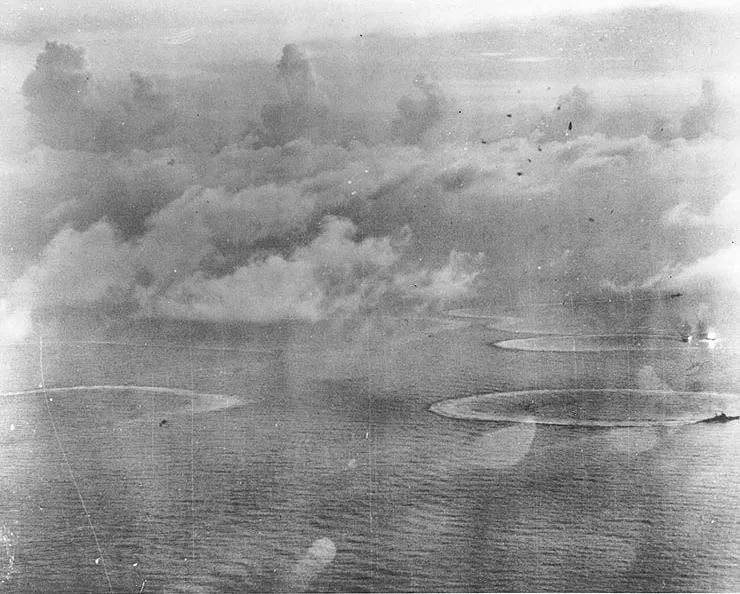
Meanwhile Ozawa, who now knew where the Americans were, launched four strike waves. At about 10 a.m. Task Force 58’s radars picked up the first – 68 machines from the Van Force’s light carriers, mostly fighters carrying bombs – at a range of about 150 miles. Mitscher recalled his fighters from over Guam, scrambled all the rest and – so as not to keep aircraft full of fuel in the hangars – sent his bombers and torpedo planes away to the east, clear of the ships. The Japanese formation lost about ten minutes regrouping before its attack, and that was enough: the Hellcats intercepted it some 70 miles out. Of the 68 aircraft, 41 or 42 were shot down. A few bombers got through to Lee’s battleships; one bomb hit South Dakota, killing 27 men, but the ship stayed in formation. Not a single machine reached the carriers.
At 11.07 a.m. the radars detected the second and largest wave – about 110 aircraft from Ozawa’s carriers, including Suisei dive bombers and Nakajima B6N torpedo bombers. The fighters shot most of them down while they were still about 60 miles away, and the few that reached the ships were brought down by anti-aircraft fire; several near misses beside the carriers caused only light casualties among their crews, and a torpedo aimed at Enterprise exploded in her wake. Of the 107–110 aircraft in the second wave, 97 were lost. The third wave, 47 aircraft from Force B, was given a wrong position for its target; most failed to find the Americans and returned, losing only seven machines.
The fourth wave, about 80 aircraft launched before noon, was also given faulty coordinates. Some of its machines stumbled by chance upon Rear Admiral Alfred Montgomery’s carrier group and attacked Wasp and Bunker Hill without result, suffering heavy losses. Most headed for Guam to land there – and over Orote airfield, as they came in to land, ran into waiting Hellcats. Of the 49 aircraft that reached Guam, 30 were shot down, and the rest were so badly damaged on the ground that they were unfit to fly.
That evening the Americans took stock of a day that passed into the legend of naval aviation. Commander David McCampbell, commander of the Essex air group, shot down seven aircraft according to American figures, and Lieutenant (junior grade) Alexander Vraciu of Lexington downed six dive bombers within a few minutes. Of the 373 aircraft Ozawa sent to attack on 19 June, about 130 returned to the carriers. Together with the land-based machines destroyed over Guam and Rota and the aircraft that went down with the sunken carriers, the Japanese lost more than 300 aircraft that day, more than 350 according to some tallies. The Americans lost about 30 aircraft that day – between 23 and 31, depending on the tally – most of them in combat. The submarines completed the fighters’ work.
19 June: the submarines
On the morning of 19 June the submarine USS Albacore, under Lieutenant Commander James Blanchard, manoeuvred into an attacking position on Ozawa’s carrier group. Her target was the nearest ship – Taihō, the newest and largest Japanese carrier and flagship of the Mobile Fleet, commissioned in March 1944 and the first in the Japanese navy with an armoured flight deck. When his torpedo data computer failed, Blanchard fired a spread of six torpedoes by eye at about 9.10 a.m. According to Japanese accounts, one of the pilots who had just taken off with the second wave, Sakio Komatsu, dived his aircraft onto one of the torpedoes; another hit the carrier on the starboard side near the bow.
The damage seemed slight: the flooding was brought under control, the ship maintained her speed and carried on flying operations. The torpedo, however, had ruptured the aviation-fuel tanks, and fumes were spreading through the hangars. An inexperienced damage-control officer ordered the ventilation turned up to full power, which spread the fumes throughout the hull – the Japanese were also using unrefined crude oil from Tarakan at the time, whose volatile fractions added to the danger. In the afternoon, at about 2.30 p.m., a spark ignited the mixture and a series of explosions tore Taihō apart. Ozawa transferred to a destroyer and then to the heavy cruiser Haguro. Of a crew of about 2,150, some 1,650 died, according to the most commonly cited figures.
Around noon a second submarine, USS Cavalla under Lieutenant Commander Herman Kossler, on her first war patrol, hit the carrier Shōkaku, a veteran of the attack on Pearl Harbor and of the Battle of the Coral Sea, with three torpedoes. Aircraft returning from the strike were being refuelled on board; a fire broke out that spread to the fuel and ammunition, and after about three hours an explosion of petrol vapour blew the ship apart. According to Japanese tallies, 1,263 men died, including 376 from the air group; 570 were rescued, among them the captain. Cavalla survived a destroyer hunt lasting several hours. For several months the Americans were not sure of the fate of the two carriers – the sinking of Taihō was confirmed only later.
20 June: the strike at dusk
During the night of 19/20 June Spruance, judging that the threat to Saipan had passed, allowed Mitscher to head west, leaving one carrier group off the Marianas. Ozawa, who transferred to Zuikaku on the afternoon of 20 June, only then learned how heavy the previous day’s losses had been. He still had about 150 aircraft and, believing that hundreds of land-based machines remained on Guam and Rota, did not give up the fight – he was planning new strikes for 21 June. His ships met the oilers to refuel.
For a long time American reconnaissance aircraft could not find the enemy. Only at about 3.40 p.m. was a report from an Enterprise Avenger confirmed: the Japanese fleet was about 275 nautical miles to the west, at the limit of the American aircraft’s range, with little more than three hours left before dark. Mitscher knew his machines would return in darkness and with their tanks almost dry, yet he decided to strike. About 240 aircraft took off, of which 226 flew on to the target: 95 Hellcats, 54 Avengers and 77 dive bombers. With the first wave already airborne, it turned out that the Japanese were some 60 miles further away than had been thought. Mitscher cancelled the second wave but did not recall the first.
The aircraft reached the Japanese fleet just before sunset. Ozawa managed to scramble only about 35 fighters, but the Japanese anti-aircraft fire was heavy. Some of the pilots from Wasp, unsure of their fuel reserves, attacked the first ships they came across – oilers; two were so badly damaged that the Japanese scuttled them. Four Avengers from the light carrier Belleau Wood hit the carrier Hiyō with a torpedo, and she sank after a fuel-vapour explosion; about 250 men died, and some 1,000 were rescued by destroyers. Lieutenant (junior grade) George Brown, who led that attack, did not return from the mission. Bombs damaged Zuikaku, Jun’yō and Chiyoda and the battleship Haruna, although the American aviators judged the effects of their hits to be much more serious than they actually were. In the fighting over the Japanese fleet the Americans lost about 20 aircraft.
The return in darkness
The hardest part of the mission began after the attack. The aircraft flew back more than 250 miles as darkness fell, with their tanks running dry; many pilots had never landed on a deck at night before. The first machines reached Task Force 58 at about 8.45 p.m. Rear Admiral Joseph J. Clark, commander of one of the groups, had his carriers lit up, and Mitscher – despite the risk of attack by Japanese submarines and aircraft – ordered lights switched on throughout the force. Tradition credits him with the terse order “Turn on the lights”. Searchlights pointed into the sky, destroyers fired star shells, and aircraft were allowed to land on any deck they could find.
Even so, some 80 machines were lost: some crashed on landing, most ditched with empty tanks, and some pilots deliberately came down on the water in groups to make the search easier. Over the following days destroyers and floatplanes scoured the sea. Most of the crews were rescued – according to the history of US naval operations written at the Navy’s request by Samuel Eliot Morison, in the end 16 pilots and 33 aircrewmen from this strike were never recovered. Of the 226 aircraft that flew against the Japanese fleet, 115 made it back to the decks.
Losses
The Japanese fleet lost three carriers – Taihō, Shōkaku and Hiyō – and two oilers; Zuikaku, Jun’yō, Chiyoda, the battleship Haruna and another oiler were damaged. Figures for aircraft losses vary, because it is hard to separate carrier aircraft from land-based ones, and those shot down from those destroyed on the ground or sunk with their ships. According to the tally by the aviation historian Christopher Shores, the Japanese lost some 550–645 aircraft in all; other studies speak of more than 400 carrier aircraft and about 200 land-based ones. After the battle Ozawa had only a few dozen serviceable aircraft left on his carriers. An estimated 3,000 or so Japanese sailors and airmen were killed, including about 450 carrier aviators – most of those who had been trained over the previous year.
The Americans lost about 123 aircraft, some 80 of them during the night return on 20 June and fewer than half in combat. About 110 airmen and sailors were killed, according to the most commonly cited, though not fully documented, figures. No American ship was seriously damaged; the worst damage was the bomb hit on the battleship South Dakota.
The controversy over Spruance’s decision
The outcome of the battle did not satisfy the American aviators. The main body of the Mobile Fleet – six carriers and all the battleships – had escaped, and many officers, especially naval aviators, believed that if Spruance had let Mitscher steam west on the night of 18/19 June, Ozawa’s carriers would have been destroyed. On the Pacific Fleet staff it was said that this was what came of putting a non-aviator in command of carriers; Vice Admiral John Towers, Nimitz’s deputy and one of the pioneers of naval aviation, even demanded that Spruance be relieved. Nimitz refused, and Spruance’s decision was backed by Admiral Ernest King, Chief of Naval Operations, and by Turner.
Later historians have judged it more kindly. Spruance acted in accordance with his orders to cover the landing and with his knowledge of the Japanese fondness for decoys; the way he chose to fight allowed Task Force 58 to receive the Japanese strikes in the most favourable conditions, without serious losses. Nor is it certain that a night advance westwards would have achieved much: American reconnaissance failed to find Ozawa’s fleet throughout 19 June, and poor air reconnaissance was a genuine American weakness in this battle. Spruance himself wrote years later that in purely tactical terms it would have been better to go out after the Japanese and destroy their carriers than to wait for their attack – but that at the start of a large and important amphibious operation he could not afford a gamble that would have put it in jeopardy.
Significance
The Battle of the Philippine Sea sealed the fate of the Marianas. Deprived of any hope of relief from the sea, the Saipan garrison fought on until early July; after the island fell, Hideki Tōjō’s cabinet collapsed in Tokyo, and over the following weeks the Americans took Guam and Tinian, from which B-29 bombers began attacking Japan from the autumn of 1944. Ozawa tendered his resignation, which was not accepted. The scale of the defeat was kept from the Japanese public.
Above all, however, the battle destroyed Japanese carrier aviation. Six carriers survived, but there was no longer anyone to man them: rebuilding the air groups after the Solomons battles had taken nearly a year, and now most of what had been rebuilt was lost in two days, with neither the time nor the fuel to replace it. In October 1944, at the Battle of Leyte Gulf, Ozawa led four carriers with little more than a hundred aircraft as a decoy intended to draw the American carriers away from the landing beaches – and lost them all. The lack of trained aviators capable of attacking the American fleet effectively by conventional means was one of the reasons why in the autumn of 1944 the Japanese navy resorted to suicide kamikaze attacks.
On the American side the battle confirmed the effectiveness of the combination of radar, fighter direction, new aircraft and anti-aircraft gunnery, as well as the role of the submarines, which sank two of the three carriers lost. The argument over Spruance’s caution resurfaced four months later, when at Leyte Admiral William Halsey did the opposite – he set off in pursuit of Ozawa’s decoy and left the landing forces exposed. In the history of the Pacific War, the battle of 19–20 June 1944 marks the moment when the Japanese fleet lost the ability to conduct large-scale carrier operations; from then on its striking power came down to battleships and land-based aviation.