Vietnam
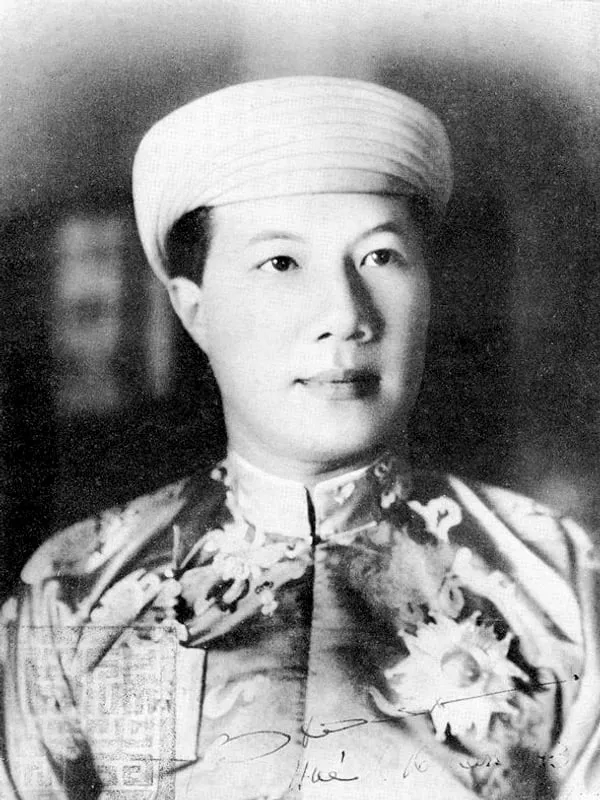
Bảo Đại
Emperor of Annam (1926–1945), Emperor of Vietnam (1945), Chief of State of the State of Vietnam (1949–1955)
- Born:
- 22 October 1913, Huế (French Indochina)
- Died:
- 31 July 1997, Paris (France)
- Author:
- Natalia
- Photo:
- autor nieznany, domena publiczna, Wikimedia Commons

Bảo Đại, born Nguyễn Phúc Vĩnh Thụy, was the thirteenth and last emperor of the Nguyễn dynasty, which had ruled Vietnam since 1802. He came to the throne as a child, was brought up in France, and all his life was a ruler without real power: first under the French protectorate, in 1945 under Japanese tutelage, then as “citizen Vĩnh Thụy” in the government of Hồ Chí Minh, and finally as head of the French-dependent State of Vietnam. In the history of the Second World War he is remembered above all as the face of the Empire of Vietnam, which the Japanese set up after their coup of 9 March 1945, and as the monarch whose abdication in August of that year closed the imperial era in Vietnam. His life mirrors the country’s path from colony to partition and war.
Childhood in Huế and Paris
He was born on 22 October 1913 in Huế, the imperial capital, the only son of Emperor Khải Định. Vietnam was then divided by the French into three parts of French Indochina: the colony of Cochinchina in the south and the protectorates of Annam and Tonkin, in which the emperor in Huế kept his title and ceremonial, but real power lay with the French Resident Superior.
In April 1922 the nine-year-old Vĩnh Thụy was proclaimed heir to the throne, and a few weeks later his father, travelling to France for the colonial exhibition in Marseille, took him along and left him in the care of Jean Charles, a former French Resident Superior in Annam, and his wife. The prince was educated at the Lycée Condorcet in Paris and later attended lectures at the Institut d’Études Politiques (Sciences Po). He grew up as a young Frenchman of good family: he spoke excellent French, hunted, played tennis and drove fast cars, and knew the land of his fathers mainly from short visits.
Khải Định died on 6 November 1925. His son returned for the funeral and on 8 January 1926, at the age of twelve, was enthroned in Huế. He took the reign name Bảo Đại – “keeper of greatness”. Immediately afterwards he went back to Paris to continue his studies, while a regency council ruled at home in his name. Even before the enthronement, in November 1925, the French had imposed on the court a convention that transferred almost all the emperor’s remaining powers to the Resident Superior; the young monarch was left with rituals and court affairs.
An emperor without power
In September 1932, aged nearly twenty, Bảo Đại returned to Vietnam and assumed personal rule in Huế. He announced reforms: the modernisation of the court, the abolition of archaic ceremonies (among other things he dispensed with the traditional prostrations of dignitaries), and reform of the judiciary and of the mandarin administration. In May 1933 he dismissed the old ministers and appointed younger ones, among them the writer Phạm Quỳnh and the Catholic official Ngô Đình Diệm, to whom he entrusted the Interior Ministry. When Diệm demanded that France respect the protectorate treaty of 1884 and hand over some real power to the Vietnamese, the French refused, and after a few months Diệm resigned. The emperor made no attempt to fight for him. The episode foreshadowed their later, far more serious clash.
On 20 March 1934 in Huế Bảo Đại married Marie-Thérèse Nguyễn Hữu Thị Lan, a French-educated Catholic from a wealthy Cochinchinese family. Contrary to court custom he took no concubines, and he immediately gave his wife the title of empress – Nam Phương. The marriage to a Catholic and the renunciation of a harem provoked opposition from conservative mandarins and from the emperor’s mother. The couple had five children; the eldest son, Bảo Long, born in 1936, became heir to the throne.
The reforms soon stalled, and the young emperor, convinced that the French would not let him rule, spent more and more of his time hunting in the mountains of central Vietnam, at his residence in Đà Lạt and on trips to France. In the eyes of Vietnamese nationalists, and of the communists too, he was a puppet of the colonial power; in the eyes of the French, a convenient symbol of continuity.
Under Vichy and under Japan
The fall of France in June 1940 and the Japanese entry into Tonkin in September of that year changed the position of the court in Huế. The Governor-General, Admiral Jean Decoux, who ruled Indochina on behalf of Vichy and had to share the colony with the Japanese army, tried to counter the Japanese propaganda of “Asia for the Asians” with a policy of his own: he emphasised the authority of the traditional monarchs, organised ceremonies and journeys for the emperor, opened more posts in the administration to Vietnamese and supported youth movements. Bảo Đại nevertheless remained a ceremonial ruler. Throughout this period the Japanese kept in Tokyo a rival to the dynasty, Prince Cường Để, a descendant of its founder, who had been seeking Japanese support for decades; for Bảo Đại this was a clear warning.
The Empire of Vietnam
On the evening of 9 March 1945 the Japanese army overthrew the French administration, interned Decoux and attacked French garrisons throughout Indochina. The next day a Japanese diplomat appeared at the palace in Huế and informed the emperor that Tokyo would recognise his country’s independence. Bảo Đại – by his own account under no illusions about Japanese intentions, but also with no possibility of refusing – accepted the offer. On 11 March a proclamation was read out in his presence: Vietnam annulled the protectorate treaty of 1884, declared its independence and undertook to cooperate with Japan within the “Greater East Asia Co-Prosperity Sphere”. The Japanese did not make use of Prince Cường Để: it suited them better to keep a monarch whom the people knew.
The emperor wanted to entrust the government to Ngô Đình Diệm, but the Japanese did not bring him in, and on 17 April the historian Trần Trọng Kim, author of a popular outline of Vietnamese history, became prime minister. His cabinet, made up of Western-educated intellectuals, restored the name “Vietnam”, introduced Vietnamese in schools and government offices and tried to fight the famine that had been killing the people of Tonkin and northern Annam since the autumn of 1944; its victims are estimated, depending on the source, at between 400,000 and 2 million. The government, however, had neither an army nor money, and the Japanese army decided everything. The Japanese handed Cochinchina over to Vietnam only in August. Meanwhile in the mountains of Tonkin the Việt Minh – Hồ Chí Minh’s communist-led independence league – was growing in strength.
Abdication and “citizen Vĩnh Thụy”
After Japan’s surrender the Việt Minh launched the August Revolution and on 19 August took power in Hanoi. Trần Trọng Kim’s government had already resigned. Deprived of all support, Bảo Đại accepted the demand for his abdication and announced it on 25 August, and on 30 August, before the Ngọ Môn gate of the citadel in Huế, he handed the imperial seal and sword to a Việt Minh delegation. In his proclamation he wrote that he would rather be a citizen of an independent country than king of an enslaved one. Thus ended the rule of the Nguyễn dynasty. On 2 September Hồ Chí Minh proclaimed the Democratic Republic of Vietnam in Hanoi.
The former emperor, now “citizen Vĩnh Thụy”, was appointed “supreme adviser” to the government of the republic, and in January 1946 he was elected to its National Assembly. This was valuable to the communists, since it legitimised the new authorities in the eyes of a traditionally minded population. In March 1946 Hồ Chí Minh sent him with a delegation to Chongqing. Vĩnh Thụy did not return: he settled in Hong Kong, where he lived as an émigré and soon became the object of overtures from the French and from Vietnamese opponents of the Việt Minh.
Chief of State of the State of Vietnam
From December 1946 France was waging war against the Việt Minh and looking for a Vietnamese alternative to Hồ Chí Minh. The so-called “Bảo Đại solution” was meant to show that France was fighting not the Vietnamese nation but communism. The former emperor bargained for a long time. On 7 December 1947 he signed a first agreement with the High Commissioner, Émile Bollaert, in Hạ Long Bay, and on 5 June 1948 a second was concluded in his presence, in which France recognised the principle of Vietnamese independence. On 8 March 1949 he signed the Élysée Accords with President Vincent Auriol. The State of Vietnam came into being – “independent within the French Union”, with Cochinchina joined to the rest of the country. Bảo Đại returned to Vietnam at the end of April 1949 and took office as Chief of State (quốc trưởng); for several months he was also prime minister.
His power was once again limited: France retained control of the army, finances and foreign policy, and the war was fought by French troops. The State of Vietnam was recognised in 1950 by the United States and Britain, and the Americans began to finance the French war effort. Bảo Đại spent most of his time in Đà Lạt, on the Côte d’Azur and in Paris, and his court was supported in part by concessions for casinos and gambling houses, which he handed over to the Bình Xuyên, a sect and criminal organisation that controlled Saigon. This cemented his image as a “playboy emperor”, indifferent to the fate of his country.
After the French defeat at Dien Bien Phu in May 1954, Bảo Đại appointed Ngô Đình Diệm prime minister in June, counting on his anti-communism and on American support. A few weeks later the Geneva Conference divided Vietnam along the 17th parallel. Diệm, backed by the Americans, quickly turned against the emperor. In 1955 he crushed the Bình Xuyên and the sects, and on 23 October 1955 he organised a referendum in which voters were to choose between him and Bảo Đại. Campaigning for the former emperor was banned, and the official result – more than 98 per cent of the vote for Diệm, and in Saigon more votes than there were registered voters – is generally regarded as rigged. On 26 October Diệm proclaimed the Republic of Vietnam and became its president.
Exile
Bảo Đại made no attempt to fight for the throne. He settled in France – first in Cannes, then in Alsace and finally in Paris – and lived ever more modestly once he had exhausted his fortune. Empress Nam Phương, who had lived apart from him for years, died in 1963 at Chabrignac in Corrèze; in 1982 he himself married a Frenchwoman, Monique Baudot. He occasionally spoke out on Vietnamese affairs: during the Vietnam War he called for reconciliation among the Vietnamese, and in 1980 he published his memoirs, Le Dragon d’Annam. He never returned to Vietnam, reunified under communist rule in 1975. He died on 31 July 1997 at the Val-de-Grâce military hospital in Paris (some sources give 30 July) and was buried in Passy Cemetery.
Significance
All his life Bảo Đại was a monarch whose throne served other people’s purposes. The French used him as an ornament of the protectorate, the Japanese as the façade of the Empire of Vietnam, the Việt Minh as a witness legitimising the revolution, and France and the United States as a counterweight to Hồ Chí Minh – until Diệm pushed him aside. His defenders point out that his abdication in 1945 averted bloodshed and that in 1949 he wrung more from France than anyone before him, including the union of Cochinchina with the rest of the country. His critics see him as a man without the will to power, who left politics to others.
In the history of the Second World War, Bảo Đại is one of the Asian rulers through whom Japan tried in 1945 to present its rule as “liberation” – alongside Ba Maw in Burma and Puyi in Manchukuo, with whom he is sometimes compared as a “last emperor”. The nominal independence of March 1945, though granted by the occupier, and then his abdication ruled out a return to the pre-war colonial order and opened the way to three decades of wars over Vietnam’s future.
Sources
Often appears with
People who appear in the same events.