Vietnam
Hồ Chí Minh
Founder of the Indochinese Communist Party (1930) and the Việt Minh (1941), President of the Democratic Republic of Vietnam (1945–1969), Prime Minister (1945–1955)
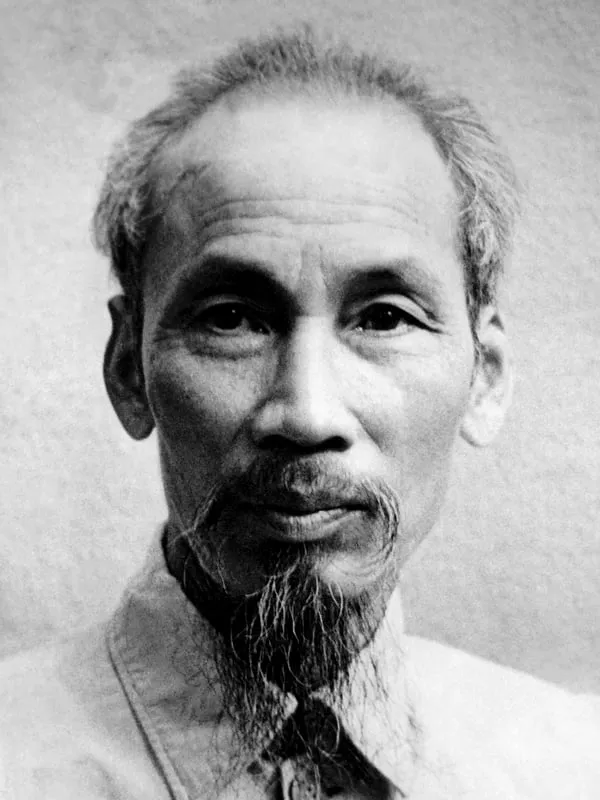
- Born:
- 19 May 1890, Kim Liên, Nghệ An province (French Indochina)
- Died:
- 2 September 1969, Hanoi (North Vietnam)
- Author:
- Natalia
- Photo:
- autor nieznany, domena publiczna, Wikimedia Commons

Hồ Chí Minh was a Vietnamese revolutionary and communist who spent thirty years abroad – as a seaman, a political émigré in Paris and an agent of the Communist International – before returning home in 1941 and founding the Việt Minh, a communist-led independence front. When Japan capitulated in August 1945 and the French, whose administration the Japanese had destroyed a few months earlier, had not yet returned, the Việt Minh took power in most of the country. On 2 September 1945 Hồ Chí Minh proclaimed in Hanoi the independence of the Democratic Republic of Vietnam. He was its president until his death in 1969 and led it through the war with France, the partition of the country in 1954 and the beginning of the war with the Americans. To some he became a symbol of the colonial peoples’ struggle for freedom; to others, a leader who in the name of that struggle built a one-party communist state and did not shrink from repression.
Childhood and youth (1890–1911)
He was born in the village of Kim Liên (or in nearby Hoàng Trù, his mother’s home village) in Nghệ An province in central Vietnam, then part of the French protectorate of Annam. The date of 19 May 1890 was adopted officially later; he himself gave other years in various documents, and some biographers regard it as uncertain. He was named Nguyễn Sinh Cung and, as a boy, in keeping with local custom, received a new name, Nguyễn Tất Thành. His father, Nguyễn Sinh Sắc, was a Confucian scholar who had passed the higher state examinations and briefly served as an official, but was dismissed from the service and later earned his living as a teacher and healer. Nghệ An was famous for its resistance to the French, and at home the young Thành heard about patriots such as Phan Bội Châu, a friend of his father’s.
He was educated at Franco-Vietnamese schools, including the prestigious Quốc Học lycée in Huế, from which, according to most accounts, he was expelled around 1908 when he was linked to peasant protests against taxes. For a time he taught at a school in Phan Thiết in the south, and then moved to Saigon. On 5 June 1911, working as a kitchen hand under the name “Ba”, he sailed from Saigon to France aboard the Amiral Latouche-Tréville. He did not return home for thirty years.
Seaman and émigré (1911–1919)
For the next few years he sailed as a kitchen hand and seaman, getting to know the ports of Africa, America and Europe. He stayed in the United States (in New York and Boston) and then in London, where according to tradition he worked in the kitchen of the Carlton Hotel. The details of this period are known mainly from his later, not always reliable, recollections. Towards the end of the First World War he settled in Paris, where tens of thousands of Vietnamese were then living – workers and soldiers brought to France for the duration of the war. He worked as a photo retoucher and joined a group of patriots gathered around Phan Châu Trinh and Phan Văn Trường.
In June 1919, during the Paris Peace Conference, this group addressed to the delegations of the Great Powers a petition, “The Demands of the Annamite People”, signed with the pseudonym Nguyễn Ái Quốc (“Nguyễn the Patriot”), which the young Thành adopted from then on. The petition did not demand independence, but equal rights, an amnesty for political prisoners, freedom of the press and of assembly, and Vietnamese representation in the French parliament. It invoked the principle of self-determination proclaimed by President Woodrow Wilson. The conference ignored it, but in France the text attracted the attention of the police, and among Vietnamese émigrés it made Nguyễn Ái Quốc a well-known figure. By his own later account, it was this disillusionment with the West, followed by his reading of Lenin’s theses on the national and colonial questions, that drew him to communism.
Comintern agent (1920–1930)
In December 1920, as a delegate to the socialist congress at Tours, he voted to join the Communist International, thereby becoming one of the founders of the French Communist Party. In the party he dealt with colonial affairs, helped found the Intercolonial Union and edited the paper Le Paria, and in 1925 he published the pamphlet French Colonialism on Trial. In 1923 he went to Moscow, studied at the Communist University of the Toilers of the East and in 1924 addressed the Fifth Congress of the Comintern, accusing the European parties of neglecting the colonies.
At the end of 1924 the Comintern sent him to Canton, where he was officially an interpreter in the mission of Mikhail Borodin, adviser to the Kuomintang government. There, among Vietnamese émigrés, he founded the Vietnamese Revolutionary Youth League (Thanh Niên) and trained its activists, who then returned home. After the Kuomintang broke with the communists in 1927 he had to flee; by way of Moscow and Europe he reached Siam in 1928, where he worked under an assumed name among the local Vietnamese.
Meanwhile the Vietnamese movement had split into rival communist groups. At the beginning of 1930 Nguyễn Ái Quốc, as the Comintern’s representative, convened their representatives in Hong Kong and brought about their unification as the Communist Party of Vietnam, which in October that year, in accordance with the Comintern’s wishes, was renamed the Indochinese Communist Party. He is regarded as its founder, although other activists took over the leadership inside the country, and the Comintern criticised his “nationalist” deviations.
Prison in Hong Kong and the Moscow years (1930–1940)
In 1930–1931 peasant revolts broke out in Nghệ An and neighbouring Hà Tĩnh, in which the communists set up local “soviets”. The French suppressed them bloodily, arrested thousands of activists and shattered the party; Nguyễn Ái Quốc was sentenced to death in absentia. In June 1931 the British police arrested him in Hong Kong. France demanded his extradition, but his lawyer, Frank Loseby, took the case all the way to the Judicial Committee of the Privy Council in London, and in 1933 Nguyễn Ái Quốc was released and left. During this time news of his death in prison spread – a story he himself kept alive.
From 1934 he lived in Moscow, where he studied at the International Lenin School and worked in the Comintern apparatus. This was the time of the purges in Stalin’s USSR; his position weakened, and the leadership of the Indochinese party passed to Moscow-trained men critical of his line of a broad national front. Yet he not only survived the Great Terror but in 1938 obtained permission to leave for China. There, during the Second Sino-Japanese War, he stayed briefly in Yan’an and then worked in offices of the communist Eighth Route Army, including at Guilin, and made contact with Vietnamese émigrés in Kunming and along the border.
Pác Bó and the founding of the Việt Minh (1940–1944)
He saw the fall of France in 1940 and the Japanese entry into Indochina as a historic opportunity. The administration of Admiral Jean Decoux, loyal to Vichy, kept power but had to cede bases to the Japanese and in July 1941 agree to their occupation of the south. At the beginning of 1941 Nguyễn Ái Quốc crossed the border and settled in the cave of Pác Bó in Cao Bằng province. There, in May 1941, the Eighth Plenum of the party’s Central Committee put the struggle for independence first, deferring the slogans of social revolution, and set up the League for the Independence of Vietnam – the Việt Minh. The front was meant to unite all patriots, but its leadership remained in communist hands.
In August 1942 he set off for China to seek Allied help, and it was then that he took the name Hồ Chí Minh (“He Who Enlightens”). Soon after crossing the border he was arrested as a suspect by the Kuomintang authorities in Guangxi; for more than a year he was moved from prison to prison. During this time he wrote, in Chinese, a cycle of poems later known as the Prison Diary. He was released in September 1943 thanks to General Zhang Fakui, who wanted to use his people for intelligence work in Indochina, and was brought into a Chinese-backed coalition of Vietnamese groups. In September 1944 he returned to Pác Bó. In December of that year, on his instructions, Võ Nguyên Giáp formed the first armed unit – the Armed Propaganda Brigade, the nucleus of the future army.
1945 and the August Revolution
The turning point came with the Japanese coup of 9 March 1945, which destroyed the French administration and army in Indochina. The Japanese proclaimed the nominal independence of the Empire of Vietnam under Bảo Đại, but a power vacuum opened up in the provinces. At the same time a great famine swept the north, which by various estimates claimed between several hundred thousand and two million lives; the Việt Minh won support by raiding Japanese rice stores and distributing the grain. In the mountains north of Hanoi a “liberated zone” was established, centred on Tân Trào, where Hồ Chí Minh moved in May.
After the March coup the Americans lost their French informants and began to use Việt Minh people instead. Hồ Chí Minh met General Claire Chennault, commander of the Fourteenth Air Force, in Kunming, and cooperated with the Office of Strategic Services, among other things in rescuing downed airmen. In July 1945 the OSS “Deer” team parachuted in near Tân Trào and trained his fighters; the team’s medic treated the leader, who was then seriously ill. The scale of American help was small, but these contacts allowed Hồ Chí Minh to present himself to his compatriots as an ally of the victorious Allies.
When news of Japan’s capitulation arrived, a general uprising was proclaimed at Tân Trào on 13 August, and on 16 August a National Congress chose a National Liberation Committee headed by Hồ Chí Minh. On 19 August the Việt Minh took power in Hanoi, and in the following days in Huế and Saigon; Bảo Đại abdicated on 25 August. Hồ Chí Minh himself arrived in Hanoi around 25–26 August, and on 28 August the composition of the provisional government was announced, in which he became chairman and Foreign Minister. On 2 September 1945, the day of Japan’s surrender in Tokyo Bay, he read out in Ba Đình Square the declaration of independence of the Democratic Republic of Vietnam. It opened with a quotation from the American Declaration of Independence and referred to the French Declaration of the Rights of Man and of the Citizen – which was also a signal addressed to Washington. The letters he later sent to President Harry Truman went unanswered.
War with France (1945–1954)
In accordance with the Potsdam decisions and General Order No. 1, the Japanese north of the 16th parallel were disarmed by the Chinese and those to the south by the British, who helped the French regain Saigon. Hồ Chí Minh manoeuvred: in January 1946 he held elections and took Chinese-backed nationalists into the government, and on 6 March 1946 he signed an agreement with France recognising Vietnam as a “free state” within the French Union in return for consenting to the return of French troops to the north in place of the Chinese (General Philippe Leclerc then entered Hanoi). The negotiations at Fontainebleau in the summer of 1946 ended with no more than a temporary arrangement. After the French shelling of Haiphong in November and fighting in Hanoi on 19 December 1946, the First Indochina War broke out.
Hồ Chí Minh’s government withdrew to the Việt Bắc mountains and waged a guerrilla war. France – whose return to Indochina had been decided as early as 1945 by the government of Charles de Gaulle – backed the State of Vietnam headed by Bảo Đại in 1949. The communist victory in China changed the balance of power: in 1950 the DRV was recognised by the People’s Republic of China and the USSR, and Mao Zedong sent weapons and advisers. In 1951 the party was re-established as the Workers’ Party of Vietnam, with Hồ Chí Minh as its chairman. The war was decided by Giáp’s victory at the Battle of Dien Bien Phu (13 March – 7 May 1954). The Geneva Conference divided Vietnam along the 17th parallel; the reunification elections announced for 1956 were never held.
President of North Vietnam (1954–1969)
In October 1954 the government returned to Hanoi. In 1953–1956 a land reform was carried out in which people’s tribunals condemned “landlords”; the number executed is usually estimated at between ten and twenty thousand, and some authors give higher figures. In 1956 the leadership admitted to “errors”, and Hồ Chí Minh publicly apologised. He gradually handed day-to-day government over to others: Phạm Văn Đồng was Prime Minister from 1955, and from 1960 the party’s First Secretary was Lê Duẩn, an advocate of war for reunification. Hồ Chí Minh remained president and the symbol of the state, and a mediator in the Sino-Soviet dispute; his role in the decisions of the 1960s is disputed by historians. The North supported the struggle in the South, and from 1965 the Vietnam War also included American bombing of the North.
Hồ Chí Minh died of heart failure in Hanoi on 2 September 1969; the authorities announced the date at the time as 3 September so as not to link his death with the national holiday, and corrected it only in 1989. Contrary to his will, in which he asked to be cremated, his body was embalmed and placed in a mausoleum opened in 1975.
Significance
Hồ Chí Minh did not live to see Vietnam reunified – Saigon was captured in April 1975 and a year later renamed Ho Chi Minh City. In the official cult “Uncle Hồ” is the father of the nation, and his portrait appears on every banknote. Historians debate whether he was above all a nationalist who used communism as a tool of liberation, or a faithful communist for whom independence was one stage of the revolution; most biographers see in him a combination of both, together with exceptional pragmatism. For the history of the Second World War his path shows how the war in the Pacific – first France’s humiliation by Japan in 1940 and 1945, then Japan’s capitulation and the brief power vacuum of August 1945 – opened the era of decolonisation in Asia. The proclamation of 2 September 1945 marked the beginning of thirty years of war in Indochina.
Sources
Often appears with
People who appear in the same events.