Burma
Ba Maw
Prime Minister of British Burma (1937–1939), head of the administration of Burma under Japanese occupation (1942–1943), head of the State of Burma (1943–1945)
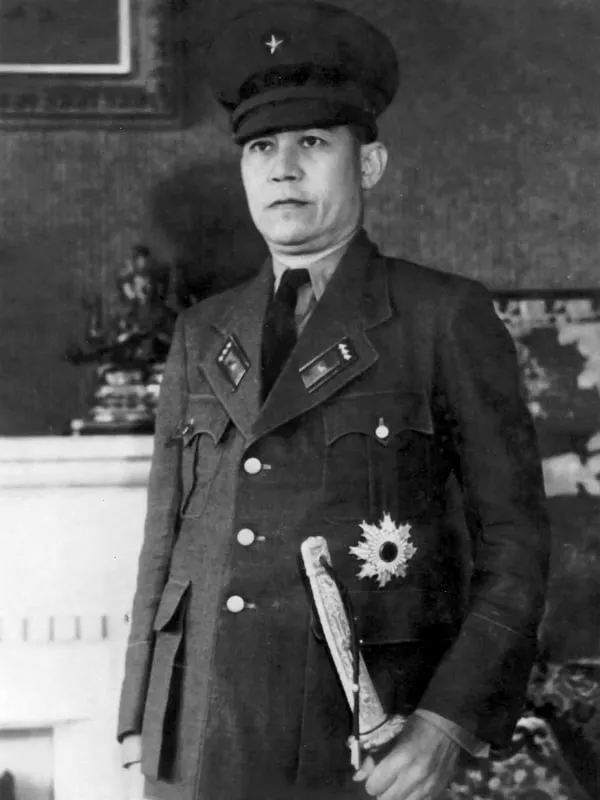
- Born:
- 8 February 1893, Maubin (British Burma)
- Died:
- 29 May 1977, Rangoon (Burma)
- Author:
- Natalia
- Photo:
- autor nieznany, domena publiczna, Wikimedia Commons

Ba Maw, known respectfully in Burma as “Dr Ba Maw”, was one of the most gifted and most controversial Burmese politicians of the 20th century. A lawyer educated in India, England and France, he made his name as defence counsel for the leaders of a peasant rising against the British; in 1937 he became the first Prime Minister of British Burma, newly separated from India, and in 1940 he ended up in a British prison for opposing his country’s participation in the war. After the Japanese conquest he headed the Burmese administration, and on 1 August 1943 he proclaimed the independence of the State of Burma, an ally of Japan. To some he was a patriot who used the war to wrest Burma from British rule; to others, a collaborator whose “independence” was merely a façade for Japanese occupation.
Family and education
He was born on 8 February 1893 in Maubin in the Irrawaddy delta. He came from a prosperous, educated family of Mon and Burmese roots. His father, Shwe Kye, spoke European languages and in the 1870s accompanied Burmese diplomatic missions to Europe sent by the last kings of Burma. Ba Maw’s elder brother, Ba Han, later became a well-known lawyer and lexicographer. According to some biographers, Ba Maw was brought up in a Christian family and adopted Buddhism only as an adult, which his opponents later used as evidence of his political calculation.
He graduated from Rangoon College, took a master’s degree at the University of Calcutta in 1917 and for several years taught English literature in Rangoon. He then studied in England, at the University of Cambridge and at Gray’s Inn, which called him to the bar in 1923. He obtained his doctorate at the University of Bordeaux with a thesis, written in French, on Buddhism in Burma. The title of doctor later became part of his political image. In 1926 he married Khin Ma Ma Maw, with whom he had seven children.
Defender of Saya San and the road to power
On his return home he practised law in Rangoon. He won fame by defending Saya San, the leader of a peasant rising that broke out over taxes in December 1930 and spread across much of Burma. As chief defence counsel Ba Maw could not save Saya San from the gallows, but the trial made him a champion of the national cause. In his later memoirs he wrote that, under the guise of trials, the colonial authorities had punished thousands of peasants who did not understand the law and knew only that they could not pay their taxes.
In the early 1930s he was among the opponents of separating Burma from India, fearing that a separate colony would receive less self-government. Once London had decided on separation, however, he joined the colonial government, serving as Minister of Education from 1934. He founded his own party, the Sinyetha, or Poor Man’s Party, which appealed to the peasantry. On 1 April 1937, when the new constitution of British Burma came into force, he became its first Prime Minister. His coalition government was weak, and a wave of anti-Indian riots and strikes in 1938 undermined his position. On 16 February 1939 parliament passed a vote of no confidence and Ba Maw had to resign.
The Freedom Bloc and prison
Ba Maw saw the outbreak of war in Europe in September 1939 as an opportunity for Burma. In the autumn of 1939, together with the young radicals of the Thakin movement, among them Aung San, he formed the Freedom Bloc. He demanded that Britain grant Burma the right to independence in return for its participation in the war. In July 1940 he resigned his seat in parliament and called on his compatriots not to take part in the war effort as long as Burma was denied freedom. On 6 August 1940 he was arrested under the Defence of Burma regulations, and on 28 August he was sentenced to a year in prison. He served his sentence first in Mandalay and then in Mogok in the north of the country. Meanwhile Aung San and his comrades secretly left for Japan, where Japanese intelligence trained them as future commanders of a Burmese army.
Under Japanese occupation
In December 1941 the Japanese entered Burma, and in March 1942 they took Rangoon. In April 1942, amid the confusion of the British retreat, Ba Maw escaped from the prison in Mogok and hid in the hills with his wife, and in the second half of May he made contact with the Japanese. They were looking for a Burmese politician with a well-known name who could run the administration, and they chose him rather than the young leaders of the Burma Independence Army. After the end of the Burma campaign, Ba Maw became head of the civil administration in June 1942, and on 1 August 1942 he took charge of the Burmese central government, subordinate to the Japanese military administration.
When the war began to turn against Japan, Tokyo decided to speed up the granting of independence to Burma. In January 1943 the Prime Minister, Hideki Tōjō, announced it in the Diet, and in March Ba Maw led a delegation to Tokyo, where he was received by Emperor Hirohito. On 8 May 1943 he became chairman of the Independence Preparatory Committee, and on 1 August 1943 he proclaimed the independence of the State of Burma and took the title of Naingngandaw Adipadi, supreme head of state, combining it with the office of prime minister. On the same day Burma concluded an alliance with Japan and declared war on the United States and Britain.
The constitution gave him almost unlimited power, and his entourage built a courtly ceremonial around him. In reality his freedom of action was limited by a secret military agreement that gave the Japanese army a free hand in the country. In November 1943 Ba Maw attended the Greater East Asia Conference in Tokyo, alongside Wang Jingwei, José P. Laurel of the Philippines and representatives of Manchukuo and Thailand. In his speech he spoke of “the call of Asiatic blood” that united the peoples of Asia. He became one of the most eloquent voices of Japan’s “Greater East Asia” propaganda.
At the same time he clashed ever more often with the Japanese military over requisitions, forced labour and the high-handedness of the military police. Some officers of the Burma Area Army wanted to replace him with U Nu, who, however, refused to take part in the plot and warned Ba Maw. In April 1944 a Japanese intelligence officer – acting, according to Japanese findings, at the instigation of a senior staff officer – tried to kill him, but the attempt was foiled by his guards. Even so, Ba Maw stood by the alliance, convinced that he alone was protecting Burma from a return of colonialism.
The fall of the State of Burma and flight to Japan
The Japanese defeat at Imphal and Kohima in 1944 sealed the fate of his state. On 27 March 1945 Aung San’s Burma National Army, formally subordinate to Ba Maw’s government, turned against the Japanese and went over to the Allies. In April 1945, as the British approached Rangoon, Ba Maw evacuated south with the Japanese and the remnants of his government, to the area of Moulmein (Mawlamyine). The State of Burma had in practice ceased to exist. After Japan’s surrender, on the advice of the Japanese ambassador, Ba Maw made his way through Thailand to Tokyo in the second half of August 1945.
In Japan he hid for several months under a false identity in a Buddhist temple in the mountain village of Ishiuchi in Niigata Prefecture, where he taught English to the locals. In January 1946 he gave himself up to the American occupation authorities in Tokyo and was sent to Sugamo Prison. Because the British government had decided to come to terms with the Burmese nationalists and not to prosecute those who had collaborated with the Japanese, Ba Maw was released at the end of July 1946 and returned to Burma in August.
After the war
In a country preparing for independence he did not regain his former standing. Aung San, then leader of the Anti-Fascist People’s Freedom League, reportedly offered him cooperation, but Ba Maw refused and rebuilt his own Mahabama party as an opposition group. After the assassination of Aung San and several members of his government on 19 July 1947, he was briefly arrested as one of the suspects, but released for lack of evidence. Burma gained independence on 4 January 1948, but Ba Maw remained on the margins of political life and never held office again.
After General Ne Win seized power in 1962, Ba Maw, like many prominent politicians of the old era, was imprisoned without trial. He was held from about 1966 until February 1968. During this time he managed to smuggle abroad the manuscript of his memoirs, published in 1968 by Yale University Press as Breakthrough in Burma: Memoirs of a Revolution, 1939–1946. The book, written from the standpoint of a man who to the end believed his choice had been right, is one of the most important testimonies on the Japanese occupation of Burma: in it he defended the idea of Asian independence while sharply describing the arrogance and cruelty of the Japanese military. He died on 29 May 1977 in Rangoon – according to some sources, a day earlier.
Significance
Ba Maw belonged to a group of Asian politicians – alongside Wang Jingwei in China, José P. Laurel in the Philippines and Subhas Chandra Bose in India – who during the Second World War allied themselves with Japan in the hope that its victory over the colonial powers would bring freedom to their nations. His State of Burma was in practice dependent on the Japanese army and won no recognition outside the circle of the Axis powers and their satellites. The army and administration created under his rule nevertheless hastened the end of British rule: from them grew the forces that turned against the Japanese in 1945 and after the war forced London into rapid concessions. In the history of Myanmar, Ba Maw remains an ambiguous figure – the country’s first head of government and first “head of an independent state”, and at the same time a symbol of collaboration with an occupier that brought Burma war, famine and destruction.
Sources
Mentioned in battles
(02)Often appears with
People who appear in the same events.