United States
Charles McVay
Commanding officer of the cruiser USS Indianapolis (1944–1945), US Navy captain, rear admiral on the retired list (1949)
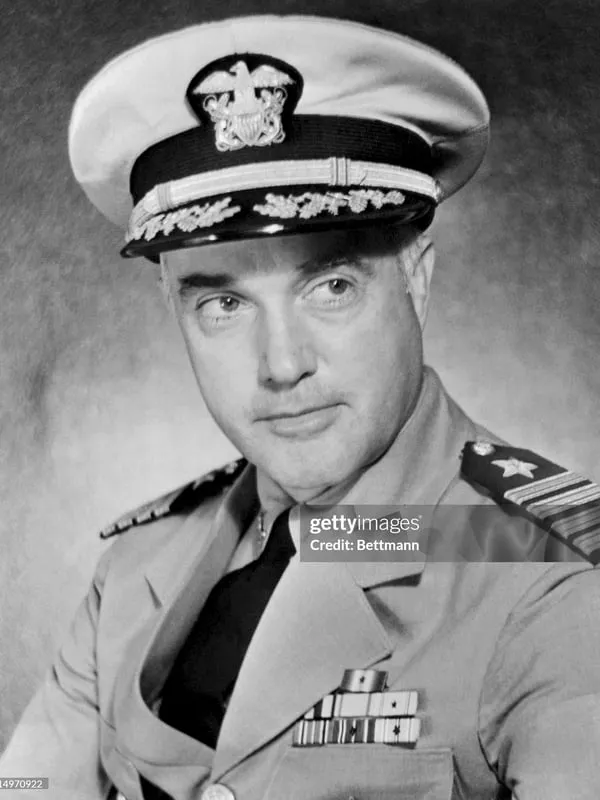
- Born:
- 31 August 1898, Ephrata (Pennsylvania, United States)
- Died:
- 6 November 1968, Litchfield (Connecticut, United States)
- Author:
- Łukasz
- Photo:
- autor nieznany, domena publiczna, Wikimedia Commons

Charles Butler McVay III was a career officer of the United States Navy, an admiral’s son and a graduate of Annapolis who for a quarter of a century pursued a typical, solid naval career. He passed into history, however, because of a single night. In July 1945 the heavy cruiser Indianapolis, under his command, delivered components of an atomic bomb to the island of Tinian; four days later, on her way to Leyte, she was torpedoed by a Japanese submarine and sank within a quarter of an hour or so. Of a crew of almost 1,200 men, only just over three hundred survived – most died in the water, waiting four days for rescue, because no one noticed that the ship had failed to reach her destination. McVay survived and became the only commander of an American warship lost in action during the Second World War to be tried by court martial – as historians of the disaster and the survivors’ organisation present the case. The verdict, the burden of guilt laid on him by some of the victims’ families and the survivors’ long campaign to clear his name together make up one of the bitterest stories of the US Navy’s war.
A family of sailors
Charles Butler McVay III was born on 31 August 1898 in Ephrata, Pennsylvania, into a family with naval traditions. His father, Charles Butler McVay Jr. (1868–1949), commanded the auxiliary Yankton during the Great White Fleet’s voyage round the world in 1907–1909, later rose to the rank of admiral and in the early 1930s commanded the US Asiatic Fleet. His mother was Edith Reno McVay. The son attended the Yates Academy preparatory school in Lancaster, and in 1916 he received a presidential appointment from Woodrow Wilson to the Naval Academy at Annapolis.
As a midshipman, in the summer of 1918 he sailed in the armoured cruiser Frederick, which escorted convoys in the Atlantic. He graduated in 1920, was commissioned as an ensign and was posted to the battleship North Dakota. In the 1920s and 1930s he served in a dozen or more ships and in Navy Department offices, climbing the successive rungs of his career without attracting notice. He married Kinau Wilder; their elder son, Charles Butler McVay IV, was born in Honolulu in 1925, and the younger, James “Kimo” Wilder McVay, in Washington in 1927.
War: Cleveland, the Solomon Islands, Washington
After the attack on Pearl Harbor McVay, by then a commander, became executive officer of the new light cruiser Cleveland in March 1942. The ship took part in the landings in North Africa in November 1942 and in December moved to the Pacific, where she covered convoys bound for the Solomon Islands. On the night of 5–6 March 1943 Cleveland, together with other cruisers and destroyers of Rear Admiral Aaron S. Merrill’s force, bombarded Japanese positions around Vila on Kolombangara and in Kula Gulf; in this action two Japanese destroyers, Murasame and Minegumo, were sunk. For his conduct under fire in this engagement McVay received the Silver Star – according to the citation “for conspicuous gallantry and intrepidity” in action against Japanese forces in Kula Gulf and the Vila–Stanmore area. A few months later the New Georgia campaign began in the same area.
McVay was soon recalled to Washington. He became chairman of the Joint Intelligence Committee of the Combined Chiefs of Staff – the body that compiled intelligence assessments for the highest Allied command – working within the office of the Deputy Chief of Naval Operations. It was a senior staff post, but a naval officer needed command of a ship if he hoped to become an admiral. On 18 November 1944 McVay, by now a captain, took command of the heavy cruiser Indianapolis, flagship of Admiral Raymond Spruance, commander of the Fifth Fleet.
Commanding the Indianapolis
Under his command the cruiser sailed with the carriers of Task Force 58 in February 1945, when their aircraft struck Tokyo for the first time, and then supported the landing on Iwo Jima with gunfire. In March Indianapolis screened the carriers during the raids on Kyushu and bombarded Okinawa ahead of the invasion. On 31 March 1945, the day before the landing on Okinawa, a kamikaze aircraft broke through the anti-aircraft fire and struck the after part of the deck; its bomb pierced the hull and exploded beneath the ship. Several sailors were killed – sources give eight or nine dead – and Spruance shifted his flag to the battleship New Mexico. McVay brought the damaged cruiser across the Pacific under her own power to the Mare Island yard in California, where she was under repair until July.
There Indianapolis was given a task about which McVay knew little: she was to carry to Tinian, as fast as possible, a top-secret cargo – components of the Little Boy uranium bomb, including most of its fissile material. He was told only that every day saved on the voyage would shorten the war and that the cargo was to be guarded at all costs. On 16 July, the day of the Trinity test, the cruiser sailed from San Francisco, reached Tinian via Pearl Harbor in record time on 26 July and unloaded her cargo. She then went on via Guam, unescorted, towards Leyte, where the crew was to undergo training before joining the fleet off Okinawa. According to historians of the disaster, McVay asked for a destroyer escort but did not receive one; nor was he told of Japanese submarines detected along the route or of the sinking of the destroyer escort Underhill on 24 July.
The night of 30 July 1945
Shortly after midnight on 30 July 1945, in the Philippine Sea halfway between Guam and Leyte, the cruiser was sighted from the submarine I-58 by Lieutenant Commander Mochitsura Hashimoto. At about 12.14 a.m. two of the six torpedoes he fired struck Indianapolis on the starboard side: one tore away part of the bow, the other hit abreast the bridge. The ship lost power and internal communications, heeled over and after about twelve minutes capsized and sank. McVay, thrown from his cabin by the explosions, managed to give the order to abandon ship only to those he could reach in person; he himself was in the water as the cruiser went down.
Of the 1,195 men on board, some three hundred went down with the ship, and roughly 880–900 ended up in the sea, most of them with nothing but lifejackets, without boats and with little water. McVay found himself with a small group of rafts some distance from the main clusters of survivors. Over the next four days men died of wounds, exhaustion, dehydration and drinking seawater, of cold at night and sunstroke by day, and some were killed in shark attacks – how many can no longer be established. No one was looking for them: the cruiser was sailing in secret, her failure to arrive at Leyte was not reported as overdue, and the distress signals which, according to some accounts, were sent off provoked no response – a matter disputed to this day. The survivors were spotted by chance on 2 August by the crew of a Lockheed Ventura patrol aircraft. Seaplanes and ships set off to the rescue; 316 men survived, among them the wounded McVay. In all, 879 members of the crew died; the sinking of the Indianapolis is regarded as the worst disaster to befall a single US Navy ship on the open sea.
The court martial
As early as August 1945 a naval Court of Inquiry convened on Guam and recommended that McVay be court-martialled. Admiral Chester Nimitz, commander of the Pacific Fleet, disagreed and wanted to settle for a letter of reprimand. The Commander-in-Chief of the US Fleet, Admiral Ernest King, overruled him, however, and Secretary of the Navy James Forrestal convened a court martial. The trial opened on 3 December 1945 at the Washington Navy Yard. McVay faced two charges: hazarding his ship by failing to steer a zigzag course, and failing to give the order to abandon ship in good time. He was acquitted on the second charge – witnesses testified that once internal communications had been destroyed, nothing more could have been done in the space of a quarter of an hour or so. On the first he was convicted.
The most controversial moment of the trial was the testimony, on 13 December, of Hashimoto himself, brought over from occupied Japan. Calling a former enemy to testify against an American officer provoked protests, and his evidence did not help the prosecution: Hashimoto stated that, given his position relative to the target, zigzagging would not have saved the cruiser from being hit. American submarine warfare specialists said much the same. The court sentenced McVay to lose one hundred places on the captains’ seniority list, but at the same time recommended clemency. In 1946 Forrestal, on the advice of Nimitz, who had become Chief of Naval Operations, remitted the sentence and restored him to duty.
Critics of the verdict – surviving sailors, historians and later members of Congress – pointed out that no one else was held responsible: neither the officers who refused him an escort and failed to pass on intelligence about submarines, nor those who did not notice that the cruiser had not reached Leyte. Of the hundreds of ships the US Navy lost in action during the war, this was the only case in which a commanding officer was court-martialled. Some authors, including Richard F. Newcomb, also cited the words of McVay’s father, that King, who as a young officer had received a reprimand from him, “never forgot a grudge” – but this is a family account, unconfirmed by documents.
Post-war years and death
McVay was never given another ship. He became chief of staff to the commandant of the 8th Naval District in New Orleans and served there until he retired on 30 June 1949. On retirement he was advanced – in line with the practice of the time for officers decorated in combat – to the rank of rear admiral. He settled in Litchfield, Connecticut. According to his family and surviving crew members, for years he received letters from the families of dead sailors blaming him for their deaths; some arrived regularly around Christmas. He rarely spoke of the disaster himself, though he kept in touch with the survivors and in 1960 attended their first reunion in Indianapolis, where he was warmly received. After his wife died of cancer in 1961 he lived an increasingly solitary life.
On 6 November 1968 McVay took his own life with a revolver on the porch of his home in Litchfield. He was 70. He left no note; his family and the survivors linked his death to loneliness and to the burden of the Indianapolis affair, which he never shook off.
Exoneration
The surviving sailors, organised in the USS Indianapolis Survivors Organization, campaigned for decades to have their captain cleared. The case was publicised by books, among them Richard F. Newcomb’s Abandon Ship! (1958) and Dan Kurzman’s Fatal Voyage, and by Captain Quint’s famous monologue in the 1975 film Jaws, which brought the survivors’ ordeal to the attention of millions of viewers. In the second half of the 1990s a schoolboy from Pensacola, Florida, Hunter Scott, joined the campaign: as part of a school history project he interviewed nearly 150 survivors and went through hundreds of documents, and later testified before Congress. The survivors were also supported by Mochitsura Hashimoto, who wrote in a letter to Senator John Warner that he did not understand why the American captain had been convicted.
In October 2000 the United States Congress passed – as part of the defence authorisation act – a resolution expressing the sense of Congress that McVay’s record should state that he is “exonerated for the loss of the USS Indianapolis”; President Bill Clinton signed the act on 30 October 2000. Hashimoto had died five days earlier, on 25 October. The resolution did not overturn the court martial’s verdict, which Congress has no power to do; in 2001 Secretary of the Navy Gordon England ordered it to be entered in McVay’s personnel record.
Significance
McVay’s story closes the wartime career of the ship that carried to Tinian the cargo meant to end the war in the Pacific – a few days after she sank, the Little Boy bomb was dropped on Hiroshima. For the US Navy the loss of the Indianapolis became a warning: after the war the rules for reporting ships’ arrivals were changed, and the investigations exposed weaknesses in communications and in the flow of intelligence. For many Americans, in turn, McVay became the symbol of a commander who paid for the failings of an entire system. His story has been told on screen, among others in the television film Mission of the Shark (1991, with Stacy Keach as McVay) and USS Indianapolis: Men of Courage (2016, with Nicolas Cage). The wreck of the cruiser was found in 2017 at a depth of about 5,500 metres in the Philippine Sea.
Sources
Often appears with
People who appear in the same events.