1940–1943: The North African campaign
Operation Torch
- Dates:
- 8–16 November 1942
- Front:
- Mediterranean
- Location:
- French North Africa: the Atlantic coast of Morocco (Safi, Fedala near Casablanca, Mehdia and Port-Lyautey), the coast of Algeria (Oran with Arzew and Les Andalouses, Algiers, Bougie, Bône) and the Algerian–Tunisian border areaOn the battle map →
- Sides:
- United States and United KingdomDwight Eisenhower, George Patton, Lloyd Fredendall, Charles Ryder, Kenneth AndersonVichy FranceFrançois Darlan, Alphonse Juin, Charles Noguès
- Result:
- Allied victory. After three days of fighting Admiral Darlan ordered the Vichy forces to cease fire, and Morocco and Algeria went over to the Allies. In response the Germans occupied southern France and moved into Tunisia, closing the Allies' quick road to Tunis.
- Author:
- Łukasz
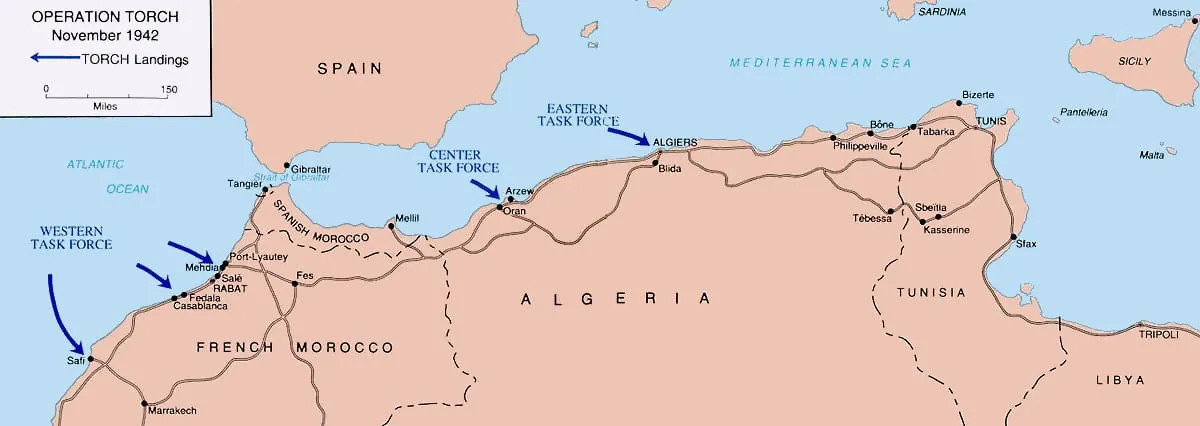
Operation Torch was the first great Anglo-American offensive against the Axis powers in the West and the United States Army’s first major land operation against the Axis on the Atlantic side of the war. On the night of 7–8 November 1942 three task forces – one sailing directly from America, two from Britain – put more than 100,000 troops ashore in French Morocco and French Algeria, colonies subject to the government of Marshal Philippe Pétain in Vichy. The Allies hoped that the French would not fire. They were wrong: for three days there was heavy fighting against the former ally at Casablanca, Oran and – more briefly – Algiers, and the roadstead of Casablanca saw the largest clash between American and French warships in history.
The outcome, however, was settled by politics rather than artillery. The commander-in-chief of the Vichy armed forces, Admiral François Darlan, happened to be in Algiers. Caught between the victorious Allies and the Marshal, on 10 November he ordered a ceasefire throughout North Africa. Hitler responded by occupying the hitherto unoccupied part of France and moving troops into Tunisia. When Allied units reached the Tunisian border on 16 November, the landing operation was over and the long campaign for Tunisia was beginning.
Name and dates
The code name Torch was given in July 1942 to a plan previously known as Gymnast (later Super-Gymnast). The operation is taken to have begun on 8 November 1942: the first landing craft reached the beaches near Algiers and Oran at about 1 a.m., and in Morocco – late – before dawn. The end date is a matter of convention. Fighting with the French ceased in Algiers on the evening of 8 November, in Oran on 10 November and in Morocco on the morning of 11 November. Many studies, however, close the operation on 16 November, when British and American paratroopers seized airfields on the Algerian–Tunisian border and the landings at Bougie and Bône (today Béjaïa and Annaba) turned into a march on Tunis. The fighting that followed belongs to the Tunisian campaign.
The places bore French names in 1942: Port-Lyautey is today’s Kenitra, Fedala is Mohammedia, Arzew is today also written Arziw, Bougie is Béjaïa and Bône is Annaba.
Background
The dispute over the second front
At the Arcadia Conference at the turn of 1941 and 1942 the Americans and British confirmed that Germany had to be defeated first. They disagreed, however, on how to do it. The US Army Chief of Staff, General George Marshall, wanted to land in France as soon as possible – if necessary as early as 1942, in a limited operation code-named Sledgehammer. The British, aware of the shortage of ships, landing craft and experienced divisions, considered this suicidal and proposed a blow at French North Africa. The decision was finally made by President Franklin Delano Roosevelt: he wanted American soldiers to be fighting the Germans in 1942 and the Soviet Union to be given some relief. In July he accepted Winston Churchill’s plan, and in August planning began at the London headquarters of General Dwight Eisenhower, appointed supreme commander of the expedition.
The landings were meant to trap the Axis forces in Africa between two fronts. From the east came the British Eighth Army, which at the turn of October and November had defeated Rommel at El Alamein and since 4 November had been pursuing him westwards. From the west the Americans and British were to advance from Algeria and take Tunisia before the Germans could.
French North Africa
Morocco (a protectorate), Algeria (formally part of France) and Tunisia (a protectorate) were subject to the Vichy government. Under the 1940 armistice France was allowed to maintain the so-called Armistice Army there – some 125,000 men in all, with old tanks (about 210 serviceable) and some 500 aircraft, including modern Dewoitine D.520 fighters. At Casablanca lay the unfinished battleship Jean Bart with one working turret of 380 mm guns, a light cruiser, several destroyers and a dozen or so submarines; at Oran there were more destroyers and submarines. The Resident-General in Morocco was General Charles Noguès, the commander of land forces throughout North Africa was General Alphonse Juin, and the naval forces at Casablanca were commanded by Vice Admiral Frix Michelier.
Feelings were mixed. Many officers hated the Germans but had sworn an oath to Pétain, and the navy had not forgiven the British for Mers-el-Kébir or the fighting at Dakar and in Syria. The Allies therefore decided that the landings should appear to be American: the United States maintained diplomatic relations with Vichy, and its consul general in Algiers, Robert Murphy, had spent two years building a network of contacts. For the same reasons General Charles de Gaulle and the Free French were left out entirely – he learned of the landings only after the event.
Murphy’s people, with General Charles Mast, commander of the division at Algiers, and General Émile Béthouart in Morocco, promised help. On the night of 21–22 October Eisenhower’s deputy, General Mark Wayne Clark, met them in secret on the coast near Cherchell. The conspirators wanted General Henri Giraud, who had escaped from German captivity in the spring, to lead the French. The British submarine Seraph picked him up from the coast of Provence on 5 November, and on 7 November Giraud reached Eisenhower’s headquarters at Gibraltar – where, to the Americans’ surprise, he demanded supreme command of the entire operation. Because he was refused, he stayed at Gibraltar during the first hours of the landings.
Plan and forces
Eisenhower, who moved his headquarters into the tunnels of Gibraltar on 5 November, had three task forces under him. The Western Task Force – entirely American, some 35,000 men under Major General George Patton in more than a hundred ships and warships under Rear Admiral Henry Hewitt – sailed from Hampton Roads in October and was to land at three points on the Atlantic coast of Morocco: at Safi in the south, at Fedala near Casablanca in the centre and at Mehdia, at the mouth of the Sebou river, in the north. The Centre Task Force, with some 18,000–20,000 men of Major General Lloyd Fredendall’s US II Corps – the 1st Infantry Division and part of the 1st Armored Division – sailed from Britain under Royal Navy escort and was to take Oran. The Eastern Task Force, some 20,000 American and British troops, was to seize Algiers. During the landing phase its troops were commanded by an American, Major General Charles Ryder, commander of the 34th Infantry Division; once the city had been secured, command was to pass to the British Lieutenant General Kenneth Anderson and his First Army, destined for the march on Tunisia. The ships of the Eastern Task Force were commanded by Vice Admiral Harold Burrough, and the naval forces as a whole by Admiral Andrew Cunningham.
According to the most commonly cited figures, the forces of the operation numbered some 107,000 men in all; more than 70,000 landed in the first wave, with more to follow. The air forces were divided by a line at Cape Ténès: to the west operated the American aircraft of General James Doolittle, to the east the RAF. Air cover for the landings was provided by aircraft carriers, including the American Ranger and four American escort carriers off Morocco, and British carriers off Oran and Algiers.
The troops were under orders not to fire first, and the task forces carried leaflets and recordings of a speech by Roosevelt in French. To save the ports from destruction, two daring raids were planned: at Algiers (Operation Terminal) and at Oran (Operation Reservist) ships were to break through the booms and land infantry directly on the quays. The whole plan rested on the assumption that the French would at least not put up stubborn resistance. All three landings were to take place simultaneously on the night of 7–8 November.
Course of the operation
The night of 7–8 November: the Algiers putsch
The French themselves were the first into action. At around midnight several hundred volunteers from the Algiers resistance – about 400 according to the most widely cited figures, many of them young Algerian Jews whom Vichy had stripped of French citizenship – led by José Aboulker and Henri d’Astier de La Vigerie, seized police stations, the telephone exchange, the post office, the radio station and government buildings. They were armed with old rifles, wore the armbands of civic guard volunteers and carried orders signed by General Mast. A detachment also surrounded the villa of General Juin, where Murphy was trying to persuade him to come over to the Allies. Juin replied that the decision lay with Darlan, who had come to Algiers to see his gravely ill son – and summoned the admiral to the villa. Darlan, informed of the landings, refused, and towards morning the gendarmerie freed both commanders. For several hours, however, the conspirators had paralysed the command of the city’s defences, which made the landings very much easier.
Algiers
The Eastern Task Force began landing at about 1 a.m. on three sectors – two west of Algiers, at Cape Sidi Ferruch and near Castiglione, and one to the east, at Cape Matifou. Some of the boats reached the wrong beaches, but almost no one fired at them: some units, obeying Mast, did not open fire at all. The battery on Cape Matifou and the forts held out longer. At 6 a.m. the Americans took Maison Blanche airfield, where British fighters from Gibraltar landed before noon, and Blida airfield surrendered to the crew of an aircraft that simply landed on it.
The bloodiest fighting was in the harbour. At 4 a.m. the British destroyers Broke and Malcolm approached the boom to land a battalion of the US 135th Infantry Regiment on the quays (Operation Terminal). Malcolm, badly hit, had to turn back. Broke broke through the boom at her third attempt and landed some 250 men, but she was riddled with shells and sank under tow two days later. Cut off on the quay, the Americans surrendered after a few hours; they had, however, managed to prevent the destruction of the port installations.
By the afternoon Algiers was surrounded. Juin, who knew by now that the city could not be held, agreed with General Ryder that evening, at about 7 p.m. and with Darlan’s consent, on a ceasefire for Algiers alone. The port and airfields passed into Allied hands on 8 November – the evening of the first day of the operation.
Oran
At Oran the French put up a much tougher defence. The Centre Task Force landed on three sectors: in the Gulf of Arzew east of the city, and at Les Andalouses and Mersa Bou Zedjar to the west. The US 1st Ranger Battalion quickly seized the batteries and the harbour at Arzew. Shoals and sandbars not marked on the charts hampered the unloading, but the beaches themselves were undefended. On both flanks the groups of the 1st Armored Division’s Combat Command B came ashore and at once set off in flying columns inland, towards the airfields of Tafaraoui and La Sénia south of Oran.
The first combat airborne operation in the history of the US Army was a failure. A battalion of the 509th Parachute Infantry took off from Cornwall and, after a flight over Spain, was to seize both airfields. Because of communication errors, bad weather and the enormous distance, the formation scattered; most of the aircraft landed on the dry salt lake of the Sebkha d’Oran, and several in Spanish Morocco, where their crews and paratroopers were interned. Tafaraoui was taken by an armoured column on 8 November, and British Spitfires from Gibraltar flew in at once; La Sénia was fought over until 10 November.
Operation Reservist ended in tragedy. At 3 a.m. two former US Coast Guard cutters, transferred to the Royal Navy as the sloops Walney and Hartland, under the command of the Canadian Captain Frederick Peters, forced their way into the harbour carrying a battalion of American armoured infantry. French destroyers and batteries caught them in crossfire at close range. Both ships burned and sank. According to American and British figures, of the battalion’s 393 men 189 were killed and 157 wounded; the Royal Navy lost more than a hundred sailors. The survivors were taken prisoner. Peters, one of the few who survived, was awarded the Victoria Cross posthumously – he was killed a few days later in an air crash.
In the morning the French destroyers left harbour and attacked the invasion force. Within two days all of them had been sunk or driven ashore by British cruisers and destroyers; in the harbour the French scuttled ships themselves to block the quays. On land French units defended themselves fiercely on the hills around the city, and the forts above Mers-el-Kébir shelled the fleet. At the village of Saint-Cloud the 18th Infantry of the 1st Infantry Division was held up for two days in front of stubbornly defended buildings. Only on 10 November, after a bombardment by the heavy guns of the battleship Rodney and with armoured columns entering the city from two directions at once, did General Robert Boissau, who commanded the defence, surrender Oran at about noon.
Morocco: Safi, Mehdia and Fedala
In Morocco the conspiracy failed. During the night General Béthouart surrounded General Noguès’s residence in Rabat with his troops and called on him to receive the Americans. Noguès, however, asked Vice Admiral Michelier whether an invasion fleet could be seen, and Michelier, whose patrols had not yet detected anything, said no. Noguès dismissed the announcement of a landing as a bluff, had Béthouart arrested and ordered resistance. When the Americans appeared a few hours later, they met defences ready for battle.
In the south, at Safi, two old destroyers, Bernadou and Cole, forced their way into the harbour before dawn and landed troops directly on the quays. Covered by the fire of the battleship New York and the cruiser Philadelphia, Brigadier General Ernest Harmon’s Americans took the port intact, and the town surrendered on the afternoon of 8 November. M4 Sherman medium tanks were unloaded there and later set off for Casablanca.
In the north, at Mehdia, Brigadier General Lucian Truscott’s troops of the 9th Infantry Division were to capture Port-Lyautey airfield, one of the few in Morocco with a hard runway. The landing was late; the first waves came ashore unopposed, but the next came under fire from the battery in the kasbah – an old fortress above the river mouth – and from air attacks. French units from Rabat counter-attacked. For three days this was the scene of the heaviest land fighting in Morocco. Only on 10 November did the old destroyer Dallas cut through the boom on the Sebou river and carry an assault party right up to the airfield, which the Americans took that same day; the kasbah fell too. Soon afterwards P-40 fighters flew in to the airfield from the escort carrier Chenango.
The most important landing took place at Fedala, 24 km north-east of Casablanca, where the 3rd Infantry Division came ashore. Unloading was delayed, and the surf and rocks wrecked many landing craft; the chaos on the beach gave the inexperienced troops more trouble than enemy fire. When the coastal batteries opened up at dawn, they were silenced by the cruisers Augusta – with Patton and Hewitt on board – and Brooklyn. Fedala surrendered on the afternoon of 8 November.
The Naval Battle of Casablanca
At dawn on 8 November the American covering group with the new battleship Massachusetts began a duel with the Casablanca batteries and Jean Bart. Several 406 mm shells put the battleship’s only working turret out of action, and aircraft from Ranger sank ships and submarines in the harbour. The French Rear Admiral Gervais de Lafond then led out of the harbour everything that could float: the cruiser Primauguet, two large destroyers (contre-torpilleurs) and several destroyers. With them he attacked the transports off Fedala. The surprised Americans beat off the attack with the fire of their cruisers and Massachusetts, and before noon the battle was decided: Primauguet was beached in flames, several destroyers sank or ran aground, and only one returned to harbour undamaged. French submarines put to sea and attacked Massachusetts, Ranger and the cruisers, but scored no hits; most of them were sunk or lost over the following days. The French air force lost more than fifty aircraft on the first day.
On 9 and 10 November the Americans closed in on Casablanca from the landward side. On 10 November the repaired Jean Bart opened fire again, until dive-bombers from Ranger hit her with two heavy bombs and sank her on the bottom of the harbour basin. Patton set the general assault on the city for the morning of 11 November. Shortly before it was due, Noguès’s order to cease fire, issued in the wake of Darlan’s instruction, arrived. The attack was called off at the last moment. In the afternoon Noguès and Patton met at Fedala and agreed the terms of the ceasefire – on Patton’s 57th birthday. The last blows in Morocco, however, were struck by German U-boats: on 11 and 12 November they torpedoed four American transports off Fedala.
Darlan, Pétain and the ceasefire
The political game began the moment the troops landed. In a radio broadcast in French, Roosevelt assured the French that the Americans came as friends and had no intention of taking France’s colonies; in a letter to Pétain he asked for cooperation. The Marshal replied on 8 November that France had been attacked and would defend herself, and his government broke off diplomatic relations with the United States. The appeal that Giraud broadcast after flying into Algiers on 9 November passed almost unnoticed – the officers of the Army of Africa had no intention of obeying a general without a mandate from Vichy.
Real authority lay with Darlan, whom the Americans held in Algiers. On 9 November General Clark flew in and began tough negotiations with him, threatening, if he refused, to hand power to Giraud and impose military government. That same day German aircraft carrying troops began landing at El Aouina airfield near Tunis – the Resident-General in Tunisia, Admiral Jean-Pierre Esteva, loyal to Vichy, did nothing to stop them. On the morning of 10 November Darlan, invoking the Marshal’s authority, ordered all French forces in North Africa to cease fire. Pétain publicly disowned him and transferred command to Noguès. Darlan wanted to rescind the order, but Clark threatened him with arrest; soon afterwards a secret telegram arrived from Vichy, which the admiral read as a sign that the Marshal in fact approved of his decision. Some historians regard this double game by Pétain as beyond dispute; others hold that the telegrams were so ambiguous that anyone could read into them what he wished.
Hitler settled the matter. On the morning of 11 November German troops marched into the unoccupied zone of France (Case Anton), and the Italians occupied Corsica and the area around Nice. For Darlan and most of the officers in Africa this was proof that the Marshal was no longer free and that the armistice of 1940 had ceased to apply. That day the fighting stopped in Morocco. On 13 November Eisenhower flew to Algiers and approved the agreement: Darlan became High Commissioner in North Africa, Giraud took command of the French forces, and Juin and Noguès kept their posts. The details were set down in the Clark–Darlan agreement signed on 22 November. At this price the Allies gained a quiet rear, ports and airfields, and the Army of Africa gradually came over to their side.
Matters took a quite different course in Tunisia. Esteva and the commander of the base at Bizerte, Vice Admiral Edmond Derrien, receiving contradictory orders from Vichy and from Algiers, offered the Germans no resistance. Only the commander of the land forces, General Georges Barré, withdrew his troops westwards into the mountains to avoid being disarmed, and in time joined the Allies. By the end of November the Germans and Italians had brought well over ten thousand troops into Tunisia by air and sea – more than twenty thousand according to some figures.
Bougie, Bône and the race east
Algiers and Tunis are some 800 km apart, linked by one road and a single railway line, and in the eastern ports there was no one to hinder the Germans. General Anderson, who on 9 November took command at Algiers as head of the British First Army (which for the time being amounted to little more than a single division), decided to leapfrog along the coast. On 11 November the British 36th Infantry Brigade landed unopposed in the port of Bougie. The airfield at Djidjelli, which was to cover the port, was taken late because of the surf, so for two days Bougie was left without fighter cover. German and Italian aircraft from Sardinia and Sicily sank the already empty transports Awatea and Cathay and the landing ship Karanja in the roadstead, and damaged the monitor Roberts.
On 12 November the British 3rd Parachute Battalion dropped on Duzerville airfield near Bône, while No. 6 Commando took the port from the sea – according to British accounts a few hours ahead of German paratroopers, who turned back on seeing the airfield occupied. On 15 November an American parachute battalion seized the airfield of Youks-les-Bains near Tébessa, and on 16 November the British 1st Parachute Battalion dropped at Souk el-Arba, already on the Tunisian side of the border. That day the leading units of the British 78th Infantry Division and the armoured group Blade Force were approaching Tunisia.
At the same time the operation was paying its last price at sea. West of Gibraltar, German submarines brought in from the Atlantic sank the British escort carrier Avenger on 15 November – almost her entire crew was lost – together with the transport Ettrick, and earlier the destroyer depot ship Hecla. With the ceasefire in North Africa and the Allied seizure of the airfields near the Tunisian border, however, the landing phase was over. Anderson’s troops had their first clash with the Germans at Djebel Abiod on 17 November, and on 25 November they began an advance on Tunis that came to a halt at the end of the month some 20–30 km from the city.
Losses
Casualty figures differ according to the source and to whether ships sunk at sea after the ceasefire are counted. According to a tally often quoted from William Breuer, the Americans lost 556 killed and 837 wounded, and the British 574 killed – including more than five hundred sailors from Avenger. French losses are estimated at at least 1,346 killed and some 2,000 wounded, many of whom died aboard ships off Casablanca and Oran.
The Allies lost the escort carrier Avenger, several destroyers (among them Broke and the Dutch Isaac Sweers), the sloops Walney, Hartland and Ibis, the depot ship Hecla and more than a dozen transports and landing ships, sunk mainly by U-boats and Axis aircraft. The Vichy navy lost the cruiser Primauguet in North Africa, most of the destroyers from Casablanca and Oran and several submarines; Jean Bart settled on the bottom of the harbour. The Germans lost several submarines in the area of the operation, the Italians two.
Significance
Torch was the first great amphibious landing by the Western Allies in the war and the American army’s baptism of fire against the Axis. All the weaknesses came to light: untrained landing-craft crews, chaos on the beaches, poor communications, over-bold raids on the ports. The lessons of Fedala, Oran and Algiers proved valuable in the landings in Sicily, Italy and Normandy, and Eisenhower, Patton, Clark and Truscott gained command experience here. The landings also in practice decided – as Marshall had feared – that the Allies would not land in France in 1943: the troops and shipping committed to Africa remained in the Mediterranean.
The political consequences were the most controversial. The deal with Darlan – a man who in 1941–1942, as Pétain’s successor, had pursued collaboration with Germany – outraged de Gaulle and the Free French, as well as much of public opinion in Britain and the United States. On 17 November Roosevelt called it “a temporary expedient”, and Eisenhower defended it as the only way to avoid a long war with the French and move quickly on Tunisia. The Vichy administration remained in place in North Africa, and with it – for months to come – the anti-Jewish laws and political prisoners in camps; the Jews of Algeria, including many of those who had taken part in the putsch of 8 November, waited a long time for their rights to be restored. On 24 December 1942 Darlan was shot dead by a young monarchist, Fernand Bonnier de La Chapelle. Giraud took his place, and in 1943 de Gaulle’s supporters gradually took over power in French North Africa.
For Vichy France Torch meant the end of any pretence of independence. The Germans occupied the whole of France, on 27 November the French fleet scuttled itself at Toulon to avoid falling into their hands, and Pétain’s state lost its empire and its army. The Army of Africa, more than a hundred thousand strong, returned to the war on the Allied side – first in Tunisia, then in Italy and France.
Strategically, however, the operation failed to achieve its main objective – the rapid seizure of Tunisia. Hitler managed to occupy Tunis and Bizerte, and the Allies became bogged down in the mountains in winter. The fighting in Tunisia lasted until May 1943 and ended with the capitulation of the Axis forces, in which – according to various estimates – between some 230,000 and 250,000 German and Italian troops were taken prisoner. Together with the victory at El Alamein and the encirclement of the Sixth Army at Stalingrad, the landings in North Africa made November 1942 go down in history as the turning point of the Second World War.
Sources
On the timeline
(03)1942
November
- 08
- Key eventThe landings in North AfricaOn 8 November 1942 more than 70,000 American and British troops landed in Morocco and Algeria. The Vichy French resisted at Casablanca and Oran.
- The Algiers putschOn the night of 7/8 November 1942 some 400 underground volunteers seized Algiers for several hours and detained General Juin and Admiral Darlan.