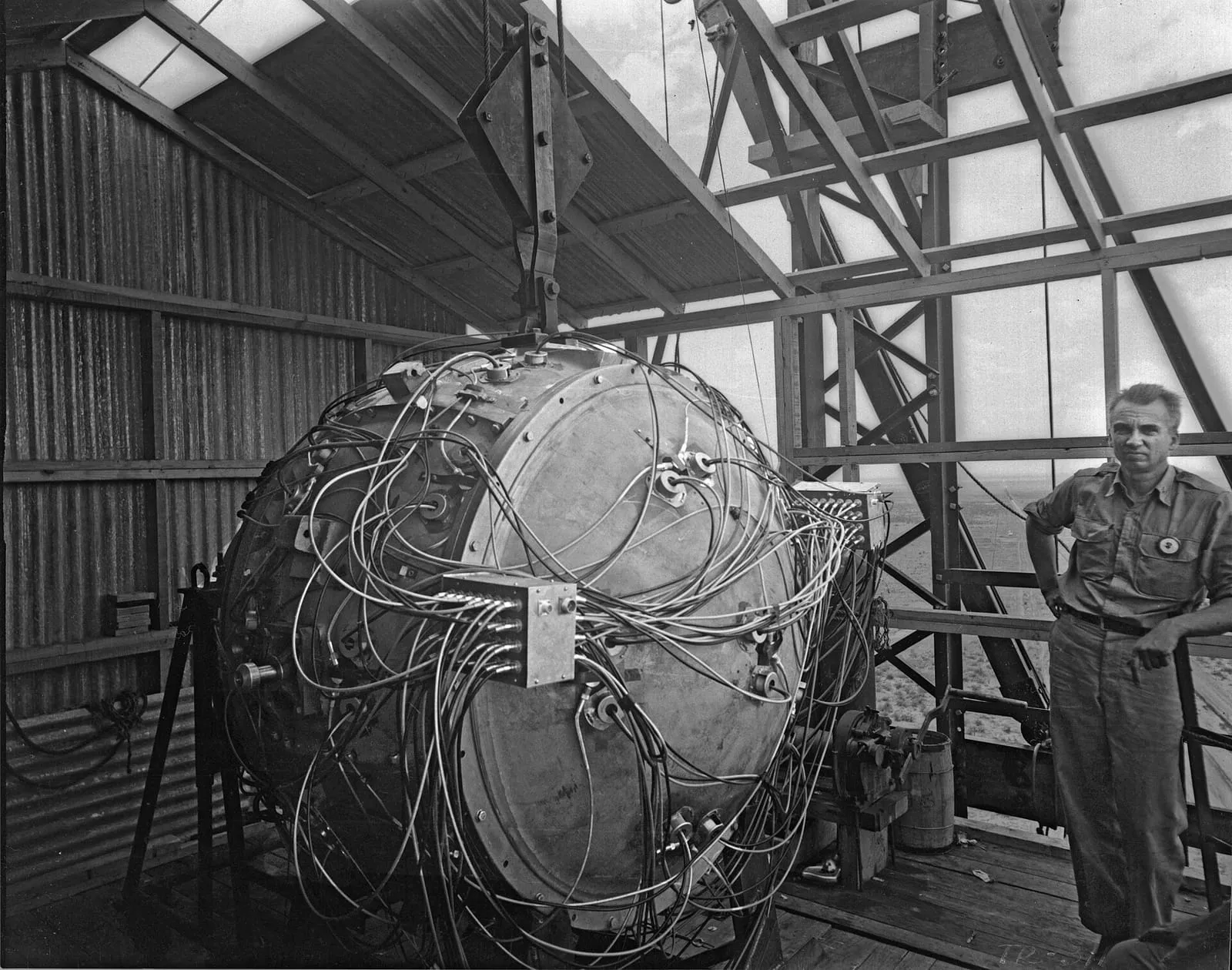
At 5:29:45 a.m. local time (Mountain War Time) on 16 July 1945, in the Jornada del Muerto desert in New Mexico, the first nuclear explosion in history took place. On top of a thirty-metre steel tower a device that its makers simply called the “Gadget” was detonated – an implosion bomb with a plutonium core, the prototype of the bomb that was to be dropped on Nagasaki three weeks later. The test, codenamed Trinity, was carried out by the United States Army as part of the Manhattan Project, and it was watched by several hundred scientists, soldiers and technicians, among them the director of the Los Alamos laboratory, Robert Oppenheimer, and the head of the whole enterprise, General Leslie Groves.
War chronicles usually place the test “at Alamogordo”. This is a shorthand: the site of the explosion lay in the northern part of the Alamogordo Bombing and Gunnery Range, in Socorro County, about 56 kilometres south-east of the town of Socorro and much further from Alamogordo itself. A week before the test, on 9 July, the range was renamed the White Sands Proving Ground – today it is the White Sands Missile Range.
Why the plutonium bomb had to be tested
The programme, which was handed over to the Army as the Manhattan Project on 18 June 1942 and entrusted to Groves in September of that year, followed two paths from the outset. The first was the rare uranium isotope uranium-235, separated from natural uranium in gigantic plants at Oak Ridge, Tennessee. The second was plutonium, an element produced artificially in reactors. The possibility of producing it had been opened up by the first controlled chain reaction, achieved by Enrico Fermi’s team in Chicago on 2 December 1942; from the autumn of 1944 the three reactors of the Hanford Engineer Works in Washington State were started up one after another, and the first plutonium reached Los Alamos from there at the beginning of 1945. These were the same works whose operation was briefly interrupted in March 1945 by a Japanese balloon.
For uranium-235 the designers at Los Alamos had a simple and reliable “gun” method: one subcritical piece of material was fired into another, forming a supercritical mass. A bomb of this type, later named Little Boy, was considered so dependable that it was never tested. The same method was planned for plutonium (the Thin Man design), but in 1944 Emilio Segrè showed that reactor plutonium contained an admixture of the isotope plutonium-240, which undergoes spontaneous fission thousands of times more often than plutonium-239. Stray neutrons would start the reaction too early, before the critical mass had fully formed – the bomb would “fizzle” at a fraction of its intended yield. In July 1944 the Thin Man design was abandoned.
The only way out was implosion: a sphere of plutonium was surrounded by a layer of explosive whose symmetrical detonation was to compress the metal into a supercritical state within millionths of a second. The idea was put forward by the physicist Seth Neddermeyer, and it was turned into a workable design by, among others, John von Neumann, who calculated the shape of the shock wave, and the chemist George Kistiakowsky, who was responsible for the explosive “lenses”. In August 1944 the Los Alamos laboratory was reorganised specifically around this problem. No one, however, could be sure that so intricate a process would work in practice – hence the decision to detonate one device experimentally before any combat use.
Preparations on the “Journey of the Dead Man”
In March 1944 Oppenheimer entrusted the direction of the test to Kenneth Bainbridge, a physicist from Harvard. Of eight sites considered, on 7 September 1944 the choice fell on the flat, waterless valley of the Jornada del Muerto (“Journey of the Dead Man”), named by Spanish travellers, within a range the government had already taken over in 1942. The only buildings nearby were the abandoned houses of the McDonald ranch. The origin of the codename “Trinity” is uncertain; it is usually attributed to Oppenheimer, who recalled years later that he had been thinking of the religious poems of John Donne.
A camp for several hundred people, a network of roads, telephone lines and instrument bunkers sprang up in the desert. Three observation shelters were built 10,000 yards (about 9.1 km) north, west and south of the tower; the southern one, S-10,000, was the control point. In case the implosion failed, “Jumbo” was built – a steel container weighing more than 200 tons, intended to contain the scattered plutonium and allow it to be recovered. By the time it was delivered in May 1945, the Hanford reactors were producing enough plutonium for it to be judged sufficient for a second test, and the container would have distorted the measurements. Jumbo was not used; set up about 700 metres from the tower, it survived the explosion.
On 7 May 1945 a rehearsal was held: about a hundred tons of ordinary explosive, mixed with radioactive isotopes, were detonated to check the instruments and procedures. The actual device was assembled in the first half of July. On 13 July, in a bedroom of the McDonald house converted into a “clean room”, a team including Louis Slotin placed a polonium-beryllium neutron initiator (the “Urchin”) between the two hemispheres of the 6.19 kg plutonium core. The core was surrounded by a tamper of natural uranium and more than two tons of explosive arranged in 32 lenses. On 14 July the Gadget was hoisted to the top of the tower.
The date was set by politics. The meteorologists forecast the best weather for 18–21 July, but President Harry Truman wanted to know the result before his talks with Joseph Stalin and Winston Churchill at Potsdam, so 16 July was chosen – the earliest day on which all the components were ready. Groves warned the Governor of New Mexico that in the event of a disaster it might be necessary to declare martial law in the south-western part of the state. On the evening of 15 July a seven-man party including Bainbridge and Kistiakowsky armed the device.
The range of uncertainty was wide. The Los Alamos theorists predicted between 5 and 10 kilotons of TNT. In a betting pool among the scientists Edward Teller went for 45 kilotons, while Isidor Isaac Rabi, who arrived last, took the only number left – 18 kilotons – and, as it turned out, won. Fermi half-jokingly took bets on whether the explosion would ignite the atmosphere; calculations had already ruled this out, but some of the guards asked to be relieved of their posts. Bainbridge feared something else: that nothing would happen and he would have to climb the tower to inspect a dud.
5:29:45
The detonation was scheduled for 4 a.m., but a storm with rain and lightning passed over the desert. After a favourable forecast at 4.45 a.m., at 5.10 a.m. the physicist Samuel Allison began the countdown of the last twenty minutes. Oppenheimer waited in the S-10,000 shelter together with Brigadier General Thomas Farrell, Groves’s deputy; Groves himself was at base camp, about 16 kilometres from the tower, where Fermi also was. A group of invited guests – among them Vannevar Bush, James Conant, Rabi and the Briton James Chadwick – watched the test from Compañia Hill, about 32 kilometres to the north-west. Everyone had been given darkened glass and told to lie face away from the blast.
At 5:29:45 the sky was lit by a light that witnesses described as brighter than the midday sun; for a few seconds the surrounding mountains stood out with a sharpness no one had ever seen. The fireball passed from white through yellow and orange to red, then rose, drawing a column of dust after it. The shock wave reached the camp after about 40 seconds, and its roar was heard and felt more than 160 kilometres from the range. The mushroom cloud rose to a height of about 12 kilometres. The steel tower vaporised. Beneath it a shallow crater about 80 metres across was formed, and the desert sand fused into a greenish, mildly radioactive glass, later named trinitite.
Fermi measured the strength of the explosion in the simplest possible way. When the shock wave reached him he let scraps of paper fall from his hand and, from how far they were carried, estimated the yield at about 10 kilotons of TNT. Radiochemical analysis of soil samples, collected by lead-lined M4 Sherman tanks sent into the crater, gave a figure of about 18.6 kilotons. Later assessments differ; the usual figure is about 20–21 kilotons, and a reanalysis of the data published in 2021 raised the value to 24.8 kilotons (±2). The Gadget’s yield thus exceeded the Los Alamos theorists’ predictions twofold, or even fourfold.
The witnesses’ reactions have passed into history, although many of them are known from later accounts. Kistiakowsky is said to have remarked that it was the nearest thing to the end of the world. Bainbridge, by his own recollection, said to Oppenheimer: “Now we are all sons of bitches.” Farrell wrote in his report to Groves of “lighting effects” that “beggared description”, and Rabi remembered the way Oppenheimer walked as he got out of a car – years later he compared it to the stride of the hero of the western High Noon. The most famous sentence comes from Oppenheimer himself, but from an interview given to NBC television in 1965: he recalled then that a line from the Hindu scripture the Bhagavad Gita had come into his mind – “Now I am become Death, the destroyer of worlds.” There is no contemporary record of his saying it aloud in the desert.
An exploding ammunition magazine
The flash was seen for hundreds of kilometres around, so secrecy could not be maintained without an official explanation. That same day the command of Alamogordo Army Air Field issued a statement prepared in advance: a “remote ammunition magazine containing a considerable amount of high explosives and pyrotechnics” had exploded on the range; no one had been killed or injured, and the damage outside the magazine itself was negligible. Most of the tens of thousands of people working on the Manhattan Project did not know what they were really working on. In the desert, however, was the New York Times journalist William L. Laurence, whom Groves had attached to the project to prepare articles for the day the bomb was revealed to the world.
Secrecy had leaked in a different place from the one counter-intelligence feared. Working at Los Alamos as a member of the British scientific mission – British participation in the project had been settled by the agreement reached at the Quebec Conference in August 1943 – was the physicist Klaus Fuchs, who was passing details of the implosion design to Soviet intelligence. According to later findings, Moscow knew the general design of the Gadget even before the test.
Fallout and the “downwinders”
The radioactive cloud drifted north-east. Groves had evacuation plans ready for the surrounding communities, but they were not used, and no one warned the inhabitants. The heaviest fallout outside the closed area was recorded on the Chupadera Mesa, about 48 kilometres from the tower, where a white dust settled on cattle; the animals suffered skin burns and discoloured hair, and the Army bought 88 head from the ranchers for observation. Under post-war radiological protection standards, developed partly on the basis of data from Trinity, people from the most exposed areas would have had to be evacuated.
The health effects on the inhabitants of the Tularosa Basin and the surrounding counties – largely poor Hispanic and Native American communities – remain a matter of dispute. A dose reconstruction published in 2020 under the auspices of the US National Cancer Institute identified the five most contaminated counties of New Mexico: Guadalupe, Lincoln, San Miguel, Socorro and Torrance. Organisations of local “downwinders”, among them the Tularosa Basin Downwinders Consortium, campaigned for decades to be covered by the Radiation Exposure Compensation Act of 1990, which applied only to victims of later tests in Nevada. Congress extended it to the inhabitants of New Mexico only in July 2025; the first payments were made in 2026.
The news at Potsdam
Truman had arrived in Germany on 15 July and was staying in a villa at Babelsberg near Potsdam. On the evening of 16 July the Secretary of War, Henry Stimson, received a coded telegram from his deputy George Harrison: “Operated on this morning. Diagnosis not yet complete but results seem satisfactory and already exceed expectations.” Stimson passed it on at once to the President and to Secretary of State James Byrnes; the next day he informed Churchill. On 18 July a second cable arrived – “the little boy is as husky as his big brother”, and the light in the “doctor’s” eyes could be seen from Washington all the way to Stimson’s estate on Long Island – a coded way of saying how bright the explosion had been. On 21 July a courier brought Groves’s detailed report, which Stimson read to Truman. According to Stimson’s notes, the President was “tremendously pepped up” by it, and Churchill, who read the report a day later, is said to have remarked that after reading it Truman behaved towards Stalin like a different man.
The news from New Mexico changed the Americans’ calculations. As recently as Yalta they had sought the USSR’s entry into the war with Japan; now Truman and Byrnes began to hope that the war might end before the Red Army could enter Manchuria. For the course of the conference itself it also mattered that the bomb was no longer a scientists’ promise but a weapon of known power.
Place in the war
Trinity confirmed that the more difficult of the two designs worked, and therefore that the United States could produce bombs from Hanford plutonium without waiting for the slow separation of uranium-235. That same morning, 16 July, the cruiser USS Indianapolis, commanded by Captain Charles McVay, sailed from San Francisco carrying components of the uranium bomb and its uranium “projectile” to the island of Tinian in the Marianas, where the B-29 group prepared for the nuclear attack was based. A second plutonium core, intended for a Fat Man bomb, was also sent to Tinian. On 24 July Truman told Stalin of “a new weapon of unusual destructive force”, and on 25 July the Army command issued the order to use the bombs against Japan after 3 August, as soon as the weather permitted. Data from Trinity were used to set the burst height over Hiroshima (6 August) and Nagasaki (9 August).
The dispute over whether using the bomb was necessary, whether Japan would have capitulated without it and whether it should first have been demonstrated began even before Trinity – among the Chicago scientists who in June 1945 signed the so-called Franck Report – and continues to this day. Some historians stress the expected casualties of an invasion of Japan; others point to the weight of the Soviet entry into the war and to political considerations regarding Moscow.
Trinity was also the beginning of the nuclear age. The USSR, which thanks to Fuchs and other sources knew the design of the Gadget, accelerated its own programme and in August 1949 detonated in Kazakhstan a device modelled on the American one. In 1965 the test site, with a stone obelisk at ground zero, was designated a National Historic Landmark of the United States. As its participants recalled years later, many of them felt relief and dread at the same time in the desert – relief that years of work had not been in vain, and dread at what they had created.
Sources
Meanwhile
(02)Elsewhere, within a week.
- 10 July 1945 · PacificHalsey's carriers over TokyoOn 10 July 1945 aircraft of Halsey and McCain's Task Force 38 struck airfields around Tokyo, opening the last carrier campaign against Japan.
- 22 July 1945 · PacificThe Battle of Tokyo BayOn the night of 22–23 July 1945 nine American destroyers attacked a Japanese convoy at the entrance to Tokyo Bay and sank one small freighter.
Related events
(04)The same battle, people or subject.
- 24 July 1945 · DiplomacyTruman tells Stalin about the bombOn 24 July 1945 at Potsdam Truman mentioned to Stalin a new weapon of unusual destructive force. Stalin, forewarned by his intelligence, took it calmly.
- 6 August 1945 · PacificThe atomic bombing of HiroshimaAt 8.15 a.m. on 6 August 1945 the B-29 Enola Gay dropped the uranium bomb Little Boy on Hiroshima – the first nuclear weapon used in war.
- 9 August 1945 · PacificThe atomic bombing of NagasakiOn 9 August 1945 the B-29 Bockscar dropped the plutonium bomb Fat Man on Nagasaki. Estimates put the deaths by the end of the year at 40,000–74,000.
- 26 July 1945 · DiplomacyThe Potsdam DeclarationOn 26 July 1945 the US, Britain and China called on Japan to surrender its armed forces unconditionally under threat of “prompt and utter destruction”.