United States
Curtis LeMay
Commander of the 305th Bombardment Group and 3rd Bombardment Division, Eighth Air Force (1942–1944), XX and XXI Bomber Command (1944–1945), Strategic Air Command (1948–1957); Chief of Staff of the US Air Force (1961–1965)
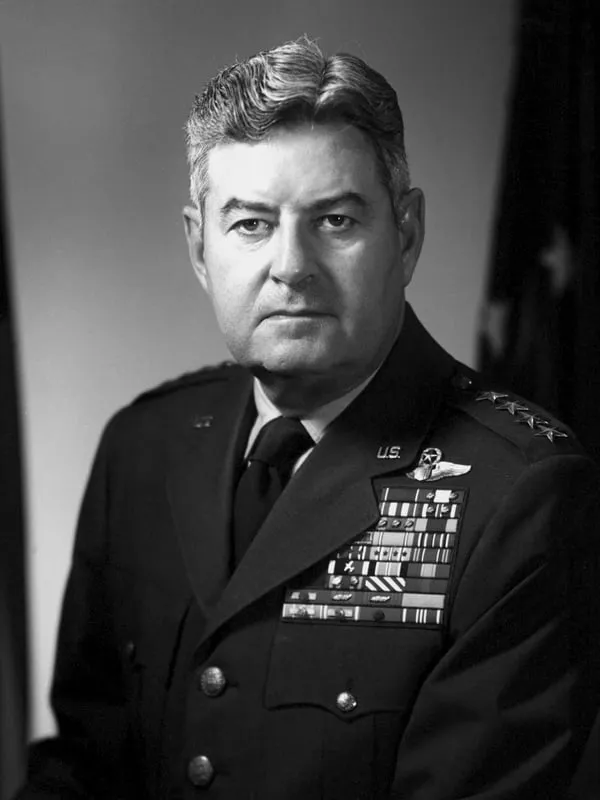
- Born:
- 15 November 1906, Columbus (Ohio, United States)
- Died:
- 1 October 1990, March Air Force Base (California, United States)
- Author:
- Łukasz
- Photo:
- autor nieznany, domena publiczna, Wikimedia Commons

Curtis Emerson LeMay was one of the most important and at the same time most controversial American commanders of the Second World War. In England, first as commander of a group and then of a division of heavy bombers, he shaped the tactics of the Eighth Air Force’s daylight raids and led his crews over the Reich himself. In 1945, at the head of XXI Bomber Command in the Marianas, he abandoned high-altitude precision bombing and sent his B-29s over Japanese cities at night, at low level, loaded with incendiaries. The first such raid, on Tokyo on the night of 9/10 March 1945, killed, by various estimates, from about 80,000 to more than 100,000 people and remains the deadliest single air raid in history. After the war LeMay built up Strategic Air Command, the American nuclear deterrent force, and as Air Force Chief of Staff he clashed with President John F. Kennedy during the Cuban Missile Crisis.
Childhood and the road to aviation
He was born on 15 November 1906 in Columbus, Ohio, the eldest of several children of Erving LeMay, a labourer and handyman who seldom kept a job for more than a few months. The family followed the father around the country, as far as Montana and California, before returning to Columbus. The boy supported himself from an early age; it was by working nights in a foundry that he paid for his civil engineering studies at Ohio State University. There he went through reserve officer training, and in 1928 he was accepted for Army Air Corps flight training. In October 1929 he became a second lieutenant in the Air Corps Reserve, and in January 1930 he received a regular commission.
He spent his first years in fighters, including with the 27th Pursuit Squadron at Selfridge Field in Michigan. On 9 June 1934 he married Helen Maitland; they had one daughter. In 1937 he moved to bombers, to the 2nd Bombardment Group, the first unit equipped with the four-engined B-17 Flying Fortress. He made his name as one of the best navigators in the Air Corps: in May 1938 he guided three B-17s which located the Italian liner Rex over the Atlantic more than a thousand kilometres from the coast – a demonstration of how land-based aircraft could defend the approaches to America, and one that irritated the Navy. He also took part in long-distance B-17 flights to South America. The war in Europe accelerated promotions: in 1940 he was still a lieutenant; by the time of the attack on Pearl Harbor he was a major.
Over the Reich with the Eighth Air Force
In the spring of 1942 LeMay, by then a lieutenant colonel, took command of the newly formed 305th Bombardment Group, flying B-17s, and in October he took it to England to join the Eighth Air Force. There the Americans bombed by day, in tight formations, counting on the fire of hundreds of machine guns to protect the bombers from fighters. The first missions went badly: to avoid anti-aircraft fire, the bombers weaved over the target and scattered their bombs. LeMay ordered his crews to fly straight and level, with no evasive action, from the initial point to bomb release, and drilled them relentlessly. His group was one of the first to adopt and refine the formation known as the “combat box” – a stepped formation of a dozen or more aircraft at different heights, in which the gunners covered neighbouring aircraft – and the rule that the whole formation dropped its bombs on the signal of the lead bombardier. These methods soon became standard throughout the Eighth Air Force. He often flew in the lead aircraft himself; his men called him “Old Iron Pants” and, because of his ever-present cigar, “the Big Cigar”.
In the summer of 1943 he took over the 4th Bombardment Wing, which in September became the 3rd Bombardment Division. On 17 August 1943 he personally led 146 B-17s in the raid on the Messerschmitt works at Regensburg. His bombers, fitted with extra fuel tanks, did not turn back to England after bombing but flew on over the Alps and the Mediterranean to Algeria; the force lost 24 aircraft. The factories were badly damaged, but the losses that day and in further deep-penetration raids in the autumn of 1943 showed that without escort fighters daylight bombing of the Reich was too costly. In September 1943 LeMay became a brigadier general and in March 1944, aged 37, a major general – one of the youngest in the US Army.
B-29s in India and China
General Henry Arnold, commander of the Army Air Forces, who personally directed from Washington the Twentieth Air Force with its new B-29 Superfortress bombers, was dissatisfied with the results of XX Bomber Command. Its B-29s, based in India and flying raids on Japan and Manchuria from forward airfields in China, rarely hit their targets, and the aircraft were plagued by engine failures. At the end of August 1944 Arnold sent LeMay to Kharagpur. The new commander introduced the methods proven in England: rigorous training, bombing by whole formations on the signal of the best lead crews, and a reorganisation of maintenance. On 8 September he flew over the steelworks at Anshan in Manchuria himself.
Results improved, but the limits set by geography could not be overcome: all the fuel and bombs for the bases in China had to be flown over the Himalayas, so every mission required weeks of preparation. LeMay also carried out tasks for other theatres – his bombers attacked Singapore, Bangkok and targets on Formosa, and on 18 December 1944 they bombed the Chinese city of Hankou with incendiaries, the fires consuming much of the port districts. Many historians see this as the first test of the method LeMay applied in Japan a few months later.
The incendiary raids on Japan
Meanwhile the main B-29 force was operating from the Marianas, from where XXI Bomber Command under General Haywood Hansell had, since November 1944, been flying daylight precision raids on Japanese aircraft plants from 8–9 kilometres up. Clouds, a jet stream of more than 200 km/h and engine failures meant that the bombs seldom hit their targets. Arnold decided to change the commander: on 20 January 1945 LeMay took over XXI Bomber Command. For several weeks he continued his predecessor’s methods while improving training and maintenance, and in February he began experimenting with incendiaries – the raid of 25 February burned out about 2.6 km² of Tokyo.
At the beginning of March he took a decision that changed the course of the air war. He concluded that Japanese cities – built of wooden houses that also contained many small workshops working for the arms industry – were particularly vulnerable to fire, and that Japan’s night air defences were weak. Directives from Washington allowed incendiary attacks on cities, but the scale and method were his own decision: the bombers were to fly at night, individually, from a height of only 1.5–2.1 kilometres, stripped of most of their defensive armament and ammunition but carrying the maximum load of M69 and M47 incendiaries. On the night of 9/10 March 1945, 279 of the more than 300 B-29s dispatched dropped some 1,665 tons of bombs on the densely built-up districts of eastern Tokyo. A strong wind turned the fires into a firestorm that consumed about 41 km² of the city. The Japanese police counted some 83,000 dead, and by other estimates 100,000 people or more were killed; over a million were left homeless. LeMay waited for the results at his headquarters on Guam, and the reports of the commander of the 314th Bombardment Wing, General Thomas Power, who circled over the burning city, convinced him that he had found a way for the B-29s to deal Japan decisive blows.
Over the next ten days, in a series later called the “fire blitz”, his bombers burned out parts of Nagoya, Osaka and Kobe, until they ran out of incendiaries. From May, after a pause to support the invasion of Okinawa, the raids extended to the other great cities, and in the summer to dozens of smaller ones as well; from the end of July leaflets were dropped before the raids, urging the population to leave the cities named. By August fire had destroyed on average about 40 per cent of the built-up area of 66 Japanese cities. Estimates of the number killed in the whole conventional bombing campaign vary between authors from more than 200,000 to several hundred thousand, and several million people were left homeless. From March 1945 LeMay’s aircraft also conducted Operation Starvation – the aerial mining of Japanese ports and the Inland Sea – which, together with submarine operations, paralysed Japan’s coastal shipping.
LeMay himself made no secret of the fact that the victims were civilians. He justified the raids by arguing that Japanese war production was dispersed among residential districts and that every day by which the war was shortened would save the lives of soldiers on both sides, while avoiding an invasion of the Home Islands would save Japanese lives too. Years later he said that if the United States had lost the war, he would have been tried as a war criminal. The debate over whether the mass bombing of cities was necessary and permissible continues among historians and ethicists to this day.
In July 1945 General Carl Spaatz took command of the strategic air forces in the Pacific, and LeMay became his chief of staff. In that role he took part in the preparations for dropping the atomic bombs on Hiroshima (6 August) and Nagasaki (9 August), carried out by the 509th Composite Group, which came under the Twentieth Air Force. On 2 September 1945 he was present on board the battleship Missouri at the signing of Japan’s surrender. A couple of weeks later he flew one of three B-29s that flew non-stop from Hokkaido to Chicago, setting distance records.
The airlift and Strategic Air Command
After the war LeMay briefly headed air research and development at the Pentagon, and in 1947 he took command of US Air Forces in Europe, part of the newly created independent service. When in June 1948 the Soviet Union blocked the land routes to the western sectors of Berlin, General Lucius Clay asked him to bring in supplies by air. LeMay started the first transport flights, and direction of the airlift was soon taken over by a logistics specialist, General William Tunner. In less than a year Western Allied aircraft delivered more than 2 million tons of goods to the city, and in May 1949 Moscow lifted the blockade.
In October 1948 LeMay became head of Strategic Air Command (SAC), the command of America’s strategic air forces. He found it poorly trained and ill-prepared; over almost nine years he turned it into a powerful, professional force of B-47 and B-52 jet bombers and tanker aircraft, with part of the force kept on constant readiness to take off with nuclear weapons. His war plans envisaged a massive nuclear strike on dozens of Soviet cities in the first days of a conflict. In 1951, aged 44, he received his fourth star, becoming the youngest American four-star general since Ulysses Grant. Under his command SAC was regarded as a model of discipline and as the foundation of America’s Cold War policy of deterrence, but also as an institution inclined to see nuclear war as a realistic option.
Air Force Chief of Staff
In 1957 LeMay became Vice Chief of Staff and in 1961 Chief of Staff of the United States Air Force. He sharply criticised the new administration, especially Secretary of Defense Robert McNamara and his civilian advisers. During the Cuban Missile Crisis in October 1962 he demanded the bombing of the Soviet missile sites in Cuba and an invasion of the island; he compared the naval blockade chosen by Kennedy to the appeasement of Hitler at Munich. The crisis ended in an agreement and the withdrawal of the missiles, not in war. In the following years LeMay called for intensive, unrestricted strategic bombing of North Vietnam instead of a gradual increase in pressure. He retired in February 1965. His memoirs, written with MacKinlay Kantor and published that same year, contained the line about bombing North Vietnam “back into the Stone Age”, which stuck to him for the rest of his life; he later claimed that he had been speaking of capabilities, not intentions.
Politics and last years
In 1968 LeMay accepted an offer from the former governor of Alabama, George Wallace, who was running for president for the American Independent Party, and became his vice-presidential running mate. Wallace, a supporter of racial segregation, had himself flown over Japan in 1945 as a B-29 flight engineer in forces under LeMay’s command. The general quickly became a liability to the campaign: at his very first press conference he said that Americans had a “phobia” about nuclear weapons, and he did not rule out using them in Vietnam. The Wallace–LeMay ticket won 13.5 per cent of the vote and five Southern states (46 electoral votes), which did not change the outcome of the election, won by Richard Nixon.
LeMay spent his last years in California, devoting himself among other things to amateur radio and motor racing, which he had earlier promoted at SAC bases. He died on 1 October 1990 in the hospital at March Air Force Base in California, aged 83. He was buried in the cemetery of the Air Force Academy in Colorado Springs.
Significance
LeMay went down in the history of the Second World War as the commander who twice changed the way America waged its air war: first he refined the tactics of daylight raids over Europe, then he replaced precision bombing of Japan with night incendiary raids on its cities. The 1945 campaign destroyed Japanese industry and the great cities, but at the cost of hundreds of thousands of civilian lives, and it remains one of the most difficult chapters in any assessment of the Allied conduct of the war.
Sources
Often appears with
People who appear in the same events.