United Kingdom
Louis Mountbatten
Chief of Combined Operations (1941–1943), Supreme Allied Commander South East Asia (1943–1946), Viceroy and Governor-General of India (1947–1948), First Sea Lord (1955–1959), Chief of the Defence Staff (1959–1965), Admiral of the Fleet
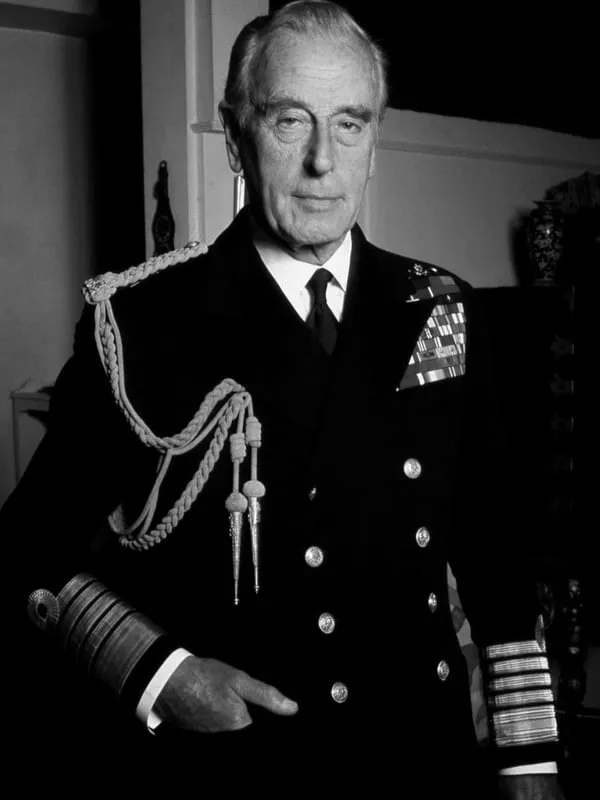
- Born:
- 25 June 1900, Windsor (United Kingdom)
- Died:
- 27 August 1979, Mullaghmore, County Sligo (Ireland)
- Author:
- Natalia
- Photo:
- Allan Warren, CC BY-SA 3.0, Wikimedia Commons

Louis Mountbatten, from 1947 Earl Mountbatten of Burma, was one of the most colourful and most controversial figures of Britain’s war. A great-grandson of Queen Victoria, a naval officer and a favourite of Winston Churchill, he rose in four years from command of a destroyer flotilla to Supreme Allied Commander in South-East Asia. As Chief of Combined Operations he was responsible for daring raids on the coast of occupied Europe, including the bloody defeat at Dieppe, and as head of SEAC he directed the war that took Burma back from the Japanese. After the war, as the last Viceroy of India, he carried through in haste the transfer of power and the partition of the country into India and Pakistan. He was killed in 1979 in a bomb attack by the Irish Republican Army.
Prince of Battenberg
He was born on 25 June 1900 at Frogmore House in the grounds of Windsor Castle as Prince Louis Francis Albert Victor Nicholas of Battenberg, the youngest child of Prince Louis Alexander of Battenberg, an officer of the Royal Navy, and Princess Victoria of Hesse, a granddaughter of Queen Victoria. One of his godparents was Tsar Nicholas II, husband of his mother’s sister Alexandra Feodorovna. In the family he was known as “Dickie”. As a boy he visited the court in St Petersburg, and all his life he cherished the memory of his imperial cousins murdered in 1918. His elder sister Alice was the mother of Prince Philip, the future husband of Queen Elizabeth II.
In 1913 he entered the naval college at Osborne. A year later his father, First Sea Lord – the professional head of the Royal Navy – since 1912, was forced to resign by a press campaign against a “German” at the head of the fleet, a humiliation his son never forgot. In July 1916 the sixteen-year-old cadet joined the battlecruiser HMS Lion, Admiral Beatty’s flagship, as a midshipman, and later the battleship HMS Queen Elizabeth. In 1917, when the royal house took the name of Windsor, the Battenbergs anglicised their name to Mountbatten and his father was created Marquess of Milford Haven. The Marquess’s younger son was henceforth known as Lord Louis Mountbatten.
Between the wars
After the war he spent two terms at Christ’s College, Cambridge, and in 1920–1922 he accompanied the heir to the throne, the future King Edward VIII, on his tours of Australia, India and Japan, forming a friendship that lasted many years. In July 1922 he married Edwina Ashley, granddaughter and heiress of the financier Sir Ernest Cassel, which made him one of the richest officers in the navy. The couple led a lavish, fashionable life, and their marriage, though lasting, was full of tension and affairs on both sides.
For all the publicity, Mountbatten took his profession seriously. He specialised in wireless communications, took courses at the signal school in Portsmouth and at Greenwich, served in the 1920s and 1930s as a signals officer in the Mediterranean Fleet, and along the way became a keen polo player, writing a manual on the game. In 1934 he received his first command, the destroyer HMS Daring. In 1936 he worked in the Naval Air Division of the Admiralty, arguing for the transfer of carrier aviation to the navy, and in June 1937 he was promoted to captain. In June 1939 he took command of the new destroyer HMS Kelly and of the 5th Destroyer Flotilla.
Kelly
In September 1939 Kelly brought the Duke of Windsor, the former King Edward VIII, from France to England. In May 1940 Mountbatten’s destroyers tried to force their way through to Namsos during the Norwegian campaign and then took part in the evacuation of Allied troops. On the night of 9–10 May 1940 Kelly was torpedoed by a German E-boat off the Dutch coast; Mountbatten brought the badly damaged ship back to port. In November 1940, leading the flotilla in the destroyer Javelin, he had both the bow and the stern of his ship blown off in an action with German destroyers – a turn he made was later judged to have been ill-advised. At the Admiralty he earned the nickname “Master of Disaster”, but also a reputation as a brave commander popular with his sailors.
In the spring of 1941 the flotilla was sent to the Mediterranean. On 23 May 1941, during the Battle of Crete, German dive-bombers sank Kelly and Kashmir; about half of Kelly’s crew were killed, and Mountbatten survived by staying with his capsized ship until the last moment before swimming clear. The story of Kelly became the basis of the film In Which We Serve (1942) by his friend Noël Coward, who worked Mountbatten’s speeches to his crew into the script. In August 1941 Mountbatten took command of the aircraft carrier HMS Illustrious, then under repair in the United States; during that time he visited Pearl Harbor and, by his own account, warned that the base was unprepared for an air attack.
Combined Operations and Dieppe
On 27 October 1941 Churchill recalled him from America and appointed him, in place of Admiral Roger Keyes, to head Combined Operations Headquarters, which was responsible for commando raids and for preparing the eventual invasion of the Continent. In March 1942 the 41-year-old captain was given the acting rank of vice admiral and the honorary ranks of lieutenant general and air marshal, and, despite the reservations of the Chief of the Imperial General Staff, Alan Brooke, he took a seat on the Chiefs of Staff Committee. Under his direction came the Vågsøy raid in December 1941, Operation Biting at Bruneval in February 1942, which brought back parts of a German radar, and the St Nazaire raid in March 1942. His staff also prepared the plan for the landing on Madagascar and later worked on the equipment and methods that were to be used in Normandy: landing craft and landing ships, the Mulberry artificial harbours and the PLUTO undersea pipeline. Among his more fanciful ideas was Project Habakkuk – an aircraft carrier made of a mixture of ice and sawdust.
The heaviest burden on his career was the Dieppe Raid of 19 August 1942. Mountbatten was one of the chief advocates and planners of the operation, which had been called off in July and was then revived in altered form. The landing ended in disaster: of some 6,000 troops, most of them Canadians, nearly 60 per cent were killed, wounded or captured. To the end of his life Mountbatten maintained that the lessons of Dieppe saved thousands of lives in Normandy. His critics, among them General Julian Thompson and Canadian historians, argue that those lessons could have been learned without such a sacrifice, and that responsibility for the plan’s shortcomings is shared between Mountbatten, the Canadian command and the British Chiefs of Staff. In Canada many veterans never forgave him for the operation.
Commander in South-East Asia
In August 1943, at the Quebec Conference, Churchill proposed and the Americans accepted Mountbatten as Supreme Allied Commander of the new South East Asia Command (SEAC), with the acting rank of admiral. His deputy was the American General Joseph Stilwell. Mountbatten flew to India at the beginning of October, and in the middle of the month in Chongqing he helped to defuse the crisis over Stilwell, whose recall Chiang Kai-shek had demanded. The command formally assumed control of operations in mid-November 1943, and in April 1944 moved its headquarters from Delhi to Kandy in Ceylon.
SEAC suffered throughout from a lack of resources, because landing craft and aircraft went first to Europe and the Pacific, and the British and Americans differed over the purpose of the war in the region – for the one it was the restoration of the empire, for the other the road to China. Mountbatten was not a field commander; the land campaign was actually run by General William Slim at the head of the Fourteenth Army. The Supreme Commander’s achievement, however, lay in raising the morale of the “Forgotten Army”, fighting malaria, deciding to keep operations going through the monsoon, and deftly reconciling British, American and Chinese interests. His bolder schemes, such as landings on Sumatra or near Rangoon, were tempered by an experienced staff. In 1944 the Japanese offensive against India broke down at Imphal and Kohima, and in 1944–1945 SEAC forces reconquered Burma, taking Rangoon in May 1945.
Mountbatten showed understanding for the national movements that had grown up under Japanese occupation. In 1945, against the views of some British colonial officials, he agreed to cooperate with Aung San and his Burma National Army, which had turned against the Japanese. On 12 September 1945 in Singapore he accepted the surrender of the Japanese forces in South-East Asia, signed by General Seishirō Itagaki. He then had to disarm the Japanese, rescue prisoners of war and restore colonial rule in Indonesia and Indochina, where fighting broke out with the independence movements. He never forgave the Japanese for their treatment of prisoners. In 1946 he was created Viscount Mountbatten of Burma and made a Knight of the Garter.
The last Viceroy
In February 1947 Prime Minister Clement Attlee appointed him Viceroy of India with the task of handing power to Indians by June 1948 at the latest, keeping the country united if possible. Mountbatten took office on 24 March 1947, when the Punjab and Bengal were engulfed by rioting between Hindus, Sikhs and Muslims. He soon concluded that a united India could not be preserved given the stance of the Muslim League leader Muhammad Ali Jinnah, and that delay risked civil war. The plan of 3 June 1947 provided for partition, and the date for the transfer of power was brought forward to 15 August 1947. The borders were drawn in haste by a commission under Sir Cyril Radcliffe, and their course was announced only after independence.
Partition was accompanied by mass flight and massacres. According to various estimates, anywhere from 10 million to well over a dozen million people were uprooted, and the death toll is put at anywhere from about 200,000 to 2 million. Mountbatten’s role remains contested. His critics, among them the economist John Kenneth Galbraith and some British historians, accuse him of contributing to the bloodshed through his haste and his delay in announcing the borders, while Pakistanis accused him of partiality towards India, especially in drawing the border in the Punjab. His defenders, such as Lawrence James, point out that order could no longer be maintained and that Britain had neither the strength nor the will to remain in India through a civil war.
At the request of Jawaharlal Nehru, Mountbatten stayed on as the first Governor-General of independent India until June 1948. He helped persuade almost all the princely states to accede to India or Pakistan; the unresolved question of Kashmir, however, gave rise to the First Indo-Pakistani War, and on his advice India took it to the United Nations in January 1948. Edwina Mountbatten’s close friendship with Nehru is still the subject of speculation. In 1947 Mountbatten was created Earl Mountbatten of Burma, and his nephew Philip, who had taken the surname Mountbatten, married the heir to the throne, Princess Elizabeth.
First Sea Lord
On his return from India Mountbatten went back to the navy as commander of a cruiser squadron in Malta; in 1952 he took command of the Mediterranean Fleet and of NATO’s Allied naval forces in the Mediterranean, and in April 1955 he became First Sea Lord, the post his father had been forced to leave some forty years earlier. In 1956 he advised Prime Minister Anthony Eden against intervention during the Suez Crisis, but submitted to the government’s decision. From 1959 to 1965, as Chief of the Defence Staff, he brought about the merger of the ministries of the three services into a single Ministry of Defence, arousing the distrust of many colleagues in the process. Edwina died in 1960 during a tour of inspection in Borneo. In retirement Mountbatten was Governor of the Isle of Wight, championed the United World Colleges movement, carefully cultivated his own legend and was a mentor to his sister Alice’s grandson, Prince Charles, later King Charles III.
Assassination at Mullaghmore
He spent his summers at Classiebawn Castle in Mullaghmore in County Sligo in Ireland, not far from the border with Northern Ireland. On 27 August 1979 Thomas McMahon, a member of the Provisional IRA, detonated a bomb that had been planted the night before on his fishing boat Shadow V. The 79-year-old Mountbatten was killed, together with his 14-year-old grandson Nicholas Knatchbull and Paul Maxwell, a 15-year-old boat boy from Enniskillen; the following day the 83-year-old Doreen, Lady Brabourne, his daughter’s mother-in-law, also died. On the same day the IRA killed 18 British soldiers at Warrenpoint in Northern Ireland. McMahon was sentenced in Ireland to life imprisonment; he was released in 1998 under the Good Friday Agreement. Mountbatten was given a ceremonial funeral in Westminster Abbey and buried in Romsey Abbey.
Significance
Mountbatten was a man of great ability and equally great vanity. His biographer Philip Ziegler wrote that both his faults and his virtues were “on the grandest scale”, and that he was an executor rather than a maker of policy, though he absorbed it so completely that he came to be regarded as its author. For the history of the Second World War three stages of his career matter: Combined Operations, which led from St Nazaire and Dieppe to the landing techniques used in Normandy; the command in South-East Asia, which restored the confidence of the army fighting in Burma; and his role as the last Viceroy, who closed the history of British India. The controversies over Dieppe and over the partition of India continue to this day. After his death allegations about his private life also surfaced; some were rejected by official inquiries, while others remain unresolved.
Sources
Commanded in battles
(01)Mentioned in battles
(02)Often appears with
People who appear in the same events.
On the timeline
(32)1941
1943
1944
1945
January
February
March
May
August
- 17
- The proclamation of Indonesian independenceOn 17 August 1945 in Jakarta Sukarno and Mohammad Hatta proclaimed Indonesia’s independence, forestalling the return of Dutch colonial rule.
- General Order No. 1On 17 August 1945 Truman approved General Order No. 1: to whom Japanese forces were to surrender, including the division of Korea at the 38th parallel.