- Category:
- Military operations
- Front:
- Pacific
- Date:
- 9 March 1945
- Author:
- Natalia
- Tags:
- United States, Japan, Henry H. Arnold, civilians
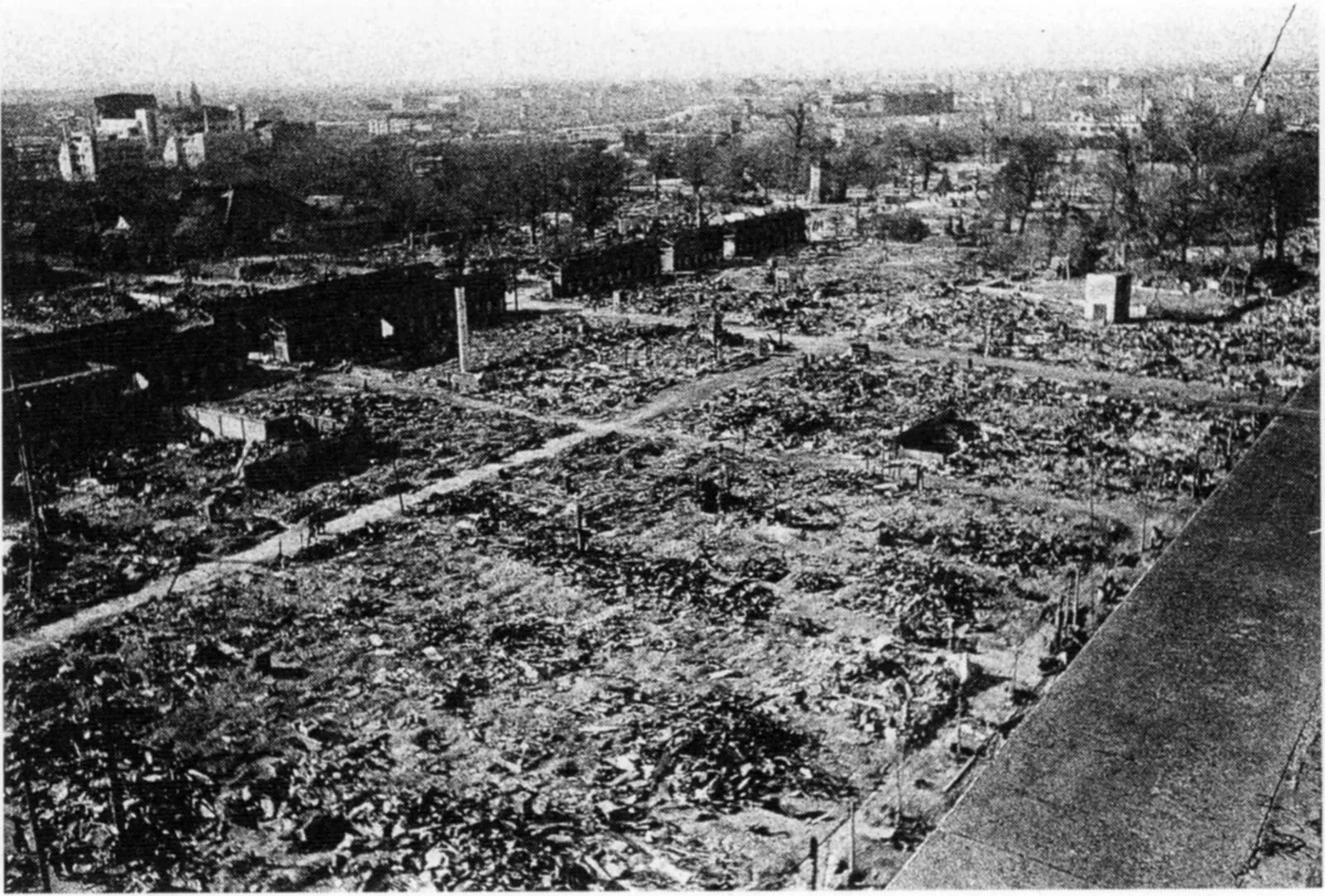
On the evening of 9 March 1945 more than 300 American B-29 Superfortress bombers took off from airfields in the Marianas. They did not fly in tight formations at high altitude, as they had all winter, but singly, at night and low, their bomb bays filled with incendiaries. A few minutes after midnight, already 10 March Tokyo time, the first loads fell on the densely built-up eastern districts of the Japanese capital. A strong wind turned thousands of fires into a firestorm that by morning had consumed some 41 km² of the city. Between more than 80,000 and about 100,000 people were killed, according to various estimates, and some researchers believe the toll was much higher. It was the most destructive single air raid in the history of warfare, deadlier than either of the atomic attacks five months later.
American planning documents designated the target area of Tokyo by the codename “Meetinghouse”, and some English-language literature describes the raid as Operation Meetinghouse. In Japan it is simply called the “Great Tokyo Air Raid” (Tōkyō daikūshū) or the raid of 10 March. The date of 9 March, given by many war chronologies, corresponds to the day the bombers took off; the bombing itself lasted from 12.08 a.m. until almost three in the morning of 10 March.
From precision to fire
Ever since the first B-29 raid on Tokyo on 24 November 1944, XXI Bomber Command of the Twentieth Air Force had tried to destroy the Japanese aircraft industry with precision daylight raids from altitudes of 8–9 kilometres. The results were meagre: the jet stream blew the bombs off course, cloud obscured the targets for most of the month, and the B-29s’ engines, overstrained by climbing with a full load, frequently failed. General Haywood Hansell, an advocate of precision bombing, was relieved in January and replaced by General Curtis LeMay, brought in from XX Bomber Command in India and China, which had carried out the B-29 raids on Japan in January 1945.
The idea of setting Japanese cities on fire was not new. As early as 1943 American analysts had pointed out that Japan’s cities – built largely of wood and paper, with thousands of small workshops working for the armaments industry among the houses – were particularly vulnerable to fire. It was remembered how in 1923 the fires that followed the Great Kantō earthquake had consumed much of Tokyo and Yokohama. Special M69 incendiary bombs were developed, filled with thickened petrol – napalm – and dropped in clusters that broke apart over the target. General Henry Arnold’s staff in Washington pressed for trials of this weapon, and the raid of 25 February, in which some 2.6 km² of Tokyo burned during a snowstorm, showed that fire destroyed Japanese buildings more effectively than high-explosive bombs. By then aircraft from American carriers were also reaching the Tokyo region, having struck the Japanese capital for the first time in mid-February.
LeMay’s decision
At the beginning of March LeMay concluded that, given the Japanese weather – on average about seven cloudless days a month – further precision raids on factories would achieve nothing. The directives from Washington permitted incendiary attacks on cities; their scale and method were decided by LeMay himself. At a conference on 7 March a series of intensive raids on the cities of Honshu between 9 and 22 March was agreed, partly as preparation for the invasion of Okinawa, planned for 1 April.
The tactics were to be radically different from those used until then. Analysis of the raid of 25 February had shown that the incendiaries were being dropped from too great a height. LeMay decided to attack at night, from only 1,500–2,100 metres, with single aircraft rather than formations, navigating by radar and the LORAN system. At low altitude the engines overheated less and the bombers used less fuel; intelligence also judged that the Japanese had only two night-fighter units and that their anti-aircraft artillery coped poorly with targets at medium altitude. The bombers were therefore stripped of their defensive armament and gunners – except for the tail position – which, together with the fuel saving, roughly doubled the bomb load.
Many airmen and some staff officers feared a massacre of their own crews; XXI Bomber Command’s intelligence officers even warned that most of the bombers might be lost. LeMay discussed the plan with Arnold’s chief of staff, General Lauris Norstad, but did not seek formal approval. He informed Twentieth Air Force headquarters of the new tactics on 8 March, when – as he knew – neither Arnold nor Norstad was in Washington. He later explained that he had wanted to spare Arnold responsibility in the event of failure. He could not lead the raid himself because, being privy to work on the atomic bomb, he was not permitted to risk capture. Command of the attack was taken by Brigadier General Thomas S. Power, commander of the 314th Bombardment Wing.
The target: Shitamachi
The order of 8 March designated a rectangular area in north-eastern Tokyo, marked as Zone I, measuring about 6.4 by 4.8 kilometres. It was bisected by the Sumida River and took in most of the districts of Asakusa, Honjo and Fukagawa – the heart of Shitamachi, the traditional “low city” of workers, craftsmen and small traders. Some 1.1 million people lived there; it was one of the most densely populated urban areas in the world. There were few large armaments plants in it, but a great many wooden houses and small workshops working for the war industry. The orders to the crews named these very workshops as the main target, but – as the literature on the subject notes – they also openly assumed that casualties among the civilian population would disrupt production.
Tokyo’s defences were not prepared for such an attack. The Japanese expected night raids, but they had not foreseen that the bombers would come down to low altitude. The 10th Air Division, which defended the Kantō region, had about 210 combat aircraft, most of them day fighters; only 25–26 were night fighters. Radar and fire-control equipment were lacking. Civil defence was even weaker: the capital’s fire brigade numbered about 8,000 men with outdated equipment, and more than 140,000 neighbourhood fire-fighting teams had mainly buckets, fire hooks and mats, helpless against napalm. Few shelters had been built – most families had dug shallow trenches next to their homes. More than 200,000 houses had been demolished to create firebreaks, and some 1.7 million children and people not employed in industry had been evacuated from the city, although at the same time poor newcomers from the countryside were flowing into Tokyo.
The night of 9–10 March
Ground crews spent a day and a half preparing the aircraft; 346 bombers from three wings were ready – the 73rd and 313th on Saipan and Tinian in the Marianas, and the 314th, which was still settling in on Guam. Take-off began at 5.35 p.m. local time on 9 March and went on for almost three hours; according to American figures 325 aircraft were dispatched (334 according to other tallies). The pathfinder aircraft carried M47 napalm bombs, the rest clusters of M69s, 6–7 tonnes of bombs per aircraft.
The first bombs fell at 12.08 a.m. The crews of the designated lead bombers, approaching at right angles to each other, burned a fiery “X” on the ground, at whose arms the following waves aimed. The alarm was not sounded in Tokyo until 12.15 – picket boats had indeed spotted the incoming bombers, but most of their reports either did not get through or were disregarded, and the radars were searching for aircraft at the usual high altitudes. A strong, gusty wind was blowing over the city, reaching 70–100 km/h according to American figures. The attack lasted about two hours and forty minutes. According to the official American history, 279 aircraft bombed Tokyo – a total of some 1,665 short tons (about 1,510 metric tonnes); a dozen or so more attacked alternative targets. General Power circled over the city for an hour and a half while the cartographers accompanying him plotted the progress of the fire on maps. Dense smoke limited visibility for the last waves, and crews recalled thermal turbulence that tossed their bombers about and the stench of burning flesh that penetrated their cabins.
The Japanese defences proved largely helpless. The anti-aircraft artillery fired too high or too low, and as the fire spread one battery after another fell silent. The fighters, lacking ground control, did not shoot down a single bomber. Even so, the Americans lost fourteen B-29s – twelve hit by anti-aircraft fire and two damaged so badly that they had to be written off – and 96 airmen killed and missing; some of the crews that ditched were rescued by US Navy submarines. The bombers returned to the Marianas from the morning of 10 March, many of them coated with soot from the burning city.
The firestorm
Within half an hour the situation was beyond the fire brigade’s control, and after an hour the firemen gave up fighting the fires and turned to leading people out; more than 125 firemen and some 500 civil defence helpers were killed, and 96 fire engines were burnt out. Driven by the wind, the fire from thousands of small blazes merged into a firestorm that swept north-westwards, destroying almost everything except stone buildings. According to accounts, the temperature at its centre reached nearly a thousand degrees.
Those who stayed at home or tried to fight the fire had practically no chance; the trenches next to the houses became traps. The historian Richard B. Frank wrote that the key to survival was to grasp quickly that the situation was hopeless, and to flee. Yet most of the victims died precisely while fleeing: in the flames, from smoke and lack of oxygen sucked away by the fire, or trampled in the crowds. People sought refuge in parks laid out after 1923 as places of escape from fire, in the precincts of the Sensō-ji temple in Asakusa, in schools and along the canals – and died there in their thousands when the fire swept through these places too. On the Kototoi Bridge over the Sumida the load of a single bomber fell on a crowd of refugees. The canals and rivers nevertheless saved many others. The fire burned itself out only before noon on 10 March, halted by wide open spaces and the Nakagawa canal.
The toll
The number of dead cannot be established exactly: before the raid the city’s population was in flux owing to evacuation and the influx of newcomers, whole families and neighbourhoods perished, records were burnt, and many bodies were carried out to sea by the river. After the raid 79,466 bodies were recovered and registered; their collection was halted after 25 days, and most were buried unidentified in mass graves. The Tokyo health department estimated the number of dead at about 83,600 (hence the often-cited “official” figure of about 83,000–84,000), the fire brigade at 97,000, and the post-war US Strategic Bombing Survey at 87,793 killed and some 41,000 injured; most of the victims were women, children and the elderly. Richard B. Frank observed that historians generally accept 90,000–100,000 dead; some authors, such as Edwin P. Hoyt and Mark Selden, believe that far more died, as many as 200,000. The Tokyo memorial in Yokoamichō Park commemorates more than 105,000 victims whose ashes were deposited there or collected by their families.
According to Japanese police figures, 267,171 buildings were destroyed – about a quarter of all the buildings in Tokyo – and more than a million people were left homeless. Some 41 km² (15.8 square miles) burned, including almost all the buildings in the districts of Asakusa, Fukagawa, Honjo, Jōtō and Shitaya. Over the following weeks more than a million people left the city; across much of the burnt-out area no attempt was even made to restore municipal services. The deaths and destruction exceeded those of any other single raid of the Second World War, including the atomic attacks on Hiroshima and Nagasaki.
Reactions
In Washington and in the Marianas the raid was hailed as a great success. Arnold cabled LeMay that the mission showed his crews had “got the guts for anything”. In the United States during the war almost nobody questioned the morality of the incendiary raids; most decision-makers and most of the public saw them as a way of ending the war sooner and saving American soldiers’ lives. The Secretary of War, Henry Stimson, who knew of LeMay’s tactics, was – historians note – troubled by the public’s lack of reaction to the burning of Japanese cities, but he did not stop these operations. LeMay himself said after the war – as recounted by Robert McNamara, then an officer on his staff – that had the United States lost the war, they would have been tried as war criminals.
In Japan the raid laid bare the impotence of the air defences. The government of Prime Minister Kuniaki Koiso and the military were unable to protect the cities; absenteeism in the factories rose, and the command began to strengthen the fighter defences, which nevertheless remained inadequate to the end of the war. On 18 March Emperor Hirohito toured the burnt-out districts. Historians differ over the effect of the sight on the monarch: some believe it convinced him that the war was lost, while others – such as Richard B. Frank – point out that until the middle of 1945 the emperor still supported continuing the war in the hope of a single victory that would improve the terms of peace.
The moral dispute
The Tokyo raid, like the bombing of Dresden a month earlier, has become one of the principal examples in the debate over the morality and effectiveness of Allied area bombing. The official history of the US Army Air Forces concluded that the attack fully achieved LeMay’s aims and – together with the incendiary raids that followed – shortened the war. Supporters of this view, such as Barrett Tillman, stress that after the failure of precision bombing area raids were the only effective method then available to air power, and that Japanese armaments production was dispersed among residential buildings. Critics – among them the philosopher A. C. Grayling, who described the raid as “unnecessary and disproportionate”, and the historian Mark Selden – see in it the beginning of warfare aimed at entire populations. Some historians, among them Tami Davis Biddle and Max Hastings, point out that Arnold and LeMay were also anxious to prove that the B-29 and an independent strategic air force could decide the war. Claims that racism determined the choice of tactics are regarded by most scholars, such as Kenneth P. Werrell and Frank, as at most one factor, less important than the flammability of Japanese cities and the lack of information about Japanese industry.
Remembrance
After the war the bodies were exhumed from the mass graves, cremated and placed in the memorial ossuary in Yokoamichō Park in Sumida ward, originally built for the victims of the 1923 earthquake. Since 1951 a Buddhist memorial service has been held there every 10 March, and in 1990 the metropolitan authorities declared the day Tokyo Peace Day. Official commemoration nevertheless remains modest compared with Hiroshima and Nagasaki; a plan for a municipal museum was abandoned in 1999, and documentation of the raids is collected above all by the private Center of the Tokyo Raids and War Damage, founded in 2002 on the initiative of the writer Katsumoto Saotome, who survived the raid as a child. For years survivors sought, in vain, compensation from the Japanese state on a par with military veterans.
Its place in the war
The raid of 9–10 March 1945 opened the most effective and at the same time the most destructive phase of the American air war against Japan. Over the next ten days the B-29s struck Nagoya, Osaka and Kobe in the same way, and after a pause caused by the exhaustion of incendiary stocks and the support of the Okinawa campaign they attacked Tokyo again from April, and in the summer dozens of smaller cities. By the end of May more than half of the capital’s built-up area had burned. Japanese industry, much of which worked in small workshops among residential buildings, was losing its labour force and its infrastructure, and millions of inhabitants were leaving the cities.
The incendiary campaign did not, however, break the Japanese leaders’ will to continue the war. Japan surrendered only in August 1945, after the atomic attacks and the Soviet Union’s declaration of war. The Tokyo raid claimed more lives than either of the atomic bombs, and it showed how far, in the course of a single war, the line of what the belligerents regarded as permissible in operations against cities had shifted – from Shanghai, Warsaw and Rotterdam, through London, Hamburg and Dresden, to Tokyo.
Sources
Meanwhile
(04)Elsewhere, within a week.
- 10 March 1945 · Military operationsFu-Go balloons over HanfordOn 10 March 1945 a Japanese Fu-Go balloon fell on a high-voltage line in Washington State, briefly shutting down the Hanford plutonium reactors.
- 7 March 1945 · Western FrontThe bridge at RemagenOn 7 March 1945 men of the US 9th Armored Division captured the intact Ludendorff Bridge at Remagen and established the first bridgehead across the Rhine.
- 6 March 1945 · Eastern FrontOperation Frühlingserwachen beginsOn 6 March 1945 the Germans attacked at Lake Balaton in the last great offensive of the war, aiming to protect Hungarian oil and reach the Danube.
- 3 March 1945 · ScandinaviaFinland declares war on GermanyOn 3 March 1945 Paasikivi’s government recorded that Finland had been at war with Germany since 15 September 1944. There was no formal declaration of war.
Related events
(04)The same battle, people or subject.
- 25 February 1945 · PacificThe incendiary raid on Tokyo of 25 FebruaryOn 25 February 1945 over 170 B-29s dropped incendiaries on Tokyo through a snowstorm. Some 2.6 km² of the city burned – a foretaste of the night raids.
- 14 April 1945 · PacificThe Tokyo raid of 13–14 AprilOn the night of 13/14 April 1945 over 300 B-29s burned some 30 km² of northern Tokyo, killing about 2,500. On 15/16 April Kawasaki and Yokohama burned.
- 6 August 1945 · PacificThe atomic bombing of HiroshimaAt 8.15 a.m. on 6 August 1945 the B-29 Enola Gay dropped the uranium bomb Little Boy on Hiroshima – the first nuclear weapon used in war.
- 14 August 1945 · PacificThe last raids on JapanOn 14 August 1945 over a thousand US aircraft struck Japan in the last great B-29 operation; air combat still went on on 15 and 18 August.