United States
Glenn Miller
Trombonist, arranger and bandleader (1937–1942), captain and major in the US Army Air Forces, leader of the Air Forces band (1942–1944)
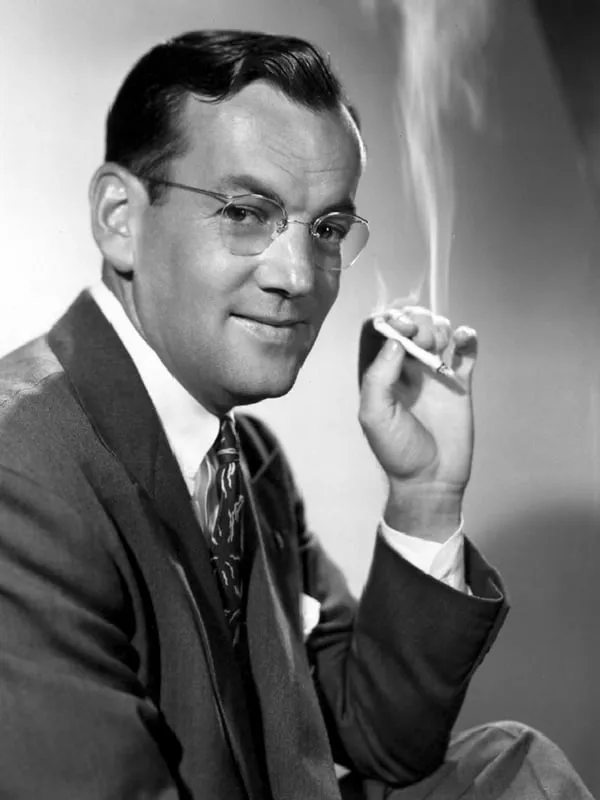
- Born:
- 1 March 1904, Clarinda, Iowa (United States)
- Died:
- 15 December 1944, The English Channel (missing in flight)
- Author:
- Łukasz
- Photo:
- autor nieznany, domena publiczna, Wikimedia Commons

Alton Glenn Miller was the most popular American bandleader at the turn of the 1930s and 1940s. His orchestra, with its characteristic sound of a clarinet leading the saxophone section, recorded dozens of hits in less than four years – from “In the Mood” through “Moonlight Serenade” to “Chattanooga Choo Choo” – and became the soundtrack of America on the eve of war. In 1942, at the height of his fame, Miller disbanded it and joined the army to play for the troops. He died at the age of 40: on 15 December 1944 the aircraft in which he was flying from England to France disappeared over the English Channel. Because the wreck was never found, his death became wrapped in a legend that accompanies his music to this day.
Childhood in the Midwest
He was born on 1 March 1904 in Clarinda, Iowa, the son of Lewis Elmer Miller and Mattie Lou, née Cavender. The family was poor and moved often: among other places it lived in North Platte, Nebraska, and in Grant City, Missouri. There the teenage Glenn – according to family tradition, with money earned milking cows – bought his first trombone and began playing in the town brass band.
From 1918 the Millers lived in Fort Morgan, Colorado. Glenn played in the school band there and, after finishing high school in 1921, in local dance bands. In 1923 he enrolled at the University of Colorado in Boulder, but he spent more time at rehearsals and gigs than at lectures, and after a few semesters he dropped out to become a professional musician. In Boulder he met Helen Burger, whom he married in October 1928.
Trombonist and arranger
In 1926 Miller joined Ben Pollack’s orchestra, in which the young Benny Goodman also played. It soon became clear that his greatest asset was not his trombone playing – he was a reliable but not outstanding soloist – but his skill at writing arrangements. At the end of the 1920s he moved to New York, where he worked as a session musician, played in Broadway theatre orchestras and sold arrangements to various bands. He also studied theory and composition privately.
In 1934 he was trombonist and arranger for the orchestra of the brothers Tommy and Jimmy Dorsey, and in 1935 he put together an American orchestra for the British bandleader Ray Noble. At this time he also wrote the melody that years later – with lyrics by Mitchell Parish – became his musical signature: “Moonlight Serenade”.
His own orchestra and success
The first orchestra under his own name, founded in 1937, was not a success, and at the beginning of 1938 Miller disbanded it. That spring he assembled a new band, and this time he perfected the sound that became his trademark: a clarinet carrying the melody over four saxophones. The breakthrough came in 1939, when the orchestra played at the fashionable Glen Island Casino ballroom in New Rochelle and at the Meadowbrook in New Jersey, from where it was broadcast on the radio. In April it recorded “Moonlight Serenade”, and in August “In the Mood” – a Joe Garland tune in an arrangement whose riff almost everyone knows today.
From December 1939 Miller hosted a CBS radio programme three times a week, sponsored by the cigarette maker Chesterfield, and his records, issued on the Bluebird label owned by RCA, topped the popularity charts. In 1940 the orchestra’s hits were joined by “Tuxedo Junction” and “Pennsylvania 6-5000”, among others. The band appeared in two 20th Century Fox films: “Sun Valley Serenade” (1941) and “Orchestra Wives” (1942). “Chattanooga Choo Choo”, from the first of them, sold more than a million copies, and in February 1942 RCA presented Miller on air with a gilded record – regarded as the first “gold record” in the history of the recording industry. The second film produced “(I’ve Got a Gal in) Kalamazoo”, nominated for the Oscar for best song.
Miller was a demanding, disciplined leader who cared more about precision of performance than about improvisation. Jazz critics accused his orchestra of commercial slickness, but the public loved it precisely for its easily recognisable, danceable and melodic swing sound.
In uniform
After the attack on Pearl Harbor Miller, who was 38, married and not liable to the draft, decided to enlist. The Navy turned down his offer, but the Army accepted it. The civilian orchestra’s last concert took place on 27 September 1942 in Passaic, New Jersey, and at the beginning of October Miller was commissioned as a captain. Soon afterwards, with the consent of the air commander, General Henry Arnold, he transferred to the US Army Air Forces. He wanted, as he himself put it, to modernise military music and give the soldiers what they had listened to at home.
At first he directed Air Forces bands in Montgomery, Alabama, and in 1943 in New Haven, where air cadets were trained in the buildings of Yale University, he created a large orchestra of professional musicians in uniform. On parade it played marches in swing rhythm – the most famous was the “St. Louis Blues March”, based on “St. Louis Blues” – which outraged traditionalists but delighted the cadets. From 1943 the orchestra broadcast a weekly radio programme, “I Sustain the Wings”, which also served to recruit for the Air Forces. During this period the Millers adopted a son, Steven, and later a daughter, Jonnie.
The AEF band in England
Miller pressed to be sent overseas, and after the Normandy landings the command agreed. At the end of June 1944 his band of about fifty arrived in London, then under fire from V-1 flying bombs, and at the beginning of July it moved to Bedford. From 9 July it broadcast on the BBC’s programme for the Allied Expeditionary Forces as “The American Band of the AEF”, while smaller line-ups – a dance band, a jazz group and a string ensemble – played their own programmes. The band also gave concerts at air bases and hospitals; in five months it performed several hundred times, before hundreds of thousands of servicemen. In August 1944 Miller was promoted to major. He also recorded programmes for the American station ABSIE, which broadcast to occupied Europe and Germany, introducing the numbers in German – part of the Allied radio propaganda aimed at Wehrmacht soldiers.
After the liberation of Paris it was decided to move the band to France, where it was to play over Christmas for troops on leave. Miller decided to fly ahead to prepare the concerts.
Disappearance
On 15 December 1944, at 1.55 p.m., Miller took off from Twinwood Farm airfield near Bedford aboard a single-engined Noorduyn Norseman (UC-64), together with Lieutenant Colonel Norman F. Baessell of the Eighth Air Force’s technical services staff. The aircraft was flown by Flight Officer John R. S. Morgan. The weather was bad, and the aircraft never reached Paris. Its absence was noticed only on 18 December, when the band flew in to Paris and Miller was not at the airfield. SHAEF announced Miller’s disappearance officially on 24 December, at a time when the world’s attention was absorbed by the Ardennes offensive.
On 20 January 1945 the board of inquiry into the disappearance concluded that the aircraft had most probably come down in the Channel because of icing, engine failure or a navigational error in poor visibility. Neither the wreck nor the bodies were found. Many theories emerged later. The one most often cited was put forward in the 1980s by a former RAF navigator, Fred Shaw: according to him, Miller’s aircraft may have been brought down by bombs jettisoned over a designated zone in the Channel by Avro Lancasters returning from an aborted raid on Siegen. Dennis Spragg, director of the Glenn Miller Archive at the University of Colorado, points out, however, in his book “Glenn Miller Declassified” (2017), that according to the records the bombers jettisoned their loads at a different time and place, and he considers an accident in bad weather the most likely explanation. Other stories – among them the version put out in 1983 by the musician’s brother Herb, that Glenn had died of lung cancer in hospital, or rumours of a secret intelligence mission – have found no confirmation in the sources, and biographers reject them.
Memory
In March 1945 Helen Miller received the Bronze Star awarded posthumously to her husband. The band, led by his colleagues, played on without him in liberated Europe until the summer of 1945. After the war further bands were formed under his name – first under the saxophonist Tex Beneke, and from 1956 the Glenn Miller Orchestra, authorised by his heirs, which still tours today. In 1954 the biographical film “The Glenn Miller Story” was made, with James Stewart in the title role, and in 2003 Miller received a posthumous Lifetime Achievement Award from the Grammy Awards. In 1992, at his daughter’s request, a memorial headstone was placed for him in Arlington National Cemetery.
His place in the war
Miller did not command in battles or influence political decisions, but his music was an important part of wartime morale. For millions of American servicemen the sound of his orchestra was a reminder of home, and for listeners in occupied Europe a foretaste of the world that would come after the war. His decision to give up a lucrative career and serve in uniform made him a symbol of American society’s commitment to the war, and his mysterious disappearance made him one of the best-known casualties of the war away from the front line. Miller, Baessell and Morgan were also three of the thousands of Allied airmen whose fate over the sea was never explained.
Sources
Often appears with
People who appear in the same events.