- Category:
- Military operations
- Front:
- Western Front
- Date:
- 25 August 1944
- Author:
- Natalia
- Battle:
- Battle of Normandy
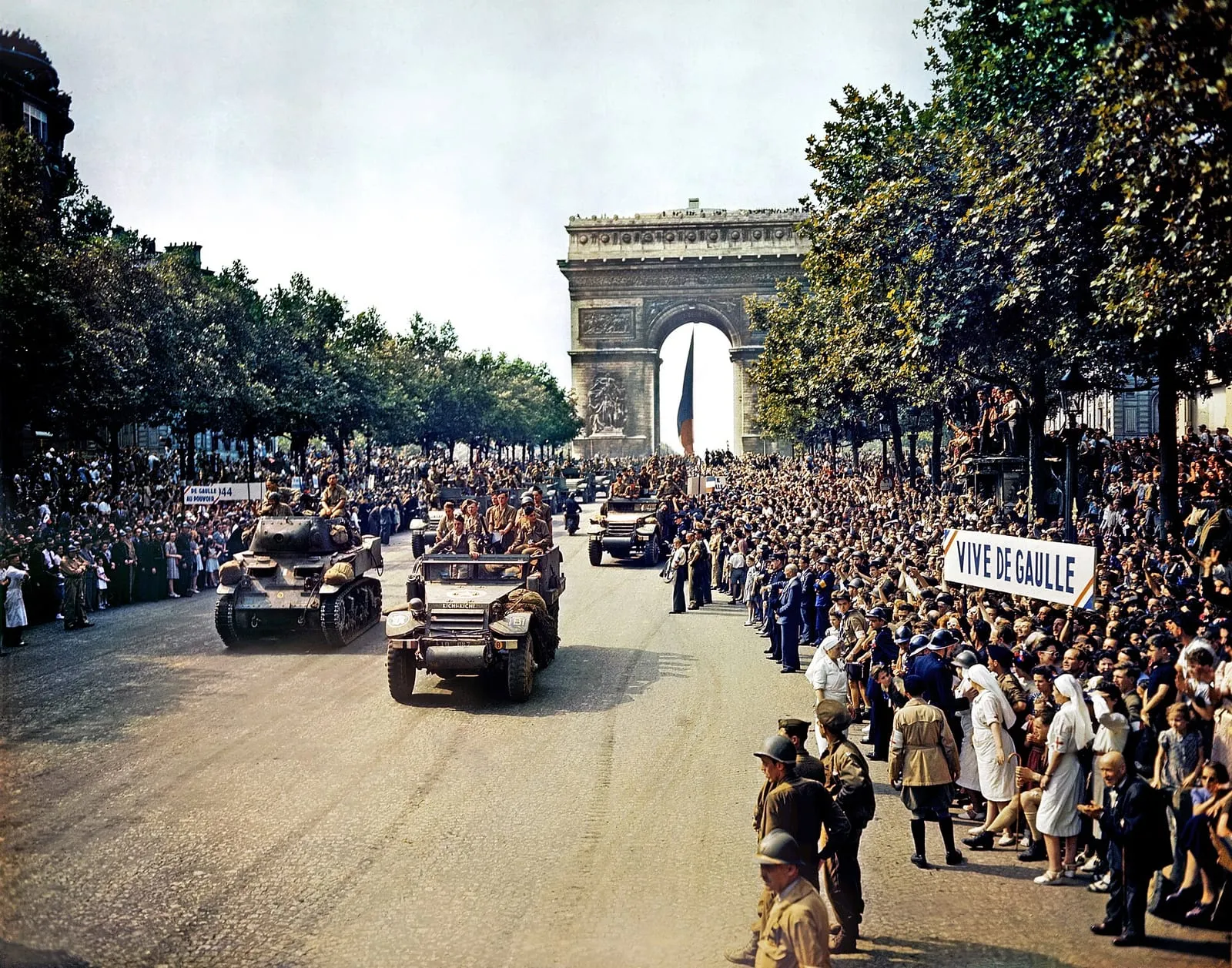
On Friday 25 August 1944, after four years and two months of occupation, Paris was free again. In the morning the main forces of General Philippe Leclerc’s French 2nd Armoured Division and the American 4th Infantry Division drove into the city. In the afternoon the commandant of Greater Paris, General of Infantry Dietrich von Choltitz, was taken prisoner at his headquarters in the Hôtel Meurice and signed the surrender of the garrison. In the evening General Charles de Gaulle spoke at the Hôtel de Ville: “Paris outraged! Paris broken! Paris martyred! But Paris liberated!”
The bridges over the Seine, the Eiffel Tower, the Louvre and Notre-Dame Cathedral survived. A few days earlier Adolf Hitler had ordered that the city must not fall into enemy hands except as a “field of ruins”. Why that order was not carried out remains a matter of dispute to this day.
From the uprising to Eisenhower’s decision
On 19 August an uprising broke out in Paris. Police officers seized the Prefecture on the Île de la Cité, units of the French Forces of the Interior under Colonel Henri Rol-Tanguy attacked German patrols, and from 22 August the city was covered with barricades. The truce negotiated by the Swedish Consul General, Raoul Nordling, was only partly observed. The insurgents controlled most districts, but they were short of ammunition and could not take the strongpoints held by the garrison – between 16,000 and 20,000 men, by various estimates, with a few dozen tanks.
General Dwight Eisenhower intended to bypass Paris and pursue the Germans fleeing from the Falaise pocket towards the Seine and further east. De Gaulle, head of the Provisional Government of the French Republic, pressed for a swift entry into the capital. His aim was for Paris to be liberated by the French and for power there to be assumed by his own administration, rather than by an Allied military government or by Resistance committees in which the communists were strong. He warned that if there were any delay he would send Leclerc’s division to Paris himself. On 21 August Leclerc, without his superiors’ consent, sent a small reconnaissance detachment towards the capital. The news brought from Paris by Rol’s chief of staff, Major Roger Cocteau, known as “Gallois”, and the fear of a massacre in the city like the one then under way in Warsaw, tipped the balance. On the evening of 22 August Eisenhower agreed that the French 2nd Armoured Division, part of General Leonard Gerow’s American V Corps, should enter Paris, followed by General Raymond Barton’s American 4th Infantry Division.
Hitler’s orders
Choltitz had been appointed commandant of Greater Paris on 7 August with the explicit task of holding the city. By mid-August sappers of the 813th Pioneer Company were laying charges under the bridges and in the more important buildings, and on 17 August Field Marshal Günther von Kluge passed on to Choltitz the order to prepare the planned demolitions. Once the uprising had broken out, further instructions began arriving from Hitler’s headquarters. The best-known order, issued by Hitler through the Wehrmacht High Command (OKW) and usually dated 23 August, called for Paris to be defended at all costs, for any resistance to be crushed by the harshest means and for the Seine bridges to be blown, and ended with the sentence: “Paris must not fall into the hands of the enemy, or only as a field of ruins.” The first of these instructions is sometimes dated 22 August: according to French studies, urgent signals from Hitler’s headquarters reached Choltitz’s staff on the evenings of 22 and 23 August. The “field of ruins” order itself, however, is dated 23 August in most sources.
The march on Paris and Dronne’s column
The 2nd Armoured Division, formed in North Africa in 1943 from soldiers of Free France and equipped with American Sherman tanks and half-tracks, had landed in Normandy at the beginning of August and fought at Argentan. On the morning of 23 August it set off for Paris from Argentan, nearly 200 kilometres away. The next day its columns ran into stiff resistance from German roadblocks in the southern suburbs – at Massy, Antony, Fresnes and in the Chevreuse valley. Soldiers and civilians were killed, and the American command, impatient at the slow progress, ordered the 4th Infantry Division to enter the city without waiting for the French.
On the evening of 24 August Leclerc sent Captain Raymond Dronne ahead with a small column: three tanks of the 501st Tank Regiment and a dozen or so half-tracks of the 9th Company of the Régiment de marche du Tchad. The company was known as “La Nueve” because most of its men were Spanish Republicans, exiles after the lost Civil War; their vehicles bore names such as “Guadalajara” and “Teruel”. Passing through the Porte d’Italie and along side streets, the column reached the Hôtel de Ville at around 9.20 p.m. The first of its officers, Lieutenant Amado Granell, was received inside by the chairman of the National Council of the Resistance, Georges Bidault. Soon the bells of Notre-Dame began to ring, followed by church bells throughout the city; the insurgents’ radio called on parish priests to ring their bells.
25 August
At dawn on 25 August Leclerc’s main forces entered the city through the western and southern gates, and the American 4th Infantry Division through the Porte d’Italie; the Americans turned east towards the Bois de Vincennes, covering the French flank. The garrison held out in a dozen or so strongpoints: in the hotels on the Rue de Rivoli, in the Tuileries Gardens, on the Place de la Concorde, at the École Militaire, in the Palais Bourbon, in the barracks on the Place de la République and in the Luxembourg Palace. Each had to be taken separately, in fighting in which insurgents went into action alongside Leclerc’s soldiers.
At around 2.30 p.m. a detachment under Lieutenant Henri Karcher broke into the Hôtel Meurice. Choltitz surrendered with his staff without resistance and was taken to the Prefecture of Police. There, at around 3.30 p.m., he and Leclerc signed the convention for the surrender of the garrison. Leclerc accepted it in the name of the Provisional Government rather than of the Allied command – a detail of great symbolic importance. The two men then went to the Gare Montparnasse, where Leclerc had his command post. There Choltitz signed ceasefire orders for the individual strongpoints, which German and French officers carried around the city. At Rol-Tanguy’s insistence the surrender document also bore the signature of the FFI commander of the Paris region – for which de Gaulle later reproached Leclerc, believing that the surrender should have been accepted only by the government’s military commander. Not every unit obeyed the order: some fought on until evening, and rooftop shooting, attributed to German stragglers and French collaborators, continued in the city for days afterwards.
The speech at the Hôtel de Ville
De Gaulle arrived in Paris on the afternoon of 25 August. At the Gare Montparnasse he received Leclerc’s report, and from there he went not to the Hôtel de Ville, where the Resistance leaders were waiting for him, but to the Ministry of War on the rue Saint-Dominique – the same ministry he had left in June 1940 as an under-secretary of state. In his memoirs he wrote that nothing there had changed – the same furniture, the same curtains, the same ushers – and that “nothing is missing here except the State”, which it was his task to restore. It was a calculated gesture: the state was returning to its buildings, not being born anew out of an insurrection. Only after a visit to the Prefecture of Police, at around 7.30 p.m., did he reach the Hôtel de Ville, where he was welcomed by Bidault and the members of the National Council of the Resistance and the Paris Liberation Committee.
There, without notes, he delivered one of the most famous speeches in French history: “Paris! Paris outraged! Paris broken! Paris martyred! But Paris liberated! Liberated by itself, liberated by its people with the help of the armies of France, with the support and help of all France, of the France that fights, of the only France, of the true France, of eternal France.” The Allies appeared only once in the text, further on, in a phrase about “our dear and admirable allies”. The American 4th Infantry Division, which was fighting in the east of the city that day, was not mentioned – something remembered in the United States and seldom recalled in France for decades. When Bidault asked him to proclaim the Republic from the balcony of the Hôtel de Ville, de Gaulle refused: in his view the Republic had never ceased to exist, since its continuity had been preserved by Free France and the government in Algiers, while the Vichy regime was “null and void”.
Did Choltitz save Paris?
Choltitz did not blow up the bridges or the buildings, even though charges had been laid in many places. In the memoirs he published after the war he presented himself as a man who had deliberately refused to carry out an insane order – because it was militarily pointless, out of respect for the city and from a conviction that Hitler had lost his mind. Those memoirs, followed by Larry Collins and Dominique Lapierre’s bestseller Is Paris Burning? (1965) and the 1966 film based on it, fixed the image of the general as the “saviour of Paris”. According to the same tradition, on 25 August Hitler asked General Alfred Jodl: “Is Paris burning?” – although there is no reliable documentary confirmation of these words.
Historians who have examined the French and German archives in recent decades assess his role more cautiously. They point out that in the second half of August Choltitz no longer controlled the city, that his forces were too weak for systematic destruction, and that the commander of the sappers, Captain Werner Ebernach, never received an order from the staff to blow the bridges at all. They also stress the role of Nordling, who spoke to the general several times, and the conduct of staff officers who – as French studies maintain – delayed passing on signals from Hitler’s headquarters. Leclerc testified that at the moment of his arrest the general was preoccupied above all with saving his own life. Choltitz also had a reason not to defy Hitler openly: under the collective liability introduced after the 20 July plot, his family in Germany could have suffered for his “treason”. How much of his conduct was calculation, how much inability, and how much a genuine wish to spare the city, the sources do not settle.
Meanwhile in the south
On the same day, 25 August, in the south of France, the Allied forces that had landed on the Riviera ten days earlier liberated Avignon. As early as 22 August, much sooner than planned, American mobile units and the FFI had entered Grenoble. General Jean de Lattre de Tassigny’s French divisions were meanwhile fighting for Toulon and Marseille, and the German Nineteenth Army was falling back northwards up the Rhône valley. Operation Dragoon opened a second route for the Allies into the heart of France, towards the Vosges and Burgundy, where the forces from the south were to link up with the armies advancing from Normandy.
Losses
No official tally of the fighting for Paris was ever drawn up, and the figures given by French historians vary considerably. The losses of the 2nd Armoured Division in the city itself and the suburbs are put at between 71 and about 150 killed and several hundred wounded; the division also lost several dozen tanks and other vehicles. The number of FFI members killed is estimated at 500–1,000, and of civilians killed at anywhere from several hundred to about 2,800, depending on the author and the period taken (from 15 or from 19 to 25 August). Some 170 police officers also lost their lives. On the German side, Adrien Dansette gave about 3,200 killed and 12,800 prisoners; other estimates are lower, and as early as 1944 it was noted that FFI figures for enemy losses might be inflated. American losses in Paris itself were small.
Significance
The liberation of Paris was of little operational importance – the German armies were retreating behind the Seine in any case, and supplying the ruined city burdened the Allied supply lines at a time when there was a shortage of fuel for the tanks advancing east. Its political and symbolic importance, however, was enormous. De Gaulle entered the capital as head of a government that the United States still did not formally recognise, and within a few days he had become the de facto master of the country. The next day he led a procession down the Champs-Élysées that drew hundreds of thousands of Parisians, and in the following weeks his government moved from Algiers to Paris, incorporated FFI units into the regular army and disbanded the armed Resistance militias. The Allies recognised the Provisional Government in October 1944.
Hitler did not accept the loss of the city: on the evening of 26 August the Luftwaffe bombed the eastern districts of Paris, killing more than 200 people. Choltitz was taken into captivity in Britain, to the camp for senior officers at Trent Park, where the British secretly recorded the prisoners’ conversations; in one of them, recorded a few days after the surrender, he said – according to the British transcripts – that on the Eastern Front he had carried out the “liquidation of the Jews” “very consistently”; historians point out that there is no other evidence of such involvement. Released in 1947, he never stood trial.
In French memory 25 August 1944 became the day on which the nation recovered its capital with its own hands: through Leclerc’s soldiers, Rol’s insurgents and the police of the Prefecture. In this picture the role of the Americans was lost for years, as was that of the Spanish Republicans of “La Nueve”, who were commemorated in Paris only in the twenty-first century. The war in France went on for many months more – in Alsace and Lorraine until early 1945, and in the besieged Atlantic ports until May 1945.
Sources
Meanwhile
(04)Elsewhere, within a week.
- 22 August 1944 · PacificThe end of the Japanese invasion of IndiaIn August 1944 the shattered Japanese Fifteenth Army, pursued through the monsoon by Slim's Fourteenth Army, fell back from Manipur to the Chindwin in Burma.
- 29 August 1944 · Central and Eastern EuropeThe Slovak National UprisingOn 29 August 1944, as the Wehrmacht entered Slovakia, Lt Col Ján Golian signalled a rising against the Germans and Tiso. Its centre was Banská Bystrica.
- 21 August 1944 · DiplomacyThe Dumbarton Oaks ConferenceOn 21 August 1944 the US, Britain and the USSR, later joined by China, began Washington talks on a post-war organisation. They produced the outline of the UN.
- 20 August 1944 · Eastern FrontThe Jassy–Kishinev offensive beginsOn 20 August 1944 the 2nd and 3rd Ukrainian Fronts struck at Iași and Bender. Within days they encircled the German Sixth Army and Romania left the Axis.
Related events
(04)The same battle, people or subject.
- 19 August 1944 · Western FrontThe Paris uprisingOn 19 August 1944 police officers seized the Prefecture on the Île de la Cité and Colonel Rol-Tanguy's FFI took on General von Choltitz's garrison in Paris.
- 14 August 1944 · Western FrontThe Falaise pocketOn 14 August 1944 Canadians and Poles advanced on Falaise in Operation Tractable. The pocket was closed on 19–21 August at Chambois and on the Mace.
- 6 June 1944 · Western FrontD-Day: the Normandy landingsOn 6 June 1944 some 156,000 Allied troops landed in Normandy by sea and air. Five beachheads were taken, but Caen remained in German hands.
- 9 July 1944 · Western FrontThe capture of CaenOn 9 July 1944 British and Canadian troops in Operation Charnwood took ruined northern Caen up to the Orne – a city that was meant to fall on D-Day.