1944–1945: The liberation of Western Europe
Battle of the Bulge
- Dates:
- 16 December 1944 – 25 January 1945
- Front:
- Western Front
- Location:
- Belgium and Luxembourg: the wooded Ardennes upland and the adjoining part of the Eifel – from the Elsenborn Ridge, Malmedy and Stavelot in the north, through St. Vith, Houffalize and Bastogne, to Clervaux, Wiltz and Echternach in northern Luxembourg; at the furthest point west, the area around Celles and Foy-Notre-Dame near Dinant on the MeuseOn the battle map →
- Sides:
- United StatesDwight Eisenhower, Omar Bradley, George Patton, Courtney Hodges, Troy Middleton, Anthony McAuliffeUnited KingdomBernard Law MontgomeryNazi GermanyGerd von Rundstedt, Walter Model, Sepp Dietrich, Hasso von Manteuffel, Erich Brandenberger
- Result:
- Allied victory. The German offensive, which was meant to cross the Ardennes and the Meuse, reach Antwerp and split the British and American armies, stalled before the Meuse within a week – on the northern flank at Elsenborn, in the centre at St. Vith and Bastogne. The Allied counter-offensive launched on 3 January 1945 eliminated the bulge in the front by 25 January. Both sides suffered heavy losses, but in the Ardennes the Germans used up their last armoured and air reserves, which they then lacked in the east when the Soviet offensive from the Vistula began on 12 January.
- Author:
- Natalia
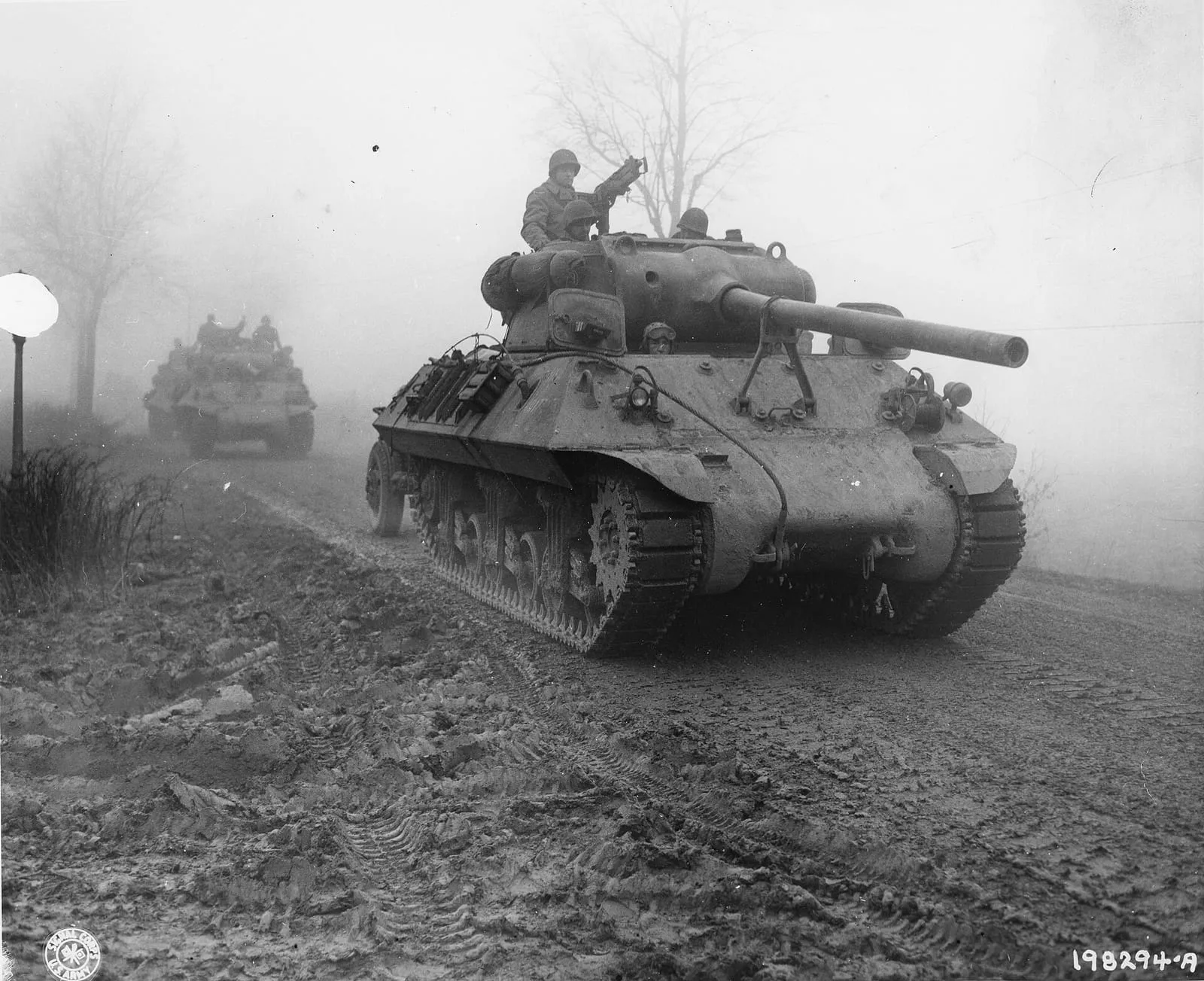
The Ardennes offensive, known in English-language historiography as the Battle of the Bulge, was Germany’s last great offensive on the Western Front. On 16 December 1944 three German armies struck a thinly held sector of the American front in the Ardennes, quiet for most of the autumn, where the borders of Belgium, Luxembourg and Germany meet. Adolf Hitler’s aim was to cross the Meuse, take Antwerp – the Allies’ main supply port – and cut off the British and Canadian forces in the north from the Americans in the south.
The surprise succeeded, and a wedge almost a hundred kilometres deep was driven into the front. Yet the plan was already failing in the first few days: the Americans held the northern shoulder of the breach on the Elsenborn Ridge, defended the road junction at St. Vith for several days, and the 101st Airborne Division, surrounded in Bastogne, refused to give up the town. The German spearheads came to a halt a few kilometres short of the Meuse, out of fuel and under air attack as soon as the weather improved. It was the largest and bloodiest battle the US Army fought in the Second World War: more than half a million American soldiers took part, and the losses on both sides ran into tens of thousands.
Name and dates
The Germans gave the operation the code name Wacht am Rhein (“Watch on the Rhine”), which was meant to suggest defensive preparations on the west bank of the Rhine. At the beginning of December the name was changed to Herbstnebel (“Autumn Mist”), but it is the first that has stuck in the literature. The American name, the Battle of the Bulge, came from the shape the front took on newspaper maps at the end of December – a bulge pushed into the Allied line. In Belgium and Luxembourg people usually speak of the Battle of the Ardennes or the Rundstedt offensive, after the German Commander-in-Chief West, to whom the Allied press attributed the plan.
The battle is taken to have begun on 16 December 1944, the day of the German attack, and to have ended on 25 January 1945, when the Americans had roughly restored the front line as it stood before the offensive; some studies move that date to 28 January, and the last German units did not withdraw to their starting positions until February. The German raid on Allied airfields of 1 January 1945 (Operation Bodenplatte) is usually counted as part of the battle, whereas the parallel offensive in Alsace (Operation Nordwind) is treated as a separate, though related, operation. The US Army awarded its units a joint battle credit, “Ardennes-Alsace”, which makes an exact accounting of losses difficult.
Background
In the autumn of 1944 the Allies reached the western borders of the Reich, but their advance lost momentum. The attempt to cross the Rhine in the Netherlands (Operation Market Garden) failed, the Americans were bleeding themselves white in the Hürtgen Forest, and Aachen fell only after several weeks of fighting. The main problem was supply, which had to be brought from Normandy across the whole of France. The solution was to be the port of Antwerp, captured as early as September but open to shipping only once the Scheldt estuary had been cleared (Battle of the Scheldt); the first convoy entered the port on 28 November. Antwerp thus became both the key to the Allied offensive against the Ruhr and the most obvious target for a German counter-attack.
Hitler conceived the idea of a blow in the Ardennes as early as September 1944, while the Western Front was only just stabilising. He calculated that the Western coalition was fragile: if Germany dealt it a painful blow, cut the British and Canadians off from the Americans and destroyed several armies, Washington and London might agree to a separate peace, and Germany would gain time to turn all its forces east. He chose the sector where the Wehrmacht had broken through the French front in May 1940 (the Battle of France): wooded, cut by valleys and with a sparse road network, which the Allies regarded as unsuitable for armoured warfare and held with small forces.
The German commanders received the plan sceptically. Field Marshal Gerd von Rundstedt, Commander-in-Chief West, and Field Marshal Walter Model, commander of Army Group B, believed that Germany lacked the strength to reach Antwerp. They proposed the so-called small solution (kleine Lösung): encircling the American forces around Aachen with pincers driven from the Ardennes and from the north. Hitler rejected these proposals and forbade any changes to the plan. The date of the attack was postponed several times – from the end of November to 10 December, and finally to 16 December – because the divisions were not ready and fuel was short. Hitler himself left the Wolf’s Lair in November, and on 11 December moved to the Adlerhorst headquarters near Bad Nauheim in Hesse, from which he directed the offensive.
Preparations were made in strict secrecy. Orders were carried by courier rather than by radio, troops moved up at night, and vehicles and guns were camouflaged in the forests of the Eifel. Many officers learned the objective of the operation only on the eve of the attack. As a result, the Allied source Ultra – decrypted German radio traffic, on which Allied staffs had grown used to relying – also fell silent. There were warning signs – the concentration of panzer divisions west of the Rhine, the interrogation of prisoners, reports of moving columns – but the intelligence staffs of the 12th Army Group and the First Army read them as preparations for defence or for a counter-attack once the Allies had crossed the Roer. The prevailing view was that the Germans were too weak to attack. Cloudy, foggy weather, moreover, made aerial reconnaissance impossible.
Forces and plan of attack
For the initial blow the Germans concentrated about 200,000 men, nearly a thousand tanks and assault guns, and more than 1,900 guns and rocket launchers; over the course of the whole battle, according to Western estimates, they committed more than 400,000 men and about 1,400 armoured vehicles. The attack was led by three armies of Army Group B:
- in the north, SS-Oberstgruppenführer Josef “Sepp” Dietrich’s Sixth SS Panzer Army, with four SS panzer divisions, was to break through the front between Monschau and the Losheim Gap, force the Meuse between Liège and Huy and drive straight for Antwerp; it was the main striking force;
- in the centre, General Hasso von Manteuffel’s Fifth Panzer Army was to reach the Meuse around Namur and Dinant by way of St. Vith and Bastogne, and then cover the advance on the Brussels side;
- in the south, General Erich Brandenberger’s Seventh Army, made up mainly of infantry, was to shield the left flank against the expected counter-attack by the US Third Army from Lorraine.
Most of the infantry divisions were newly formed Volksgrenadier divisions (PL), filled out with young recruits and men from disbanded Luftwaffe and navy units. The panzer divisions were better equipped, among other things with Panther tanks and a few Tiger IIs, but too little fuel had been stockpiled to reach Antwerp: the plan relied on capturing American dumps. Two special operations supported the attack. In Operation Greif, Otto Skorzeny’s commandos, in American uniforms and jeeps, were to sow confusion in the rear, while his 150th Panzer Brigade was to seize bridges over the Meuse. In Operation Stösser, paratroopers under Colonel Friedrich von der Heydte were to take road junctions north of Malmedy. The Luftwaffe assembled more than a thousand aircraft in the west, but because of the bad weather it had almost no influence on the fighting in the first few days.
On the American side, the sector of about 130 kilometres from Monschau to the Luxembourg–French border was held by units of General Courtney Hodges’s First Army, part of General Omar Bradley’s 12th Army Group. In the north stood V Corps, with the inexperienced 99th Infantry Division and the veterans of the 2nd Infantry Division, who were just then attacking towards the Roer dams. Most of the front was held by General Troy Middleton’s VIII Corps: the 106th Infantry Division, which had arrived at the front a few days earlier and occupied exposed positions on the Schnee Eifel ridge, and the 28th and 4th Infantry Divisions, bled white in the Hürtgen Forest and sent to the Ardennes to rest, together with part of the 9th Armored Division. In all there were about 80,000 American soldiers in the whole sector. On some axes the Germans had a numerical superiority of several to one, and in tanks even more.
The breakthrough (16–19 December)
The attack began at 5.30 a.m. on 16 December with an artillery barrage along the whole sector. Surprise was complete, but it did not produce a breakthrough everywhere. In the north the Sixth SS Panzer Army ran into fierce resistance from the 99th and 2nd Infantry Divisions in the woods and villages east of Elsenborn (PL) – at Krinkelt, Rocherath and Losheimergraben. By 19 December the Americans had fallen back to the Elsenborn Ridge, which they held until the end of the battle, and the attacks of the 12th SS Panzer Division Hitlerjugend at Bütgenbach brought no breakthrough. This so-called northern shoulder of the breach closed Dietrich’s shortest routes to the Meuse and Liège, and the advance of Hitler’s main striking force narrowed to a few side roads.
Furthest on the northern flank pushed the spearhead battle group of the 1st SS Panzer Division Leibstandarte SS Adolf Hitler, commanded by SS-Obersturmbannführer Joachim Peiper. By way of Honsfeld and Büllingen, where it captured American fuel, it reached the Baugnez crossroads near Malmedy on 17 December. There the battle group’s soldiers shot prisoners, mostly from Battery B of the US 285th Field Artillery Observation Battalion; according to the most commonly cited figures, 84 of them were killed (the Malmedy massacre). On 18 December Peiper broke into Stavelot, but American engineers blew the bridges ahead of him at Trois-Ponts and then on the Lienne. On 19 December his group took Stoumont, but the Americans retook Stavelot behind it and cut it off from the rest of the division. Surrounded at La Gleize and out of fuel, Peiper led about 800 men out on foot during the night of 23–24 December, abandoning his tanks and vehicles.
In the centre the Fifth Panzer Army achieved more. Two regiments of the 106th Infantry Division on the Schnee Eifel were surrounded and surrendered on 19 December – between 7,000 and 8,000 soldiers, according to various figures, were taken prisoner, the largest surrender of the US Army in Europe. Further south the regiments of the 28th Infantry Division, stretched out over several dozen kilometres, held out at Clervaux, Hosingen, Wiltz and other places in northern Luxembourg. They were broken, but they delayed the Germans by two or three precious days. On the southern flank the 4th Infantry Division and part of the 9th Armored Division held the Echternach area, and the Seventh Army failed to carry out its covering task.
Von der Heydte’s paratroopers, dropped during the night of 16–17 December in high winds and darkness, were scattered over a wide area; most of them never reached their objectives, and their commander himself was taken prisoner a few days later. Skorzeny’s men in American uniforms did little material damage but caused considerable nervousness behind the Allied lines: military policemen at roadblocks tested soldiers’ knowledge of baseball and American life, and rumours circulated of a plot to assassinate the Supreme Allied Commander, General Dwight Eisenhower. Commandos captured in enemy uniform were shot after sentence by courts martial. The 150th Panzer Brigade’s attack on Malmedy on 21 December was repulsed.
Eisenhower quickly understood that this was no local counter-attack. As early as the evening of 16 December he sent the 7th and 10th Armored Divisions to the Ardennes, and on 17 December he placed at the disposal of Bradley and Hodges the only strategic reserve in Europe – the 82nd and 101st Airborne Divisions, resting near Reims after the fighting in the Netherlands. The 82nd Division stopped Peiper on the Amblève and the Lienne; the 101st went by truck to Bastogne.
St. Vith and Bastogne
For the Fifth Panzer Army two road junctions were crucial: St. Vith in the north and Bastogne in the south of its sector of attack. The Germans had wanted to take St. Vith on the very first day. Instead, from 17 December it was defended by a forward group of the 7th Armored Division under Brigadier General Bruce Clarke, together with the remnants of the 106th Division and units of the 9th Armored Division. For almost a week this horseshoe of defences tied down several German divisions and blocked the roads along which both the Fifth Panzer Army and part of Dietrich’s forces were to advance. The Germans broke into the town on the evening of 21 December. By 23 December the defenders, with Montgomery’s consent, had withdrawn behind the river Salm (the Battle of St. Vith).
Bastogne, where seven roads converged, was even more important. General Middleton decided to defend it at all costs. Forward teams of the 10th Armored Division’s Combat Command B – among them Major William Desobry’s group at Noville – delayed the 2nd Panzer Division and the Panzer-Lehr-Division for two days, and during the night of 18–19 December the 101st Airborne Division reached the town, led in the absence of its commander by Brigadier General Anthony McAuliffe. On 20 and 21 December General Heinrich von Lüttwitz’s XLVII Panzer Corps closed the ring around the town, trapping about 18,000 American soldiers inside. On 22 December the Germans called on the defenders to surrender; McAuliffe replied with a single word: “Nuts!”. The defenders were short of artillery ammunition, dressings and winter clothing, and the number of wounded kept growing. From 23 December, when the sky cleared, transport aircraft dropped supplies over the town. On the afternoon of 26 December tanks of Lieutenant Colonel Creighton Abrams’s 37th Tank Battalion of the 4th Armored Division broke through from the south to the defenders.
Meanwhile, on 19 December, Eisenhower called a conference of commanders at Verdun. It was agreed that the troops on the flanks of the breach would hold them, while General George Patton’s Third Army would break off its offensive in the Saar, wheel through ninety degrees and strike north towards Bastogne. Patton promised to attack within 48 hours and kept his word: his III Corps moved off on 22 December. On 20 December, because communications between Bradley’s headquarters in Luxembourg and the armies north of the breach had been severed, Eisenhower placed the US First and Ninth Armies under Field Marshal Bernard Law Montgomery, commander of the 21st Army Group. The decision was militarily sound but deeply offended Bradley and marked the beginning of bitter disputes within the Allied command. Montgomery put the defence of the northern flank in order, had the line shortened and sent General Brian Horrocks’s British XXX Corps to the west bank of the Meuse to cover the bridges.
Before the Meuse: weather and air power
Bypassing Bastogne, Manteuffel’s panzer divisions pressed on westwards. The furthest to get was the 2nd Panzer Division, whose spearhead reached Foy-Notre-Dame (PL) and Celles on 24 December, a few kilometres from the Meuse near Dinant. There, however, its fuel was running out, and British tanks of the 29th Armoured Brigade were already waiting on the west bank of the river. On 25 and 26 December the US 2nd Armored Division of General Joseph Lawton Collins’s VII Corps, supported by aircraft, destroyed the German forces in pockets near Celles and Foy-Notre-Dame. Forward units of the Panzer-Lehr-Division and the 116th Panzer Division were stopped near Rochefort, Hotton and Marche-en-Famenne. This was the high-water mark of the offensive; the Meuse was never crossed.
For the first week low, dense cloud, fog and snowstorms kept the Allied air forces on the ground, as the Germans had counted on. On 23 December a high-pressure system brought frosty, dry air from Russia over the Ardennes, and the sky cleared. Fighter-bombers of the Ninth Air Force and the RAF – among them P-47 Thunderbolts and Typhoons – attacked columns on the congested roads, while heavy bombers of the Eighth Air Force and the RAF bombed railway junctions, bridges and small towns in the rear: Houffalize, St. Vith, La Roche. On 24 December more than two thousand bombers flew over Germany – the Eighth Air Force’s largest single-day operation of the war. Air power did not decide the battle on its own – the Germans were stopped above all by resistance on the ground, traffic jams on the roads and lack of fuel – but from 23 December it denied them free movement by day and the bringing up of supplies.
War crimes and the civilian population
The battle was marked by atrocities. The most notorious was the massacre at the Baugnez crossroads on 17 December, but Peiper’s men killed prisoners and civilians at other places on their route as well – at Honsfeld, Büllingen, Ligneuville, Stavelot and in neighbouring villages along the Amblève, where, according to Belgian findings, more than a hundred civilians, including women and children, were killed. The group’s commander and dozens of his soldiers were tried in 1946 by a US military tribunal at Dachau. At Wereth on 17 December soldiers of another battle group of the same division (Schnellgruppe Knittel) murdered eleven black American artillerymen who had surrendered, and at Bande on 24 December members of the German Security Police shot 34 young men in reprisal for resistance activity in September.
News of Malmedy spread quickly through the American forces and provoked reprisals. In some units orders were given not to take SS men prisoner; on 1 January 1945 soldiers of the 11th Armored Division killed several dozen German prisoners at Chenogne – about sixty, according to most studies. The perpetrators were never tried.
The people of the Ardennes suffered terribly. For weeks on end the inhabitants sheltered in cellars while their villages were fought over; some fled west, and some were taken away by the Germans for forced labour. Bombing and shelling destroyed St. Vith, Houffalize, La Roche-en-Ardenne and Bastogne; three times, on 23–25 December, American aircraft mistakenly bombed Allied-held Malmedy, killing – according to local findings – more than two hundred civilians and many soldiers. According to Belgian and Luxembourg estimates, about 2,500 civilians died in Belgium during the battle and about 500 in Luxembourg, among them victims of executions, shelling, bombing and mines.
Bodenplatte, Nordwind and the fighting around Bastogne
After Christmas it became clear that Antwerp was out of reach. Model and Rundstedt proposed withdrawing the troops from the bulge, but Hitler ordered them to hold the ground they had taken, to try again to capture Bastogne and to open new fronts. On New Year’s Eve Army Group G launched Operation Nordwind in northern Alsace against the US Seventh Army, which had been weakened by the shift of Patton’s forces to the north. The fighting in Alsace – among other places for Haguenau and for bridgeheads on the Rhine, with Strasbourg threatened with being lost again – lasted until 25 January and ended in German failure.
On the morning of 1 January 1945 the Luftwaffe carried out Operation Bodenplatte – a massed raid by several hundred fighters on Allied airfields in Belgium, the Netherlands and northern France. According to the most commonly cited figures it destroyed or damaged about 465 Allied aircraft, most of them on the ground, but itself lost some 270–300 aircraft, a large proportion of them to its own anti-aircraft artillery, which had not been warned of the operation. The Allies made good their losses within a few days. The Germans lost more than two hundred pilots, among them many experienced commanders whom they had no one to replace; for the Luftwaffe’s fighter arm it was a disaster from which it never regained the capacity for larger operations in the west.
Around Bastogne the fighting intensified. Through the narrow corridor from the south, further divisions of the Third Army reached the town, while the Germans brought up, among others, the 1st and 12th SS Panzer Divisions from the northern flank. Around the turn of the year bitter battles were fought for the villages around the town – Lutrebois, Villers-la-Bonne-Eau, Sibret, Chenogne – in which both sides lost more than during the encirclement itself. The Germans kept attacking Bastogne until about 7 January.
The Allied counter-offensive
Eisenhower wanted Montgomery to attack from the north as early as 1 January, at the same time as Patton from the south, and cut off the Germans in the tip of the bulge. Montgomery, unwilling to send unprepared infantry into an attack in a snowstorm, did not open the First Army’s offensive until 3 January 1945. Collins’s VII Corps and General Matthew Ridgway’s XVIII Airborne Corps attacked, with the British XXX Corps from the west. Progress was slow: deep snow, frosts of minus ten degrees and more, icy roads and mines meant that the troops advanced a kilometre or two a day. The quarrel between the commanders was sharpened by Montgomery’s press conference of 7 January, at which he presented his part in the battle in a way the Americans took as belittling their achievements; Bradley – as he himself later recalled – declared that he would rather resign than serve under Montgomery, and a conciliatory speech by Winston Churchill in the House of Commons on 18 January helped to cool tempers.
On 8 January Hitler authorised the withdrawal of the divisions from the western part of the bulge. The Germans fell back in good order, fighting fiercely on every line. On 16 January patrols of the First and Third Armies met at Houffalize, cutting the bulge in two. The next day the First Army returned to Bradley’s command. The Sixth SS Panzer Army was withdrawn from the front – a month later it was transferred to Hungary. On 23 January the Americans retook the ruins of St. Vith, and on 25 January the front returned more or less to the line of 16 December. The last fighting to regain the starting positions went on until 28 January.
Losses
Figures for the losses vary according to the time frame adopted and the method of counting. The official tally of the US Army Center of Military History gives about 75,000 Americans killed, wounded, missing and captured; a preliminary report by the First and Third Armies listed 75,482 men, including more than 8,400 killed. Other studies, which include support units and a longer period, give 81,000 (Charles B. MacDonald) or about 89,000. More than 20,000 American soldiers were listed as missing – most of them had been taken prisoner. The British XXX Corps lost about 1,400 men.
German losses are estimated at between about 67,000 (the German historian Hermann Jung, for the three armies taking part in the attack) and about 100,000 (an American estimate); the German command’s own returns spoke of more than 80,000 killed, wounded and missing. Each side lost several hundred tanks and armoured guns – the Germans, according to various sources, between about 550 and 800 – with the difference that the Americans replaced their losses within a few weeks, while the Germans no longer had anything to replace them with.
Significance
The Ardennes offensive was Hitler’s last attempt to reverse the course of the war in the west, and it ended in failure. It did not even reach the Meuse, did not break up the coalition and did not significantly delay the Allied advance to the Rhine: once it had been repulsed, the Americans and British resumed their offensive as early as February 1945, and in March they crossed the Rhine. The outcome of the battle was decided in its first days by the stubbornness of individual American battalions and divisions on the northern flank, at St. Vith and in Bastogne, by the swift reaction of Eisenhower and his commanders, and later by the Allies’ superiority in materiel and in the air. For the US Army it was the hardest and bloodiest battle of the war, and after the initial surprise it became a symbol of its soldiers’ endurance. Churchill told the House of Commons that it was the greatest American battle of the war, which would be regarded as “an ever-famous American victory”.
The battle’s most serious consequences, however, were felt in the east. In the Ardennes and in Alsace the Germans used up their last armoured reserves, their stocks of fuel and ammunition and what was left of their fighter force, all accumulated since the autumn with this single operation in mind. When the Red Army opened its offensive from the Vistula on 12 January 1945, the German front in Poland had nothing left to defend itself with and within a few weeks fell back to the Oder. The timing of the Soviet attack is sometimes linked to a request from Churchill, who on 6 January asked Stalin about his plans for an offensive in the east; historians disagree about how far this request influenced Soviet decisions that had been in preparation for some time. The Sixth SS Panzer Army, withdrawn from the Ardennes, did not return to the west – Hitler threw it into Hungary, where in March 1945 it was defeated at Lake Balaton.
Disputes over the course of the battle – about the Allied command’s underestimation of intelligence warnings, about Montgomery’s role and about the delay in the counter-offensive – continued in generals’ memoirs for decades. For the Belgians and Luxembourgers of the Ardennes the winter of 1944–1945 remained the most tragic period of the war: many small towns liberated in September had to be liberated a second time, from their ruins.