- Category:
- Military operations
- Front:
- Pacific
- Date:
- 7 December 1941
- Author:
- Łukasz
- Battle:
- Attack on Pearl Harbor
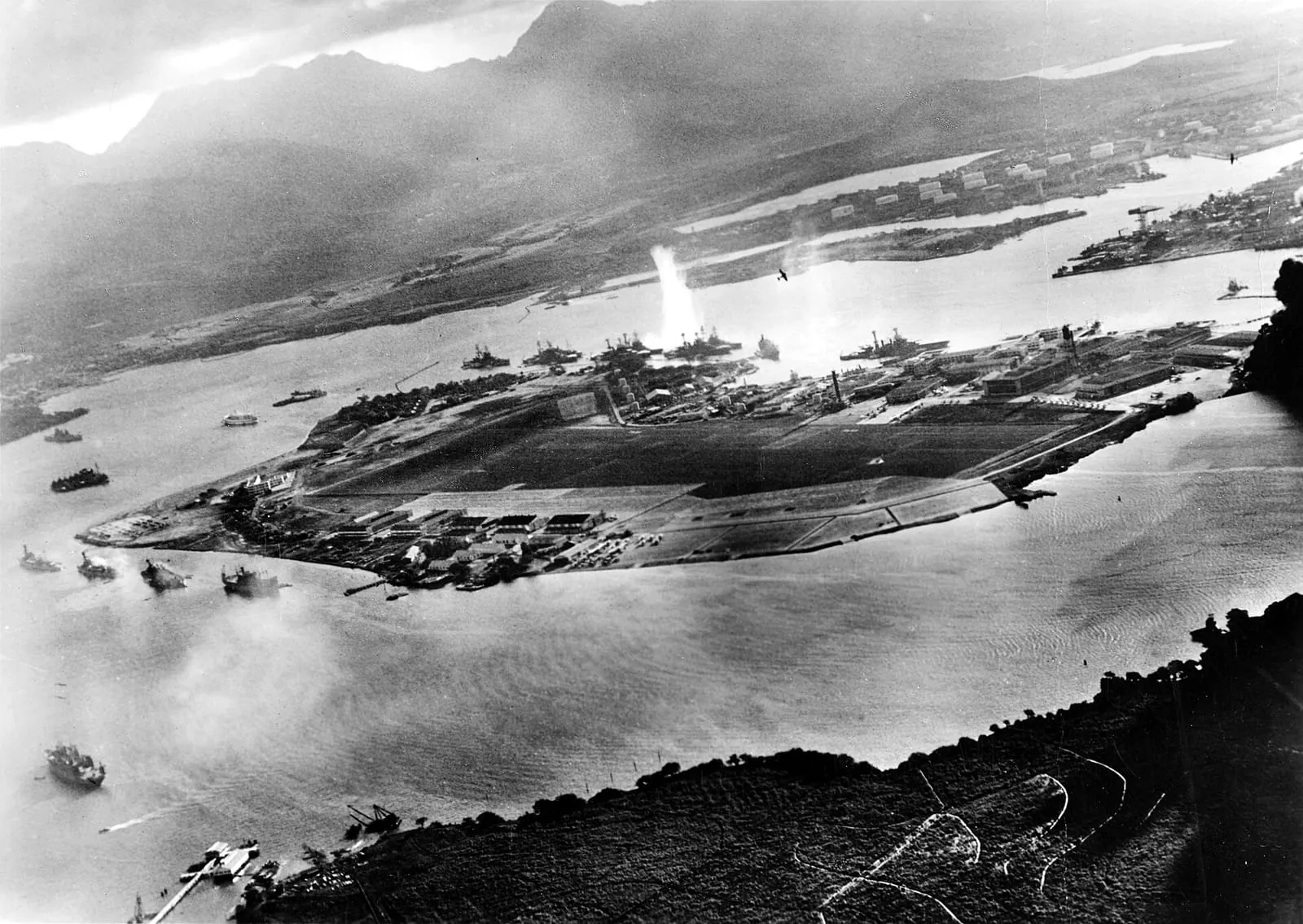
On Sunday 7 December 1941, at 7.48 a.m. Hawaiian time, the first Japanese aircraft opened fire on American flying boats at the Kāneʻohe base on the island of Oʻahu. A few minutes later torpedo bombers swept over Pearl Harbor (PL), the main base of the US Pacific Fleet, and began dropping torpedoes at the battleships moored in pairs alongside Ford Island. In less than two hours two waves of aircraft from Vice Admiral Chūichi Nagumo’s six carriers sank or damaged eight battleships, destroyed nearly two hundred aircraft and killed 2,403 Americans. It happened without a declaration of war, while diplomatic talks were still under way in Washington.
In Hawaii it was Sunday 7 December, but in Tokyo and the whole of East Asia it was already Monday 8 December: the first bombs fell on Oʻahu at 3.18 a.m. Tokyo time, the time kept by the Japanese ships. In Washington it was then 1.18 p.m. That is why Japanese sources and histories of the war in Asia date the attack to 8 December, and American ones to 7 December. During the same night, by the clocks, Japanese forces also began the invasion of Malaya and struck at Thailand, Hong Kong, the Philippines, Guam and Wake. Pearl Harbor was only one part – though the most audacious – of a coordinated offensive across the whole Pacific.
Before dawn
Nagumo’s striking force, which had sailed from the Kurils on 26 November and spent twelve days steaming under radio silence across the empty North Pacific, reached its launch point, some 230 nautical miles north of Oʻahu, during the night of 6–7 December. It had received the order to carry out the attack, the signal “Niitakayama nobore 1208”, on 2 December. From naval intelligence Nagumo knew the state of the harbour over the last few days: the reports of Takeo Yoshikawa, who had been watching Pearl Harbor since the spring from the consulate in Honolulu, said that the battleships were in port but the carriers were not. The Japanese hoped that one of them might still return. The attack plan was based on the concept of Admiral Isoroku Yamamoto, who since the beginning of 1941 had argued that a war with America must open with a blow against its fleet, and who drew in part on the British attack on Taranto.
At about six in the morning, in a heavy swell, the first wave began taking off from the decks of Akagi, Kaga, Sōryū, Hiryū, Shōkaku and Zuikaku. It comprised 183 aircraft: 49 Nakajima B5N bombers carrying heavy armour-piercing bombs converted from naval artillery shells, 40 more of the same type carrying torpedoes adapted to the shallow water of the harbour, 51 Aichi D3A dive-bombers and 43 Mitsubishi A6M Zero fighters. A few aircraft failed to take off because of faults. The whole strike was led by Commander Mitsuo Fuchida. About an hour later the second wave took off, led by Lieutenant Commander Shigekazu Shimazaki: according to most studies, 167 aircraft, including 54 level bombers, 78 dive-bombers and 35 fighters. In all, some 350 aircraft reached Oʻahu. More than forty fighters remained over the carriers as cover.
More than ninety vessels lay in the harbour, among them eight of the Pacific Fleet’s nine battleships. Seven of them were moored along the south-eastern shore of Ford Island, in a line the sailors called “Battleship Row”; the eighth, the flagship Pennsylvania, was in dry dock at the navy yard. Most of the crews were on Sunday leave or asleep. The aircraft at the army and navy airfields were parked tightly, wingtip to wingtip, in the open, because the command regarded sabotage by local Japanese as the greatest threat, not an air attack. Anti-aircraft ammunition was locked in the magazines.
Warnings that were not understood
The first sign came from the sea. At about 3.45 a.m. the minesweeper Condor spotted a periscope off the harbour entrance and informed the patrolling destroyer Ward. A few hours earlier five large Japanese submarines had released at the entrance to Pearl Harbor five Ko-hyoteki-class midget submarines, two-man craft armed with two torpedoes each, which were to slip into the harbour behind incoming ships. At about 6.37 a.m. Ward, commanded by Lieutenant William Outerbridge, sighted the conning tower of one of them following the supply ship Antares, opened fire with her gun, hit the conning tower and dropped depth charges on it. These were the first American shots of the Pacific War, fired more than an hour before the air raid. The report of the sinking of a submarine reached the headquarters of the 14th Naval District before seven, but there it was taken for another doubtful alarm, of which there had been many in Hawaii, and staff began checking it instead of sounding the alert.
The second sign came from radar. At Opana Point on the northern tip of Oʻahu one of the army’s few mobile SCR-270 radar stations was operating as part of a training programme. At 7.02 a.m. Privates Joseph Lockard and George Elliott saw on their screen the largest echo they had ever seen: a group of aircraft about 130 miles to the north, approaching the island. They reported it to the information centre at Fort Shafter, where the only duty officer, Lieutenant Kermit Tyler, a pilot with no radar training, concluded that it was a dozen B-17 bombers due in from California that morning. He told them not to worry about it. According to later testimony, the operators did not tell him how large the echo was.
The third sign came from Washington, but too late. During the night and morning American cryptanalysts had decoded the last parts of Japan’s reply to the Hull note, the so-called fourteen-part message, together with the instruction for Ambassador Kichisaburō Nomura to deliver it to the Secretary of State at exactly 1 p.m. Washington time, that is 7.30 a.m. in Hawaii. The Army Chief of Staff, General George Marshall, considered the timing ominous and at about midday sent a warning to the commanders in the Pacific. Because the army’s radio link with Hawaii was disrupted, the message went by ordinary commercial telegraph. It reached Honolulu some 20 minutes before the attack, but was not delivered in time, and the army commander in Hawaii, Lieutenant General Walter Short, received it only in the afternoon.
The first wave
At 7.40 a.m. Fuchida, seeing clear skies over the target and an unprepared harbour, fired a signal flare, and at 7.49 he radioed the order to attack. At 7.53 he sent Akagi the agreed report “Tora! Tora! Tora! (PL)”, meaning that surprise had been achieved. Dive-bombers struck the airfields at Hickam, Wheeler, Ford Island, Ewa and Kāneʻohe to prevent fighters from taking off, while the torpedo bombers came in low over the water towards Battleship Row. At 7.58 the headquarters of the naval patrol wing on Ford Island sent out the message: “Air raid Pearl Harbor. This is not drill.”
The torpedoes caused the heaviest losses. Oklahoma took several hits and within a quarter of an hour capsized, trapping hundreds of sailors inside her hull. West Virginia, struck by seven torpedoes, settled upright on the bottom thanks to rapid counter-flooding, but her captain, Mervyn Bennion, was mortally wounded by a splinter. Torpedoes and bombs also hit California, which sank slowly over the next three days. On the other side of Ford Island the old battleship Utah, used as a target ship, capsized, and a torpedo that hit the light cruiser Helena overturned the minelayer Oglala moored alongside with the shock of its explosion.
At about 8.06 a.m. an armour-piercing bomb dropped from high altitude pierced the deck of Arizona near the forward turret and ignited the magazines. The explosion tore apart the forward part of the ship, and a column of fire and smoke rose hundreds of metres into the air. 1,177 members of her crew were killed – almost half of all the victims of the attack – among them the commander of the battleship division, Rear Admiral Isaac C. Kidd, the first American admiral to die in the war, and the ship’s captain, Franklin Van Valkenburgh. Burning oil from Arizona spread across the water and surrounded the neighbouring ships. The battleships Maryland and Tennessee, shielded on the seaward side by Oklahoma and West Virginia, escaped the torpedoes and suffered only lighter bomb damage.
The Americans fought back with whatever came to hand. Sailors broke the locks off ammunition lockers, and men fired machine guns and even rifles. A cook from West Virginia, Doris Miller, who as a black sailor had not been trained to use weapons, helped carry the mortally wounded captain and then fired a machine gun at the aircraft. At the same time twelve unarmed B-17s from California were arriving over Oʻahu with almost empty tanks, together with dive-bombers from the carrier Enterprise, which was returning to Pearl Harbor. They flew into the middle of the battle, and some were shot down by the Japanese or by American anti-aircraft fire.
The second wave
The second wave arrived at about 8.55 a.m., when the defences were already on the alert. Its main targets were the airfields, the hangars and the ships that had survived the first attack. The only battleship that managed to get under way, Nevada, already hit by a torpedo, was just passing the burning Arizona on her way to the harbour mouth. The Japanese airmen concentrated their attacks on her, hoping to sink her in the narrow channel and block the harbour. Lieutenant Commander Francis Thomas, in command in the captain’s absence, beached her at Hospital Point so that she would not obstruct the fairway. Bombs also struck the dry dock in which Pennsylvania lay with two destroyers, Cassin and Downes, which burned out, and the destroyer Shaw, whose forward magazines exploded, producing one of the most famous photographs of the day.
The midget submarines achieved nothing certain. One of them entered the harbour and at about 8.40 a.m. fired torpedoes at the seaplane tender Curtiss and the destroyer Monaghan, but missed and was rammed. Another, commanded by Ensign Kazuo Sakamaki, ran aground on the reefs. Sakamaki swam ashore and on 8 December became the first Japanese prisoner of war in American hands. Whether these craft played a part in sinking the battleships, as some later researchers have suggested on the basis of a Japanese aerial photograph, remains disputed.
At about ten o’clock the last Japanese aircraft flew off to the north. Black smoke from burning oil hung over Pearl Harbor, and a slick of fuel was still burning on the water. Over the next two days rescuers cut through the hull of Oklahoma, bringing out 32 sailors alive. Admiral Husband Kimmel, commander of the Pacific Fleet since February, watched the attack from his headquarters at the submarine base. According to witnesses, when a spent bullet struck him in the chest, he said it would have been merciful had it killed him.
The toll
According to official American lists, 2,403 Americans were killed in the attack: 2,008 navy personnel, 109 marines, 218 army soldiers and airmen, and 68 civilians. Some of the civilian casualties in Honolulu were caused by American anti-aircraft shells falling on the city. There were 1,178 wounded. Four battleships sank – Arizona, Oklahoma, West Virginia and California – Nevada was beached, and the other three were damaged. In all, eighteen warships and auxiliaries were sunk or damaged. Of some 400 navy and army aircraft in Hawaii, 188 were destroyed and 159 damaged, most of them on the ground. The Japanese lost 29 aircraft (9 in the first wave and 20 in the second), all five midget submarines and 64 men killed: 55 airmen and 9 crew members of the midget submarines. Several dozen other aircraft returned damaged.
The defeat, however, was not as complete as it looked that day. None of the Pacific Fleet’s three carriers was in harbour. Enterprise, under Vice Admiral William Halsey, was returning from Wake, where she had delivered Marine fighters, and was some 200 miles west of Oʻahu. Lexington was carrying aircraft to Midway, and Saratoga was at San Diego. Nor did the Japanese bomb the fuel tanks, which held several million barrels of oil, or the navy yard, repair shops, dry docks and submarine base. Their plan did not include such targets: the airmen, trained to fight ships, were to destroy the fleet, not the base. Of the eight battleships hit, six later returned to service, and the hulls of West Virginia and California were raised from the bottom as early as 1942. Only Arizona, Oklahoma and Utah were lost for good.
Nagumo does not repeat the attack
By about 1 p.m. the aircraft of the second wave had landed on the carriers. According to an account that Fuchida repeated many times after the war, he and Lieutenant Commander Minoru Genda, who had drafted the outline of the plan, urged Nagumo to launch a third strike against the fuel tanks and the navy yard. Some historians question this account, since Genda himself denied making any such request, and other recollections of Fuchida’s have proved unreliable. What is certain is that aircraft were being readied on the carriers for another launch, and that the commander of the 2nd Carrier Division, Rear Admiral Tamon Yamaguchi, reportedly signalled his readiness for a further attack. Nagumo, a cautious admiral who had been sceptical of the plan from the outset, and his chief of staff, Rear Admiral Ryūnosuke Kusaka, decided that the objective had been achieved. They did not know where the American carriers were, they feared land-based bombers, the second wave had suffered markedly heavier losses than the first, and a third would have had to land after dark. The destroyers’ fuel was also running perilously low. At about 1.30 p.m. the force turned north-west, towards Japan.
Yamamoto, who was receiving the reports of victory aboard the battleship Nagato in the Inland Sea, approved this decision, although some of his staff officers considered it a mistake. After the war the American admiral Chester Nimitz, who took command of the Pacific Fleet at the end of December, said that the destruction of the fuel tanks would have prolonged the war by two years. This assessment is sometimes considered exaggerated, but the survival of the base allowed the Americans to repair their ships quickly and, within a few months, to conduct carrier operations from Hawaii.
The belated note
Ambassador Nomura and the special envoy Saburō Kurusu were to hand the Japanese note to Cordell Hull at 1 p.m. Washington time, half an hour before the planned start of the attack. The embassy staff, however, failed to decode the long document and type it out in time. Nomura asked for the meeting to be postponed, and the two diplomats were not received at the State Department until 2.20 p.m., more than an hour after the first bombs. Hull already knew of the attack from President Franklin Delano Roosevelt, who had been telephoned at about 1.40 p.m. by the Secretary of the Navy, Frank Knox. He also knew the contents of the note, since the cryptanalysts had decoded it before the Japanese in the embassy had. He read it in silence and then, by his own account, said that in fifty years of public service he had never seen a document so crowded with “infamous falsehoods and distortions”, and without another word showed the diplomats the door.
The note was not, in any case, a declaration of war. It stated merely that, in view of the attitude of the United States, further negotiations could not lead to agreement. According to documents found in Japan in the late 1990s, the army and navy had been reluctant to agree even to such a limited warning to the enemy, and on 7 December the General Staff’s diary wrote of “deceptive diplomacy” that was heading for success. The formal imperial rescript on war with the United States and Britain was not proclaimed in Tokyo until the late morning of 8 December, Tokyo time, many hours after the attack. The note’s late delivery allowed the Americans to present the attack as a treacherous assault in the midst of negotiations, and for years it became a symbol of Japanese perfidy.
The same day
News of the attack reached American radio stations at about 2.25 p.m. Eastern time and interrupted Sunday programmes across the country. In the evening Roosevelt assembled his cabinet and the leaders of Congress. Prime Minister Winston Churchill, who heard of the attack on the radio at Chequers, telephoned the President and was told that they were all in the same boat now. In Hawaii Governor Joseph Poindexter declared martial law in the afternoon and handed authority to General Short. That same evening FBI agents and the military began detaining hundreds of leaders of the Japanese community on the islands and on the mainland. A damaged Japanese fighter landed on the remote island of Niʻihau, and for several days its pilot, with the help of local Japanese residents, tried to recover the papers taken from him; the Niʻihau incident later served as one of the arguments for interning Americans of Japanese descent.
Meanwhile 8 December was dawning over East Asia. Japanese aircraft were bombing Singapore, Hong Kong and the Philippines, and troops were landing in Malaya and Thailand.
Place in the war
The attack on Pearl Harbor was a tactical success such as the Japanese navy never achieved before or after. It put the American battleships out of action for several months and allowed Japan to seize Malaya, the Philippines and the Netherlands East Indies unhindered – the islands whose oil had been at the heart of the dispute since the summer of 1941. It also showed that a carrier force could destroy a battle fleet in its own base. Paradoxically, it was the Americans who gained most from this lesson: deprived of their battleships, they based the war in the Pacific on the carriers and submarines that the Japanese had spared. As early as June 1942 four of the six carriers that had struck Pearl Harbor were sunk at the Battle of Midway.
Strategically the attack was a disaster for Japan. Instead of breaking the Americans’ will and inducing them to accept a compromise peace, it united a hitherto divided country in the determination to fight on to unconditional victory. The next day Roosevelt called 7 December “a date which will live in infamy”, and Congress, with near unanimity, voted to declare war on Japan. On 11 December Adolf Hitler and Benito Mussolini declared war on the United States, and the wars in Europe, in the Atlantic and in the Far East became a single world war. In the same week in which Japan opened a new front, the Red Army went over to the counter-offensive at Moscow, and the German plan for a swift victory over the Soviet Union collapsed.
For the Americans the question remained of how this could have happened. On 17 December Kimmel and Short were relieved of their commands, and in January 1942 a commission chaired by Supreme Court Justice Owen Roberts held them responsible for the lack of readiness. Later inquiries, culminating in the joint congressional committee of 1945–1946, spread the blame more widely: to Washington, which had not passed on to the commanders everything it knew from the decoded Japanese correspondence, and to the entire command system. Theories that Roosevelt knew of the attack and deliberately allowed it in order to draw America into the war have found no support in the documents and are rejected by the overwhelming majority of historians. The wreck of Arizona, in which more than 900 sailors still lie, is today a memorial.
Sources
Meanwhile
(04)Elsewhere, within a week.
- 8 December 1941 · DiplomacyThe “Day of Infamy” speechOn 8 December 1941 Roosevelt called Pearl Harbor a day of infamy and Congress declared war on Japan. Within days a dozen or more other states had done the same.
- 5 December 1941 · Eastern FrontThe counter-offensive at MoscowOn 5 December 1941 the Kalinin Front, and on 6 December the Western Front, struck an exhausted Army Group Centre. The Germans fell back along the whole front.
- 9 December 1941 · AfricaThe miners’ strike in the Belgian CongoOn 9 December 1941 Force Publique soldiers opened fire on striking Union Minière miners at the football stadium in Élisabethville. Dozens were killed.
- 4 December 1941 · DiplomacyThe Sikorski–Stalin declarationOn 4 December 1941 General Sikorski and Stalin signed a declaration of friendship and mutual aid at the Kremlin. Anders's army was to grow and move south.
Related events
(04)The same battle, people or subject.
- 26 November 1941 · Far EastThe Kidō Butai sails for HawaiiOn 26 November 1941 Vice-Admiral Chūichi Nagumo’s six carriers left Hitokappu Bay in the Kurils, sailing under radio silence to strike Pearl Harbor.
- 26 November 1941 · DiplomacyThe Hull noteOn 26 November 1941 Cordell Hull handed the Japanese a note demanding withdrawal from China and Indochina. It set no deadline, but Tokyo saw it as an ultimatum.
- 2 December 1941 · Pacific“Climb Mount Niitaka”On 2 December 1941 Tokyo signalled the fleet “Niitakayama nobore 1208”, fixing the attack for 8 December. The day before, an Imperial Conference had chosen war.
- 18 October 1941 · PoliticsHideki Tōjō becomes Prime MinisterOn 18 October 1941 General Hideki Tōjō, the War Minister who had refused to withdraw troops from China, became Prime Minister of Japan after Konoe resigned.