Russia
Grand Duke Michael Alexandrovich
Grand Duke, heir to the throne (1899–1904), commander of the Savage Division and of the 2nd Cavalry Corps (1914–1917)
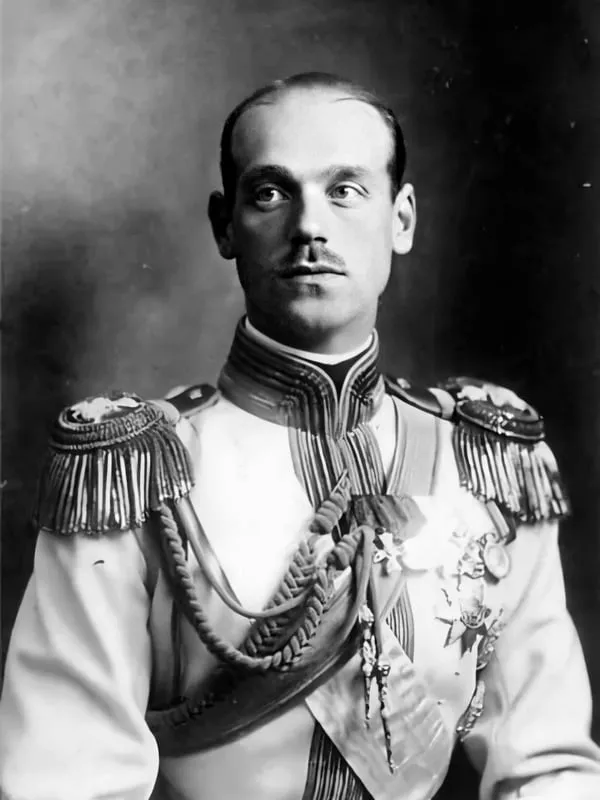
- Born:
- 4 December 1878, St Petersburg (Russian Empire)
- Died:
- 13 June 1918, Near Perm (Soviet Russia)
- Author:
- Łukasz
- Photo:
- autor nieznany, domena publiczna, Wikimedia Commons

Grand Duke Michael Alexandrovich was the youngest brother of the last Emperor of Russia, Nicholas II. For several years he was heir to the throne, but he never took any interest in politics. He valued private life more than power, and by marrying a twice-divorced woman he brought down on himself his brother’s anger and exile. During the Great War he commanded with courage a cavalry division made up of volunteers from the Caucasus. In March 1917, in the midst of the February Revolution, Nicholas II renounced the throne in his favour. For a single day Michael was, in the eyes of some Russians, emperor, but he would not accept the crown unless the nation entrusted it to him. His decision brought to an end more than three hundred years of Romanov rule. A year later the Bolsheviks murdered him, the first member of the dynasty to die at their hands.
Childhood and youth
He was born on 4 December 1878 (22 November by the Julian calendar) in the Anichkov Palace in St Petersburg, the youngest son of Grand Duke Alexander, later Emperor Alexander III, and of Maria Feodorovna, born a Danish princess. When revolutionaries assassinated his grandfather Alexander II in 1881, the family moved for security reasons to the palace at Gatchina. Michael grew up there with his youngest sister Olga in deliberately spartan conditions: cold baths, hard camp beds and plain food. In the family he was called “Misha”, and almost everyone liked him for his gentle nature and directness.
On his father’s death in 1894 his eldest brother Nicholas became emperor. Michael graduated from the artillery school and in 1898 began service in the Guards horse artillery. In July 1899 his elder brother George, who had long suffered from tuberculosis, died suddenly, and since Nicholas then had only daughters, Michael became heir to the throne. In 1901 he represented Russia at the funeral of Queen Victoria. When the Tsarevich Alexei was born in 1904, during the war with Japan, Michael ceased to be heir, but he remained second in the line of succession and was to become regent should Nicholas die before his son came of age.
Love against his brother’s will
The Grand Duke’s private life was a source of one scandal after another. First Nicholas refused to allow him to marry his cousin, Princess Beatrice of Saxe-Coburg, and then in 1906 to marry his sister’s lady-in-waiting, Alexandra Kossikovskaya, because the laws of the imperial house forbade members of the dynasty to marry outside the ruling houses. In 1907 Michael met Natalia Wulfert, née Sheremetevskaya, the wife of a fellow officer in his regiment, who had previously divorced her first husband. They soon became lovers, and in 1910 their son George was born. The Tsar transferred his brother to a hussar regiment in Oryol to avoid a scandal, but could not separate the couple.
On 16 October 1912 Michael and Natalia were married in secret in the Serbian Orthodox church of St Sava in Vienna. Nicholas II was shaken, all the more so because in those same days his haemophiliac son had almost died at the hunting lodge at Spała. He relieved his brother of his command, forbade him to return to Russia, took away his property and stripped him of the right to the regency. Michael settled with his family in France and then in England, where he leased Knebworth House near London.
The war
When war broke out in 1914, Michael asked his brother for permission to return and serve in the army. Nicholas agreed. The Grand Duke was given the rank of major general and command of the newly formed Caucasian Native Cavalry Division, known as the Savage Division. It was made up of volunteers from the North Caucasus – Chechens, Ingush, Dagestanis, Kabardians, Circassians and Tatars – under Russian officers. Discipline was hard to maintain, but in battle the division was effective. At the beginning of 1915 Michael received the Order of St George, 4th class, for the fighting in the Carpathians. War correspondents wrote of him as a modest, straightforward man who wore a plain uniform and lived in field conditions. In 1915 the Tsar recognised his son and gave him the title of Count Brasov.
In February 1916 Michael took command of the 2nd Cavalry Corps, which fought in the summer during the Brusilov Offensive. He was promoted to lieutenant general. In the autumn, forced by a stomach illness to take leave, he wrote his brother a letter warning that the mood of even the most loyal people had changed alarmingly. Like many members of the family, he urged the Tsar to make concessions to the Duma. He knew, however, that his voice counted for little. At the beginning of 1917, appointed inspector general of cavalry, he returned to Gatchina.
Two days in March 1917
When the Petrograd garrison mutinied on 12 March 1917, Michael came from Gatchina to the capital, summoned by the President of the Duma, Mikhail Rodzianko. That evening in the Mariinsky Palace Rodzianko and the prime minister, Prince Nikolai Golitsyn, urged him to take power as regent and form a new government. Michael refused to act without his brother’s consent, but he telegraphed General Headquarters in Mogilev asking for the immediate appointment of a government enjoying the country’s confidence, which might be headed by Prince Georgy Lvov. The Tsar refused. Insurgent patrols prevented the Grand Duke from returning to Gatchina, and during the night of 12–13 March he took refuge in the flat of Princess Putyatina on Millionnaya Street.
Late on the evening of 15 March, in Pskov, Nicholas II renounced the throne. In the afternoon he had agreed to abdicate in favour of his son with Michael as regent, but in the evening he changed his mind and passed the throne to his brother, because he did not want to be parted from his sick child. Nobody asked Michael. In the early hours of 16 March some units and towns had already begun proclaiming “Emperor Michael II”, but in Petrograd the news caused uproar. The Petrograd Soviet and the street were demanding a republic.
On the morning of 16 March members of the Duma Committee and of the new Provisional Government came to the flat on Millionnaya Street, among them Rodzianko, Lvov, Pavel Milyukov and Alexander Kerensky. Most of them advised the Grand Duke to decline. Only Milyukov and Alexander Guchkov argued that without a monarch the new authorities would not survive. Michael asked to speak to Rodzianko alone and asked him whether the Duma could guarantee his safety. Rodzianko said it could not. In the afternoon the Grand Duke signed an act drawn up by the lawyers Vladimir Nabokov and Baron Boris Nolde. In it he declared that he would accept supreme power only if that was the will of the people, expressed through a Constituent Assembly elected by universal, equal, direct and secret ballot. Until then he called on citizens to obey the Provisional Government.
Formally the act was not an abdication but a suspension of the decision. In practice it meant the end of the monarchy. Kerensky and the French ambassador, Maurice Paléologue, regarded Michael’s gesture as noble and patriotic. Nicholas II wrote in his diary: “God knows who advised him to sign such a vile thing!”
Gatchina, Petrograd, Perm
In the spring of 1917 Michael was discharged from the army. He lived with his family at Gatchina. In August, before the former Tsar was taken to Tobolsk, Kerensky allowed the brothers to meet for a few minutes. It was their last conversation. Soon afterwards Michael and Natalia were placed under house arrest for several weeks. When Kerensky proclaimed Russia a republic on 14 September 1917, the Grand Duke noted in his diary that it did not matter what form the government took, so long as there was order and justice.
After the Bolshevik seizure of power in November 1917 Michael lived at Gatchina for several months without much interference. In March 1918, on the orders of the head of the Petrograd Cheka, Moisei Uritsky, he was arrested together with his English secretary, Nicholas Johnson, and exiled to Perm in the Urals. At first he was held in prison; later he was allowed to live in a hotel and move about the town. Natalia had earlier managed to get their son out of the country. In May she visited her husband in Perm, but with fighting approaching the Urals she left after a few days.
During the night of 12–13 June 1918 four men from the local Cheka and militia, sent by the Bolshevik Gavril Myasnikov, came to the hotel. They showed a forged order and drove Michael and Johnson to a forest near Motovilikha, where they shot them both. The bodies were hidden, and the authorities spread the story that the Grand Duke had been abducted by unknown persons and had disappeared. It is still unclear whether the killers acted with the knowledge of the authorities in Moscow, but Moscow never punished them, and Myasnikov and his men later boasted of the deed. The remains have never been found. A month later Nicholas II and his family were murdered in Yekaterinburg.
The family’s fate and remembrance
Natalia Brasova, with German help, made her way to Kiev in 1918 and from there to the West. She died in poverty in Paris in 1952. Their son George was killed in a car accident in France in 1931, just before his twenty-first birthday. In 2009 the Prosecutor General’s Office of the Russian Federation officially rehabilitated Michael and Johnson as victims of repression.
Significance
Michael was not a politician and did not seek power. Some historians believe that had he accepted the crown on 16 March, a constitutional monarchy might have given the new authorities support in the army and the countryside. Others stress that in the face of the Soviet’s and the street’s hostility he had no force at his disposal, and that an attempt to take the throne would have ended in bloodshed. His decision placed Russia’s future in the hands of the Constituent Assembly, which did not meet until January 1918 and was dispersed after a single day by Vladimir Lenin’s Bolsheviks. Michael’s death in Perm began the Bolsheviks’ killing of more than a dozen members of the dynasty in 1918 and 1919, and the way it came about – with the lie about an escape and the silence of the authorities – foreshadowed the methods the Soviet state would use in the decades that followed.