Russia
Vladimir Lenin
Leader of the Bolshevik party, Chairman of the Council of People’s Commissars of Soviet Russia (1917–1924) and of the USSR (1923–1924)
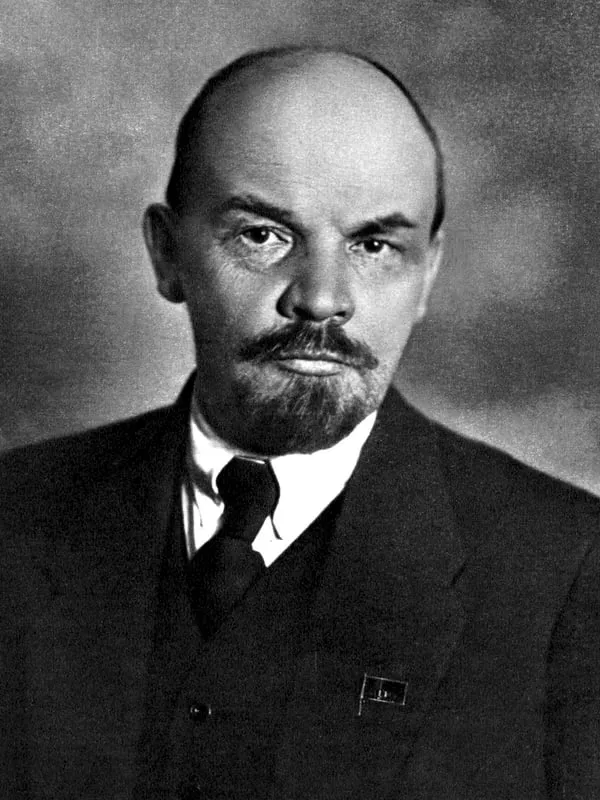
- Born:
- 22 April 1870, Simbirsk (Russian Empire)
- Died:
- 21 January 1924, Gorki near Moscow
- Author:
- Natalia
- Photo:
- autor nieznany, domena publiczna, Wikimedia Commons

Vladimir Ilyich Ulyanov, known by the pseudonym Lenin, was the founder of the Bolshevik party and of the Soviet state. For most of his life he was an émigré and the leader of a small faction of Russian Social Democrats, convinced that revolution could be carried out only by a disciplined party of professional revolutionaries. The First World War gave him the chance he had been waiting for. In November 1917 his party seized power in Petrograd, in March 1918 it concluded a separate peace with Germany, and in the Civil War it defended its power by terror and the Red Army. For the road to the Second World War Lenin is a key figure: he created the system of one-party dictatorship, the political police and the Communist International – the tools later wielded by Joseph Stalin – and the fear of the revolution he kindled became one of the chief fuels of fascism and Nazism in Europe.
Youth and the road to Marxism
He was born on 22 April 1870 (10 April in the Julian calendar) in Simbirsk on the Volga, into the family of an inspector of elementary schools who had risen to hereditary nobility. He was a gifted pupil at the local gimnazium, whose headmaster was the father of Alexander Kerensky, the future prime minister whom Lenin would overthrow in 1917. In May 1887 his elder brother Alexander was hanged for his part in a plot against the life of Tsar Alexander III. A few months later Vladimir was expelled from Kazan University for taking part in a student meeting. He passed his law examinations as an external student in St Petersburg in 1891, but practised as a lawyer only briefly. Marxism absorbed him.
In 1895 he was arrested for his activity in the St Petersburg “League of Struggle for the Emancipation of the Working Class”, and after more than a year in prison he was exiled for three years to the village of Shushenskoye in Siberia. There he married Nadezhda Krupskaya, a comrade from the movement, and wrote a work on the development of capitalism in Russia. From 1901 he signed himself with the pseudonym Lenin.
Émigré and founder of Bolshevism
From 1900 he lived mainly abroad. He co-edited the newspaper Iskra, and in the pamphlet What Is to Be Done? (1902) he set out a model of a party that was to be a centralised organisation of professional revolutionaries, leading the workers rather than following them. At the congress of the Russian Social Democratic Labour Party in 1903 the dispute over this conception split the party into the Bolsheviks, Lenin’s supporters, and the Mensheviks. In these disputes Lenin could be ruthless. He broke with his closest collaborators when he decided that they had strayed from the correct line, and he was unscrupulous in his methods, financial ones included.
Russia’s defeat in the war with Japan and the revolution of 1905 seemed to herald the fall of tsarism. Lenin returned to Russia at the end of 1905, but the revolution died down, and from the end of 1907 he again lived in exile, in Geneva and Paris. In 1912 he moved to Kraków, spending the summers at Poronin in the Podhale region. From Galicia, close to the border, he directed the legal newspaper Pravda and the Bolshevik deputies in the Duma.
War on the war
The outbreak of war found him in Galicia as a citizen of an enemy state. On 8 August 1914 the Austrian gendarmerie arrested him on suspicion of espionage and held him in the prison at Nowy Targ. Polish and Austrian socialists, among them Ignacy Daszyński, interceded for him, and after eleven days he was released. In September he left for Switzerland.
What shook him most was that the German, French and other socialists had backed their governments. He concluded that the Second International had gone bankrupt. He called the war imperialist and proclaimed slogans that scandalised even radicals: the lesser evil for Russian workers was the defeat of tsarism, and the socialists’ task was to turn the war between states into a civil war between classes. At the anti-war conferences at Zimmerwald (1915) and Kienthal (1916) he gathered the most radical minority around himself. In 1916 he wrote Imperialism, the Highest Stage of Capitalism. In January 1917 he said in Zurich that his generation might not live to see the decisive battles of the revolution.
1917
He learned of the February Revolution and the abdication of Nicholas II from the newspapers. The route through the Entente countries was closed to him, so he accepted an offer of passage through Germany. Berlin agreed, counting on the radicals to undermine the Russian war effort. On 16 April Lenin arrived at the Finland Station in Petrograd, and the next day he proclaimed his April Theses: no support for the Provisional Government, all power to the soviets, peace. Within a few weeks he had won the party over to them. At the First Congress of Soviets in June, when the Menshevik Irakli Tsereteli said that there was no party in Russia ready to take power on its own, Lenin replied from the floor that there was such a party.
After the failed rising in July the government accused the Bolsheviks of acting on Germany’s behalf and issued a warrant for Lenin’s arrest. He went into hiding near Petrograd and then in Finland, where he wrote The State and Revolution. The question of German money remains disputed to this day. Documents of the German Foreign Ministry confirm that Berlin passed considerable sums to the Bolsheviks through intermediaries, but most historians believe that Lenin was nobody’s agent: he took money from anyone who could hasten the revolution, and he intended afterwards to set it alight in Germany too.
After the collapse of General Lavr Kornilov’s revolt in September the Bolsheviks won majorities in the Petrograd and Moscow soviets. From hiding Lenin bombarded the Central Committee with letters insisting that power must be seized at once. In October he secretly returned to the capital, and on 23 October (10 October Old Style) he forced through a resolution on armed insurrection. The preparations, however, were directed mainly by Leon Trotsky, chairman of the Petrograd Soviet. On 7 November the Bolsheviks overthrew the Provisional Government, and the Second Congress of Soviets adopted the decrees on peace and on land written by Lenin and set up the Council of People’s Commissars with him as its chairman.
Brest-Litovsk and dictatorship
From the very first days Lenin built the rule of a single party. He closed opposition newspapers, in December 1917 he set up the political police, the Cheka, under Felix Dzerzhinsky, and in January 1918 he dispersed the Constituent Assembly, in which the Socialist Revolutionaries held a majority. At the same time he sought peace with Germany at any price. He believed that the army no longer existed and that the revolution needed a “breathing space”. Most of the party wanted a “revolutionary war”, and at Brest-Litovsk Trotsky tried the formula of “neither war nor peace”. When the Germans launched an offensive, Lenin, by threatening to leave the government, forced through the acceptance of their terms. The Treaty of Brest-Litovsk was signed on 3 March 1918: Russia lost Poland, the Baltic lands, Finland and Ukraine. The government moved to Moscow.
Peace abroad opened war at home. In the summer of 1918 Soviet power was on the verge of collapse. In July the Bolsheviks murdered the imperial family in Yekaterinburg; no known document proves Lenin’s direct involvement, but most historians believe the crime would not have happened without Moscow’s consent. On 30 August 1918 Lenin was seriously wounded in an assassination attempt in Moscow attributed to the Socialist Revolutionary Fanny Kaplan. The response was the Red Terror: mass executions of hostages and “class enemies”, which Lenin had already demanded in confidential orders. Germany’s collapse, sealed by the Armistice of Compiègne, allowed him to annul the Treaty of Brest-Litovsk and to advance westwards in the wake of the retreating Germans.
World revolution and the war with Poland
Lenin was convinced that the revolution in Russia would survive only if it spread to Europe, above all to Germany. He greeted the German Revolution of autumn 1918 and the Hungarian Soviet Republic of 1919 as heralds of that wave. In March 1919 he founded in Moscow the Communist International, which was to direct communist parties throughout the world and imposed on them obedience to Moscow. In the spring of 1920 open war broke out with the Poland of Józef Piłsudski. After the Polish Kiev expedition had been repulsed, Lenin, against more cautious advisers, pushed the Red Army on towards Warsaw in the hope that the revolution would reach Germany through Poland. The defeat in August 1920 closed that road, and the Peace of Riga of 1921 fixed a border that lasted until September 1939.
The last years
The Bolsheviks won the Civil War, but the country lay in ruins. Peasant revolts swept it, and in March 1921 the sailors of Kronstadt, until recently the pride of the revolution, mutinied. Lenin ordered the mutiny crushed and at the same time announced the New Economic Policy (NEP), which partially restored free trade. The same party congress banned factions within the party, which later made it easier for Stalin to deal with his opponents. In 1922 at Rapallo Soviet Russia and Germany, two states excluded from the post-war order, established diplomatic relations, which opened the way to secret military cooperation. On 30 December 1922 the Union of Soviet Socialist Republics was founded.
By then Lenin was gravely ill. In May 1922 he suffered his first stroke, in December a second, and in March 1923 a third, which deprived him of speech. In his last notes, later called his Testament, he assessed his successors and warned against Joseph Stalin, General Secretary of the party since April 1922. In a postscript of January 1923 he advised removing him from that post as too rude a man. This did not happen. Lenin died on 21 January 1924 at Gorki near Moscow. His embalmed body was put on display in a mausoleum on Red Square, and Petrograd was renamed Leningrad.
Significance
No figure of the Russian Revolution provokes such extreme judgements. Soviet historiography revered Lenin as the genius who gave the peoples of Russia peace and land, and Stalin made him an object of worship and a source of legitimacy for his own rule. Western historians such as Richard Pipes and Robert Service see him above all as the creator of one-party dictatorship, of political-police terror and of the camp system that Stalin merely expanded. Others, such as Orlando Figes, stress that without the war and its defeats the Bolsheviks would never have come to power, and that Lenin knew better than anyone how to exploit the soldiers’ weariness and the peasants’ hunger for land.
For the history of the road to the Second World War his legacy is twofold. The state he created became one of the main players of the 1930s: first an outcast and Germany’s partner at Rapallo, then a member of the League of Nations, and in August 1939 Hitler’s ally in the partition of Poland. At the same time the fear of Bolshevism, which Lenin had wanted to spread across Europe, pushed millions of people towards movements of the far right, from Italian fascism to German Nazism, and inclined many Western governments to treat Hitler as the lesser evil.
Sources
Mentioned in battles
(03)Often appears with
People who appear in the same events.
On the timeline
(21)1917
1918
October
- 28
- The Aster RevolutionOn 28 October 1918 police fired on demonstrators at the Chain Bridge in Budapest. Three days later Mihály Károlyi took power in Hungary.
- The German Revolution beginsOn 28 October 1918 Germany became a parliamentary monarchy while its admirals readied the fleet for a last battle. A sailors' revolt set off a revolution.